Wax-Free Polishing Pads in CMP Process Applications
In modern semiconductor manufacturing, CMP is no longer an isolated unit operation but a tightly integrated process module interacting with upstream deposition, downstream cleaning, and overall yield management. The adoption of wax-free CMP polishing pads fundamentally alters how wafers are held, loaded, polished, and released, requiring deliberate process integration rather than simple consumable replacement.
This document focuses on how wax-free polishing pads are practically integrated into CMP processes, what process parameters are directly affected, and how fabs can leverage wax-free architectures to improve process stability, yield consistency, and cost efficiency.
Integration of Wax-Free Pads in CMP Flow
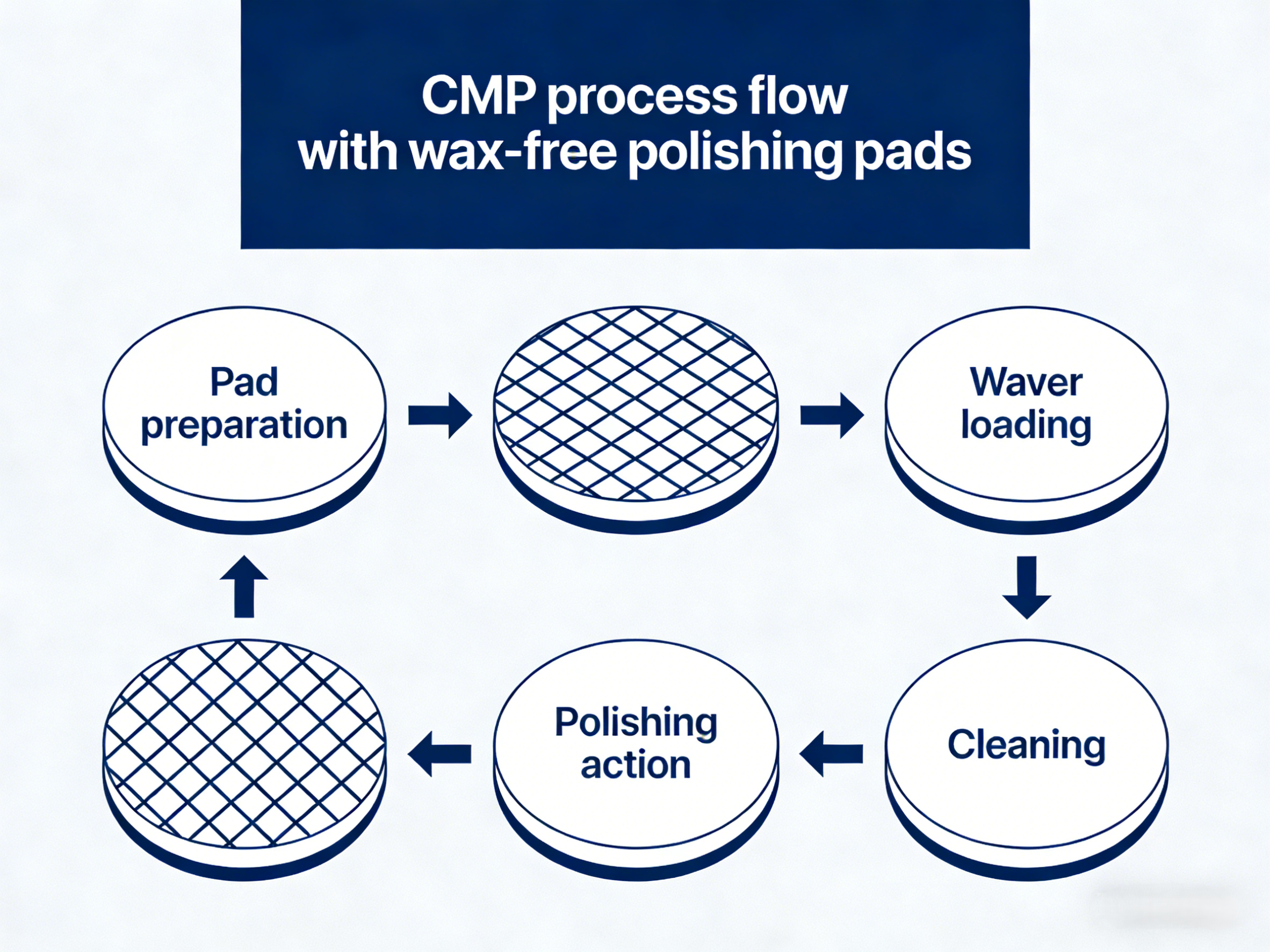
From a process integration perspective, wax-free polishing pads remove the wax bonding and debonding steps traditionally embedded in CMP workflows. This structural change simplifies the CMP process flow while simultaneously tightening mechanical coupling between wafer, carrier, and polishing interface.
A typical wax-free CMP integration flow includes direct wafer loading, adsorption-based fixation, polishing under controlled downforce, in-situ conditioning, and immediate wafer release without thermal cycling. The elimination of heating and cooling steps reduces cycle time and minimizes thermal history variation between wafers.
Compatibility with CMP Slurry Systems
Wax-free polishing pads demonstrate broader slurry compatibility compared to wax-based systems due to the absence of organic adhesive layers that can interact with slurry chemistries. However, integration still requires careful matching of slurry rheology and pad surface structure.
For oxide, copper, and barrier CMP, slurry particle size distribution, pH, oxidizer concentration, and surfactant content directly influence slurry transport within pad asperities. Wax-free pads typically feature engineered pore networks that promote uniform slurry replenishment and minimize local starvation.
| CMP Type | Typical Slurry pH | Wax-Free Pad Compatibility |
|---|---|---|
| Oxide CMP | 9–11 | Excellent |
| Copper CMP | 2–4 | Excellent |
| Barrier CMP | 3–6 | Good |
Detailed interaction mechanisms between slurry and adsorption structures are further explained in How Wax-Free Polishing Pads Work.
Pressure Distribution and Kinematic Behavior
One of the most significant integration advantages of wax-free pads is the improvement in pressure uniformity across the wafer surface. Traditional wax layers introduce viscoelastic damping that varies with temperature and polishing duration, whereas wax-free adsorption maintains stable normal force distribution.
In practical CMP operation, this translates to tighter control over within-wafer non-uniformity (WIWNU), particularly at wafer edges where wax creep often causes pressure roll-off. Wax-free pads enable more predictable kinematic behavior under varying platen speeds and carrier oscillation profiles.
Pad Conditioning and Wear Management
Pad conditioning behavior changes noticeably when transitioning to wax-free polishing pads. Because there is no wax contamination or smearing on the pad surface, diamond conditioners interact directly with the pad polymer matrix.
Wax-free pads typically exhibit:
- More stable groove regeneration
- Lower glazing tendency
- Predictable pad wear rate
Conditioning parameters such as downforce (2–6 psi), sweep rate, and diamond grit size can often be optimized downward, extending pad lifetime without sacrificing MRR stability.
Endpoint Detection and Process Control
Endpoint detection accuracy improves with wax-free pad integration due to reduced signal noise from backside contamination and thermal fluctuation. Optical, motor current, and friction-based endpoint systems benefit from cleaner and more repeatable mechanical interfaces.
In copper CMP, fabs frequently report improved endpoint repeatability and reduced over-polish margin when using wax-free pads, directly contributing to lower dishing and erosion.
Impact on Yield, Defects, and Process Stability
From a yield engineering standpoint, wax-free polishing pads reduce several dominant defect modes associated with wax usage, including organic residue, backside particles, and post-CMP cleaning variability.
Observed benefits in high-volume manufacturing include:
- Lower random particle counts
- Reduced micro-scratch density
- Improved lot-to-lot consistency
These improvements are particularly valuable in advanced logic and memory nodes where CMP-related defects increasingly dominate yield loss.
Typical CMP Use Cases and Integration Scenarios
Wax-free polishing pads are commonly integrated in the following CMP applications:
- Cu bulk and Cu barrier CMP
- Low-k dielectric planarization
- STI oxide CMP
- Advanced packaging redistribution layers (RDL)
For decision-level comparison between wax-free and wax-based systems, refer to Wax-Free vs Wax Polishing Pads. For material-level considerations, see CMP Polishing Pad Materials.