CMP Polishing Pad Materials and Structure Explained
In CMP, polishing pad materials define the fundamental mechanical, chemical, and tribological interactions that ultimately determine planarization efficiency, defectivity, and process stability. For wax-free CMP polishing pads, material selection becomes even more critical because wafer fixation, force transmission, and slurry interaction are governed directly by pad bulk and surface properties rather than auxiliary wax layers.
This document provides a material-mechanism-level analysis of CMP polishing pad materials, focusing on polymer systems, microstructural design, mechanical parameters, wear behavior, and their specific implications for wax-free pad architectures.
Overview of CMP Polishing Pad Materials
CMP polishing pads are typically fabricated from engineered polymer systems designed to balance elasticity, hardness, chemical resistance, and wear stability. Unlike traditional lapping or grinding pads, CMP pads must maintain controlled asperity structures under continuous mechanical and chemical attack.
The most commonly used CMP pad material families include:
- Polyurethane (PU) and PU blends
- Polyurethane-urea hybrid systems
- Filled polymer composites with inorganic modifiers
In wax-free pads, these materials must additionally support integrated adsorption structures, making uniformity, permeability, and structural integrity across the pad thickness essential.
Polymer Chemistry and Matrix Design
Polyurethane-based systems dominate CMP polishing pad manufacturing due to their tunable mechanical properties and chemical stability across a wide pH range. By adjusting hard segment to soft segment ratios, pad designers can precisely control elastic modulus, rebound behavior, and abrasion resistance.
Typical polymer chemistry parameters include:
- Hard segment content: 30–55%
- Glass transition temperature (Tg): −20°C to +30°C
- Crosslink density tailored for controlled viscoelasticity
For wax-free adsorption pads, polymer matrices must also maintain dimensional stability under localized vacuum or capillary forces, preventing micro-collapse of adsorption channels.
Microstructure and Porosity Engineering
Microstructure is arguably the most critical factor governing CMP pad performance. Pore size distribution, pore connectivity, and surface asperity geometry collectively determine slurry transport, debris evacuation, and real contact area.
Wax-free polishing pads often feature engineered micro-porous networks with:
- Average pore diameters: 10–80 μm
- Controlled open porosity: 30–60%
- Directional or isotropic pore connectivity
These microstructures serve a dual function: enabling efficient slurry delivery while simultaneously supporting adsorption-based wafer holding, as described in Wax-Free Adsorption Polishing Pad Technology.
| Microstructure Parameter | Typical Range | Function |
|---|---|---|
| Pore Diameter | 10–80 μm | Slurry transport and debris removal |
| Porosity | 30–60% | Compliance and adsorption capability |
| Asperity Height | 5–30 μm | Contact mechanics control |
Mechanical Properties and Load Transfer
Mechanical properties govern how polishing pressure is transmitted from the carrier to the wafer surface. Key parameters include hardness, elastic modulus, and viscoelastic damping.
Typical wax-free CMP pad mechanical ranges:
- Shore D hardness: 45–65
- Elastic modulus: 50–300 MPa
- Compression set: <10%
Compared to wax-based systems, wax-free pads provide more direct load transfer with reduced energy dissipation, leading to improved within-wafer uniformity and edge control, especially under dynamic polishing conditions.
Material Interaction with CMP Slurry
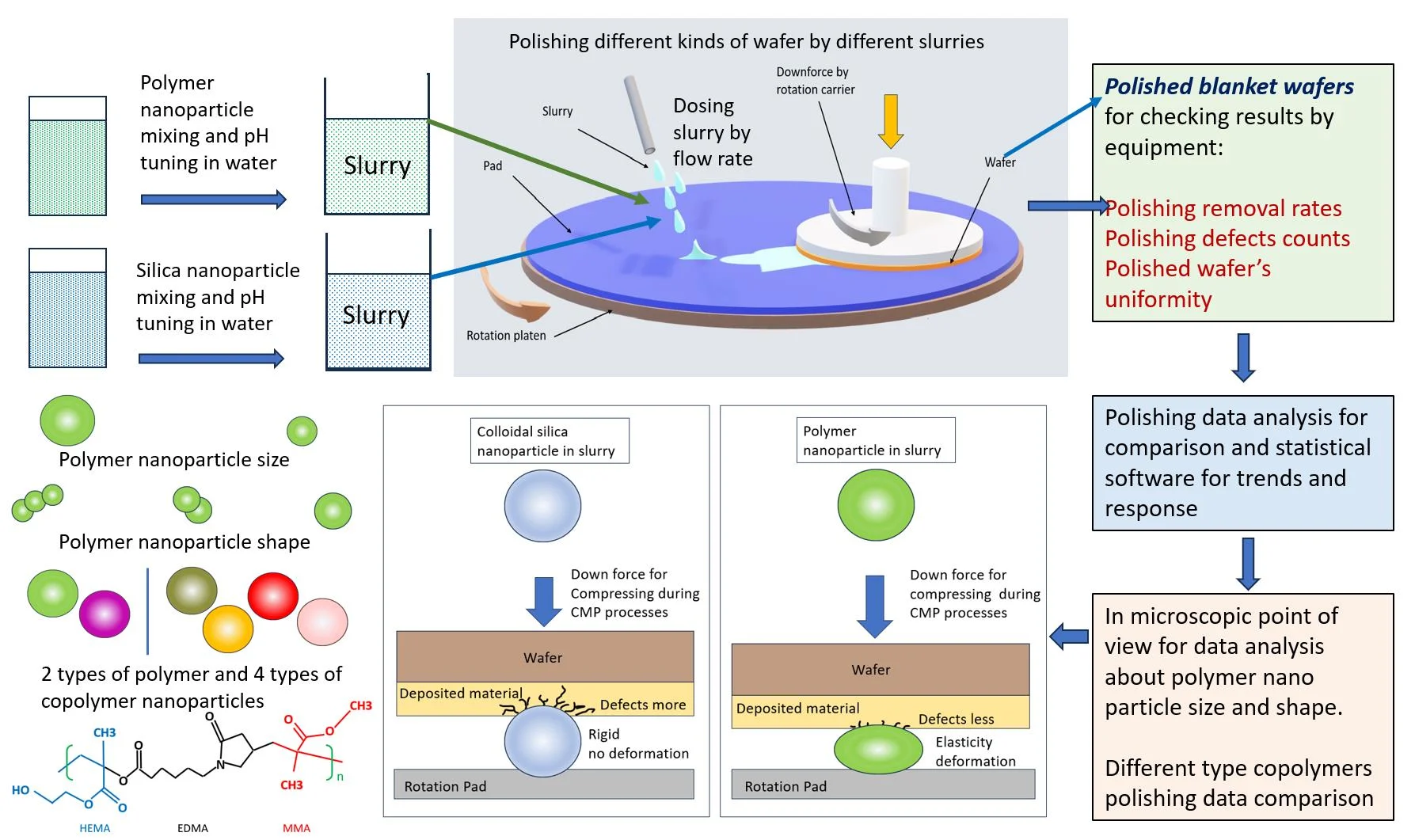
CMP slurry interacts continuously with pad materials through mechanical abrasion, chemical attack, and particle embedding. Polymer chemistry must resist swelling, hydrolysis, and surface degradation across slurry chemistries ranging from acidic copper slurries to alkaline oxide formulations.
Wax-free pad materials often incorporate surface treatments or fillers to enhance:
- Chemical resistance
- Surface energy control
- Reduced particle adhesion
Stable slurry interaction directly contributes to predictable MRR and lower defectivity over extended pad lifetime.
Wear Mechanisms and Pad Lifetime
Pad wear in CMP arises from a combination of mechanical abrasion by slurry particles, chemical degradation, and diamond conditioning. In wax-free systems, wear behavior is more uniform due to the absence of wax-induced glazing or contamination.
Common wear mechanisms include:
- Gradual asperity flattening
- Pore wall erosion
- Polymer chain scission under chemical exposure
Well-designed wax-free pads exhibit linear wear rates and predictable end-of-life behavior, simplifying preventive maintenance planning.
Material Selection Guidelines for Wax-Free Pads
Material selection for wax-free CMP polishing pads should align with both process requirements and integration constraints. Key considerations include:
- Target material stack (Cu, oxide, low-k)
- Slurry chemistry and abrasives
- Pressure and speed operating window
- Desired pad lifetime and conditioning strategy