CMP Slurry for Semiconductor Planarization: Chemistry, Types & Selection
CMP slurry is the active medium through which both material removal and surface quality are determined in semiconductor planarization. This in-depth guide covers slurry composition, the chemistry of every major abrasive type, how each of the four primary slurry families works, slurry stability and handling requirements, and a practical selection framework for oxide, STI, tungsten, and copper CMP applications.
01What Is CMP Slurry?
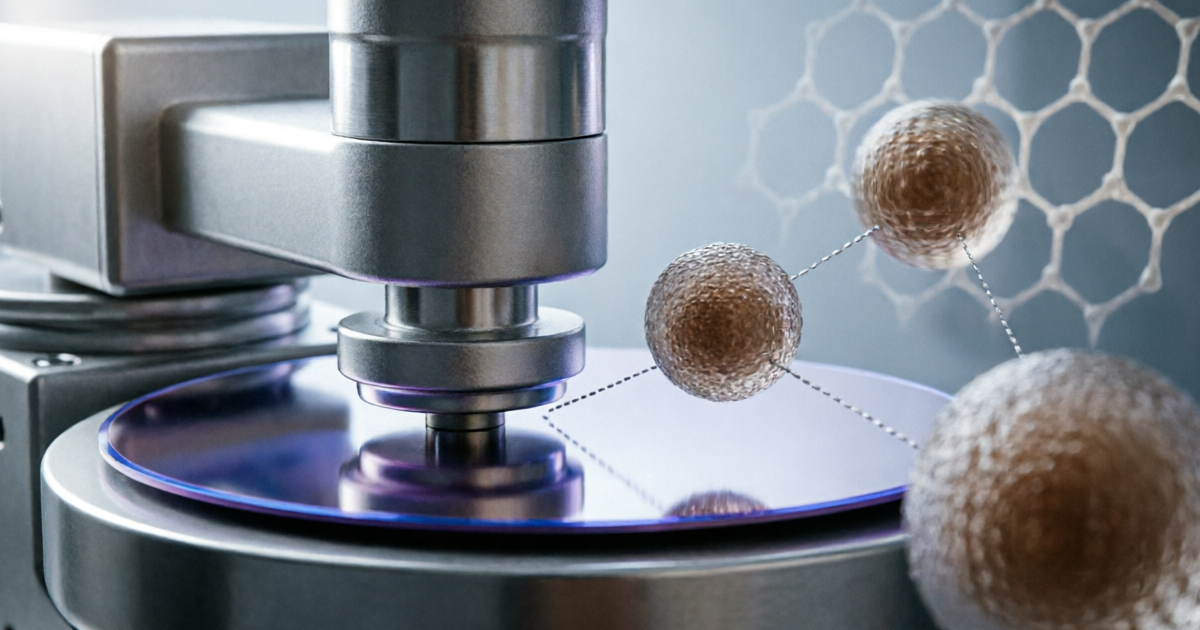
CMP slurry is an engineered aqueous dispersion that serves simultaneously as the chemical reagent and the mechanical abrasive medium in a Chemical Mechanical Planarization process. It is the consumable that most directly determines the material removal rate (MRR), film selectivity, post-CMP surface roughness, and defect density of every CMP step. No other consumable has as large an influence on CMP process performance as the slurry.
A fully formulated CMP slurry typically contains four functional components working in concert:
- Abrasive particles — nano-scale inorganic solids (20–200 nm) that provide the mechanical cutting force at the pad–wafer interface
- Chemical agents — oxidizers, chelating agents, corrosion inhibitors, and pH modifiers that react with the wafer surface to enhance material removal and control selectivity
- Stabilizers and dispersants — surfactants and polymeric additives that maintain colloidal stability and prevent particle agglomeration during storage and dispensing
- Aqueous carrier — ultra-pure deionized water (typically 18 MΩ·cm resistivity) as the solvent and transport medium for all other components
Neither the chemical components nor the abrasive particles alone are sufficient for CMP. The chemical agents reduce the surface hardness of the target film through reaction, and the abrasive particles then efficiently remove this weakened surface layer. Together, they produce MRR values 10–100× higher than either mechanism alone — the fundamental reason why CMP is both fast and selective.
02Abrasive Particle Types In Depth
Colloidal Silica (SiO₂)
Colloidal silica is produced by the Stöber process — controlled hydrolysis and condensation of tetraethyl orthosilicate (TEOS) in an alcoholic ammonia solution — producing near-perfectly spherical SiO₂ particles with narrow, tunable size distributions (typically 30–150 nm diameter). The spherical morphology and smooth surface texture are critical advantages: spherical particles produce minimal surface scratching compared to angular or irregular particles of the same size, enabling the sub-0.5 nm Ra values required for copper CMP buff and hybrid bonding surface preparation.
Colloidal silica is stable in aqueous dispersion at pH 8–11 (alkaline silica slurry) where the particle surfaces carry a high negative zeta potential (−40 to −60 mV), providing strong electrostatic repulsion that prevents agglomeration. Below pH 7, zeta potential decreases toward zero (the isoelectric point for SiO₂ is pH ~2), risking colloidal instability. This constrains oxide CMP with colloidal silica to alkaline pH operation.
Applications: Oxide ILD CMP, silicon wafer final polishing (bare wafer CMP), copper CMP final buff step, polysilicon CMP.
Fumed Ceria (CeO₂)
Fumed ceria particles are produced by vapor-phase oxidation of cerium precursors, creating irregularly shaped primary particles (5–20 nm) that aggregate into larger secondary structures (50–300 nm). The unique chemical activity of CeO₂ in oxide CMP stems from the Ce³⁺/Ce⁴⁺ redox couple at the particle surface — a mechanism called the “chemical tooth” effect first described by Cook in 1990. CeO₂ surface sites react directly with Si–O–Si surface bonds of the oxide film, breaking them chemically and greatly accelerating material removal beyond what the mechanical abrasion alone would produce.
The most critical advantage of ceria is its outstanding oxide-to-nitride selectivity: because the chemical tooth mechanism is specific to oxide (Si–O) bonds and does not efficiently attack Si₃N₄ surfaces, CeO₂ slurries can achieve SiO₂:Si₃N₄ removal rate ratios of 50:1 to >200:1. This selectivity is essential for STI CMP, where the polishing must remove the oxide overburden but stop precisely on the silicon nitride hard mask without removing it.
Applications: STI CMP (primary), ILD CMP where high oxide-to-nitride selectivity is needed, shallow trench etch stop.
Fumed Alumina (Al₂O₃)
Fumed alumina is produced by vapor-phase flame hydrolysis of AlCl₃, yielding aggregated primary particles (10–30 nm) with irregular, angular morphology and Mohs hardness of 9.0. This high hardness enables the aggressive material removal required for tungsten (W) CMP — tungsten is substantially harder than SiO₂, making the soft abrasion of colloidal silica insufficient for practical W removal rates. Alumina slurries in acidic pH (2–4) combined with H₂O₂ or KIO₃ oxidizers achieve W removal rates of 200–600 nm/min with good selectivity over the TiN/TiW barrier layer and the underlying SiO₂.
The high hardness and angular morphology of alumina do carry a cost: alumina-based slurries produce higher surface scratch and defect densities than silica-based alternatives. Point-of-use filtration (typically 1–3 µm) and tightly controlled particle size distribution are essential quality controls for tungsten slurry.
Applications: Tungsten (W) plug CMP, W hard mask CMP, polysilicon CMP.
03Chemical Agents: Oxidizers, Chelants & Surfactants
Oxidizing Agents
Oxidizers are the chemical agents that react with the metal or film surface to create a softer, more easily abraded surface compound. Selection depends on the target metal and compatibility with the abrasive and stabilizer system:
- H₂O₂ (hydrogen peroxide): The most widely used CMP oxidizer. For copper, H₂O₂ (0.5–5 wt%) oxidizes Cu⁰ to Cu₂O and Cu(OH)₂ at the surface — compounds significantly softer than metallic copper. For tungsten, H₂O₂ oxidizes W to WO₃. Advantages: decomposes to water and oxygen (no metallic impurities); adjustable concentration. Disadvantage: unstable — decomposes over time, requiring point-of-use addition (two-part slurry mixing) for copper CMP applications.
- KIO₃ (potassium iodate): A stable, solid oxidizer for tungsten CMP. Does not decompose spontaneously, enabling longer slurry shelf life than H₂O₂-containing formulations. The iodate anion oxidizes W surface to WO₃ at low pH (2–3). Limitation: introduces potassium and iodide ions that require thorough post-CMP cleaning to prevent ionic contamination of the gate oxide.
- Oxone (KHSO₅): Used in specialty metal CMP applications including cobalt and ruthenium CMP at advanced nodes. Provides aggressive oxidation at neutral pH, enabling metal CMP without strong acid chemistry.
Chelating and Complexing Agents
Chelating agents form stable soluble complexes with dissolved metal ions, preventing them from re-depositing onto the wafer surface as metallic or oxide particles. In copper CMP, glycine, citric acid, and ammonium citrate are common chelating agents that complex Cu²⁺ ions as they are released by oxidation and abrasion. Without chelation, dissolved copper would re-precipitate as CuO or Cu₂O particles on the wafer surface — a significant source of particle contamination and surface discoloration.
Corrosion Inhibitors
Benzotriazole (BTA) is the most important corrosion inhibitor in copper CMP. BTA molecules adsorb strongly onto copper surfaces, forming a thin Cu–BTA coordination complex that passivates the copper and reduces its dissolution rate. By selectively passivating flat, recessed copper areas (which experience lower contact pressure) while allowing the mechanical abrasion to remove the passivation from protruding features, BTA enables the slurry to achieve high pattern selectivity — high MRR over protruding copper and low MRR in recesses — which controls dishing in wide features. BTA concentration (typically 0.01–0.1 wt%) is one of the most sensitive process tuning parameters in copper CMP recipe development.
Surfactants and pH Buffers
Non-ionic and anionic surfactants (polyethylene glycol derivatives, ammonium lauryl sulfate) control particle dispersion stability by providing steric and electrostatic repulsion between abrasive particles. They also modify the wetting behavior of the slurry on the pad surface, influencing how uniformly the slurry is distributed across the polishing interface. pH buffers (ammonium hydroxide, KOH, HNO₃, citric acid) maintain the required pH window that controls both colloidal particle stability and the rate of chemical reaction with the film surface.
04Oxide ILD CMP Slurry
Oxide ILD CMP is the most common and highest-volume CMP application in any semiconductor fab. The target films are thermally grown or CVD-deposited SiO₂, TEOS oxide, fluorinated silicate glass (FSG, k ~ 3.5–3.7), or low-k SiCOH (k ~ 2.7–3.0). The objective is to remove a controlled thickness of oxide to planarize the ILD surface after metal line patterning, achieving a WIWNU specification typically below 2%.
Standard oxide CMP slurries use colloidal silica (30–100 nm, 10–30 wt% solids content) dispersed in alkaline aqueous solution (pH 10–11, buffered with KOH or NH₄OH). The alkaline pH serves two purposes: it maintains colloidal stability of the silica particles (high zeta potential) and it accelerates the chemical step in oxide removal by breaking Si–O surface bonds. MRR is typically 150–400 nm/min. Selectivity to silicon nitride is moderate (3:1 to 10:1), meaning Si₃N₄ stop layers must be thick enough to absorb this over-polishing without being fully consumed.
For low-k dielectric CMP (porous SiCOH, k < 2.5), slurry formulation must account for the mechanical fragility of porous dielectric — reduced silica particle size (20–40 nm), lower abrasive concentration, reduced down-force, and higher surfactant content to reduce the risk of dielectric delamination or mechanical damage to the open pore structure.
05STI CMP Slurry: Ceria Chemistry and High Selectivity
Shallow Trench Isolation (STI) CMP requires a slurry that can remove a large amount of HDP-CVD oxide (typically 300–600 nm overburden) while stopping precisely on the underlying Si₃N₄ hard mask (typically 100–200 nm thick). The required SiO₂:Si₃N₄ selectivity of 50:1 to >100:1 far exceeds what conventional silica-based slurries can achieve, making ceria (CeO₂) the standard abrasive for STI CMP.
Ceria Slurry Chemistry and Selectivity Mechanism
The high oxide-to-nitride selectivity of ceria slurries arises from two complementary mechanisms:
- Chemical tooth selectivity: Ce³⁺ surface sites on the ceria particle react specifically with Si–O–Si surface bonds of SiO₂ through a Ce–O–Si surface complex, dramatically accelerating oxide removal. Si₃N₄ surfaces, which present Si–N bonds rather than Si–O bonds, do not form this complex efficiently, limiting ceria’s chemical interaction with nitride and producing the inherently high selectivity.
- Passivation additive selectivity: Many commercial STI slurries contain polymeric additives (e.g., polyacrylic acid, PAA) that preferentially adsorb onto Si₃N₄ surfaces, forming a passivation layer that further suppresses nitride removal and dramatically increases the achievable selectivity to >100:1 in some formulations.
STI slurries operate at near-neutral to mildly acidic pH (pH 4–7), where ceria particles are positively charged (isoelectric point of CeO₂ ~ pH 6–7). Careful pH control is critical — small pH variations can shift the zeta potential of ceria particles, affecting colloidal stability and changing the selectivity ratio through altered surface adsorption behavior.
STI CMP oxide-to-nitride selectivity directly controls the remaining nitride thickness after polish — a critical process metric because the nitride serves as the STI pull-back etch mask in subsequent processing. A slurry with selectivity of 100:1 removes only 1 nm of nitride for every 100 nm of oxide removed, enabling tight control of remaining nitride thickness across the wafer.
06Tungsten CMP Slurry
Tungsten (W) contact plug CMP removes the CVD-W overburden deposited above contact holes during the TEOS/Ti/TiN/W contact plug formation module. The target film system is W (200–400 nm overburden) on TiN/TiW (5–20 nm) barrier on SiO₂ (ILD). The CMP must efficiently remove the W overburden and TiN/TiW barrier while stopping on the SiO₂ ILD without significant dishing of the W plugs or erosion of the surrounding oxide.
Slurry Composition
Standard tungsten CMP slurries use fumed alumina (Al₂O₃, 0.5–3 wt%) in acidic aqueous solution (pH 2–4) with H₂O₂ (0.5–5 wt%) or KIO₃ (1–5 wt%) as oxidizer. The mechanism is: H₂O₂ oxidizes the W surface to brittle, easily-abraded WO₃; Al₂O₃ particles mechanically remove the WO₃ layer; fresh metallic W is exposed and immediately re-oxidized; the cycle repeats. W CMP MRR is typically 200–500 nm/min.
Selectivity Considerations
W:SiO₂ removal selectivity is typically 5:1 to 15:1 — moderate selectivity that must be managed carefully to avoid excessive SiO₂ erosion around dense plug arrays. TiN/TiW barrier removal is faster than SiO₂ and slower than W in most formulations, enabling a “barrier clearing” polishing step that removes all TiN residue while minimizing SiO₂ loss. Key defect concern: alumina particles agglomerate more readily than colloidal silica, making point-of-use filtration and slurry freshness management critical quality controls.
07Copper Damascene CMP Slurry
Copper CMP for dual-damascene interconnects is the most complex CMP application from a chemistry design perspective, requiring slurries that balance multiple competing requirements: high copper removal rate (bulk step), controlled selectivity between Cu, TaN/Ta barrier, and SiO₂ or low-k dielectric, minimum dishing of wide copper features, and sub-0.5 nm Ra surface finish after polishing.
Two-Step Copper CMP Process Chemistry
Copper CMP typically uses two distinct slurry formulations in a sequential process:
Step 1 — Bulk Copper Removal
Colloidal silica (30–60 nm, 5–15 wt%) in aqueous solution at pH 4–6, with H₂O₂ (1–5 wt%, added at point-of-use) as oxidizer and glycine or alanine (0.1–1 wt%) as chelating agent. The goal is high-rate Cu removal (300–600 nm/min) with good selectivity to barrier metal (Cu:TaN selectivity typically 5:1 to 20:1), stopping when the Cu overburden is nearly cleared and the barrier is about to be exposed. BTA (0.001–0.05 wt%) may be included at low concentration to suppress dishing in wide Cu features during the final stage of Step 1.
Step 2 — Barrier Clearing and Final Planarization
A barrier-clearing slurry removes the exposed TaN/Ta diffusion barrier while planarizing the remaining Cu and the surrounding dielectric simultaneously. Higher BTA concentration (0.01–0.1 wt%) suppresses copper dissolution during this step. Barrier slurries for traditional Cu-SiO₂ systems typically use H₂O₂ oxidizer with citrate or malonate chelation at pH 5–7. For low-k dielectric systems (k < 2.5), barrier slurries must use reduced mechanical force and non-corrosive chemistry to avoid delamination or mechanically damaging the fragile porous dielectric.
Related: CMP Polishing Pads — Types, Structure & Role in Wafer Planarization →08Slurry Stability, Storage & Handling
CMP slurry is a thermodynamically metastable colloidal dispersion — given enough time, temperature excursions, or mechanical stress, abrasive particles will aggregate (agglomerate) into larger clusters. Agglomerated particles are the leading cause of CMP surface scratches, a yield-critical defect. Slurry stability management is therefore a mandatory discipline in any CMP operation.
Storage Temperature Control
Most CMP slurries must be stored at 15–25°C. Below 5°C, colloidal particles can undergo irreversible agglomeration due to reduced electrostatic repulsion and potential freezing of the aqueous carrier. Above 30°C, increased thermal energy accelerates particle collision frequency and promotes agglomeration. Temperature-controlled storage rooms or cabinets are standard in high-volume fabs. Slurry must never be frozen.
Shelf Life and Expiry Management
CMP slurries have defined shelf lives ranging from 3 to 24 months, depending on abrasive type, pH, oxidizer presence, and concentration. H₂O₂-containing slurries have the shortest stability windows (often 6–12 months from manufacture) due to slow H₂O₂ decomposition. First-in, first-out (FIFO) inventory rotation and lot expiry date tracking are essential operational disciplines. Using expired slurry risks elevated particle counts and degraded CMP performance.
Point-of-Use Filtration
In-line filters (0.2–3 µm, polypropylene or PTFE membrane) installed in the slurry supply line between the bulk storage tank and the CMP tool dispense nozzle remove agglomerated particles before they reach the wafer surface. Filter element replacement frequency is determined by monitoring the differential pressure across the filter — a rise in ΔP indicates particle loading and signals time for replacement. Some fabs use in-line dynamic light scattering (DLS) sensors for real-time particle size monitoring.
Mixing and Agitation
Slurry storage tanks are maintained under gentle, continuous agitation (recirculation pump at low flow rate, or paddle mixing at 5–20 rpm) to prevent particle sedimentation — particularly important for denser abrasives like ceria and alumina, which have higher settling rates than colloidal silica. Re-circulation loop design (no dead-legs, smooth bends, no high-shear pump designs) prevents shear-induced agglomeration during circulation.
09Slurry Selection Guide
| CMP Application | Recommended Abrasive | pH Range | Key Oxidizer | Primary Selection Criteria |
|---|---|---|---|---|
| Oxide ILD CMP | Colloidal SiO₂ (50–100 nm) | 10–11 | None (pH drives chemistry) | MRR (200–400 nm/min), WIWNU, low scratch rate |
| STI CMP | Fumed CeO₂ (50–200 nm) | 4–7 | None (chemical tooth mechanism) | Oxide:nitride selectivity (>50:1), WIWNU, dishing |
| Tungsten CMP | Fumed Al₂O₃ (50–150 nm) | 2–4 | H₂O₂ or KIO₃ | W:SiO₂ selectivity, plug dishing, scratch density |
| Cu CMP (Step 1) | Colloidal SiO₂ (30–60 nm) | 4–6 | H₂O₂ (point-of-use) | Cu MRR, Cu:barrier selectivity, dishing control |
| Cu CMP (Step 2 barrier) | Colloidal SiO₂ (20–40 nm) | 5–7 | H₂O₂ (low concentration) | Barrier clearance, low Cu dishing, low-k compatibility |
| Polysilicon CMP | Colloidal SiO₂ or Al₂O₃ | 10–12 | None or KOH | Poly:oxide selectivity, gate height uniformity |
| SiC CMP | Colloidal SiO₂ + Fenton reagent | 3–5 | H₂O₂/Fe²⁺ (Fenton) | MRR (SiC hardness challenge), Ra <0.2 nm |
10JEEZ CMP Slurry Products
JEEZ (Jizhi Electronic Technology Co., Ltd.) manufactures a comprehensive portfolio of CMP polishing slurries for semiconductor planarization applications. As a direct manufacturer — not a distributor — JEEZ maintains full control over abrasive synthesis, slurry formulation, quality testing, and technical support.
The JEEZ CMP slurry lineup covers oxide ILD, STI (high-selectivity ceria-based), tungsten plug, and copper damascene applications. Each product line is engineered for: tight particle size distribution control (D99 < 200 nm), long-term dispersion stability, application-specific selectivity and MRR targets, and compatibility with standard slurry delivery and filtration infrastructure. JEEZ application engineers work directly with customers to match slurry specifications to specific tool platforms, process integration requirements, and downstream metrology targets.
All JEEZ slurry products are manufactured under ISO-certified quality systems and are available for global supply to logic, memory, power device, and compound semiconductor manufacturing facilities.
Request CMP Slurry Datasheets or Technical Consultation
Contact JEEZ to request product datasheets, discuss slurry qualification for your specific CMP module, or arrange a technical consultation with our application engineering team.
Contact JEEZ Technical Team →