CMP Cost Optimization: How to Reduce Slurry Consumption and Improve Yield
A systematic guide to reducing silicon wafer CMP operating costs — covering the consumable cost structure, slurry recirculation, flow rate optimization, pad life extension, yield as the primary cost lever, and a total cost of ownership framework for data-driven slurry grade selection.
The Economics of Silicon Wafer CMP
Chemical mechanical polishing is one of the most consumable-intensive steps in silicon wafer manufacturing. Every wafer that passes through the polishing line consumes slurry, depletes the polishing pad, wears the conditioning disc, and requires chemical cleaning solutions. At a 300mm wafer manufacturing scale of 50,000 wafers per month — typical for a mid-sized silicon wafer fab — the cumulative consumable cost is substantial, and optimizing it is a genuine engineering challenge with significant financial impact.
This guide from Jizhi Electronic Technology Co., Ltd. (JEEZ) provides a systematic framework for reducing CMP operating costs while maintaining or improving surface quality. It covers the CMP cost structure, four major cost-reduction levers, yield as the primary economic driver, and a total cost of ownership (TCO) framework for making data-driven decisions between slurry grades. This article complements our Complete Guide to Silicon Wafer Polishing.
CMP Cost Structure: Where the Money Goes
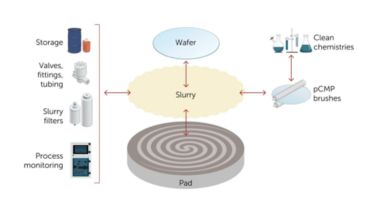
Before optimizing CMP costs, it is essential to understand the cost structure accurately. The variable cost (cost per wafer) of silicon wafer CMP has four main components:
| Cost Component | Typical Share | Primary Cost Drivers |
|---|---|---|
| Polishing slurry | 30–50% | Slurry price per liter, flow rate, recirculation ratio, polish time |
| Polishing pads | 20–30% | Pad price, wafers per pad (lifetime), number of pad changes |
| Conditioning discs | 5–10% | Disc price, conditioning frequency, disc lifetime |
| Cleaning chemicals | 10–15% | NH₄OH, H₂O₂, HCl, HF prices; chemical consumption per wafer; bath replenishment frequency |
| DI water and utilities | 5–10% | Water consumption rate, energy for heating, N₂ consumption for drying |
| Equipment depreciation | (Capex, separate) | Tool cost, depreciation period, tool utilization rate |
Slurry dominates the variable cost structure in most silicon wafer polishing operations, making it the highest-leverage target for cost optimization. However, slurry cost reduction must always be evaluated in the context of its effect on yield — a slurry that is cheaper per liter but produces more defects and wafer rejections will have a higher effective cost per good wafer shipped.
Slurry Cost Reduction Strategies
Strategy 1: Slurry Recirculation
Slurry recirculation is the highest-impact single intervention available for reducing CMP slurry costs. In a recirculation system, spent slurry collected from the polishing tool drain is processed through a multi-stage filtration and replenishment system before being returned to the tool:
- Collection Spent slurry drains from the polishing tool into a collection tank. The spent slurry contains the original abrasive particles, dissolved silicon reaction products (silicic acid), partially spent alkaline base, and any contamination picked up during polishing (pad debris, metallic traces).
- Coarse filtration The collected slurry passes through a 1–5 μm filter that removes large agglomerates, pad debris fragments, and silicon swarf. This step protects downstream fine filters from rapid fouling.
- Fine filtration A 0.2–0.5 μm filter removes smaller particles that could accumulate to form killer-particle concentrations in the recirculated stream.
- Analysis and replenishment The filtered slurry is analyzed for pH (typically 0.2–0.5 units lower in spent slurry due to CO₂ absorption and dissolved Si loading), abrasive concentration (depleted by dilution and loss), and silicon concentration (builds up over cycles). Fresh concentrated slurry is added in a controlled ratio to restore these parameters to specification.
- Return to tool The replenished slurry is pumped back to the tool’s slurry supply circuit, blended with any additional fresh slurry required to reach the target fresh-to-recirculated ratio.
Typical savings: Well-optimized recirculation systems achieve fresh slurry consumption reductions of 30–60% while maintaining surface quality within specification. The capital cost of the recirculation system (filtration skids, tanks, pumps, sensors) is typically recovered within 12–24 months in a 300mm production environment.
Strategy 2: Slurry Flow Rate Optimization
Most CMP tools are operated with slurry excess — a flow rate higher than the minimum needed for complete pad coverage and uniform abrasive delivery to the wafer-pad contact zone. Systematic flow rate reduction experiments — incrementally reducing flow rate while monitoring removal rate uniformity and surface quality — typically reveal that the original flow rate was 30–50% above the minimum effective rate. Reducing flow rate to the minimum effective value reduces slurry consumption proportionally without any quality degradation.
The key measurement for this optimization is within-wafer uniformity (WIWNU): if slurry starvation occurs in any radial zone, removal rate drops locally and WIWNU increases. Monitor WIWNU carefully at each flow rate step. Also monitor haze — insufficient slurry at the finish-polish pad can cause localized dry contact, elevating haze in those zones.
Strategy 3: Dilution Protocol Optimization
Many CMP slurries are supplied as concentrates intended for dilution with DI water at the tool. The specified dilution ratio is a starting point — not a fixed rule. Small increases in dilution ratio (using more DI water per unit of concentrate) reduce the abrasive concentration and cost per liter of working solution. This can be done without degrading surface quality up to the point where the abrasive concentration drops below the rate-limiting threshold for the polishing stage. For finish-polish steps that are already chemistry-dominant (low abrasive concentration), additional dilution typically has minimal removal rate effect while reducing cost. For rough-polish steps, more careful monitoring is needed because removal rate is more sensitive to abrasive concentration.
Polishing Pad Cost Optimization
The polishing pad represents 20–30% of CMP consumable costs and also has an indirect influence on slurry efficiency (pad condition affects slurry retention and distribution). Three strategies extend pad life and reduce pad cost per wafer:
Conditioning Recipe Optimization
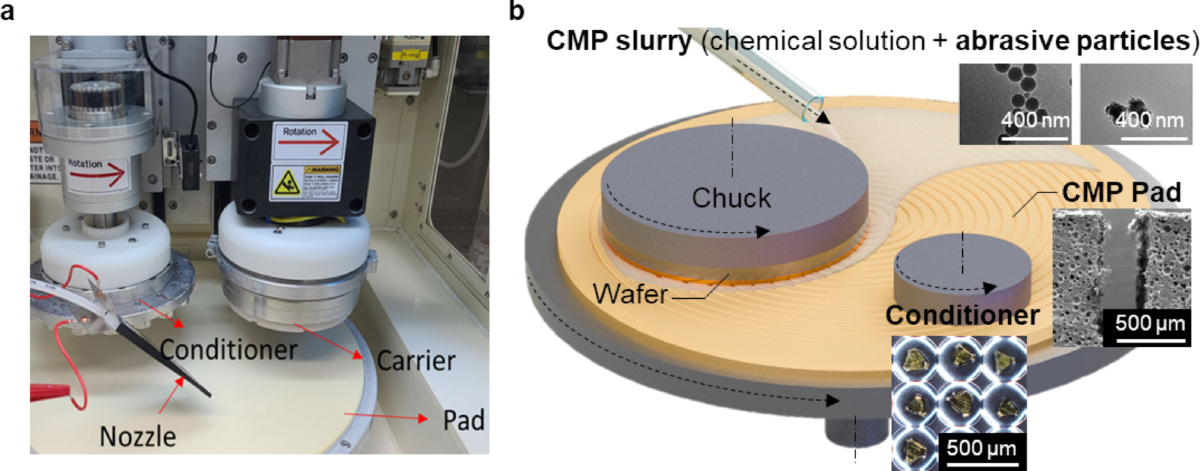
Pad conditioning is necessary to maintain pad surface texture and prevent glazing, but over-conditioning removes pad material faster than required and shortens pad lifetime. The optimal conditioning recipe — conditioning disc downforce, sweep speed, and conditioning interval (wafers between conditioning cycles) — should be determined through a designed experiment that measures removal rate stability and WIWNU as conditioning parameters are varied. The target is the minimum conditioning intensity that maintains removal rate within ±3% of target over the pad’s usable life.
SPC-Based Pad Life Extension
Instead of changing pads on a fixed wafer-count schedule, use statistical process control (SPC) on removal rate, WIWNU, and haze trends to determine actual end-of-life. Most pads have significant residual life remaining at the time of a fixed-schedule pad change — wasting usable consumable. SPC-based change triggers (pad change when a control limit is breached) typically extend average pad life by 15–30% versus fixed-schedule replacement, with no quality compromise because the metric-based trigger prevents quality drift before it begins.
Break-in Dummy Wafer Cost Reduction
New pad break-in requires 50–100 dummy (non-production) wafer polishes, consuming significant production time and dummy wafer cost. Optimized break-in protocols — using more aggressive conditioning during break-in to accelerate surface stabilization — can reduce the required dummy wafer count by 30–40% while achieving equivalent removal rate stability. Coordinate break-in scheduling with planned maintenance windows to minimize production impact.
Yield: The Most Powerful — and Most Underestimated — Cost Lever
In silicon wafer manufacturing, every wafer rejected at the post-polish inspection step represents a complete write-off of all upstream manufacturing cost accumulated in that wafer: crystal growth, slicing, lapping, etching, and partially completed polishing. At 300mm, this upstream cost typically ranges from $200 to $600 per wafer depending on crystal type (prime CZ, epi-ready, SOI) and the specific fab’s cost structure.
The yield impact of slurry quality is direct and quantifiable. A slurry with poor colloidal stability (elevated D99, higher killer particle rate) will produce a higher scratch and LPD defect rate, resulting in higher wafer rejection at inspection. The yield-adjusted effective cost per good wafer shipped includes the cost of all rejected wafers:
Effective cost per good wafer = (total consumable cost) / (total wafers × yield fraction)
A numerical example illustrates the magnitude: if a premium-grade slurry costs 15% more per liter than a standard-grade slurry but improves polish yield from 96% to 99%, and the upstream wafer cost at the reject point is $400:
- Standard slurry: 4% reject rate = $400 × 0.04 = $16 per wafer lost to rejects + slurry cost
- Premium slurry: 1% reject rate = $400 × 0.01 = $4 per wafer lost to rejects + 15% higher slurry cost
If the slurry cost per wafer is $8 for standard grade, the premium grade at $9.20/wafer (+15%) combined with reduced rejects ($4 vs. $16) gives a total cost reduction of $12 − $1.20 = $10.80 per wafer. A 15% premium on slurry price delivers a far larger total cost saving through yield improvement.
Total Cost of Ownership: A Decision Framework
Making data-driven CMP consumable decisions requires a structured total cost of ownership (TCO) framework that includes all cost components — not just the purchase price of the slurry or pad:
| TCO Component | How to Quantify | Lever to Reduce |
|---|---|---|
| Slurry purchase cost | $ per liter × liters consumed per wafer | Flow rate optimization, recirculation, dilution |
| Pad purchase cost | $ per pad ÷ wafers per pad | Conditioning optimization, SPC-based replacement |
| Cleaning chemical cost | $ per chemical × volume per wafer | Bath concentration and replenishment optimization |
| Reject wafer cost | Rejection rate × upstream wafer cost | Slurry quality upgrade, process optimization |
| Rework cost | Rework rate × additional polish cost per wafer | Defect prevention through slurry and process control |
| Tool downtime cost | MTBF hours × hourly production value | Preventive maintenance, consumable quality |
For detailed guidance on slurry recirculation systems as they relate to 300mm-scale operations, see: 300mm Silicon Wafer Polishing: Challenges and Uniformity Control. For the slurry selection decisions that most influence yield, see: CMP Slurry for Silicon Wafer: Types, Selection & Best Practices.
Frequently Asked Questions
Lower Your CMP Cost Per Good Wafer with JEEZ
JEEZ works with silicon wafer manufacturers to optimize both slurry performance and process economics — from recirculation compatibility testing to TCO analysis comparing slurry grades. Contact our team to discuss your process and cost targets.
Contact JEEZ Technical Team