CMP Slurry for Semiconductor Wafer Polishing
What Is CMP Slurry?
Chemical Mechanical Planarization (CMP) slurry is a highly engineered consumable used in semiconductor wafer polishing processes to achieve global and local planarization of thin films. Unlike conventional abrasive slurries used in mechanical polishing, CMP slurry is a chemically active suspension designed to interact with wafer materials at the atomic and molecular levels while simultaneously enabling controlled mechanical removal.
A typical CMP slurry consists of abrasive particles dispersed in an aqueous chemical solution. These particles, combined with oxidizers, complexing agents, pH modifiers, and corrosion inhibitors, enable precise material removal with nanometer-level uniformity. CMP slurry is not a generic polishing fluid; it is a tightly controlled process chemical whose formulation is tailored to specific materials, device nodes, and integration schemes.
From an engineering standpoint, CMP slurry serves three simultaneous functions:
- Initiates surface chemical reactions (oxidation or hydration)
- Mechanically removes reacted surface layers
- Controls selectivity, defectivity, and within-wafer non-uniformity (WIWNU)
For a foundational explanation of CMP slurry fundamentals, see
What Is CMP Slurry?.
Role of CMP Slurry in Semiconductor Manufacturing
CMP slurry plays a central role in modern semiconductor manufacturing, particularly as device geometries continue to scale below the 10 nm technology node. Lithography depth-of-focus limitations require extremely flat surfaces, and CMP slurry is the primary enabler of this planarization.
Key Manufacturing Functions
- Interlayer dielectric (ILD) planarization
- Shallow trench isolation (STI) CMP
- Metal damascene and dual-damascene processes
- Barrier and liner removal
- Advanced packaging and redistribution layer (RDL) polishing
In each of these steps, CMP slurry directly impacts:
- Material removal rate (MRR, nm/min)
- Surface roughness (Ra, RMS)
- Dishing and erosion control
- Defect density (scratches, pits, corrosion)
- Tool uptime and consumable lifetime
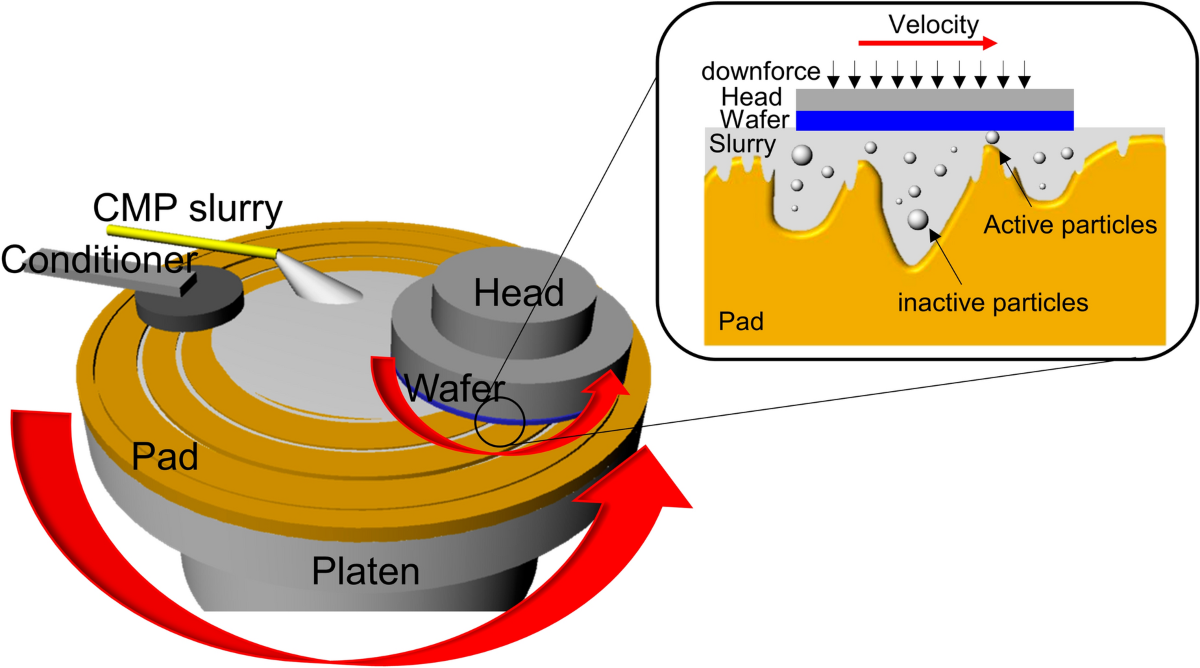
The interaction between CMP slurry chemistry, polishing pad asperities, and wafer surface topography defines the process window. Poor slurry selection or inadequate slurry control often results in yield loss that cannot be corrected downstream.
Types of CMP Slurry
CMP slurry types are classified primarily by the target material being polished and the chemical-mechanical removal mechanism employed. While the basic slurry architecture remains similar, the formulation differences are substantial.
Primary CMP Slurry Categories
- Oxide CMP slurry
- Metal CMP slurry
- Barrier layer CMP slurry
- Selective CMP slurry
Each category requires different abrasive hardness, chemical reactivity, and selectivity profiles. A detailed breakdown is provided in
CMP Slurry Types.
Oxide CMP Slurry
Oxide CMP slurry is typically based on colloidal silica or fumed silica abrasives, operating under mildly alkaline conditions (pH 9–11). Removal occurs via hydration and mechanical shearing of the silicon dioxide network.
Metal CMP Slurry
Metal CMP slurry relies heavily on controlled oxidation-reduction reactions, followed by abrasive removal of the reacted layer. This category includes copper, tungsten, aluminum, and emerging metals.
For metal-specific formulations, refer to
Metal CMP Slurry.
CMP Slurry Composition and Key Ingredients
The composition of CMP slurry is the primary determinant of polishing performance. Minor formulation changes can significantly alter removal rate, selectivity, and defectivity.
Core Components of CMP Slurry
- Abrasive particles
- Oxidizers
- Complexing agents
- pH adjusters
- Corrosion inhibitors
- Stabilizers and dispersants
Abrasive Particles
Common abrasives include:
- Colloidal silica (20–80 nm)
- Fumed silica
- Alumina (alpha or gamma phase)
- Ceria (CeO₂) for oxide CMP
Particle size distribution (PSD), zeta potential, and hardness must be tightly controlled to prevent agglomeration and scratching.
A deep engineering discussion is available in
CMP Slurry Composition and
What Does Slurry in CMP Contain?.
Metal CMP Slurry Applications
Metal CMP slurry is essential for interconnect fabrication in advanced semiconductor devices. The most widely used metal CMP processes involve copper and tungsten.
Copper CMP Slurry
Copper CMP slurry must balance high removal rate with minimal dishing and erosion. Typical formulations include:
- Oxidizers: H₂O₂, ferric nitrate
- Complexing agents: glycine, citric acid
- Inhibitors: benzotriazole (BTA)
See
Copper CMP Slurry for detailed chemistry and performance metrics.
Tungsten CMP Slurry
Tungsten CMP slurry operates under acidic conditions and relies on surface oxidation followed by abrasive removal. Control of tungsten oxide formation is critical to avoid residue and corrosion.
Further details are covered in
Tungsten CMP Slurry.
CMP Slurry Filtration and Process Control
Slurry filtration is a critical but often underestimated aspect of CMP process stability. Particle contamination, agglomerates, and pad debris are primary sources of scratches and killer defects.
Why Filtration Is Critical
- Prevents large particle-induced scratching
- Stabilizes removal rate over slurry lifetime
- Reduces random defect excursions
Typical filtration ratings range from 0.05 µm to 1.0 µm, depending on slurry type and process sensitivity.
Engineering guidance is provided in
CMP Slurry Filtration and
CMP Slurry Filters.
How to Choose CMP Slurry for Wafer Polishing
CMP slurry selection must be driven by process requirements rather than cost or availability. Key selection parameters include:
- Target material and film stack
- Required selectivity
- Defect tolerance
- Pad compatibility
- Tool platform and flow architecture
Incorrect slurry selection often leads to hidden yield loss due to corrosion, micro-scratches, or within-wafer non-uniformity.
A step-by-step engineering selection guide is available in
How to Choose CMP Slurry.
CMP Slurry Supplier and Custom Formulations
As device integration becomes more complex, off-the-shelf CMP slurry solutions are increasingly insufficient. Semiconductor manufacturers and advanced packaging facilities often require custom slurry formulations tailored to specific:
- Film stacks
- Node requirements
- Defectivity targets
- Tool and pad combinations
A qualified CMP slurry supplier should provide not only chemical products but also process support, filtration recommendations, and failure analysis capabilities.
From an engineering and yield management perspective, CMP slurry is not a consumable to be optimized in isolation—it is a core process enabler.