CMP Slurry Guide:Types, Selection & Optimization
A comprehensive technical reference for process engineers and procurement specialists — covering abrasive chemistry, slurry formulation, application-specific selection criteria, stability requirements, and optimization strategies for every major CMP application in semiconductor manufacturing.
What Is a CMP Slurry?
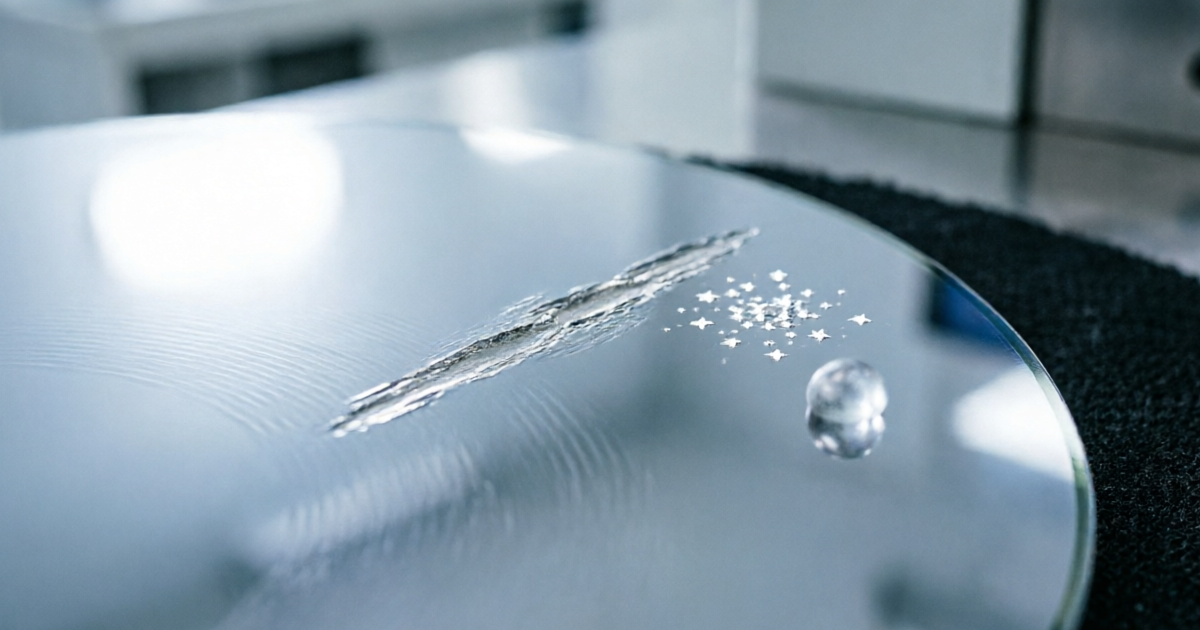
A CMP polishing slurry is a precisely engineered colloidal dispersion used as the chemical and abrasive medium in Chemical Mechanical Planarization. Unlike conventional abrasive compounds used in optics or metallurgy, a semiconductor-grade CMP slurry must meet extraordinary purity requirements, deliver repeatable nanometer-scale removal rates, and leave behind a defect-free surface ready for the next critical process step.
The word “slurry” is somewhat misleading — a well-formulated CMP slurry is not a thick paste but typically a low-viscosity aqueous liquid, clear or milky in appearance, with a solids content of 1–15% by weight. Its performance emerges from the precise interplay between abrasive particle characteristics, chemical formulation, and the physical conditions of the polishing process.
This article is part of the JEEZ CMP knowledge series. For the foundational context of how slurry fits into the overall CMP process, refer to the CMP Semiconductor Complete Guide. For the specific role of slurry in the step-by-step polishing process, see CMP Process Step-by-Step.
Slurry Components Explained
Every CMP slurry — regardless of application — contains three functional layers: abrasive particles, a chemical carrier solution, and performance additives. Understanding each component’s role is the foundation of rational slurry selection and troubleshooting.
Abrasive Particles
Nanoscale particles (50–250 nm diameter) that provide the mechanical cutting action. Material type, particle size distribution (PSD), shape, and surface chemistry all determine polishing performance and defectivity.
Chemical Carrier
Aqueous solution with pH carefully controlled by acids, bases, or buffers. Contains oxidizing agents, complexing agents, and dissolution promoters matched to the target film material.
Functional Additives
Surfactants for particle dispersion stability, corrosion inhibitors (e.g., BTA for copper), chelating agents for metal removal, polymeric dispersants, and biocides to prevent microbial growth in the slurry.
The Role of pH
pH is arguably the single most important slurry parameter. It simultaneously controls the surface charge (zeta potential) of the abrasive particles — which determines colloidal stability and aggregation tendency — and the chemical reactivity of the carrier solution with the target film. A well-formulated slurry maintains its target pH within ±0.2 units throughout its shelf life and during dilution.
For oxide and STI CMP, alkaline pH (10–11) keeps silica particles highly negatively charged (zeta potential more negative than −30 mV), ensuring strong electrostatic repulsion between particles and a stable, well-dispersed colloid. For copper CMP, acidic conditions (pH 2–4) promote the formation of a soluble copper complex layer that is then abraded by the mechanical action of the pad and particles. Tungsten CMP typically operates near neutral pH (6–8) with oxidizing agents that form a softer tungsten oxide layer on the surface.
Oxidizing Agents
Metal CMP slurries require an oxidizing agent to convert the hard metallic surface into a softer oxide form that can be removed at practical rates. Hydrogen peroxide (H₂O₂) is the most widely used oxidizer for copper CMP — it is relatively safe, leaves no metal ion contamination, and decomposes to water and oxygen. Ferric nitrate (Fe(NO₃)₃) is commonly used in tungsten CMP. Potassium iodate (KIO₃) and periodic acid are used in specialty applications. The oxidizer concentration must be carefully controlled: too little leads to insufficient removal rate; too much can cause excessive corrosion, especially in recessed copper features.
Abrasive Types: Silica vs Ceria vs Alumina
The abrasive material is the most fundamental slurry design choice. Each abrasive type has a distinct set of mechanical and chemical properties that make it optimal for specific CMP applications.
| Abrasive | Hardness (Mohs) | Primary Applications | Key Advantages | Key Limitations |
|---|---|---|---|---|
| Colloidal Silica (SiO₂) | 6.5–7 | Oxide ILD, copper barrier, low-k, final buff | Low defectivity, tunable surface chemistry, excellent dispersion stability | Lower oxide MRR than ceria; requires alkaline pH for stability |
| Fumed Silica (SiO₂) | 6.5–7 | Oxide planarization (legacy) | Low cost, widely available | Higher defectivity than colloidal; inferior dispersion stability |
| Ceria (CeO₂) | 6–6.5 | STI CMP, pre-metal dielectric, oxide ILD | Very high oxide MRR, excellent oxide-to-nitride selectivity (>100:1) | Higher defect risk if not properly formulated; higher cost |
| Alumina (Al₂O₃) | 9 | Tungsten CMP, cobalt CMP | High MRR on hard metals, stable at near-neutral pH | High hardness increases scratch risk on softer films; not suitable for oxide |
| Zirconia (ZrO₂) | 7–8 | Specialty: SiC, sapphire, compound semiconductors | Intermediate hardness, chemically inert in many environments | High cost; limited availability in fine PSD grades |
Why Ceria Dominates STI CMP
Cerium dioxide has a unique ability to catalyse the breaking of Si–O bonds through a chemical-tooth mechanism — cerium ions at the particle surface form transient Ce–O–Si bonds with the oxide surface, dramatically accelerating material removal compared to pure mechanical abrasion. This “chemical tooth” mechanism gives ceria slurries an inherently high oxide-to-nitride selectivity: oxide dissolves rapidly while the silicon nitride stop layer is essentially inert. For STI CMP, this selectivity acts as a natural endpoint mechanism — the process self-terminates when the oxide overburden is cleared, providing a wide and forgiving process window.
Particle Size Distribution: The Critical Specification
For any abrasive type, the particle size distribution (PSD) is more important than the mean particle size alone. The large-particle count (LPC) — typically defined as the number of particles larger than 0.5 µm or 1.0 µm per mL of slurry — is the primary predictor of scratch defect density. A slurry with a mean particle size of 120 nm but an LPC of 5,000 particles/mL will produce far more scratches than one with a mean size of 150 nm but an LPC of 500 particles/mL. This is why modern slurry specifications always include both mean PSD and LPC limits, and why point-of-use filtration is essential even for qualified slurry lots.
Slurry Selection by Application
The right slurry for any CMP application must match the target film material, the underlying stop layer, the required removal rate and selectivity, the defect density budget, and the post-CMP surface condition requirements. The selection decision tree below covers the four primary production CMP applications.
Key Slurry Performance Metrics
Qualifying and monitoring a CMP slurry requires tracking a defined set of physical and chemical metrics. These metrics form the basis of the certificate of analysis (CoA) supplied with each slurry lot and the ongoing statistical process control (SPC) program in production.
- Removal Rate (MRR): Measured in Å/min on a blanket test wafer of the target film. The primary performance metric. Should be reported as mean and 1-sigma across the wafer.
- Selectivity: The ratio of MRR on the target film to MRR on the stop layer (e.g., oxide:nitride ratio for STI CMP). Determines process window width.
- Within-Wafer Non-Uniformity (WIWNU): Standard deviation of remaining film thickness across the wafer after CMP, expressed as a percentage of mean thickness. Target typically <3% for production.
- Defect Density (scratch count): Measured by KLA-Tencor or equivalent bright-field inspection on a polished monitor wafer. Reported as defects per cm².
- Large-Particle Count (LPC): Number of particles >0.5 µm per mL, measured by single-particle optical sensing (SPOS). A leading indicator of scratch risk.
- Zeta Potential: Surface charge of abrasive particles in the formulated slurry, measured by electrophoretic light scattering. Determines colloidal stability; should be more negative than −25 mV or more positive than +25 mV.
- pH: Must be within ±0.2 of specification. Measured with a calibrated pH meter on freshly prepared slurry.
- Viscosity: Determines flow behavior in delivery lines; should be stable across the storage temperature range.
Slurry Stability & Shelf Life
A CMP slurry is a thermodynamically unstable system: the abrasive particles are in a state of kinetic stability maintained by electrostatic and steric repulsion. Any perturbation — temperature extremes, contamination, or mechanical shock — can trigger irreversible agglomeration that makes the slurry unsuitable for production use.
Ageing and Oxidizer Decomposition
Slurries containing hydrogen peroxide are particularly sensitive to storage conditions. H₂O₂ decomposes over time — especially at elevated temperatures and in the presence of metal ion contamination — releasing oxygen and reducing oxidizer concentration. This causes a progressive decline in removal rate that can be mistaken for pad glazing or process drift. Peroxide-containing slurries typically have a shelf life of 3–6 months from the date of manufacture and should be stored in a cool environment away from light.
For this reason, some fabs use a two-component (2C) slurry delivery system where the abrasive dispersion and the hydrogen peroxide are stored and delivered separately, mixing at the point of use (POU) immediately before dispensing onto the pad. This approach maximizes slurry freshness and oxidizer consistency but requires more complex delivery infrastructure.
Microbial Contamination
Aqueous slurries stored for extended periods at ambient temperature are susceptible to microbial growth — bacteria and fungi that can alter pH, generate surfactant-degrading enzymes, and introduce organic contamination. Most production slurries contain a biocide (commonly isothiazolinone-based) to prevent microbial growth. Slurry storage systems should be regularly cleaned and sanitised, and slurry lots beyond their expiry date should never be used in production.
Handling, Storage & Safety
Proper slurry handling protects both product quality and personnel safety. CMP slurries can contain corrosive chemicals, oxidizing agents, and nanoparticulate materials, all of which require appropriate precautions. For a comprehensive treatment of slurry handling protocols, refer to our dedicated safety resource: CMP Slurry Storage, Handling & Safety.
- Storage temperature: 5–30°C for most slurries. Store away from heat sources and direct sunlight. Never freeze.
- Container integrity: Always use slurry in the original sealed container until ready for dispensing. Avoid introducing foreign materials into the slurry container.
- Agitation before use: Gently roll or rock drums before connecting to the delivery system to re-suspend any settled particles — do not shake vigorously, which can introduce air bubbles and shear agglomerates.
- PPE requirements: Acid/alkaline-resistant gloves, safety glasses, and lab coat when handling concentrated slurry. Peroxide-containing slurries are oxidizing agents and must be kept away from flammable materials.
- Spill management: Contain spills immediately and absorb with appropriate inert material. Slurry drain water must be treated before discharge; nanoparticulate material and dissolved metals must not be released to the municipal sewer without pH adjustment and filtration.
- Waste disposal: Follow local environmental regulations for nanoparticulate waste and chemical waste streams. Many fabs recycle copper-containing CMP waste water for copper recovery.
Process Optimization Strategies
Once a baseline CMP process is qualified with a specific slurry, ongoing optimization can further improve performance. The most impactful optimization levers are slurry dilution, pH adjustment, oxidizer concentration tuning, and delivery flow rate optimization.
Dilution Ratio Optimization
Many production slurries are supplied as concentrates and diluted at point-of-use with deionized water. The dilution ratio affects both abrasive concentration and chemical concentrations proportionally. Increasing dilution reduces MRR but can improve surface finish and reduce defect density. The optimal dilution ratio balances throughput requirements with surface quality and defect targets. Because DI water quality (particularly dissolved metal ion content and TOC) affects slurry behavior, the dilution water specification must be included in the process qualification.
Oxidizer Concentration Tuning
For metal CMP slurries, the oxidizer concentration provides an additional degree of freedom for rate control. In a two-component delivery system, increasing the H₂O₂ addition rate raises the removal rate and can improve planarization efficiency for raised features, while decreasing it reduces over-polish in recessed areas and improves within-die uniformity. Optimizing the oxidizer concentration independently of the abrasive concentration is one of the key advantages of a 2C delivery system over a pre-mixed single-component slurry.
Temperature as a Process Lever
Since chemical reaction rates are temperature-dependent, slurry temperature can be used to fine-tune removal rate without changing the slurry formulation. Some advanced CMP tools incorporate platen temperature control (through the pad surface) or slurry temperature conditioning to maintain process stability and compensate for seasonal facility temperature variations. A 5°C increase in slurry temperature typically increases oxide CMP removal rate by 10–15%.
Slurry Qualification Protocol
Qualifying a new CMP slurry — whether for initial product introduction or lot-to-lot incoming inspection — follows a structured protocol that protects against yield loss from out-of-specification material entering production.
Standard Slurry Qualification Steps
1. CoA review: Verify that all supplier-specified parameters (PSD, LPC, pH, MRR on reference wafer) are within specification.
2. Incoming PSD and LPC measurement: Independent measurement at the receiving fab using calibrated instruments.
3. Blanket wafer polishing test: Measure MRR and WIWNU on target film at standard recipe conditions.
4. Defect inspection: Run polished monitor wafer through bright-field inspection tool; compare defect density to baseline.
5. Selectivity check (if applicable): Verify oxide-to-nitride or Cu-to-barrier selectivity meets process requirement.
6. Lot release or rejection: Release to production if all parameters pass; quarantine and notify supplier if any parameter fails.
Slurry qualification is closely linked to defect management. Understanding which slurry parameters drive which defect modes is essential for efficient investigation of excursions. For a complete guide to CMP defect root causes and mitigation strategies, refer to: CMP Defect Types, Root Causes & Yield Improvement.
Looking for High-Performance CMP Slurry?
JEEZ manufactures and globally supplies CMP polishing slurries engineered for production-grade consistency and low defectivity. Contact us to discuss your application.
Contact JEEZ →