How Wax-Free Polishing Pads Work in CMP Processes
Table of Contents
- 1. Introduction: Why Wax-Free Pad Working Principles Matter
- 2. CMP System Context: Wax-Free Pads as a Mechanical Subsystem
- 3. Pad–Wafer Contact Mechanics Without Wax Bonding
- 4. Wafer Loading and Initial Adsorption Formation
- 5. Pressure Ramp-Up and Adsorption Force Stabilization
- 6. Slurry Introduction and Frontside–Backside Decoupling
- 7. Steady-State CMP: Dynamic Adsorption Under Motion
- 8. Thermal and Mechanical Stability During CMP Operation
- 9. Controlled Wafer Release and De-Adsorption Behavior
- 10. Manufacturing-Level Process Control Implications
1. Introduction: Why Wax-Free Pad Working Principles Matter
Understanding how wax-free polishing pads work is essential for modern CMP process development because wafer holding is no longer an isolated auxiliary step but an integral part of planarization performance, defect control, and yield stability. As semiconductor devices migrate toward smaller nodes, thinner wafers, and heterogeneous integration, traditional wax-based bonding introduces unacceptable variability in thermal response, chemical interaction, and contamination risk.
Wax-free polishing pads replace chemical adhesion with a mechanically governed adsorption mechanism that evolves dynamically throughout the CMP process. This document explains how that mechanism functions step by step, from wafer loading through steady-state polishing and final release, emphasizing real CMP operating conditions rather than idealized material descriptions. For a high-level definition and product overview, refer to the page Wax-Free CMP Polishing Pads.
2. CMP System Context: Wax-Free Pads as a Mechanical Subsystem
In a CMP tool, the polishing pad, wafer, carrier head, platen, and slurry form a coupled mechanical–fluidic system. Wax-free polishing pads operate as a compliant mechanical interface that must translate carrier-applied pressure into uniform wafer holding while remaining insensitive to slurry chemistry and thermal fluctuation.
Unlike wax-based systems, where holding force is dominated by adhesive strength, wax-free systems rely on pressure-induced conformity and interface sealing. Adsorption force therefore depends on system-level variables such as downforce, rotation speed, and pad deformation, making it inherently adaptive rather than fixed.
| System Requirement | Wax-Free Pad Response |
|---|---|
| Wafer fixation | Pressure-dependent adsorption and friction |
| Pressure transmission | Distributed elastic conformity |
| Process adaptability | Dynamic response to load and motion |
3. Pad–Wafer Contact Mechanics Without Wax Bonding
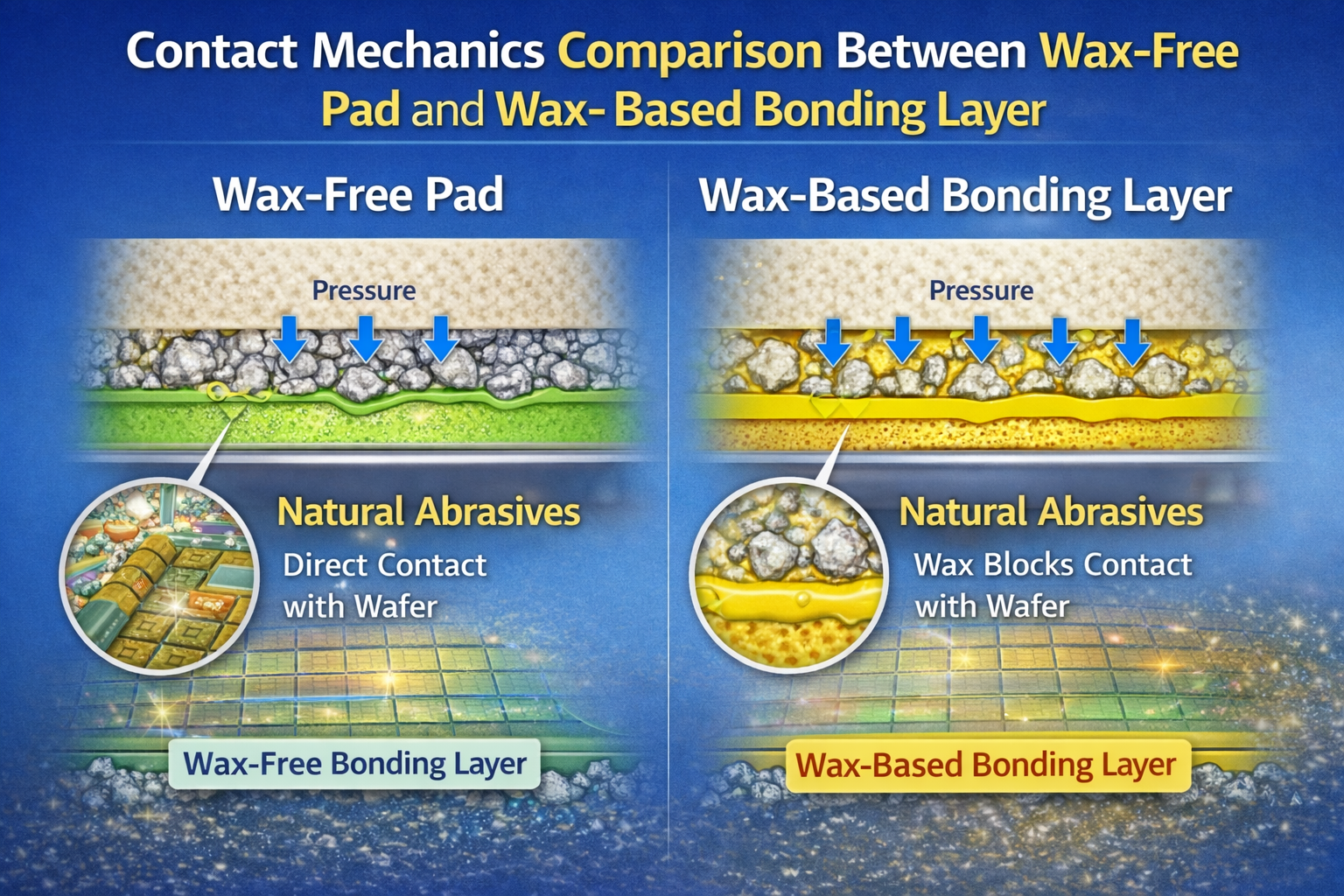
At the core of wax-free polishing pad operation is contact mechanics. When a rigid wafer contacts a compliant pad surface, the real contact area is determined by pad elastic modulus, surface roughness, and applied normal load. In wax-free systems, this contact area governs both pressure transmission and adsorption behavior.
As load increases, micro-asperities on the pad surface deform elastically, increasing the true contact fraction while avoiding stress concentration at the wafer backside. This behavior differs fundamentally from wax layers, which introduce a viscoelastic interlayer with temperature-sensitive properties and non-uniform thickness.
4. Wafer Loading and Initial Adsorption Formation
During wafer loading, minimal preload is applied as the wafer backside contacts the pad surface. At this stage, adsorption force is governed primarily by air displacement and initial surface conformity rather than pressure sealing. Trapped air escapes laterally through pad surface grooves and vertically through interconnected pore networks.
As air volume decreases, localized low-pressure regions form at the interface, generating an initial adsorption force sufficient to stabilize wafer positioning before full polishing pressure is applied. This mechanism enables repeatable wafer alignment without thermal activation or chemical bonding steps.
| Parameter | Typical Engineering Range |
|---|---|
| Initial preload | 1–5 kPa |
| Pad compressibility | 3–8% |
| Surface roughness (Ra) | 3–10 μm |
5. Pressure Ramp-Up and Adsorption Force Stabilization
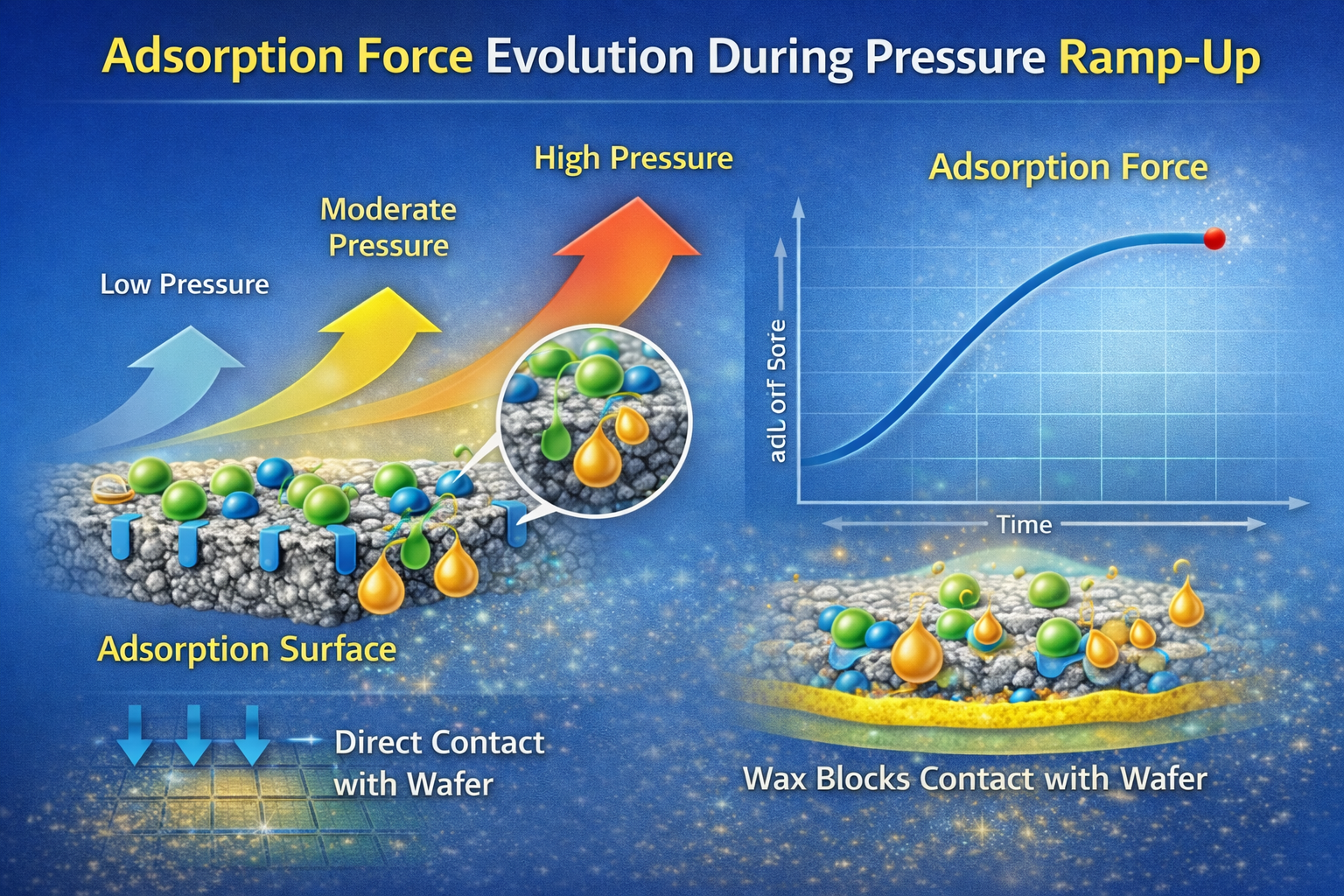
As the carrier head ramps up polishing pressure, the pad undergoes controlled elastic deformation. This deformation increases interfacial sealing efficiency and expands the real contact area, producing a proportional rise in adsorption force. Because adsorption scales with pressure, the system naturally resists lateral wafer motion as downforce increases.
This self-regulating behavior contrasts sharply with wax systems, where increased pressure can induce wax flow, thickness variation, or localized debonding. Wax-free pads therefore exhibit superior stability during pressure transients and recipe transitions.
6. Slurry Introduction and Frontside–Backside Decoupling
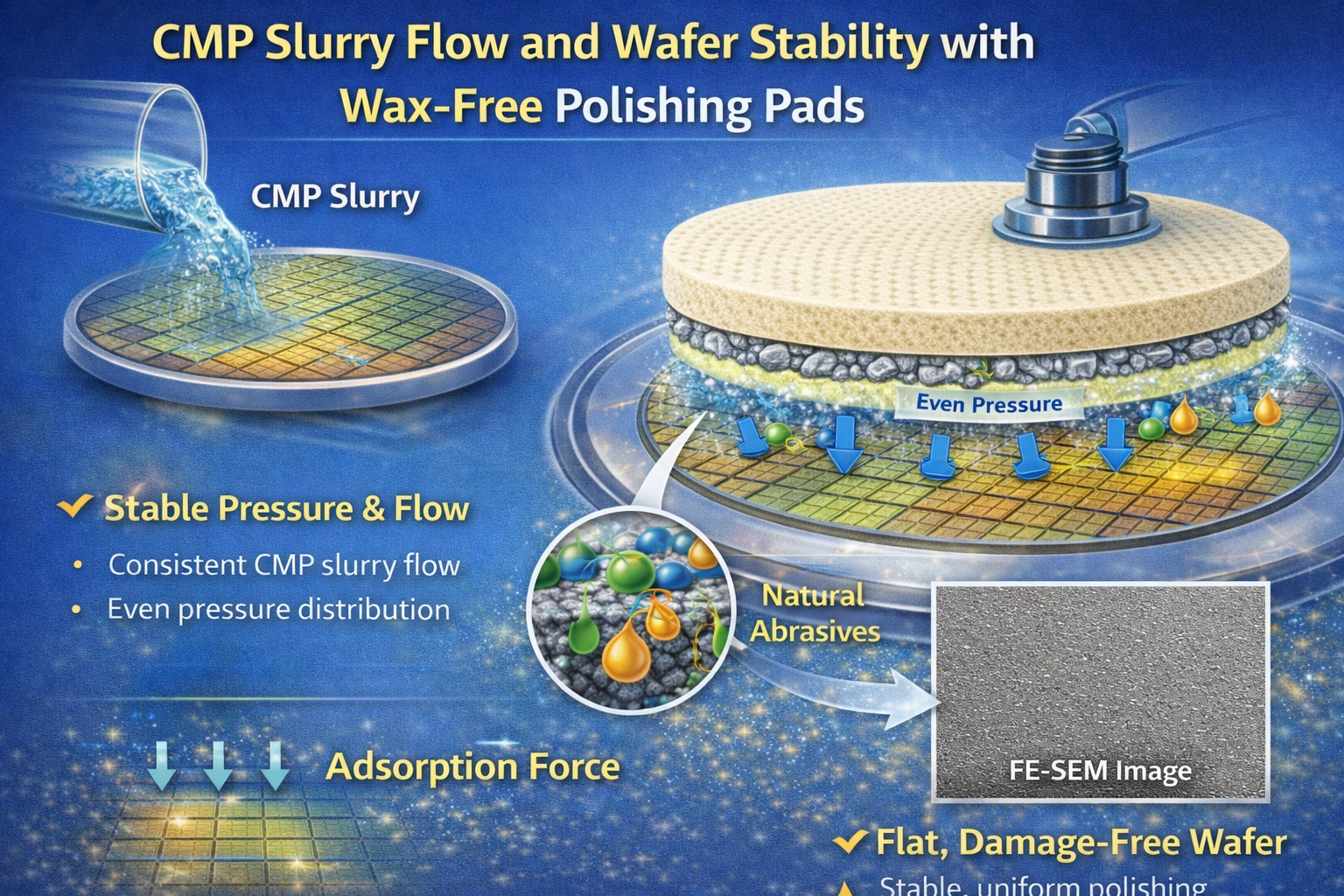
Once slurry flow begins, hydrodynamic shear and chemical activity dominate the frontside polishing interface. Wax-free polishing pads are designed so that slurry penetration does not disrupt backside adsorption, maintaining mechanical isolation between holding and material removal functions.
This decoupling enables CMP engineers to adjust slurry chemistry, flow rate, and temperature without compromising wafer stability. It also eliminates wax–slurry interaction pathways that commonly lead to backside contamination or bonding degradation.
7. Steady-State CMP: Dynamic Adsorption Under Motion
During steady-state CMP, platen rotation, carrier rotation, and slurry flow reach equilibrium. Wax-free polishing pads maintain wafer fixation through distributed elastic conformity rather than chemical adhesion, allowing them to tolerate minor load, speed, and temperature fluctuations without loss of holding force.
| Process Parameter | Typical Range |
|---|---|
| Downforce pressure | 20–60 kPa |
| Platen speed | 30–90 rpm |
| Carrier speed | 20–70 rpm |
| Interface temperature | 30–60 °C |
8. Thermal and Mechanical Stability During CMP Operation
Frictional heating and slurry shear generate thermal gradients during CMP. Wax-free polishing pads exhibit stable mechanical properties across the operating temperature range because no thermally sensitive bonding layer is present. Elastic modulus, compressibility, and adsorption behavior remain consistent, supporting predictable polishing outcomes.
| Material Property | Typical Value |
|---|---|
| Elastic modulus | 10–50 MPa |
| Operating temperature | 20–80 °C |
| Thickness tolerance | ±0.05 mm |
9. Controlled Wafer Release and De-Adsorption Behavior
At the end of polishing, gradual pressure reduction leads to proportional de-adsorption. The wafer separates cleanly from the pad surface without chemical solvents, heating, or mechanical shock. This controlled release is particularly important for thin wafers, fragile substrates, and advanced packaging applications.

10. Manufacturing-Level Process Control Implications
By removing wax-related variability, wax-free polishing pads simplify CMP process control and improve manufacturing robustness. Benefits include tighter run-to-run control, reduced maintenance complexity, elimination of debonding steps, and improved compatibility with advanced semiconductor process nodes.