Top CMP Slurry Manufacturers & Suppliers in 2026: A Complete Procurement Guide
Who makes the CMP slurry that powers the world’s most advanced semiconductor fabs — and how do you evaluate them for your specific process and supply chain needs? This guide profiles every major global supplier, compares their product portfolios and technical capabilities, and provides a structured six-dimension framework for making the right sourcing decision.
📋 Table of Contents
- The CMP Slurry Supply Chain: Market Structure Overview
- Global Tier-1 Suppliers: Full Profiles
- Regional & Specialist Suppliers
- China Domestic CMP Slurry Suppliers
- Jizhi Electronic Technology: CMP Slurry from Wuxi
- Full Portfolio Comparison Table
- 6-Dimension Supplier Evaluation Framework
- Total Cost of Ownership (TCO) Analysis
- Supplier Qualification Process: A Step-by-Step Guide
- Frequently Asked Questions
1. The CMP Slurry Supply Chain: Market Structure Overview
The global CMP slurry supply chain is structurally concentrated — a characteristic driven by the extraordinarily high barriers to entry in this specialty chemical segment. Developing a production-qualified semiconductor-grade CMP slurry requires years of application engineering investment, a dedicated abrasive synthesis and formulation facility, ultrapure chemical handling infrastructure, and the patience to navigate 12–24 month qualification cycles at leading fabs. These barriers have historically limited the competitive field to a small group of deep-technology specialty chemical companies.
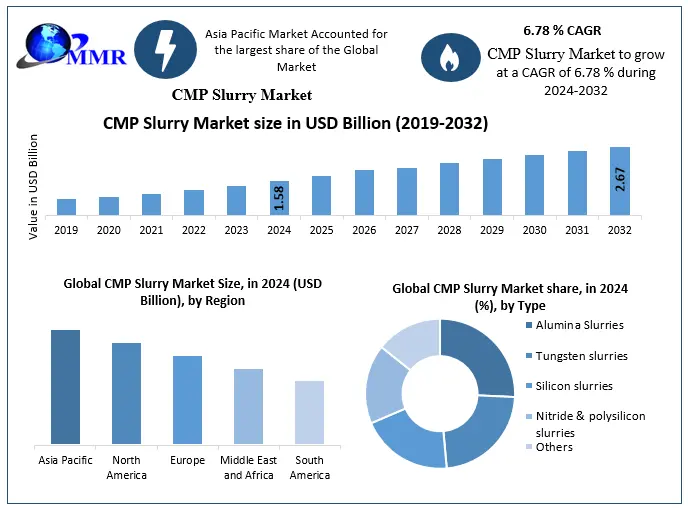
As of 2025, the top five global suppliers — CMC Materials (now part of Entegris), Fujimi, DuPont Electronic Materials, AGC, and Resonac — collectively account for an estimated 65–70% of global CMP slurry revenue. The remainder of the market is served by a mix of regional specialists, niche formulation companies, and a growing cohort of Chinese domestic suppliers whose market share is expanding rapidly in the domestic Chinese fab ecosystem. A full market size and competitive dynamics analysis is available in our CMP Slurry Market Size, Growth & Forecast 2025–2032 article.
📌 Supply Chain Structure
CMP slurry suppliers can be broadly classified into three tiers: Tier 1 Global Leaders — full-portfolio suppliers qualified at TSMC, Samsung, Intel, and Micron, with global distribution networks and advanced-node development programs; Tier 2 Regional / Specialist Suppliers — suppliers with strong positions in specific applications or geographies; and Tier 3 Domestic/Emerging Suppliers — primarily China-based companies serving domestic fabs at ≥28nm nodes with rapidly improving technical capabilities.
2. Global Tier-1 CMP Slurry Suppliers: Full Profiles
CMC Materials / Entegris
CMC Materials — absorbed into Entegris following a landmark $6.5B acquisition in 2022 — holds the largest single-company global market share in CMP slurry. The combined entity now spans slurry, CMP pads, filtration, and advanced liquid delivery, giving Entegris a uniquely integrated consumables value proposition. CMC’s heritage strengths lie in its broad tungsten and copper slurry portfolio, its deep qualification pedigree at virtually all Tier-1 fabs, and its continued investment in advanced-node formulations for 3nm and below.
The Entegris–CMC integration has also raised supply chain concentration concerns among fabs seeking multi-source strategies — creating an opening for alternative suppliers across several application segments. The combined entity’s R&D pipeline is focused on cobalt, ruthenium, and abrasive-free slurry chemistries for sub-3nm logic and advanced packaging applications.
Fujimi Incorporated
Fujimi is arguably the founding company of modern CMP abrasive technology, having developed and commercialized colloidal silica-based polishing compounds for semiconductor and precision optics applications since the 1960s. Its PLANERLITE series of oxide slurries and GLANZOX series of silicon wafer final-polish slurries are among the most widely qualified products in FEOL CMP globally. Fujimi’s core competency is in FEOL dielectric and silicon polishing; its BEOL copper and tungsten portfolio is less dominant relative to CMC/Entegris or DuPont.
DuPont Electronic Materials
DuPont’s CMP slurry business — significantly strengthened by the acquisition of Versum Materials in 2019 — is concentrated in BEOL and advanced-node applications. DuPont has deep expertise in copper and barrier slurry chemistries and is one of the few suppliers with demonstrated advanced-node qualification (TSMC N5/N3) in cobalt and ruthenium CMP. Its heritage in advanced post-CMP cleaning chemistry also makes DuPont a natural partner for fabs that want to co-optimize slurry formulation and cleaning process.
AGC Inc. (incorporating Showa Denko KK)
AGC — encompassing the former Showa Denko Electronic Materials business — is widely regarded as the leading global authority on cerium oxide abrasive synthesis and ceria-based CMP slurry formulation. Its STI slurry products are among the most widely qualified ceria slurries in FEOL processing worldwide. Beyond semiconductors, AGC’s slurry business spans display glass, optical glass, and sapphire substrate polishing — making it one of the most diversified CMP slurry producers by end market.
Resonac Holdings Corporation
Resonac — the rebranded successor to Hitachi Chemical — has a strong heritage in copper CMP slurry, particularly its GPX series products which have long production qualifications at TSMC and other leading logic fabs. Resonac has been investing in advanced packaging CMP applications (CoWoS, HBM, RDL planarization), positioning itself in one of the fastest-growing segments of the CMP consumables market. Its integration within the broader Resonac advanced materials group provides access to complementary chemistry platforms for next-generation slurry development.
3. Regional & Specialist CMP Slurry Suppliers
Beyond the five global Tier-1 leaders, a group of regional and specialist suppliers serve specific application niches or geographic markets with competitive formulations:
| Company | HQ | Specialty | Key Application Segment |
|---|---|---|---|
| Ferro Corporation / Prince International | USA | Fumed silica slurry; display glass | Cost-competitive mature-node oxide; display |
| Kumho Petrochemical | South Korea | Oxide and STI slurry for memory fabs | Samsung / SK Hynix DRAM/NAND supply |
| KC Tech | South Korea | Ceria STI slurry; oxide slurry | Korean memory fabs; growing logic presence |
| Soulbrain (SOULBRAIN Co., Ltd.) | South Korea | Tungsten and copper CMP slurry | Samsung, SK Hynix DRAM/NAND |
| Versum Materials Taiwan (DuPont subsidiary) | Taiwan | Local distribution and support for DuPont products | TSMC, MediaTek, UMC supply chain |
Korean Tier-2 suppliers — particularly Kumho, KC Tech, and Soulbrain — hold meaningful positions in the Samsung and SK Hynix memory fab supply chains, benefitting from geographic proximity, Korean-language technical support, and longstanding supplier relationships. Their slurry formulations for DRAM and 3D NAND applications are competitive with the global Tier-1 products at mature nodes, though their advanced-node (sub-10nm) portfolios are less developed.
4. China Domestic CMP Slurry Suppliers: A Rising Force
The Chinese domestic CMP slurry market has undergone a significant structural shift since 2020, driven by national semiconductor self-sufficiency policy, preferential procurement mandates at SMIC, YMTC, and CXMT, and substantial government-backed R&D investment. Chinese domestic CMP slurry suppliers now hold meaningful market share in mature-node applications (≥28nm) and are systematically targeting advanced-node qualifications. The growth dynamics of this segment are analyzed in detail in our CMP Slurry Market article.
| Company | Location | Founded | Key Products | Target Customers |
|---|---|---|---|---|
| Jizhi Electronic Technology | Wuxi, Jiangsu | 1997 | CMP polishing slurry (oxide, STI, metal) | Domestic fabs; Yangtze Delta cluster |
⚠️ Technology Gap Context
Chinese domestic CMP slurry suppliers have made rapid progress in mature-node applications but still face a meaningful technology gap versus global Tier-1 suppliers in advanced-node (≤14nm) formulations, particularly for ultra-low-k dielectric CMP, cobalt and ruthenium chemistries, and EUV-era defectivity requirements. This gap is narrowing — but remains real as of 2025. Procurement decisions should account for node-specific qualification status when evaluating domestic suppliers.
5. Jizhi Electronic Technology Co., Ltd.: CMP Slurry from Wuxi
Jizhi Electronic Technology Co., Ltd.
Jizhi Electronic Technology Co., Ltd. is a CMP polishing slurry specialist headquartered in Wuxi, Jiangsu — a city that sits at the heart of China’s most active semiconductor manufacturing cluster in the Yangtze River Delta. Wuxi is home to major domestic and joint-venture fab operations, making geographic proximity to customer facilities a meaningful operational advantage: shorter lead times, faster response to process excursions, and the ability to station application engineers on-site during process development and qualification cycles.
As a focused CMP slurry supplier rather than a diversified chemicals conglomerate, Jizhi brings application engineering depth and responsiveness that larger organizations can struggle to match for domestic customers. This specialization also means the team’s entire technical expertise is centered on CMP slurry performance — formulation chemistry, particle characterization, process integration, and QC methodology — rather than distributed across a broad chemical product portfolio.
For procurement teams at domestic Chinese fabs seeking to diversify their CMP slurry supply base — whether driven by supply security strategy, cost optimization, or domestic content requirements — Jizhi represents a technically capable local partner with the fab-proximity advantages that global suppliers based in Japan, the US, or Europe cannot replicate. Prospective customers are encouraged to contact the Jizhi technical team to discuss qualification programs, sample requests, and product specifications aligned to their specific CMP process requirements.
Interested in Qualifying Jizhi CMP Slurry?
Our application engineering team is ready to discuss your process requirements, provide sample lots, and support your qualification program from initial blanket wafer testing through full production qualification.
Request a Sample & Technical Discussion →6. Full Portfolio Comparison Table
The table below summarizes each major supplier’s coverage across the principal CMP slurry application types. Coverage ratings reflect publicly available information on production-qualified products as of mid-2025. For a deep dive into each application type, see our guide on CMP Slurry Types: Oxide, STI, Copper, Tungsten & Beyond.
| Supplier | Oxide ILD | STI (Ceria) | Cu Bulk | Barrier | Tungsten | Poly-Si | Co / Ru | Advanced Node |
|---|---|---|---|---|---|---|---|---|
| CMC / Entegris | ●●●●● | ●●●●○ | ●●●●● | ●●●●● | ●●●●● | ●●●●○ | ●●●●○ | ●●●●● |
| Fujimi | ●●●●● | ●●●○○ | ●●○○○ | ●●○○○ | ●●●○○ | ●●●●● | ●●○○○ | ●●●○○ |
| DuPont | ●●●○○ | ●●●○○ | ●●●●● | ●●●●● | ●●●○○ | ●●○○○ | ●●●●○ | ●●●●● |
| AGC | ●●●●○ | ●●●●● | ●●○○○ | ●●○○○ | ●●○○○ | ●●●○○ | ●○○○○ | ●●●○○ |
| Resonac | ●●●●○ | ●●●○○ | ●●●●● | ●●●●○ | ●●●○○ | ●●●○○ | ●●○○○ | ●●●●○ |
| KC Tech / Kumho | ●●●●○ | ●●●●○ | ●●●○○ | ●●●○○ | ●●○○○ | ●●●○○ | ●○○○○ | ●●○○○ |
| Anji Microelectronics | ●●●●○ | ●●●○○ | ●●●●○ | ●●●○○ | ●●●○○ | ●●○○○ | ●○○○○ | ●●○○○ |
| Jizhi Electronic Technology | ●●●○○ | ●●●○○ | ●●●○○ | ●●○○○ | ●●○○○ | ●●○○○ | ●○○○○ | ●○○○○ |
● = Production qualified · ○ = Not available / limited. Ratings based on publicly available information; contact individual suppliers for current qualification status.
7. Six-Dimension Supplier Evaluation Framework
Selecting a CMP slurry supplier is a strategic procurement decision with direct implications for fab yield, process stability, and supply continuity. The following six-dimension framework provides a structured methodology for evaluating any CMP slurry supplier — whether a global Tier-1 or a domestic specialist.
-
Dimension 1: Technical Performance & Qualification Depth
The most fundamental criterion: does the supplier’s slurry deliver the required MRR, selectivity, WIWNU, and defectivity performance on your specific CMP tool, pad, and target film stack? Evaluate this through a structured blanket wafer DOE and patterned wafer qualification. Ask for data from comparable qualifications at peer fabs — not just the supplier’s own internal lab results. Understand how their formulation handles your specific process conditions including tool downforce, platen speed, and post-CMP clean chemistry. For a detailed framework on CMP slurry performance parameters, see our guide on CMP Slurry Composition & Formulation.
-
Dimension 2: Batch-to-Batch Consistency & QC Rigor
Production yield depends not just on average slurry performance but on the consistency of every lot. Request the supplier’s incoming QC specification sheet — at minimum it should cover pH (±0.15), D50 (±10 nm), D99 (<200 nm for silica), LPC (<100 particles/mL >0.5 µm), zeta potential (>±30 mV), oxidizer assay (±5%), and ICP-MS trace metal content (<5 ppb per element for BEOL-critical slurries). Ask for three consecutive lot CoA (Certificate of Analysis) data sheets and review the actual measured values — not just the specification limits — for lot-to-lot variability. Statistical process control (SPC) data sharing between supplier and customer is a hallmark of a mature supplier relationship.
-
Dimension 3: Supply Chain Reliability & Regional Infrastructure
Even the best-performing slurry is a liability if it cannot be delivered reliably. Evaluate lead time commitments, safety stock programs, regional distribution center locations, and the supplier’s track record for on-time delivery. For fabs in China, having a supplier with domestic production or bonded warehouse inventory eliminates customs clearance delays and currency exposure. Assess the supplier’s business continuity plan for scenarios including raw material shortages, logistics disruptions, and production facility incidents. Ask whether they maintain qualified backup production lines for critical products.
-
Dimension 4: Application Engineering Support
CMP slurry qualification and process troubleshooting require active collaboration between supplier and customer application engineers. Evaluate the supplier’s technical support infrastructure: do they have dedicated application engineers with CMP tool-level process knowledge? Can they commit to on-site support during qualification? What is their typical response time to a process excursion report — hours or weeks? Suppliers that treat technical support as a sales tool rather than a core service commitment are a risk in high-stakes CMP environments. A local application engineer, speaking the same language and in the same time zone, is worth a measurable qualification cycle-time reduction.
-
Dimension 5: Regulatory & Environmental Compliance
CMP slurries may contain substances subject to REACH (EU), RoHS, China’s hazardous chemical management regulations (危险化学品管理), and TSCA (US). Specific components of concern include benzotriazole (BTA) — a potential environmental hazard in wastewater; hydrogen peroxide — classified as a hazardous oxidizer; iodate-based oxidizers in tungsten slurry; and certain amine-based surfactants. Confirm that the supplier provides compliant Safety Data Sheets (SDS) for all products, can provide substance declaration data for compliance audits, and has an established process for notifying customers of formulation changes that may affect regulatory status. For handling and disposal guidance, see our article on CMP Slurry Filters, Storage & Handling.
-
Dimension 6: Total Cost of Ownership (TCO)
List price per liter is only the starting point of CMP slurry cost analysis. True TCO encompasses MRR efficiency (slurry volume consumed per Å of film removed), filter consumption rate, post-CMP clean chemistry cost driven by residue characteristics, re-work rate and yield loss attributable to slurry defectivity, and engineering labor cost for excursion investigation and qualification. A slurry priced 20% below the market average that delivers 10% higher defect rates and 2× the filter change frequency may have a substantially higher TCO than the premium product. Build a full TCO model before making sourcing decisions based on unit price alone.
8. Total Cost of Ownership: Beyond the Price Tag
| TCO Component | Description | Typical % of Total CMP Slurry TCO | Influenced By |
|---|---|---|---|
| Slurry Purchase Cost | Unit price × consumption volume per wafer | 45–60% | Abrasive type, concentration, lot size |
| Filter Consumption | POU filter replacement frequency & unit cost | 8–15% | LPC, abrasive type (alumina > ceria > silica) |
| Yield Loss / Rework | Defect-attributable wafer scrap and rework cost | 10–25% | Scratch rate, LPC, defectivity profile |
| Post-CMP Clean Cost | Additional cleaning chemistry for residue removal | 5–12% | Abrasive adhesion force (ceria > silica) |
| Waste Treatment | pH neutralization, metal removal, solid waste disposal | 5–10% | Oxidizer type, metal content, abrasive type |
| Engineering / QC Labor | Incoming QC, process monitoring, excursion investigation | 3–8% | Lot-to-lot consistency, supplier responsiveness |
9. CMP Slurry Supplier Qualification: A Step-by-Step Guide
Qualifying a new CMP slurry supplier — or a new slurry product from an existing supplier — is a structured process that typically spans 6–18 months depending on the application complexity and the fab’s qualification standards. The following steps represent industry-standard practice:
- Step 1 — Technical Pre-Screening: Review supplier datasheets, reference customer lists, and application-specific performance claims. Confirm the product covers your target film, stop layer, and nominal process conditions. Request QC specification sheets and at least three recent lot CoAs.
- Step 2 — Sample Lot Request & Incoming QC: Request a qualification sample lot (typically 20–50L for initial evaluation). Perform full incoming QC: pH, D50, D99, LPC, zeta potential, oxidizer assay (if applicable), and reference oxide wafer MRR test. Confirm the lot meets the supplier’s stated specifications before proceeding.
- Step 3 — Blanket Wafer DOE: Polish thermal oxide, metal, or other target film blanket wafers across the relevant process window (pressure, velocity, slurry flow rate, temperature). Map MRR, WIWNU, and selectivity as functions of process parameters. Compare to your current supplier or internal baseline.
- Step 4 — Patterned Wafer Evaluation: Polish patterned test wafers (SEMATECH 854 or equivalent) at your standard process conditions. Measure dishing, erosion, and post-CMP defectivity (scratch count, LPD, metal contamination) versus spec. This step is the primary yield-risk gate in the qualification.
- Step 5 — Extended Lot-to-Lot Consistency Study: Qualify three to five consecutive production lots to establish the supplier’s real-world batch-to-batch variability distribution. Compare incoming QC data and wafer-level results across lots to confirm process capability (Cpk ≥ 1.33 on critical parameters).
- Step 6 — Production Pilot and Release: Run a controlled production pilot (typically 200–500 wafers across one to two product lots) with full process monitoring and yield tracking. After passing yield and defectivity gates, release the supplier and product to approved vendor list (AVL) status. Establish SPC trigger limits and escalation protocols for ongoing monitoring.
✅ Qualification Tip
Engage the supplier’s application engineer at Step 2 — before blanket wafer testing begins. A supplier who understands your tool platform (Applied Materials Reflexion, Ebara, etc.), pad type, and conditioner can proactively recommend process parameter starting points that dramatically reduce the number of DOE wafers needed to find the optimum operating window. This collaboration can cut typical blanket-wafer DOE time by 30–50%.
10. Frequently Asked Questions
How long does it typically take to qualify a new CMP slurry supplier?
Should I single-source or multi-source CMP slurry?
What information should a CMP slurry supplier provide with each production lot?
Can Chinese domestic CMP slurry suppliers meet advanced fab quality requirements?
What is the impact of the Entegris–CMC Materials merger on CMP slurry supply security?
Conclusion
The CMP slurry supplier landscape in 2025 is more diverse and competitive than at any point in the technology’s history. Global Tier-1 suppliers — CMC/Entegris, Fujimi, DuPont, AGC, and Resonac — maintain leadership in advanced-node and full-portfolio coverage. Regional specialists in Korea hold strong positions in memory fab supply chains. And Chinese domestic suppliers are establishing credible, production-qualified alternatives in mature-node applications with rapidly improving advanced-node programs.
For procurement teams and process engineers, the right supplier selection depends on a rigorous, multi-dimensional evaluation: technical performance, batch consistency, supply reliability, application engineering support, regulatory compliance, and true total cost of ownership. No single supplier is optimal across every dimension for every application — and maintaining a qualified dual-source strategy remains the best practice for supply security at all nodes.
For a foundational understanding of CMP slurry technology before evaluating suppliers, return to our Complete CMP Slurry Guide. To understand how formulation chemistry drives the performance differences between supplier products, see our article on CMP Slurry Composition: Abrasives, Chemicals & Formulation.