What Is CMP Slurry?
Definition of CMP Slurry
CMP slurry is a chemically active, particle-based suspension specifically formulated for use in Chemical Mechanical Planarization (CMP) processes during semiconductor wafer manufacturing. Unlike generic abrasive slurries, CMP slurry is engineered to achieve highly controlled material removal through the combined action of surface chemistry and mechanical abrasion.
In practical manufacturing terms, CMP slurry is not merely a polishing medium. It is a process-critical chemical system whose formulation directly influences wafer planarity, defect density, electrical performance, and ultimately device yield.
A precise definition of CMP slurry can be stated as follows:
CMP slurry is a stabilized aqueous suspension containing nanoscale abrasive particles and functional chemical additives that enable controlled chemical reaction and mechanical removal of wafer surface materials during CMP processes.
This definition highlights three non-negotiable characteristics:
- It is chemically functional, not chemically inert
- It contains engineered abrasive particles with controlled size distribution
- It operates as part of a tightly coupled CMP system (pad, pressure, motion, flow)
For a broader overview of CMP slurry as a product category, refer to the main guide:
CMP Slurry for Semiconductor Manufacturing.
CMP Slurry in Chemical Mechanical Planarization
To understand what CMP slurry truly is, it must be examined within the context of the CMP process itself. Chemical Mechanical Planarization is a surface finishing technique used to achieve global and local planarization of semiconductor wafers.
Why Planarization Is Required
Modern semiconductor devices are built through dozens of sequential deposition, lithography, and etching steps. Each step introduces surface topography variations that accumulate over time. Without planarization, these variations exceed the depth-of-focus limits of advanced lithography systems.
CMP slurry enables planarization by allowing controlled removal of material from high topography regions while minimizing removal in recessed areas.
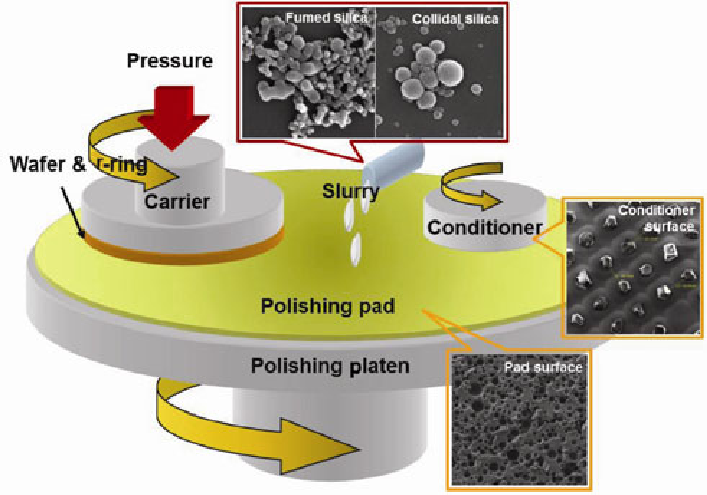
CMP System Components
A complete CMP process consists of:
- Polishing platen
- CMP polishing pad
- Downforce and carrier head
- Slurry delivery system
- CMP slurry
Among these, CMP slurry is the only component that simultaneously influences chemistry, mechanics, and defect formation.
How CMP Slurry Works: Chemical and Mechanical Interaction
The effectiveness of CMP slurry arises from the synergistic interaction between chemical reactions at the wafer surface and mechanical forces applied by abrasive particles.
Chemical Action
The chemical components of CMP slurry initiate surface reactions that modify the mechanical properties of the wafer material. Examples include:
- Oxidation of copper to form softer copper oxide layers
- Hydration of silicon dioxide networks
- Formation of passivation layers to control selectivity
These reactions are carefully controlled through oxidizer concentration, pH, and complexing agents.
Mechanical Action
Once the surface layer is chemically modified, abrasive particles embedded in the slurry mechanically remove the reacted layer through shear forces generated by pad asperities.
The removal is not a bulk abrasion process. Instead, it is a repeated cycle of:
- Surface reaction
- Mechanical detachment
- Fresh surface exposure
This cycle occurs thousands of times per second across the wafer surface.
Functions of CMP Slurry in Wafer Polishing
CMP slurry performs multiple critical functions simultaneously. Treating it as a single-purpose consumable is a common but costly misconception.
Primary Functions
- Enable controlled material removal rate (MRR)
- Maintain planarization efficiency
- Control selectivity between different materials
- Suppress corrosion and galvanic reactions
- Minimize surface defects and scratches
Material Removal Rate Control
MRR is influenced by slurry chemistry, abrasive concentration, particle size, and interaction with pad properties. Typical MRR targets range from tens to hundreds of nanometers per minute depending on application.
Defect Control
CMP slurry formulation directly affects defect modes such as:
- Micro-scratches
- Pitting and corrosion
- Particle-induced defects
This is why slurry filtration and stability are critical topics, discussed in detail in
CMP Slurry Filtration.
Typical Applications of CMP Slurry
CMP slurry is used across multiple process layers in semiconductor manufacturing. Each application imposes unique requirements on slurry formulation.
Oxide CMP Applications
- Interlayer dielectric (ILD) planarization
- Shallow trench isolation (STI)
- Pre-metal dielectric smoothing
Metal CMP Applications
- Copper interconnect planarization
- Tungsten plug removal
- Aluminum metallization
Metal-focused formulations are covered in:
CMP Slurry vs Conventional Polishing Compounds
A frequent misunderstanding is equating CMP slurry with traditional polishing compounds used in optics or metal finishing. This comparison is fundamentally flawed.
| Aspect | CMP Slurry | Conventional Polishing Compound |
|---|---|---|
| Chemical Activity | High, process-specific | Minimal or none |
| Particle Size | Nanometer scale | Micron scale |
| Process Control | Tightly controlled | Operator dependent |
| Defect Sensitivity | Extremely high | Low |
Key CMP Slurry Process Parameters
Understanding what CMP slurry is also requires understanding how it is controlled in production.
Critical Parameters
- pH (typically 2–11 depending on application)
- Abrasive concentration (wt%)
- Oxidizer concentration
- Slurry flow rate
- Temperature
Deviations in these parameters can lead to unstable removal rates and defect excursions.
Common Misunderstandings About CMP Slurry
“CMP Slurry Is Just an Abrasive”
This misconception ignores the dominant role of chemistry in CMP processes.
“Higher Removal Rate Is Always Better”
Excessive MRR often increases dishing, erosion, and defectivity.
“One Slurry Fits All Processes”
Modern semiconductor manufacturing requires highly specialized slurry formulations.
CMP Slurry Within the Complete CMP Ecosystem
CMP slurry cannot be optimized in isolation. It must be evaluated as part of a complete CMP ecosystem involving:
- Pad material and conditioning
- Tool architecture
- Filtration systems
- Post-CMP cleaning
For a comprehensive engineering-level treatment of CMP slurry across all applications, refer to the pillar page: