What Is Polishing Slurry? A Complete Guide to CMP Slurry Composition, Types & Selection
Polishing slurry is the chemical and mechanical heart of every modern wafer-finishing process. This guide from JEEZ explains what a polishing slurry is, how CMP slurry works, the abrasive and chemical systems behind it, how to select the right formulation for copper, tungsten, oxide and polysilicon, and how to qualify and multi-source a reliable supplier.
What Is Polishing Slurry?
A polishing slurry is a precisely engineered liquid in which fine abrasive particles are suspended in a chemically active solution. When applied between a rotating polishing pad and a workpiece, the slurry removes material through the simultaneous action of mechanical abrasion and chemical reaction, producing surfaces that are flat, smooth and defect-controlled at the nanometre scale.
In the semiconductor industry the term is most often used to mean CMP-Schlamm — the consumable that drives Chemical Mechanical Planarization (CMP), the process that flattens each successive layer of a wafer so that the next layer can be patterned correctly. But polishing slurries are also indispensable in optics, sapphire substrates, hard disk media, advanced packaging and precision glass, anywhere a surface must be brought to an exacting finish.
What separates a polishing slurry from a simple abrasive paste is balance. The chemistry softens, oxidises or dissolves the surface so that the abrasive can shear it away cleanly, while the abrasive provides the controlled mechanical contact that keeps removal uniform. Get that balance right and you achieve high removal rates with low defectivity; get it wrong and you see scratches, dishing, erosion or unstable, drifting performance. For the underlying mechanism in detail, see our explainer on how CMP slurry works.
A polishing slurry = abrasive particles (silica, ceria, alumina or diamond) + a chemical system (oxidisers, complexing agents, pH buffers, dispersants, inhibitors) + a carrier fluid (ultrapure or deionised water), formulated for a specific material and process target.
How CMP Slurry Works
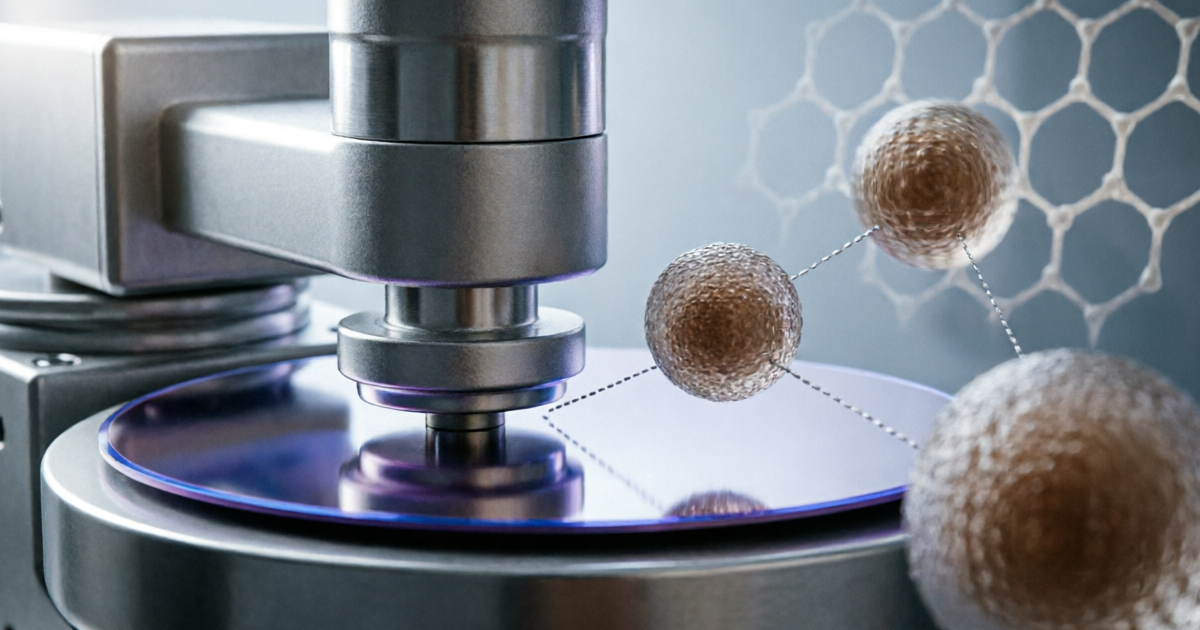
CMP works by pressing a wafer face-down against a polishing pad while slurry is continuously fed onto the pad surface. The wafer and the pad rotate, and downforce presses the high points of the wafer topography into contact with abrasive particles trapped between the wafer and the pad asperities. Because the raised features experience the highest local pressure, they are removed faster than the recessed areas — and the surface progressively planarises.
The “chemical” half of the process is what makes CMP so powerful. Rather than relying on brute mechanical grinding, the slurry chemistry continuously modifies the topmost atomic layer of the surface — oxidising a metal, hydrating an oxide, or forming a soft, easily removed reaction product. The abrasive then shears away only this modified layer, leaving the bulk material untouched. This synergy delivers the global flatness, low surface roughness and tight defect control that downstream lithography demands.
Three variables dominate the result: the removal rate (how fast material is taken off), the selectivity (the ratio of removal between two different materials, which protects stop layers), and the planarisation efficiency (how well high features are removed relative to low ones). Every formulation is a deliberate trade-off between these. A deeper, step-by-step walkthrough of the contact mechanics and chemistry lives in our companion article on how CMP slurry works.
CMP Slurry Composition
Although a finished slurry looks like a simple milky liquid, it is a tightly controlled multi-component system. Each ingredient is there to push one of the three performance levers — rate, selectivity or defectivity — without disturbing the others. Understanding the building blocks is the first step to selecting or troubleshooting any slurry; our full breakdown is in CMP slurry composition explained.
The core ingredients
- Abrasive particles. The mechanical workhorse — typically colloidal or fumed silica, cerium oxide, alumina or, for the hardest substrates, diamond. Particle size, distribution and purity govern both removal rate and scratch risk.
- Oxidisers. For metal CMP, oxidisers such as hydrogen peroxide convert the metal surface into a softer oxide that the abrasive can clear. Oxidiser type and concentration are primary tuning knobs for removal rate.
- Complexing and chelating agents. These bind dissolved metal ions, control etch behaviour and help set the static-etch-versus-mechanical balance that determines dishing and corrosion.
- Corrosion inhibitors. Film-forming additives that protect recessed metal from static etch, which is critical for copper interconnect integrity.
- Dispersants and surfactants. Polymeric additives that keep abrasive particles separated and the slurry stable over its shelf life, preventing the agglomeration that causes scratches.
- pH buffers. Surface charge, particle stability and reaction rates are all pH-dependent, so buffering holds the slurry in its designed operating window.
- Ultrapure water. The carrier and the largest component by volume — its purity directly affects defectivity.
No single ingredient acts alone. Raising an oxidiser to boost rate can change pH, shift particle charge and accelerate static etch — which is why reformulating a slurry is never a one-variable exercise and why supplier-side process control matters so much.
Abrasive Types Compared: Silica, Ceria, Alumina & Diamond
The choice of abrasive is the single most defining decision in a slurry formulation, because it sets the baseline for hardness, chemical reactivity, achievable finish and cost. The four families below cover the overwhelming majority of polishing slurries on the market today; for a side-by-side technical comparison see silica vs ceria vs alumina vs diamond slurry.
| Abrasivmittel | Typical hardness | Best-fit applications | Key characteristic |
|---|---|---|---|
| Colloidal / fumed silica | Mäßig | Metal CMP, silicon & polysilicon, final polish | Versatile, low-defect, highly tunable |
| Cerium oxide (ceria) | Mäßig | Oxide / dielectric CMP, glass, STI | High chemical affinity for oxide; excellent planarisation |
| Tonerde | Hoch | Hard metals, certain barrier & optical work | Aggressive removal; requires defect management |
| Diamond | Highest | Sapphire, SiC, ultra-hard substrates | Cuts the hardest materials; premium cost |
Because diamond and the harder oxides are chemically less reactive, formulators increasingly pair them with engineered surface chemistries to lift removal efficiency without raising scratch risk. The practical takeaway: match the abrasive’s hardness and chemistry to the substrate, not the other way around.
Types of CMP Slurry by Application
In semiconductor manufacturing, slurries are usually named after the material they planarise. Each material presents a different chemistry challenge, so the formulations diverge sharply even when they share the same abrasive family. Below are the four workhorse categories, each with a dedicated selection guide.
Copper CMP slurry
Copper interconnects are formed by the damascene process, then planarised to remove the overburden and expose the dielectric. The slurry must oxidise copper, protect recessed lines from static etch with inhibitors, and control dishing and erosion at the same time. Barrier-removal steps add a further selectivity requirement against tantalum or cobalt. See our dedicated copper CMP slurry selection guide.
Tungsten CMP slurry
Tungsten plugs and local interconnects demand high, stable removal rates with a peroxide-based oxidiser system and excellent dispersion stability. Because tungsten and the surrounding oxide behave very differently under the slurry, selectivity tuning is central to topography control. The full treatment is in our tungsten CMP slurry selection guide.
Oxide & dielectric (ceria) slurry
Interlayer dielectric and bulk oxide removal rely heavily on cerium-oxide chemistry, which has a strong chemical affinity for silicon dioxide and delivers outstanding step reduction and planarisation. Tight particle-size control keeps defectivity low on these large-area films. Read more in the oxide and dielectric ceria CMP slurry guide.
Polysilicon & STI slurry
Shallow Trench Isolation and polysilicon steps require carefully balanced selectivity — often using a stop on nitride — so that the process self-terminates at the right depth across the whole wafer. These slurries reward precise removal-rate control over raw speed. Details are in the polysilicon and STI CMP slurry guide.
Stability, Defectivity & Quality
A slurry that performs beautifully on day one is worthless if it drifts in the tank or on the shelf. Slurry stability — the ability of the abrasive to stay uniformly dispersed without agglomerating or settling — is one of the most important and most underestimated properties of any polishing slurry.
When particles begin to agglomerate, the effective particle-size distribution changes, large-particle counts climb, and the very defects CMP is meant to remove start appearing as scratches. Subtle shifts in pH, temperature, shear or contamination can all trigger it. This is why high-purity raw materials, controlled manufacturing and disciplined storage and handling matter as much as the recipe itself. We cover the failure modes and how to guard against them in CMP slurry stability and particle agglomeration.
How to Select the Right CMP Slurry
Choosing a slurry is a structured engineering decision, not a catalogue pick. The right starting point is always the material being polished and the process target, then a disciplined narrowing from there. A practical, step-by-step framework is laid out in how to select a CMP slurry by material and process; the essentials are:
- Define the material and the stop layer. Copper, tungsten, oxide or polysilicon each map to a different chemistry family and selectivity requirement.
- Set your removal-rate and uniformity targets. Throughput goals must be balanced against within-wafer and wafer-to-wafer uniformity.
- Bound your defectivity budget. Scratch and residue limits often decide between two otherwise-similar slurries.
- Confirm pad and conditioner compatibility. The slurry is one part of a consumable set; it must work with the pad and post-CMP clean.
- Model the total cost, not the litre price. Consumption rate, dilution and yield impact usually outweigh unit cost.
Beyond Semiconductors: Other Polishing Slurry Applications
While CMP dominates the conversation, polishing slurries are equally critical across precision optics and advanced substrates — and the formulation principles carry directly across.
- Optical glass & lenses. Fine ceria and silica slurries deliver the low roughness and figure accuracy that lenses and fibre optics require — see polishing slurry for optical glass and lenses.
- Sapphire substrates. Sapphire’s extreme hardness demands engineered, often diamond- or colloidal-silica-based systems, covered in our sapphire substrate polishing slurry guide.
- Advanced packaging & TSV. Through-silicon vias and heterogeneous integration introduce thick-copper and dissimilar-material polishing challenges, addressed in CMP slurry for advanced packaging and TSV.
CMP Slurry Cost of Ownership
The price per litre is one of the least useful numbers when comparing slurries. What actually drives cost is the total cost of ownership: how much slurry is consumed per wafer, the achievable removal rate and throughput, dilution ratios, defect-driven yield loss, and the downstream cost of rework or scrap. A slurry that costs more per litre but removes faster, lasts longer in the loop and protects yield is frequently the cheaper option in production. We break the full model down in CMP slurry cost of ownership.
Choosing & Qualifying a Slurry Supplier
As of June 2026, the CMP consumables market has grown noticeably more concentrated following several large supplier mergers. For fabs, that concentration has sharpened the need for resilient, multi-source supply strategies — and created real opportunity for qualified alternative suppliers who can match technical performance with supply-chain stability.
Three companion resources cover the supplier dimension end to end. Start with the landscape in our top CMP slurry manufacturers and suppliers guide. Then, to de-risk a single-source dependency, read alternative and multi-source CMP slurry supplier strategy. Finally, when you are ready to bring a new vendor online, our checklist on how to qualify a new CMP slurry supplier walks through the audits, sampling and performance benchmarks that protect a production line.
JEEZ — Jizhi Electronic Technology Co., Ltd. — supplies high-precision surface-processing materials including polishing slurries, polishing pads and semiconductor dicing blades, with a focus on the reliability and consistency that critical manufacturing steps demand. For engineering teams building a multi-source strategy, we offer a qualified, technically grounded alternative across several application segments.
The Complete Polishing Slurry Library
Every topic in this guide expands into a dedicated, in-depth article. Use the library below to dive straight into the area you need.
Häufig gestellte Fragen
What is the difference between polishing slurry and CMP slurry?
They overlap heavily. “Polishing slurry” is the broad term for any abrasive-in-liquid system used to refine a surface, across optics, glass, metals and semiconductors. “CMP slurry” specifically means a polishing slurry engineered for Chemical Mechanical Planarization of semiconductor wafers, where chemical surface modification and mechanical abrasion are tightly balanced. Every CMP slurry is a polishing slurry, but not every polishing slurry is built for CMP.
What is polishing slurry made of?
A polishing slurry combines abrasive particles (silica, ceria, alumina or diamond), a chemical system (oxidisers, complexing agents, corrosion inhibitors, dispersants and pH buffers) and a high-purity carrier fluid, usually ultrapure water. The exact recipe is tuned to the material being polished. See our full composition guide.
Which abrasive should I choose — silica, ceria, alumina or diamond?
It depends on the substrate. Silica is the versatile default for metals and silicon; ceria excels on oxide and glass; alumina handles harder metals aggressively; diamond is reserved for the hardest substrates such as sapphire and silicon carbide. Our abrasive comparison covers the trade-offs in detail.
How do I select the right CMP slurry for my process?
Start from the material and stop layer, set removal-rate, uniformity and selectivity targets, define your defectivity budget, confirm pad and clean compatibility, and evaluate total cost of ownership rather than unit price. The full framework is in how to select a CMP slurry by material and process.
Why does slurry stability matter so much?
If abrasive particles agglomerate or settle, the effective particle-size distribution changes during use, large-particle counts rise and scratches appear — degrading exactly the surface quality CMP is meant to deliver. Stable raw materials, controlled manufacturing and correct handling are essential. More in slurry stability and particle agglomeration.
How do I qualify an alternative or second-source slurry supplier?
Qualification combines supplier audits, controlled sampling and head-to-head performance benchmarking against your incumbent on rate, uniformity, selectivity and defectivity, plus supply-chain and quality-system due diligence. Our checklist on qualifying a new CMP slurry supplier and the multi-source strategy guide cover the full process.
Talk to the JEEZ slurry engineering team
Whether you are selecting a first slurry, optimising removal rate and defectivity, or building a resilient multi-source supply strategy, JEEZ — Jizhi Electronic Technology Co., Ltd. — can help you match the right polishing slurry to your material and process targets.
Contact JEEZ →Part of the JEEZ Polishing Slurry knowledge series. Reviewed and updated June 2026 by Jizhi Electronic Technology Co., Ltd.