CMP Process Defects: Causes, Types & Solutions

公開日: 2026年4月30日ビュー202
JEEZ Technical Guide · CMP Defects

A complete engineering reference for identifying, characterizing, and eliminating the most common CMP yield-limiting defects — scratches, dishing, erosion, delamination, corrosion, particles, and metal contamination — with root cause analysis frameworks and corrective action roadmaps.

📅 Updated April 2026 ⏱ Reading time: ~20 min ✍️ JEEZ Technical Editorial Team
← Back to CMP Materials: The Complete Guide

1. The Impact of CMP Defects on Yield and Reliability

CMP-related defects represent one of the largest single categories of yield loss events in semiconductor manufacturing. Unlike lithography or etch defects, which tend to be spatially random and process-event-driven, CMP defects often have systematic components — patterns related to wafer position, pattern density, or polishing time — that make them simultaneously easier to diagnose and harder to eliminate because they require changes to the fundamental process rather than simple equipment maintenance.

The consequences of CMP defects range from immediate yield loss (short-circuiting or opening metal features, causing functional failures at electrical test) to latent reliability degradation (sub-threshold scratch damage that creates preferential corrosion or electromigration paths under device operating conditions) to contamination-induced long-term device degradation (metal ions from CMP that diffuse into active device regions and create trap states or pn-junction leakage).

15–30%
Estimated fraction of total fab yield loss attributable to CMP-related defects
>50%
Of CMP defects preventable through slurry and pad selection optimization alone
<1 ppb
Maximum allowable Cu contamination on FEOL wafer surfaces
0
Acceptable deep scratches (>100 nm depth) per wafer in advanced-node production

2. Scratches: The Most Common CMP Defect

Surface Scratches
CRITICAL — Immediate yield loss risk

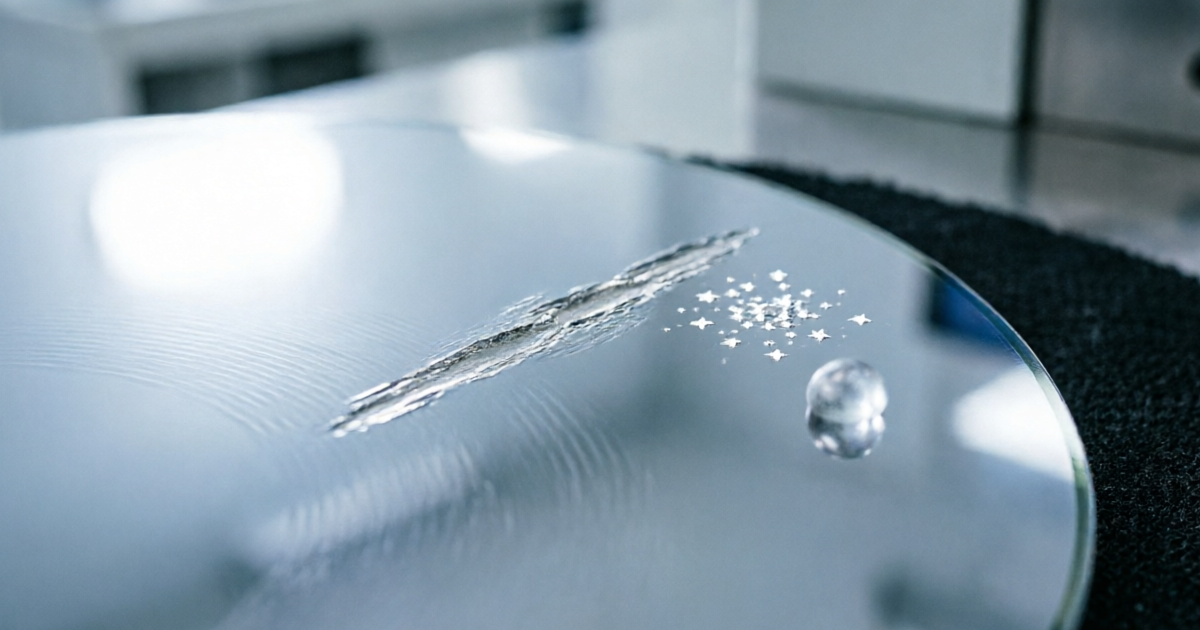
Scratches are elongated mechanical damage features on the wafer surface caused by abrasive contact events that exceed the fracture toughness of the surface film. They range from shallow micro-scratches (5–30 nm deep, detectable by bright-field inspection) to deep fatal scratches (50–500+ nm deep, visible under conventional optical inspection) that immediately open or short interconnect features.

Scratch Root Causes and Mechanisms

Root CauseMechanismDetection MethodPrimary Solution
Oversized abrasive particlesSingle large particle (D99 tail) creates a deep groove across the wafer surfaceDLS particle size measurement; wafer defect inspection (KLA/Hitachi)Tighten incoming PSD spec; add 0.1–0.2 µm POU filter
Particle agglomerationMultiple small particles aggregate into a large cluster that acts as a single oversized abrasiveDLS measurement after mixing; in-line turbidity monitor at POUCheck POU mixing compatibility; verify slurry temperature; avoid electrolyte contamination
Diamond shedding from conditionerDetached diamond grit from conditioner disc enters slurry stream and causes catastrophic deep scratchPost-polish inspection; deep scratch cluster pattern indicates single point sourceReplace conditioner disc; inspect and flush slurry lines; run dummy wafers
パッドの破片Chunks of pad material detached by over-aggressive conditioning break off and scratch waferWafer defect inspection; pad surface visual inspectionReduce conditioner downforce; inspect pad for delamination; reduce polish pressure
Hard particle contamination (tool)Metal particles from tool components (bearings, platen), dried slurry, or pad debris accumulate and cause scratch eventsDefect review SEM; energy-dispersive X-ray (EDX) for particle compositionRegular tool maintenance and cleaning; slurry line flush schedule; wafer edge exclusion inspection
Insufficient lubricationSlurry starvation or insufficient DI water leads to dry-contact friction eventsMonitor platen friction current (torque) for spikes; check slurry flow rateIncrease slurry flow rate; verify POU dispensing nozzle condition; inspect pad grooves for clogging
⚠️
Critical distinction: A sudden increase in scratch count from a previously stable process almost always indicates a single root cause change — a new slurry lot with different PSD, a conditioner disc reaching end of life, a tool maintenance event that introduced contamination, or a process parameter drift. Treat a scratch count spike as an alarm requiring immediate root cause investigation, not a normal process variation to be averaged over time.

3. Dishing: Metal Over-Removal in Wide Features

🔵
Copper / Metal Dishing
HIGH — Resistance increase, reliability risk

Dishing refers to the concave depression formed in metal features (most commonly copper) after CMP, where the metal surface is recessed below the surrounding dielectric surface. It occurs because the CMP process preferentially removes the softer, unprotected metal surface in wide features where the passivation inhibitor film cannot be maintained uniformly.

Physics of Copper Dishing

In copper CMP, the BTA (benzotriazole) inhibitor forms a thin passivation film on copper surfaces that protects them from chemical attack. In wide copper features (typically >10 µm), the pad can conform into the feature during polishing, making direct contact with the copper surface even after the surrounding dielectric has been exposed. At this stage, the continued mechanical contact with the pad removes the BTA film from the copper center, allowing the chemical oxidizer to attack the unprotected surface and creating a dished profile.

  • Slurry factors: High oxidizer concentration accelerates dishing by increasing the chemical etch rate on unprotected copper. Insufficient BTA concentration reduces passivation film stability. Slurry with high silica abrasive aggressiveness mechanically removes BTA faster than it reforms.
  • Pad factors: Soft pads conform more deeply into wide features, increasing dishing. Hard pads maintain a more planar contact surface, reducing dishing — but at the cost of higher downforce on narrow feature edges.
  • Process factors: Over-polishing (excessive time beyond endpoint) is the most direct cause of dishing. Tight endpoint control using in-situ optical reflectance or eddy-current monitoring is the most effective single-parameter correction.

Acceptable dishing limits by node: At 28 nm and above, Cu dishing of 20–30 nm in wide features is typically acceptable. At 10 nm and below, the limit tightens to 10–15 nm. For hybrid bonding layer CMP, Cu dishing must be below 5 nm — requiring a fundamentally different process approach (ultra-low force, extended buff steps) compared to conventional copper BEOL.


4. Erosion: Pattern-Density-Driven Dielectric Loss

🌊
Dielectric Erosion
HIGH — Overlay budget impact, reliability

Erosion is the thinning of the dielectric film in areas of high metal pattern density. In dense metal array regions, the local effective hardness of the CMP surface is lower (due to the mixture of soft copper and hard oxide), causing the polishing pressure to be distributed differently than in sparse or isolated feature regions. The result is faster dielectric removal in dense areas than in sparse areas — leaving a topographic variation across the die that degrades overlay in subsequent lithography steps.

Erosion vs. Dishing: Distinguishing the Two Defects

Dishing and erosion are often discussed together but are distinct in both their physical mechanism and their measurement methodology. Dishing is measured as the height difference between the metal surface center and the adjacent dielectric surface — it is a feature-level metric. Erosion is measured as the thickness reduction of the dielectric in a pattern array region compared to an isolated dielectric region — it is a pattern-density-level metric. Both contribute to the total height variation across the die, and both must be independently controlled within specification.

Solutions for Erosion Control

  • Increase slurry selectivity (Cu:oxide ratio): A higher Cu:SiO₂ removal rate ratio in the Step 2 barrier slurry reduces the amount of oxide removed per unit of barrier metal cleared, directly reducing erosion.
  • Optimize pattern density with dummy fill: CAD layout tools can insert electrically isolated copper or dielectric dummy fill structures to normalize the local pattern density across the die, reducing the density-dependent removal rate variation that drives erosion.
  • Reduce over-polish time: Erosion grows approximately linearly with over-polish time after endpoint. The same endpoint optimization that reduces dishing also reduces erosion.
  • Use harder pad: Harder pads are less sensitive to the local pattern density because they maintain a more uniform contact pressure regardless of what lies below the surface. This reduces the pattern-density dependence of the removal rate and therefore reduces erosion.

5. Delamination: Structural Failure in Low-k Films

💥
Film Delamination
CRITICAL — Wafer scrap risk

Delamination is the complete or partial separation of a film layer from the underlying surface during CMP, caused by shear or tensile stress that exceeds the interfacial adhesion energy. It is most common in ultra-low-k (ULK) dielectric films and in advanced packaging structures where dissimilar materials are bonded through thin adhesive or dielectric interlayers. Delamination events can propagate laterally across the wafer during polishing, creating large-scale yield loss events.

Mechanical Model of CMP-Induced Delamination

During CMP, the wafer surface experiences both a normal force (compressive, from the pad downforce) and a tangential shear force (from the relative motion between pad and wafer). For conventional oxide and metal films, the shear stress generated during polishing is well below the interfacial fracture energy. For ultra-low-k dielectric films with Young’s moduli of 2–5 GPa, however, the shear stress is amplified by the low stiffness of the film, and the interfacial adhesion energy (particularly at the ULK/etch-stop interface) can be insufficient to withstand polishing conditions that are routine for other film types.

Delamination Prevention Strategies

  • Reduce CMP downforce below the critical threshold: Process conditions for ULK CMP should keep the product of contact pressure and relative velocity (the Preston parameter) below the value where lateral shear stress exceeds the worst-case interfacial adhesion energy. Typical ULK CMP downforce targets are <1.5 psi (10 kPa).
  • Use ultra-soft polishing pads: Soft pads distribute the polishing force more uniformly and reduce peak shear stress at feature edges and pattern boundaries.
  • Improve film adhesion through process optimization: Deposition conditions (plasma treatment, interface adhesion layers, Cu seed layer thickness) affect the adhesion energy of the critical interface. Optimizing deposition in coordination with CMP process design is the most robust long-term solution.
  • Monitor acoustic emission during polishing: Some CMP tools offer acoustic emission monitoring that can detect the high-frequency signal associated with delamination events in real time, enabling immediate process stop and preventing full wafer loss.

6. Corrosion and Pitting: Electrochemical Attack

🔴
Galvanic Corrosion / Pitting
HIGH — Resistance increase, reliability degradation

Corrosion pitting in CMP occurs when the electrochemical potential difference between two dissimilar metals in contact (e.g., copper and TiN barrier, or cobalt and TiN) drives anodic dissolution of the more electrochemically active metal at their shared interface. The pits formed at these interfaces create localized resistance increases and stress concentration sites that degrade both immediate yield and long-term electromigration reliability.

Galvanic Corrosion at Cu/TaN and Co/TiN Interfaces

In copper CMP, the transition from Step 1 (bulk Cu removal) to Step 2 (barrier clearing) creates a period where both copper and barrier metal (TaN, TiN) are simultaneously exposed to the oxidizing slurry environment. The electrochemical potential difference between Cu and TaN drives galvanic dissolution of copper at the perimeter of each via or trench, creating the characteristic “cusp corrosion” or “moat” defects visible on cross-sectional TEM.

In cobalt CMP (used at 7 nm and below), the Co/TiN interface is similarly susceptible. Cobalt’s standard electrode potential is more negative than copper’s, making it even more susceptible to galvanic attack in oxidizing environments. This is why cobalt CMP slurry chemistry requires very carefully tuned Co-specific corrosion inhibitors — the azole compounds used for copper (BTA, TTZ) must be supplemented or replaced with inhibitors that form stable passivation films specifically on cobalt surfaces.

ソリューション

  • Increase corrosion inhibitor concentration in Step 2 / barrier slurry
  • Reduce oxidizer concentration to minimum effective level for barrier removal
  • Minimize the time the wafer spends in the transition between Step 1 and Step 2 conditions
  • For Co CMP: use Co-specific inhibitors; avoid slurry pH >7 which destabilizes Co passivation
  • Optimize post-CMP clean to remove slurry residues before they continue to chemically etch metal surfaces during wafer queue time

7. Residual Particles and Post-CMP Clean Failures

🔴
Post-CMP Particle Residues
HIGH — Downstream patterning yield loss

Residual slurry particles remaining on the wafer surface after CMP and post-CMP clean cause defects in subsequent lithography steps (particles acting as contact layer mask defects), dielectric constant increase (particles embedded in ULK film surfaces), and metal contamination (metal-oxide abrasive particles leaching ions into the device layer during thermal processing).

Post-CMP Clean Chemistry Compatibility

The effectiveness of post-CMP clean depends critically on the compatibility between the clean chemistry and the slurry residue chemistry. Key considerations:

  • pH of clean vs. slurry: Silica particles that are stable and well-dispersed at alkaline slurry pH can agglomerate and become difficult to remove if the post-CMP rinse drops the pH toward the silica isoelectric point (~pH 2). Post-CMP clean sequences should maintain the colloidal stability of residue particles (keeping them dispersed rather than agglomerated) until they are physically removed by brush scrubbing or megasonic energy.
  • BTA and organic inhibitor removal: BTA and similar azole inhibitors used in copper CMP form strongly adsorbed films on copper that resist water rinse alone. Removal requires alkaline clean chemistry (APM, dilute NH₄OH) or specific BTA chelating agents. Incomplete BTA removal can cause contact resistance increase and adhesion problems in subsequent dielectric deposition.
  • Megasonic frequency matching: Megasonic cleaning at 0.8–1.5 MHz effectively removes particles above ~50 nm through cavitation-assisted momentum transfer. For smaller particles (including silica fragments from CMP) and for feature geometries below 20 nm where megasonic cavitation can cause mechanical damage, lower-frequency or pulsed megasonic modes may be required.

8. Metal Contamination: The Silent Yield Killer

⚗️
Metal Ion Contamination
CRITICAL — Long-term reliability; FEOL yield

Metal contamination from CMP slurry or pad is one of the most insidious defect types because it is invisible to optical and electron-beam inspection but can catastrophically degrade device performance and reliability at concentrations below 10¹⁰ atoms/cm². Copper, iron, nickel, and chromium are the most damaging contaminants at the transistor level, where they create mid-gap trap states, increase junction leakage, and reduce minority carrier lifetime.

Sources of Metal Contamination in CMP

  • Slurry raw material impurities: Abrasive particles (particularly alumina from some sources) can contain iron, chromium, or nickel at ppm levels that are unacceptable for FEOL applications. Always verify slurry COA metal content against SEMI C standards for the relevant process level.
  • Metal dissolution from polished surface: Dissolved copper ions, cobalt ions, or barrier metal ions (Ta, Ti) from the polished wafer surface can adsorb onto other regions of the wafer surface if not promptly removed by dilution and post-CMP clean. Copper in particular diffuses rapidly in silicon at process temperatures and must be removed to sub-ppb surface concentrations by effective post-CMP DHF clean.
  • Tool hardware contamination: Stainless steel slurry delivery components can leach Fe and Ni ions into the slurry stream. Using all-PVDF or all-polypropylene slurry handling components eliminates this source.
  • Pad additives: Some pad formulations contain metal-containing curing agents or catalysts. Verify pad COA for metal extractables, particularly for FEOL gate CMP applications where iron contamination limits are in the sub-ppb range.

For slurry sourcing guidance covering metal purity requirements, see our discussion in the CMP Abrasives article.


9. Root Cause Analysis Framework for CMP Defects

When a new defect type or a defect count increase is detected at post-CMP inspection, a structured root cause analysis (RCA) approach minimizes the time to corrective action and reduces the risk of misdiagnosis.

RCA StepActionTools / Methods
1. Characterize the defectCollect full-wafer defect map; measure size, morphology, and spatial distributionKLA/Hitachi optical inspection; SEM review; defect classification (ADC)
2. Identify the defect signatureDetermine if defects are random, systematic (edge/center), or periodic (linked to tool rotation)Defect map overlay analysis; wafer-to-wafer correlation
3. Correlate with process eventsCheck maintenance logs, slurry lot changes, conditioner replacement history, recipe changesFMEA, change control records, SPC charts for MRR and WIWNU
4. Analyze defect compositionEDX/EDS on defect particles to identify chemical composition; determines if slurry-derived or tool-derivedSEM-EDX; ToF-SIMS for metal contamination; VPD-ICPMS for surface metals
5. Perform split experimentsTest individual process variables (new slurry lot, conditioner replacement, pad change) in isolation to identify the root cause variableDesigned experiment (DOE) on blanket wafers; one variable at a time (OVAT) for faster response
6. Implement and verify fixApply corrective action; verify defect count returns to baseline on multiple wafers before returning to full productionDefect inspection on 5+ wafers; statistical comparison to baseline

10. Systematic Defect Prevention Program

The most cost-effective approach to CMP defect management is prevention rather than detection and corrective action. A systematic defect prevention program for CMP should include the following elements:

  • Incoming material qualification: Establish receiving inspection specifications for every incoming slurry and pad lot that include PSD measurement (DLS), pH verification, metal impurity assay (spot-check by ICP-MS), and reference wafer MRR test. Reject lots that fall outside specification before they reach the tool.
  • Point-of-use filtration: Install 0.1–0.2 µm absolute-rated inline filters in all slurry delivery lines at the point of use. Filter performance should be verified monthly by measuring particle counts upstream and downstream of the filter.
  • Slurry line management: Establish a preventive maintenance schedule for slurry delivery lines including periodic full flush with DI water and inspection for biofilm, dried slurry deposits, and micro-crack formation that can shed particles into the stream.
  • Conditioner lifecycle management: Track conditioning hours per disc; implement proactive replacement at 80% of the maximum qualified lifetime; inspect disc surface under 10× loupe before installation to detect pre-existing diamond loss zones.
  • SPC on critical process outputs: Implement statistical process control on MRR, WIWNU, and post-CMP defect counts, with defined warning and control limits. Automated alarm on out-of-control conditions enables rapid response before significant yield impact accumulates.
  • Post-CMP clean optimization: Re-evaluate post-CMP clean effectiveness whenever the slurry formulation changes or a new device level is introduced. Clean effectiveness should be characterized by VPD-ICPMS for metal and by particle count at the post-clean inspection step.

JEEZ provides detailed application notes and process optimization guidance for defect reduction when our slurry and pad products are used. Contact our technical team for application-specific defect troubleshooting support.


11. FAQ

What is the most common cause of scratch defects in copper CMP?

In copper CMP, the most common scratch root causes in production are: (1) oversized or agglomerated particles in the slurry — particularly at the point-of-use mixing manifold where the slurry base contacts the H₂O₂ additive; (2) conditioner disc wear approaching end of life, increasing the risk of diamond particle shedding; and (3) dried slurry deposits in delivery lines that shed large flakes during high-flow-rate delivery events. POU filtration at 0.1 µm is the single most cost-effective countermeasure for all three root causes.

How do I distinguish between dishing and erosion on a polished wafer?

Dishing is measured by profilometry (AFM or stylus) across a single wide metal feature, measuring the height difference between the metal center and the adjacent dielectric surface. Erosion is measured by comparing the dielectric thickness in a dense metal array region (e.g., 50% or 70% density) to the dielectric thickness in a nearby isolated dielectric region, using ellipsometry or thin-film measurement. Both measurements should be taken at the same radius on the wafer to avoid conflation with radial MRR non-uniformity.

Can metal contamination from CMP be detected by standard wafer inspection tools?

Not directly. Metal contamination at levels of concern for device reliability (10⁹–10¹¹ atoms/cm²) is far below the detection limit of any optical or electron-beam inspection tool. The standard characterization methods are Vapor Phase Decomposition ICPMS (VPD-ICPMS), which collects and concentrates metal ions from the entire wafer surface for mass spectrometric analysis, and Total Reflection X-ray Fluorescence (TXRF), which provides non-destructive surface metal quantification. Both methods should be part of the CMP qualification protocol for any application where metal contamination is a concern.

What causes periodic scratch patterns on the wafer that look like arcs or rings?

Periodic arc-shaped scratch patterns are a classic signature of tool-related scratch sources rather than slurry-related sources. An arc-shaped scratch pattern typically results from a hard particle deposited on the pad surface at a fixed radial position, which then creates a scratch arc every time the wafer rotates over it. The radius of the arc corresponds to the radial distance of the contaminant particle from the platen center. The first step in root cause investigation for this pattern is a pad surface visual inspection for embedded hard particles, followed by slurry line inspection for dried slurry deposits at the dispensing nozzle.


CMP DefectsCMP ScratchesCopper Dishing CMP ErosionMetal ContaminationCMP Yield Post-CMP CleanJEEZ

Get Expert CMP Defect Troubleshooting Support

JEEZ application engineers provide hands-on defect troubleshooting support for processes using our slurry and pad products — including on-site visits, reference wafer testing, and root cause analysis documentation.

Request Defect Troubleshooting Support ← CMP Materials Complete Guide

この記事をシェアする

ご相談とお見積もり

ニュースレターを購読して最新情報を入手