Tungsten CMP Slurry Chemistry and Mechanism: How Oxidizers and Abrasives Work Together
When a tungsten CMP step produces inconsistent removal rates, surface staining, unexpected dishing, or a sudden spike in post-clean defect counts, the root cause traces almost invariably to the chemistry of the slurry rather than to a hardware or mechanical problem. Material Removal Rate (MRR) in tungsten CMP is not simply proportional to downforce and pad speed; it is the outcome of an interconnected electrochemical reaction chain that converts hard metallic tungsten into a soft, removable oxide at exactly the rate that suspended abrasive particles can clear it away. Engineers who understand this mechanism can diagnose process excursions at their source, optimize formulation variables methodically, and have far more productive conversations with slurry suppliers during qualification and troubleshooting.
This guide provides a comprehensive technical walkthrough of the tungsten CMP removal mechanism — from the primary oxidation reaction through the Fenton catalytic cycle to abrasive particle physics and the pH effects that govern the entire system. It covers practical diagnostics for identifying which phase is rate-limiting in your process, and explains how chemistry-driven defects originate and how slurry formulation choices prevent them.
1. Why Tungsten Resists Mechanical Polishing Alone
Metallic tungsten has a bulk hardness of approximately 7.5 to 8.0 GPa — placing it substantially harder than the inter-layer dielectric films that surround it in a semiconductor device structure and significantly harder than the copper or aluminum interconnect metals processed by CMP at other levels. If you attempted to remove tungsten overburden at production rates using only mechanical abrasion — even with hard alumina (Al2O3, Mohs 9) particles at elevated downforce — you would need contact pressures that generate catastrophic microscratch damage in the surrounding dielectric, penetrate through the TiN/Ti adhesion liner, and produce uncontrolled surface roughness incompatible with subsequent lithography steps. The hardness of tungsten, combined with the tight surface quality requirements of advanced device fabrication, makes purely mechanical material removal at production rates physically impractical.
The enabling insight that made tungsten CMP industrially viable in the 1990s was that metallic tungsten (hard, ~8 GPa) could be chemically converted to tungsten trioxide, WO3 (mechanically soft, ~1–2 GPa, and moderately water-soluble under acidic conditions) by a controlled oxidation reaction at the wafer surface. WO3 can be abraded and removed by SiO2 particles at the downforces used in standard CMP tools (1 to 5 psi), producing acceptable surface quality without damaging the surrounding dielectric or the TiN/Ti liner. The chemistry is therefore not an auxiliary feature of the process — it is the mechanism that makes tungsten CMP viable at all.
💡 Key Principle
Tungsten CMP chemistry does not merely assist mechanical abrasion — it enables it. Without chemical oxidation converting W to WO3 first, the mechanical step cannot achieve production-viable removal rates at surface quality levels compatible with advanced device fabrication.
2. The Two-Phase Removal Model
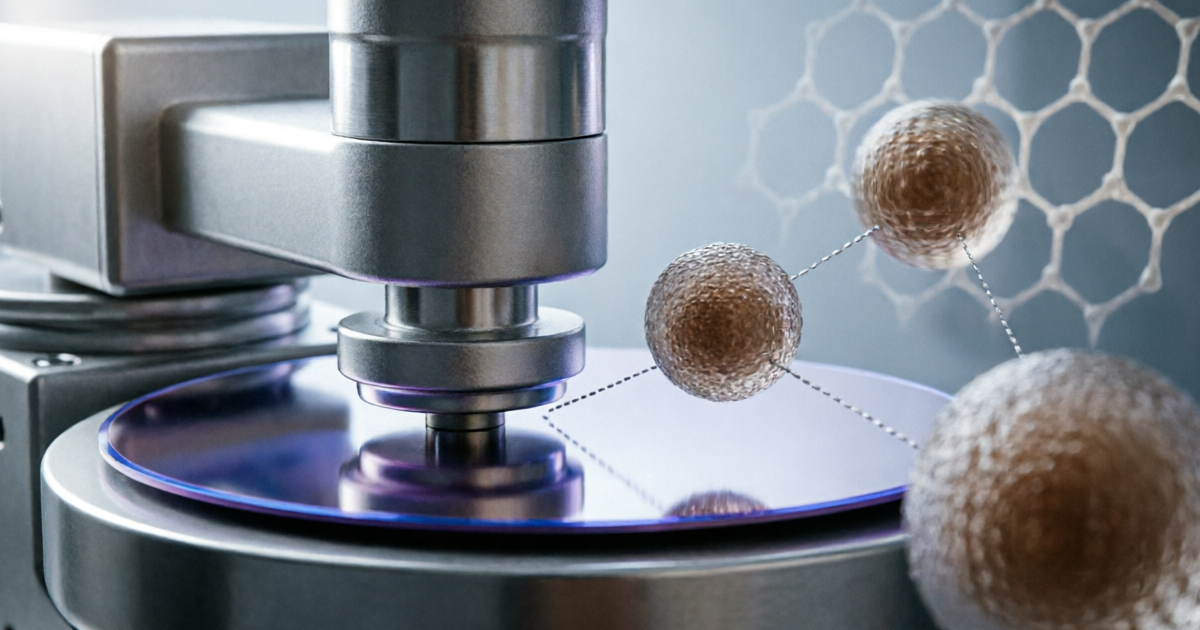
Tungsten CMP operates on a cyclical two-phase removal model in which chemical oxidation and mechanical abrasion act simultaneously and are coupled through the shared availability of WO3 at the tungsten surface. The overall model has three sequential sub-steps that repeat continuously during polishing:
- Chemical oxidation: Oxidizing agents in the slurry react with metallic tungsten at the wafer surface, forming a thin, continuous WO3 passivation layer.
- 機械的摩耗: Abrasive particles trapped between the polishing pad and wafer physically abrade and dislodge the WO3 layer from the surface.
- Dissolution and transport: Dislodged WO3 dissolves into the slurry’s aqueous phase and is swept away by hydrodynamic flow between pad and wafer, exposing fresh metallic tungsten for the next oxidation cycle.
The net MRR is governed by whichever phase is rate-limiting. Three operating regimes exist:
| Regime | Rate-Limiting Step | 症状 | Corrective Lever |
|---|---|---|---|
| Chemically limited | WO3 forms slower than abrasive removes it | Low MRR; elevated surface roughness; high friction coefficient | Increase oxidizer or catalyst concentration |
| Balanced (optimal) | Neither phase is limiting | Maximum MRR; good uniformity; low defect rate | Maintain current formulation |
| Passivation (mech. limited) | WO3 accumulates faster than abrasive removes it | MRR drops with increasing oxidizer; WO3 surface residue | Reduce oxidizer; increase abrasive loading or downforce |
Slurry formulation is fundamentally the exercise of placing the balanced operating point at conditions — downforce, rotation speed, temperature, flow rate — that are compatible with production CMP tool capabilities. The process window is widest and most stable when this balance point is well centered within the tool’s operating parameter space.
3. Hydrogen Peroxide: The Primary Oxidizing Agent
過酸化水素(H2O2) is present at 0.3 to 2.0 weight percent in virtually every commercial tungsten CMP slurry at the point of use. Its selection over alternative oxidizers reflects a favorable combination: low cost, high semiconductor-grade purity availability, high intrinsic oxidizing power (E° = +1.77 V vs. SHE in acidic conditions), benign decomposition products (H2O and O2), and compatibility with SiO2-based abrasive systems.
The primary oxidation of tungsten by H2O2 is simplified as:
⚛ Primary Oxidation Reaction
W(s) + 3 H2O2(aq) → WO3(s) + 3 H2O(l)
Metallic tungsten is converted to tungsten trioxide. WO3 is mechanically soft and slightly water-soluble under acidic conditions, making it abradable by SiO2 particles at standard CMP downforces.
The relationship between H2O2 concentration and tungsten MRR follows a characteristic non-linear curve with three distinct zones:
Sub-threshold zone (below ~0.1 wt%): Oxidation rate is insufficient to maintain a continuous WO3 layer. The abrasive contacts bare tungsten metal, friction spikes, and MRR is far below the mechanical capacity of the abrasive system. Surface roughness is elevated due to intermittent hard-on-hard contact.
Optimal zone (typically 0.5–1.5 wt%): WO3 forms at a rate matched to mechanical removal capacity. MRR is maximized for given process conditions. This is the formulation target.
Passivation zone (typically above 2.0–3.0 wt%): WO3 accumulates faster than abrasive removes it. The passivation layer thickens, limiting oxidant access to the tungsten below. MRR decreases with further oxidizer increase and surface residue may appear on post-CMP inspection.
Because H2O2 decomposes in the presence of metal ions, heat, and UV radiation, it cannot be pre-mixed with the abrasive slurry for extended periods. Commercial W CMP slurries using H2O2 are supplied as two-component (2C) systems: the abrasive dispersion (Component A) and the H2O2 solution (Component B) are stored and shipped separately, then blended at the polishing tool’s point-of-use mixing panel immediately before dispensing to the platen. Modern mixing panels achieve ±0.5% mixing ratio accuracy, providing consistent oxidizer concentration at the pad surface.
4. The Fenton-Type Catalytic Cycle: How Fe3+ Amplifies Oxidation
Even at optimal H2O2 concentrations, the direct reaction between molecular hydrogen peroxide and metallic tungsten is kinetically too slow to support the removal rates required in production (typically >1,500 Å/min for bulk tungsten removal). The universal solution — employed in virtually all commercial W CMP slurries since the 1990s — is the addition of ferric ions (Fe3+), most commonly as ferric nitrate (Fe(NO3)3), at concentrations of 10 to 100 parts per million.
Ferric ions participate in a Fenton-type catalytic cycle that generates hydroxyl radicals (·OH) from H2O2:
⚛ Fenton-Type Catalytic Cycle
Reaction 1: Fe3+ + H2O2 → Fe2+ + HO2· + H+
Reaction 2: Fe2+ + H2O2 → Fe3+ + ·OH + OH−
Iron is regenerated in this cycle (true catalyst). Hydroxyl radicals (·OH, E° = +2.80 V vs. SHE) are far more powerful oxidizers than H2O2 alone (+1.77 V), accelerating tungsten oxidation by 5× to 20×.
Catalyst loading optimization follows a well-characterized pattern that every slurry engineer should know:
- Below ~5 ppm Fe3+: Negligible Fenton enhancement; MRR close to uncatalyzed baseline.
- 10–50 ppm Fe3+: Strong catalytic enhancement; typical production window. MRR significantly above uncatalyzed baseline.
- Above ~100 ppm: Diminishing MRR return; increasing risk of Fe(OH)3 precipitation if pH exceeds ~3.5, generating hard contaminant particles that cause microscratch excursions indistinguishable from abrasive quality problems.
⚠ Critical Warning: Iron Precipitation
Fe(OH)3 precipitates as a rust-colored floc when slurry pH exceeds approximately 3.5 — even transiently, in dead zones of the slurry delivery system. These precipitates act as hard abrasive particles and generate microscratch counts that are often misattributed to abrasive quality problems. pH control and monitoring are the primary defense.
5. Abrasive Particles: The Mechanical Engine of CMP
While the chemical phases of the mechanism govern WO3 formation, the abrasive particles perform the physical work: abrading and dislodging the oxide layer. The physical properties of the abrasive — composition, particle size, size distribution, and surface chemistry — directly determine the mechanical removal rate, post-CMP surface roughness, and the type and density of surface defects generated.
Silicon dioxide (SiO2) is the dominant abrasive in tungsten CMP. Its Mohs hardness of approximately 7 is sufficient to abrade WO3 (hardness ~1–2 GPa) efficiently while being too soft to damage the tungsten metal or the surrounding dielectric with the severity that harder abrasives (Al2O3, Mohs 9) would produce at equivalent loading. Alumina abrasive does appear in some Step 2 (barrier) formulations where its higher hardness is needed to remove the TiN/Ti liner, but requires very careful downforce control.
The relationship between abrasive concentration and MRR follows a saturation curve:
- At low loading: MRR increases approximately linearly with abrasive concentration as more active abrasive contacts participate in WO3 removal.
- At saturation: The pad-wafer contact zone is fully occupied with active abrasive contacts; further increases in loading do not increase MRR.
- At excessive loading: Slurry viscosity increases, particle mobility decreases, and MRR may actually decline. Defect risk also increases from particle-particle interactions.
Typical production abrasive loadings are 1 to 10 wt% SiO2, with optimal loading determined empirically for each formulation and CMP tool configuration.
6. Fumed vs. Colloidal Silica: Performance Trade-offs
Synthesis: Flame hydrolysis of SiCl4
- Branched aggregate morphology; irregular shape
- Broad PSD with oversized-agglomerate tail
- Higher MRR per unit loading due to edge contact geometry
- Higher microscratch risk from large-particle tail
- Requires robust point-of-use filtration (0.2–0.5 μm)
- Lower cost per unit weight
- Preferred for cost-sensitive, less-critical applications
Synthesis: Wet-chemical precipitation (Stöber process)
- Spherical morphology; narrow, controlled PSD
- Minimal large-particle tail — better defect profile
- Lower MRR per unit loading vs. fumed at same concentration
- Superior lot-to-lot PSD consistency
- Preferred for advanced node applications (<65 nm defect budgets)
- Better surface finish and lower roughness after polishing
- Higher cost per unit weight; compensated by lower defect rework costs
The selection between fumed and colloidal silica is ultimately an engineering cost-of-ownership decision: fumed silica provides higher peak MRR at lower raw material cost, while colloidal silica reduces the defect-driven yield loss and rework cost that offset its higher purchase price at advanced nodes. Most leading-edge logic and memory applications specify colloidal silica for Step 1 bulk removal and colloidal silica or fine alumina for Step 2 buff.
7. pH: The Master Variable in Tungsten CMP Chemistry
The pH of the slurry at the point of polishing simultaneously controls four critical chemical behaviors: the rate of WO3 formation, the solubility of WO3 reaction product, the stability of the Fe3+ catalyst, and the colloidal stability of the abrasive particles. Standard W CMP slurries operate in the pH window of 2 to 4. This window is bounded at each end by critical chemical transitions:
| pH Zone | Chemical Behavior | Practical Effect |
|---|---|---|
| Below pH 2 | Very high H+ activity; aggressive tungsten dissolution at grain boundaries and defect sites | Corrosion pitting; abrasive flocculation risk; difficult SiO2 stabilization |
| pH 2–4 (optimal) | WO3 moderately soluble; Fe3+ stable; SiO2 zeta potential adequate for colloidal stability | Optimal MRR; low defect rate; stable slurry in delivery system |
| Above pH 4 | Fe(OH)3 begins precipitating; WO3 dissolution rate changes; abrasive zeta potential shifts | Iron particle contamination; microscratch excursions; unstable MRR |
pH drift during production use — from inadequate two-component mixing ratios, temperature changes in the slurry recirculation loop, or trace contamination in the delivery system — is one of the most common causes of unexplained MRR instability and microscratch excursions in production W CMP. Real-time pH monitoring at the polishing tool mixing panel is engineering best practice, and pH verification against the supplier’s Certificate of Analysis should be a standard incoming quality control check for every slurry delivery.
8. Balancing Chemistry and Mechanics: Identifying Your Operating Regime
Determining whether your process is operating in the chemically limited, balanced, or passivation regime requires only three simple diagnostic experiments, each performed by varying one parameter while holding all others constant:
Downforce response test: Increase polishing downforce by 20–30%. If MRR increases proportionally, the process is in the mechanically limited or balanced regime — chemistry is keeping pace. If MRR barely changes, the process is in the passivation regime — the thick WO3 layer is limiting abrasive-substrate contact.
Oxidizer concentration test: Increase H2O2 concentration by 25% while holding everything else constant. If MRR increases, you are in the chemically limited regime. If MRR stays flat or decreases, you are already at or beyond the balance point.
Catalyst loading test: Double the Fe(NO3)3 concentration (within the safe range ≤100 ppm). A significant MRR increase confirms chemical limiting; no MRR change confirms mechanical limiting.
By combining these three data points with the slurry supplier’s technical data package (which should include MRR vs. H2O2 concentration curves at standard process conditions), a process engineer can precisely locate the operating regime and identify the most efficient variable for optimization — without running large factorial experiments.
9. Chemistry-Driven Defects and How to Prevent Them
Several of the most prevalent defect types in tungsten CMP are caused directly by slurry chemistry variables rather than by hardware or mechanical factors. Recognizing these chemistry signatures is essential for rapid root-cause identification.
Corrosion Pitting
Localized over-oxidation at tungsten grain boundaries, crystallographic triple-junction points, or regions of high local pad contact pressure produces submicron-diameter hemispherical pits in the tungsten surface. Primary causes: excess H2O2 concentration, elevated process temperature (which accelerates H2O2 kinetics beyond the optimal rate), or excess Fe3+ generating high local radical concentrations. Prevention: operate oxidizer and catalyst concentrations at the lower end of the MRR plateau; monitor slurry temperature at the dispensing nozzle.
Iron Hydroxide Staining
Rust-brown surface haze or mottled contamination from Fe(OH)3 precipitation on the wafer surface, caused by pH excursions above ~3.5 in the slurry delivery loop, at the mixing panel, or in poorly stirred storage tanks. Confirmed by XRF or EDS detection of Fe signal on the wafer surface. Prevention: tight pH control in manufacturing, real-time pH monitoring in delivery, and fresh slurry use within validated shelf-life windows.
WO3 Surface Residue
Micro-residue haze from incomplete dissolution or re-precipitation of the WO3 reaction product. Causes: insufficient complexant (organic acid) concentration; pH conditions that reduce WO3 solubility; very high MRR generating WO3 faster than dissolution kinetics can transport it away. Resolved by increasing complexant loading or slightly reducing pH within the acceptable window.
Galvanic Micro-Corrosion at W/TiN Interface
The electrochemical potential difference between tungsten (more noble) and titanium nitride (less noble) drives galvanic corrosion at the W/TiN interface under conditions where the slurry chemistry does not maintain a continuous WO3 passivation layer uniformly across the wafer. Visible in post-CMP cross-section TEM as enhanced metal loss at the liner interface. Occurs most commonly at sub-threshold oxidizer concentrations in the chemically limited regime.
Related Guide — Defect Engineering
Dishing, Erosion, and Defects in Tungsten CMP: Root Causes and Slurry-Level Solutions
10. Practical Implications for Slurry Selection and Process Control
Understanding the tungsten CMP mechanism translates directly into a set of practical engineering guidelines for slurry selection, process setup, and ongoing quality management:
Two-component system is non-negotiable for H2O2-based slurries. Any supplier offering a pre-mixed, ready-to-use H2O2-containing tungsten CMP slurry in bulk quantities with a standard shelf life should be questioned on their stability data. Verify the mixing ratio accuracy of your point-of-use mixing system at least quarterly, or after any maintenance event on the mixing panel.
Specify and verify pH at incoming quality control and at the tool. Your slurry supplier’s Certificate of Analysis should include pH measured at a defined temperature (typically 23°C) with a tolerance of ±0.2 pH units. Verify this on incoming lots. Continuously monitor pH at the mixing manifold during production.
Characterize your abrasive PSD, not just the mean particle size. The defect-relevant metric is the large-particle tail (concentration of particles >1 μm, measured by single-particle optical sensing or laser diffraction with appropriate tail sensitivity). Request this data in the technical specification and set incoming acceptance limits.
Map your process to the three-regime framework before optimizing. The three diagnostic tests described in Section 8 take fewer than five wafers to execute and provide more actionable information than a large parameter sweep.
Track MRR stability over slurry shelf life. H2O2 concentration decreases over time in the delivered lot, even in separated two-component storage. Define and enforce use-by dates for both components, especially Component B (oxidizer), and verify MRR on a freshly mixed reference wafer if any component has been in on-tool storage for more than 72 hours.
Related Guide — Process Selection
Highly Selective vs. Low Selective Tungsten CMP Slurry: Which One Does Your Process Need?
Summary
Tungsten CMP chemistry is a coupled electrochemical-mechanical system in which H2O2 (accelerated by Fe3+ through the Fenton cycle) converts metallic tungsten to soft WO3, which is then mechanically removed by SiO2 abrasive particles. pH controls the stability of every component in this system. The process operates optimally when the chemical oxidation rate exactly matches the mechanical abrasion rate — identifying which phase is rate-limiting in your process is the first step in any MRR or defect optimization effort. Slurry-level defects (corrosion pitting, iron staining, WO3 residue) all trace to chemistry excursions and are preventable through systematic incoming quality control and process monitoring.
Discuss Your Tungsten CMP Process with JEEZ
Jizhi Electronic Technology Co., Ltd. (JEEZ) supplies tungsten CMP slurries with colloidal SiO2 abrasive, optimized Fenton catalyst loading, and tightly controlled pH for both bulk and barrier applications. Samples and full technical data packages are available for process qualification.
Request a Sample & Data Package Read the Complete W CMP Guide