ダイヤモンドダイシングブレード
Whether you’re singulating silicon wafers for advanced ICs, slicing SiC substrates for EV power devices, or cutting ceramic packages for RF modules, the performance of your dicing blade directly determines yield, throughput, and cost. This comprehensive guide covers everything process engineers, procurement specialists, and R&D teams need to know — from blade anatomy and bond types to troubleshooting chipping and extending blade life.
1. What Is a Dicing Blade?
A dicing blade — also called a dicing saw blade or diamond dicing wheel — is an ultra-thin abrasive cutting tool mounted on high-speed spindle dicing saws to singulate (dice) semiconductor wafers, substrates, packages, and other brittle electronic materials into individual chips or dies. The blades are typically made from a matrix of diamond abrasive particles bonded together by a metallic, resin, or electroformed binder, with outer diameters ranging from 50 mm to 76.2 mm and blade thicknesses as slim as 0.015 mm for the finest kerf requirements.
Dicing blades operate at spindle speeds of 20,000 to 60,000 RPM, making them among the most precisely engineered consumable tools in the semiconductor supply chain. Even minor deviations in diamond concentration, grit uniformity, or bond hardness can propagate into yield losses measured in fractions of a percent — which, at high-volume production scale, translates directly to significant revenue impact.
Beyond silicon, modern dicing blades are engineered to cut an expanding range of compound semiconductors, advanced ceramics, glass, and multi-layer laminates — each demanding a carefully optimised combination of bond type, diamond grit size, blade thickness, and process parameters.
2. How Dicing Blades Work
The cutting mechanism of a dicing blade is micro-fracture abrasion rather than shearing. As the blade spins at high RPM, exposed diamond grains on the rim contact the workpiece material. Each grain acts as a miniature cutting point that induces micro-cracks and removes material in the form of fine swarf. The effectiveness of this process depends on three interacting factors:
- Diamond exposure: The extent to which diamond grains protrude above the bond matrix determines cutting aggressiveness. A blade with excessive bond wear exposes too many grains (leading to premature blade failure), while a glazed or “loaded” blade has grains buried under debris and can no longer cut efficiently.
- Bond hardness: The matrix must wear away at a rate that continuously presents fresh, sharp diamond to the workpiece. A bond that is too hard retains worn diamonds; a bond that is too soft sacrifices blade life and dimensional stability.
- Coolant flow: Deionised water — or, more effectively, a formulated dicing coolant — performs multiple roles simultaneously: removing heat generated by friction, flushing swarf out of the kerf, lubricating the blade–workpiece interface, and preventing static charge buildup on sensitive devices.
Understanding this tripartite relationship between diamond, bond, and coolant is the foundation for all dicing process optimisation decisions discussed throughout this guide.
3. Types of Dicing Blades
Choosing the right blade type is the single most consequential decision in dicing process setup. The three principal bond types — resin, metal, and nickel (electroformed) — each offer distinct trade-offs in cutting quality, blade life, self-sharpening behaviour, and cost per cut.
3.1 Resin Bond Blades
Resin bond blades use a polymer-based matrix to hold diamond particles. The relatively soft nature of the resin binder promotes excellent self-sharpening behaviour: as the blade wears, worn diamonds are released and new sharp grains are exposed continuously. This makes resin bond blades the preferred choice for hard, brittle materials that would otherwise cause rapid glazing of harder bond systems.
Typical applications include silicon (Si) wafers, gallium arsenide (GaAs), lithium niobate (LiNbO₃), and ferrite ceramics. Resin bond blades generally produce lower cutting forces and superior surface finish on these materials, but their softer matrix means they wear faster and may not sustain tight kerf tolerances over long production runs without periodic blade dressing.
3.2 Metal Bond Blades
Metal bond blades use a sintered metallic matrix — typically a copper, tin, or cobalt alloy — to encapsulate diamond grains. The high bond hardness delivers excellent dimensional stability and long blade life, making metal bond blades the workhorse choice for high-throughput production lines cutting softer substrates such as glass, quartz, and alumina ceramics.
The trade-off is that metal bond blades require more aggressive dressing to maintain consistent diamond exposure, and they are more susceptible to loading (clogging) when cutting certain ductile materials. For very hard materials like silicon carbide, metal bond formulations must be carefully matched to avoid catastrophic blade failure from insufficient self-sharpening — this is discussed in detail in our SiC dicing best practices guide.
3.3 Nickel Bond (Electroformed) Blades
Electroformed nickel bond blades are manufactured through an electroplating process that deposits a precisely controlled layer of nickel matrix around diamond particles. This process enables the production of extremely thin blades (down to 0.015 mm) with very tight thickness tolerances (±0.002 mm), making them indispensable for fine-pitch dicing applications where kerf width is at a premium.
The single-layer diamond structure of electroformed blades means they have a fixed service life — once the diamond layer wears away, the blade cannot be redressed. However, their exceptional thinness, minimal lateral runout, and consistent geometry make them the blade of choice for QFN package singulation, flip-chip dicing, and LED wafer separation. Our dedicated article on QFN package dicing provides a detailed discussion of electroformed blade selection criteria for these applications.
3.4 Hub Type vs. Hubless (Washer) Type
Beyond bond chemistry, dicing blades are also classified by their mechanical mounting configuration. This structural distinction affects installation ease, flange compatibility, and ultimately, the types of dicing saws on which the blade can be used. Our detailed comparison of hub type vs. hubless dicing blades walks through flange matching, runout considerations, and how to select the correct configuration for DISCO, K&S, and other leading dicing platforms.
| 債券の種類 | 硬度 | Self-Sharpening | ブレード・ライフ | Best For |
|---|---|---|---|---|
| 樹脂ボンド | Soft | 素晴らしい | 中程度 | Si, GaAs, LiNbO₃, ferrite ceramics |
| メタルボンド | Hard | 低い | ロング | Glass, quartz, Al₂O₃, softer ceramics |
| Nickel Bond (Electroformed) | ミディアム | N/A (single-layer) | Fixed | Fine-pitch, QFN, LED, flip-chip |
4. Key Specifications Explained
Reading a dicing blade datasheet can be daunting without context. Our complete specifications guide provides a thorough breakdown, but the four most critical parameters are summarised below.
4.1 Outer Diameter (OD) and Inner Diameter (ID)
The OD determines cutting depth capacity. Standard values are 55.56 mm (2.187″) そして 76.2 mm (3.0″), with 55.56 mm being by far the most common for standard wafer dicing. The ID (bore size) must precisely match the spindle flange — typical bore sizes are 19.05 mm and 40 mm. Any mismatch results in runout and potential spindle damage.
4.2 Blade Thickness (T)
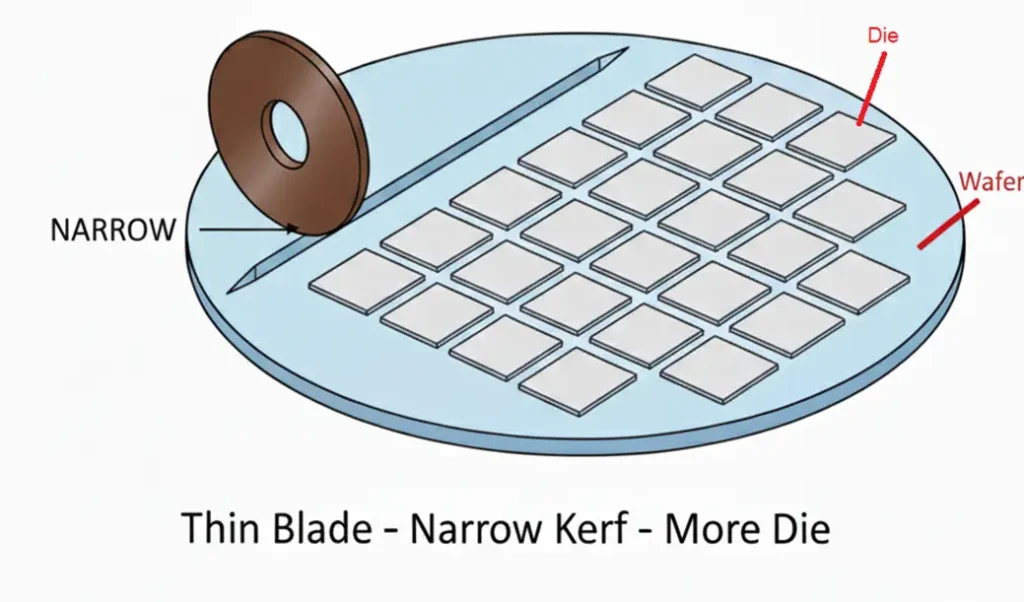
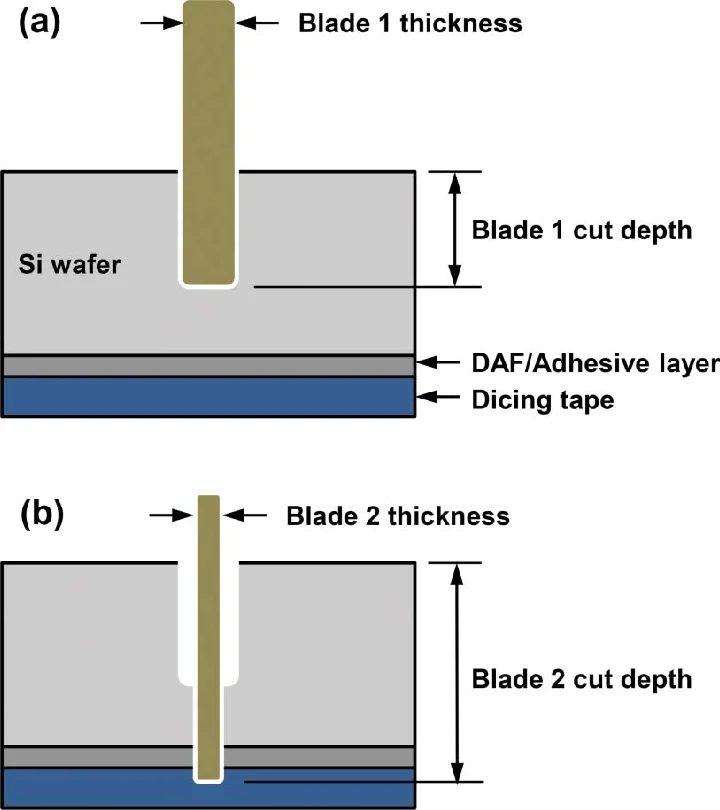
Blade thickness directly governs kerf width. Because the cut kerf is always slightly wider than the blade due to lateral diamond protrusion and blade wobble, a 0.200 mm blade typically produces a kerf of 0.210–0.225 mm. For dense die layouts where street width is constrained to 80 µm or less, blade thicknesses of 0.015–0.040 mm (electroformed) become essential.
4.3 Diamond Grit Size
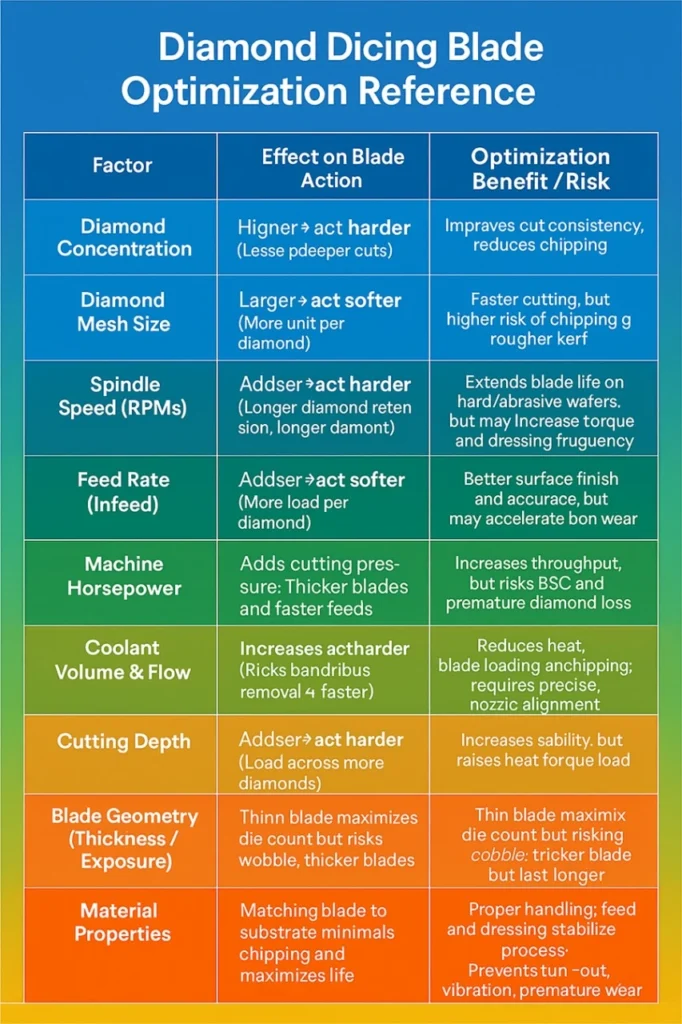
Expressed as mesh number (e.g., #320, #2000) or micron particle size, grit size governs the surface finish vs. cutting rate trade-off. Coarser grits (lower mesh numbers, larger particles) cut faster and last longer but generate more subsurface damage and chipping. Finer grits produce superior surface finish and lower chipping, but wear more quickly and may load faster on certain materials. Matching grit size to material hardness and the acceptable chipping budget is a core process engineering decision — discussed in depth in our blade specifications guide.
4.4 Diamond Concentration and Exposure
Diamond concentration (the volume percentage of diamonds within the bond matrix) influences both cutting efficiency and blade life. Blade exposure — how far the abrasive rim protrudes beyond the mounting flanges — must be carefully set relative to the wafer thickness plus tape thickness to ensure full singulation without grinding into the dicing tape adhesive, which causes blade loading.
5. Material Compatibility Guide
The semiconductor and electronics industry processes an increasingly diverse range of substrate materials, each presenting unique challenges to the dicing blade. Our material compatibility chart provides a comprehensive reference, but the table below summarises recommended blade strategies for the most common substrates.
| 素材 | モース硬度 | 主要課題 | Recommended Bond | Recommended Grit |
|---|---|---|---|---|
| ケイ素 (Si) | 6.5 | Brittle; subsurface cracking | 樹脂 | #600–#2000 |
| 炭化ケイ素(SiC) | 9.5 | Extreme hardness; rapid wear | Metal / Special Resin | #200–#600 |
| ガリウムヒ素(GaAs) | 4.5 | Soft, toxic dust; large chips | Resin (soft) | #800–#2000 |
| Sapphire (Al₂O₃) | 9.0 | Very hard; high wear rate | Metal / Resin hybrid | #320–#800 |
| Gallium Nitride (GaN on Si/SiC) | ~8.5 | Layered structure; delamination | Resin / Nickel | #600–#1200 |
| Glass (BK7 / Borosilicate) | 5.5–6.5 | Micro-cracks; edge quality | Metal / Resin | #400–#1200 |
| Quartz | 7.0 | Stress-induced cracking | メタル | #400–#800 |
| Alumina Ceramic (Al₂O₃) | 8.5–9.0 | Porosity; irregular wear | メタル | #200–#600 |
| LiNbO₃ / LiTaO₃ | 5.5 | Cleavage planes; thermal sensitivity | Resin (soft, fine) | #1200–#2000 |
| PCB / Organic Laminate | — | Fibre pull-out; delamination | Metal (fine) | #200–#400 |
| For custom or unusual materials, consult the Jizhi application engineering team for tailored blade recommendations. | ||||
6. The Wafer Dicing Process: An Overview
A thorough, step-by-step walkthrough of the entire workflow — from backside grinding through tape mounting, blade setup, cutting, and post-dice cleaning — is provided in our wafer dicing process guide for engineers. Here we provide a condensed overview to contextualise where the dicing blade fits within the broader process.
- Backside Grinding (BSG) / Thinning: The wafer is thinned to the target die thickness (commonly 50–300 µm) using a grinding wheel. Thinner die require finer-grit, lower-force dicing blades to avoid fracture.
- Tape Mounting (Frame Mounting): The thinned wafer is laminated onto a dicing frame tape. Tape type (UV-release, thermal-release, standard) must match the downstream die-attach process.
- Blade Installation & Flange Inspection: The dicing blade is mounted on the spindle with its matching flanges. Flange face flatness and cleanliness are checked; a new blade typically requires an initial dress pass.
- Kerf Check & Alignment: A short test cut is made and the kerf width and position are measured under the alignment microscope to verify blade geometry and alignment accuracy.
- Cutting: The dicing saw executes the programmed cut pattern at the selected spindle speed, feed rate, and cut depth. Coolant flows continuously throughout the cut.
- Post-Cut Inspection: Kerf width, chipping (front and back), and die edge quality are inspected — typically at intervals defined by the process control plan.
- Wafer Cleaning: Cut debris and coolant residue are rinsed from the diced wafer using DI water spray, followed by spin-dry or air-knife drying.
- Die Pick-Up: Individual dies are picked from the tape by a die ejector / pick-and-place system for subsequent assembly or test.
7. The Role of Coolant in Dicing — Why DI Water Is Not Enough
Many production facilities default to pure deionised (DI) water as their dicing coolant. While DI water satisfies the basic requirement of thermal cooling, it falls short in several critical performance dimensions that directly affect dicing yield and blade life. Our dedicated article on dicing coolant selection provides a comprehensive treatment; the key points are as follows.
Why Coolant Matters Beyond Cooling
The dicing zone generates localised temperatures that can exceed 200°C at the blade–workpiece interface during cutting of hard materials. At these temperatures, thermal shock becomes a significant source of subsurface cracking, particularly in brittle compound semiconductors. A properly formulated coolant additive:
- Reduces surface tension to improve wetting of the kerf and more effectively flush swarf from the cut zone.
- Provides boundary lubrication at the blade–chip interface, reducing cutting forces and heat generation.
- Inhibits static charge buildup on diced die surfaces, which can attract contamination particles during and after cutting.
- Controls foam to prevent impairment of camera vision systems and coolant flow sensors.
- Protects metal bond blades from corrosion, extending blade service life.
At Jizhi Electronic Technology, our polishing slurry and coolant additive formulations are engineered in coordination with our dicing blade products to ensure chemical compatibility across the full consumable system. Explore our dicing blade product range alongside our coolant solutions for a matched process package.
8. Blade Dressing and Conditioning
Blade dressing is the process of exposing fresh, sharp diamond grains by selectively eroding the bond matrix — either to initialise a new blade before first use, or to restore cutting performance when a blade has become glazed, loaded, or geometrically distorted during production. A complete step-by-step dressing protocol, including dresser board selection and parameter recipes, is provided in our blade dressing tutorial.
When Is Dressing Required?
- New blade initialisation: A new blade’s diamond grains are not yet properly exposed. An initial dress of 5–20 passes on a dedicated silicon dresser or alumina dresser board is essential before cutting production wafers.
- Blade loading: When swarf or workpiece material clogs the abrasive matrix, the blade stops cutting efficiently. Dressing exposes fresh abrasive and restores performance.
- Glazing: Overuse without dressing causes diamond grains to become polished (glazed), dramatically increasing cutting forces and chipping. Dressing fractures the worn grain faces to restore sharpness.
- Profile correction: Extended cutting can cause the blade edge to develop an uneven or rounded profile. Dressing restores a flat, square cutting face.
9. Troubleshooting Common Dicing Problems
Even with a correctly specified blade and well-configured process, dicing operations encounter periodic defects. The following sub-sections address the four most prevalent failure modes; each links to a dedicated deep-dive article for detailed root cause analysis and corrective action guidance.
9.1 Chipping
Chipping — the fracture of die material at the cut edge — is the most common and impactful dicing defect, measured separately on the top surface (front-side chipping, FSC) そして bottom surface (back-side chipping, BSC). Even small chips that stay within the die edge exclusion zone represent subsurface crack seeds that can propagate into die cracking failures during assembly or field operation.
Our comprehensive article on dicing blade chipping — causes, diagnosis, and solutions provides a systematic diagnostic framework. Common root causes and first-response corrective actions are summarised here:
| Symptom | Likely Root Cause | First Corrective Action |
|---|---|---|
| Front-side chipping only | Blade too coarse; excessive feed rate | Reduce feed rate 20%; switch to finer grit |
| Back-side chipping only | Tape not supporting die underside; blade worn | Check tape adhesion; dress or replace blade |
| Chipping on both sides | Blade loading; severe glazing; incorrect bond | Dress blade; verify bond type for material |
| Intermittent chipping (random) | Spindle runout; flange contamination; loose blade | Inspect and clean flanges; check spindle TIR |
| Progressive chipping increase | Natural blade wear approaching end of life | Dress blade; plan blade change |
9.2 Excessive Blade Wear
Blade life is quantified in linear meters of cut or number of dies singulated per blade. When blades wear significantly faster than the baseline established during process qualification, the cost-per-die impact can be substantial. Our article on diagnosing and reducing excessive dicing blade wear identifies the five most common accelerating factors:
- Material hardness mismatch: Cutting a harder material (e.g., SiC) with a blade specified for softer Si causes accelerated abrasive wear.
- Insufficient coolant flow or poor coolant formulation: Thermal overload degrades the bond matrix at an accelerated rate.
- Excessive spindle speed for the material: Higher RPM increases heat generation per unit time and may reduce blade life despite improving cut quality on some materials.
- Blade loading / underdressing: A loaded blade requires greater force to cut, increasing bond stress and wear rate.
- Bond type too soft for the application: A softer bond self-sharpens well but sacrifices blade life — verify that the bond hardness matches the material.
9.3 Blade Loading
Blade loading occurs when swarf (cut debris) or workpiece material becomes trapped within the bond matrix, effectively burying the diamond abrasive and rendering it unable to cut. The blade continues to spin and contact the workpiece but removes material inefficiently, generating excess heat and cutting force. Characteristic signs include a sudden increase in spindle load current (measurable on most modern dicing saws), deteriorating cut quality, and an audible change in the cutting sound.
The full diagnostic and remediation workflow for dicing blade loading covers identification, dressing protocols, and preventative measures including coolant optimisation and bond type re-evaluation.
9.4 Kerf Width Variation
Kerf width variation — deviations in the actual cut width from the nominal value across a wafer or between wafers — affects die layout density, die edge quality, and the reliability of downstream processes such as wire bonding proximity to the die edge. The primary causes of kerf variation are blade wear (causing gradual kerf narrowing as the blade diameter decreases), lateral blade runout, and flange-related geometric errors. Our article on kerf width variation root causes and control methods provides a statistical process control (SPC) framework for monitoring and correcting kerf variation in production.
10. Advanced Applications: SiC Power Devices and QFN Packages
10.1 Dicing Silicon Carbide (SiC) Wafers
Silicon carbide has emerged as the substrate of choice for high-voltage, high-temperature power semiconductor devices in electric vehicles, solar inverters, and industrial motor drives. With a Mohs hardness of 9.5 — second only to diamond among commercial substrate materials — SiC poses unique challenges that make standard dicing blade specifications inadequate. Our detailed guide on SiC wafer dicing challenges and best practices covers the full parameter space, including blade bond selection, feed rate optimisation, coolant requirements, and strategies for managing the significant thermal gradients generated during SiC cutting.
Key considerations for SiC dicing include the use of high-diamond-concentration metal bond or specialised resin bond blades, significantly reduced feed rates compared to silicon (typically 1–5 mm/s versus 30–100 mm/s for Si), and optimised coolant delivery pressure to manage the extreme heat generated at the cutting interface.
10.2 QFN and Advanced IC Package Singulation
Quad flat no-lead (QFN) packages, BGAs, and similar laminate-based IC packages introduce multi-material cutting challenges absent in pure wafer dicing. The blade must simultaneously cut through solder mask, copper traces, FR4 laminate, and mould compound — materials with widely differing hardness, ductility, and thermal properties. Preventing copper burr formation on the die pad wettable flanks is a critical quality requirement for wettable QFN packages used in automated optical inspection (AOI) lines. Our article on QFN package dicing blade selection and process parameters provides vendor-agnostic guidance on blade specification and parameter optimisation for these demanding applications.
11. Quick Selection Guide: Choosing the Right Dicing Blade
Use the decision framework below as a starting point for blade specification. For complex or borderline applications, consulting with an experienced applications engineer is strongly recommended before committing to a production specification.
| パラメータ | Consideration | Guide |
|---|---|---|
| Substrate material | Hardness, brittleness, ductility | 参照 material chart |
| Kerf width requirement | Street width on layout design | <50 µm → Electroformed; 50–150 µm → Resin/Metal; >150 µm → Metal |
| Chipping tolerance | Die edge quality spec (µm) | Tight (<5 µm) → Fine grit resin; Relaxed → Coarser grit for speed |
| Throughput priority | Blades/hour vs. cost/die trade-off | High throughput → Metal bond (long life); High quality → Resin bond |
| Mounting type | Dicing saw model and flange type | 参照 Hub vs. Hubless guide |
| Bond type | Material hardness and surface finish | 参照 Bond type comparison |
Need a Custom Blade Recommendation?
Jizhi Electronic Technology’s application engineers can evaluate your material, kerf requirement, and throughput targets to recommend the optimal dicing blade specification — at no obligation.
Request Free Consultation Browse Dicing Blade Products12. Frequently Asked Questions
13. Related Articles in This Series
This pillar page is supported by a full library of in-depth technical articles. Explore the topics most relevant to your current process challenge:
A deep-dive comparison of the three principal bond types with selection flowcharts.
Mounting configurations, flange compatibility, and saw platform matching guide.
How to read a blade datasheet and match every parameter to your process.
The complete substrate-to-blade matching reference for 10+ materials.
Full workflow from BSG and tape mount to post-dice cleaning and inspection.
Coolant functions, additive science, and how to select the right formulation.
Initial conditioning, in-process dressing, dresser board selection, and parameter recipes.
Complete parameter optimisation guide for the hardest mainstream substrate material.
Multi-material cutting strategies for QFN, BGA, and wettable flank packages.
Systematic diagnostic framework for front-side and back-side chipping defects.
Root causes of accelerated wear and 10 practical strategies to extend blade life.
Identification, immediate remediation, and long-term prevention of blade loading.
SPC-based monitoring and correction strategies for consistent kerf geometry.
Partner with Jizhi Electronic Technology for Your Dicing Consumables
Jizhi Electronic Technology Co., Ltd. manufactures diamond dicing blades, CMP polishing slurries, and polishing pads engineered for the demanding tolerances of advanced semiconductor and electronics manufacturing. Our application engineering team works directly with process engineers to optimise blade selection, dressing protocols, and coolant integration for your specific substrate and equipment combination.
View Dicing Blade Products Contact Our Engineers