CMPスラリーの選び方
An Engineering-Level Decision Framework for Semiconductor Wafer Polishing
1.はじめに
Choosing the right CMP slurry is one of the most consequential decisions in semiconductor manufacturing. Unlike many consumables, slurry selection directly impacts material removal rate (MRR), uniformity, defectivity, yield, and cost of ownership.
At advanced nodes, an improperly selected slurry can silently degrade yield long before catastrophic failure becomes visible.
This document provides a structured, engineering-driven methodology for selecting CMP slurry based on material science, process integration, and manufacturing realities.
スラリーの基礎知識については、以下を参照のこと:
半導体製造用CMPスラリー
2. First-Principles Approach to Slurry Selection
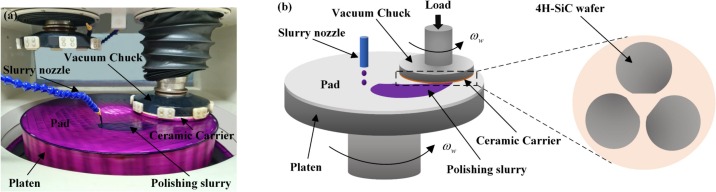
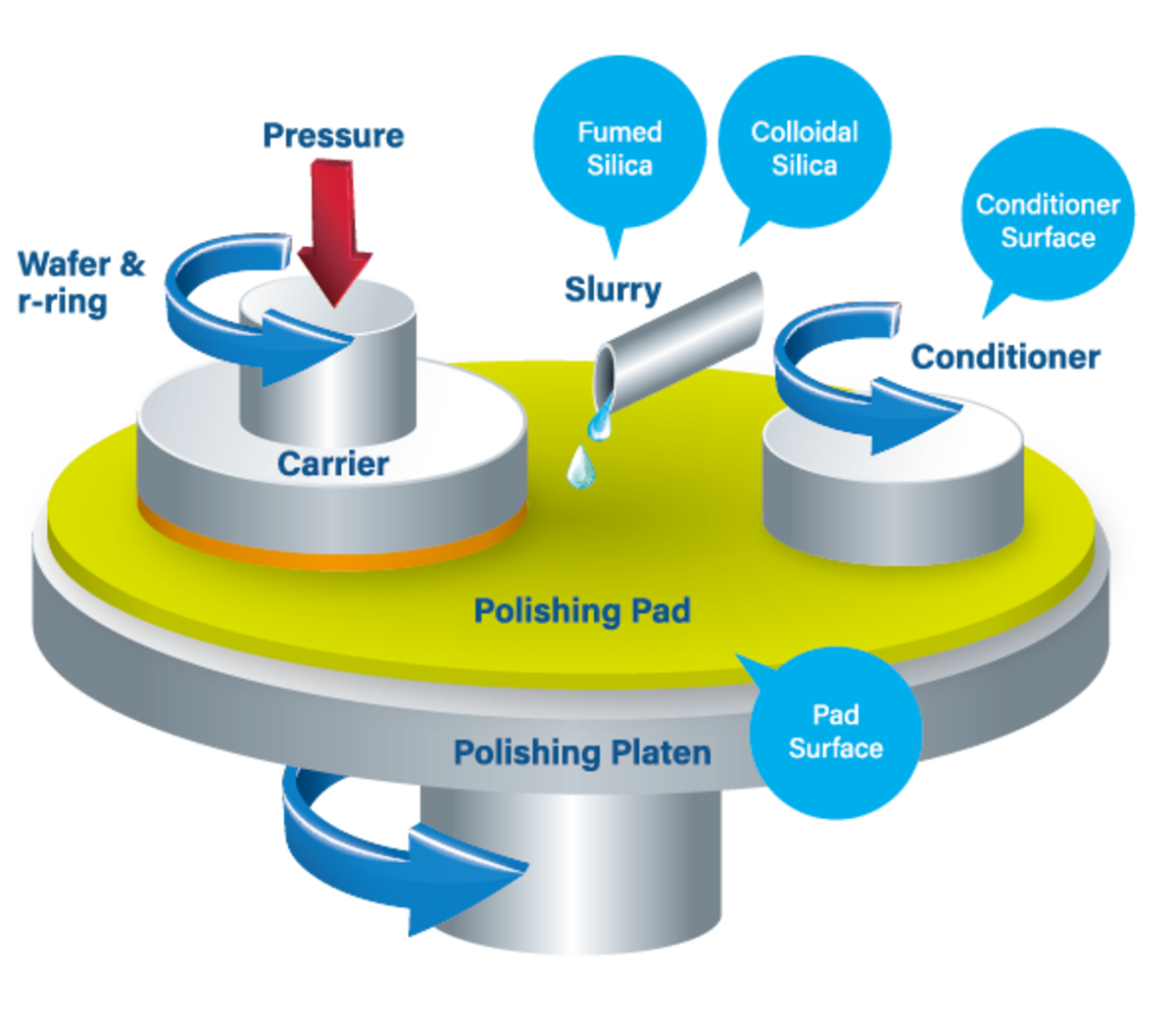
CMP is governed by a synergistic interaction of:
- Mechanical abrasion
- Chemical reaction
- Hydrodynamic transport
Slurry selection must therefore begin with first principles, not product catalogs.
3. Wafer Material Considerations
Different materials require fundamentally different slurry chemistries.
| 素材 | Key Challenge | Preferred Slurry Traits |
|---|---|---|
| SiO₂ | Uniform removal | Colloidal silica, alkaline pH |
| 銅 | Dishing & corrosion | Controlled oxidation, inhibitors |
| タングステン | 硬度 | Strong oxidizers, alumina |
| Barrier Layers | 選択性 | Low MRR, high control |
Material selection logic must consider not only the top layer but also underlying and adjacent films.
4. Matching Slurry Type to CMP Process
Slurry type must match the CMP step objective.
- Bulk removal
- Clear step
- Barrier polish
Using a high-MRR slurry for a barrier step is a common but costly mistake.
For reference:
CMP Slurry Types
5. Key Performance Metrics
| メートル | Why It Matters | 典型的な範囲 |
|---|---|---|
| MRR | スループット | 100–5000 Å/min |
| WIWNU | Uniformity | < 5% |
| スクラッチ密度 | 収量 | < 0.1/cm² |
| 選択性 | Profile control | > 5:1 |
6. Process Window & Margin Engineering
An optimal slurry is not the one with the highest peak performance, but the one with the widest stable process window.
Wider windows tolerate:
- Pad aging
- ツール間のばらつき
- Minor chemistry drift
7. Compatibility with CMP Polishing Pads
Pad–slurry compatibility determines real-world performance.
| Pad Type | Slurry Compatibility | リスク |
|---|---|---|
| Hard polyurethane | 高い | Scratch risk |
| Soft porous pad | 中程度 | Dishing |
Slurry selection without pad consideration is incomplete.
8. Defectivity & Yield Risk Assessment
Each slurry formulation has a characteristic defect fingerprint.
- Scratches → abrasive tail risk
- Pitting → oxidizer excess
- Dishing → inhibitor imbalance
Understanding this fingerprint allows proactive yield control.
9. CMP Tool & Delivery System Constraints
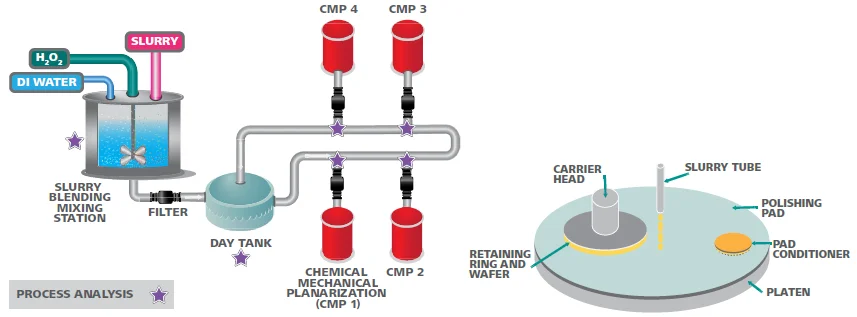
Slurry must be compatible with:
- Flow rate limits
- Filter pore size
- Recirculation systems
For filtration considerations, see:
CMPスラリーろ過
10. High-Volume Manufacturing (HVM) Considerations
HVM slurry selection prioritizes stability over peak performance.
| Factor | Engineering Focus |
|---|---|
| Batch consistency | Lot-to-lot control |
| Shelf life | Minimal aging drift |
| Supply reliability | Dual sourcing readiness |
11. Common CMP Slurry Selection Mistakes
- Chasing maximum MRR
- Ignoring filtration constraints
- Underestimating pad interactions
- Skipping long-term aging tests
Most yield excursions originate from these avoidable errors.
12. Qualification & Ramp-Up Strategy
A structured qualification plan includes:
- Lab-scale screening
- Short-loop tool tests
- Extended defect monitoring
- HVM pilot runs
13. Engineering Summary
Choosing CMP slurry is an engineering decision, not a purchasing choice. The optimal slurry balances performance, stability, defectivity, and manufacturability within a well-defined process window.
A disciplined selection methodology reduces yield risk, accelerates ramp-up, and lowers total cost of ownership.