How CMP Slurry Works
CMP slurry is what turns a rotating pad and a wafer into a nanometre-precise planarization tool. This guide explains how CMP slurry works — the synergy of chemistry and mechanics, the levers that govern the result, the process parameters that control it, and how the step knows when to stop.
The Role of Slurry in Chemical Mechanical Planarization
Chemical Mechanical Planarization (CMP) flattens each layer of a semiconductor wafer so the next layer can be patterned with the depth-of-focus that modern lithography demands. As devices have moved to multilevel interconnects and 3D structures, the number of CMP steps in a single process flow has climbed into the dozens, making slurry one of the most consumed and most yield-critical materials in the fab.
The slurry is the active consumable that makes planarization possible: a liquid carrying fine abrasive particles in a balanced chemical package. Without it, a CMP polisher is just a pad pressing against a wafer. To see where this fits in the bigger picture, start with our pillar guide on what polishing slurry is.
The defining feature of CMP — and the reason it dominates both front-end and back-end planarization — is that it removes material by combining gentle mechanical contact with targeted surface chemistry, rather than by aggressive grinding. That combination delivers global flatness with extremely low surface and subsurface damage, which is exactly what downstream patterning and, increasingly, wafer bonding require.
The Mechanical–Chemical Synergy
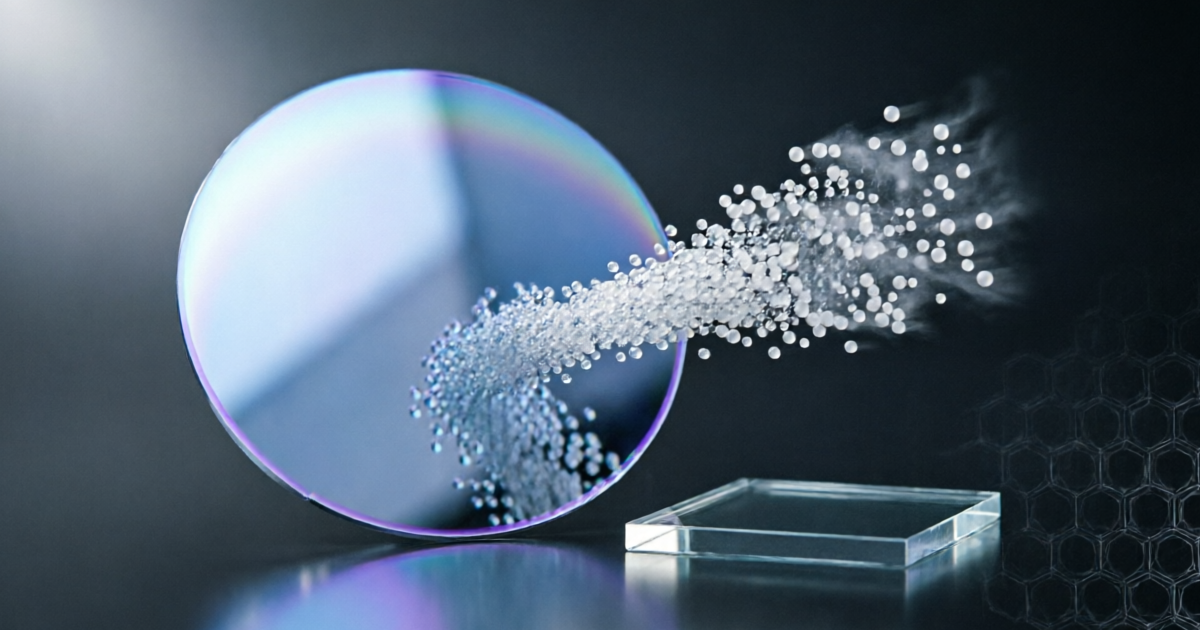
During polishing, the slurry chemistry continuously modifies only the topmost atomic layer of the wafer surface — oxidising a metal, hydrating an oxide, or forming a soft, easily sheared reaction product. The abrasive particles then remove this modified layer while leaving the bulk material untouched. Because chemistry softens the surface first, the mechanical action needed is small, which is precisely why CMP produces such low defectivity compared with pure mechanical lapping.
This is genuine teamwork. Chemistry alone would etch isotropically and ruin planarity; mechanics alone would scratch, dish and leave subsurface damage. The art of slurry design — covered in our composition guide — is tuning the two so they advance in lockstep across the whole wafer and across millions of features of different sizes. The choice of abrasive sets how hard the mechanical half pushes and how chemically active the particle surface itself is.
A useful mental model is a self-renewing cycle repeating millions of times per second across the contact area: chemistry forms a thin soft film, the abrasive shears it away to expose fresh material, and chemistry immediately re-forms the film. Keep that cycle balanced and removal is fast, flat and clean; let either half dominate and defects appear.
The Three Performance Levers
Every CMP result is described by three interdependent metrics. A formulation is always a deliberate trade-off between them:
- Removal rate — how fast material is taken off, usually reported in nanometres or angstroms per minute. It drives throughput but must not come at the cost of control.
- Селективность — the ratio of removal between two materials (for example metal versus barrier, or oxide versus nitride). High selectivity lets a process self-terminate cleanly on a stop layer.
- Planarization efficiency — how preferentially high features are removed relative to low ones, which determines how flat the surface becomes across both individual dies and the whole wafer.
Pushing one lever almost always moves the others. Raising removal rate by adding oxidiser or abrasive can erode selectivity and lift defectivity; chasing aggressive planarization can slow the step. This coupling is why slurry development is an iterative, application-specific discipline rather than a search for one universal product.
Removal Rate and Preston's Equation
To a first approximation, material removal in CMP follows Preston’s relationship: the removal rate is proportional to the applied pressure multiplied by the relative velocity between wafer and pad, scaled by a coefficient that bundles together the slurry, pad and consumable chemistry. In plain terms, push harder or move faster and you remove more — up to the limits set by defectivity, uniformity and heat.
The Preston coefficient is where the slurry lives. Two slurries run at identical pressure and velocity can give very different rates because their chemistry and abrasive change that coefficient. Real processes also depart from the simple linear model: thresholds, saturation and chemical-rate limits all appear, which is why empirical tuning on the actual tool remains essential.
Inside the CMP Loop and Its Key Parameters
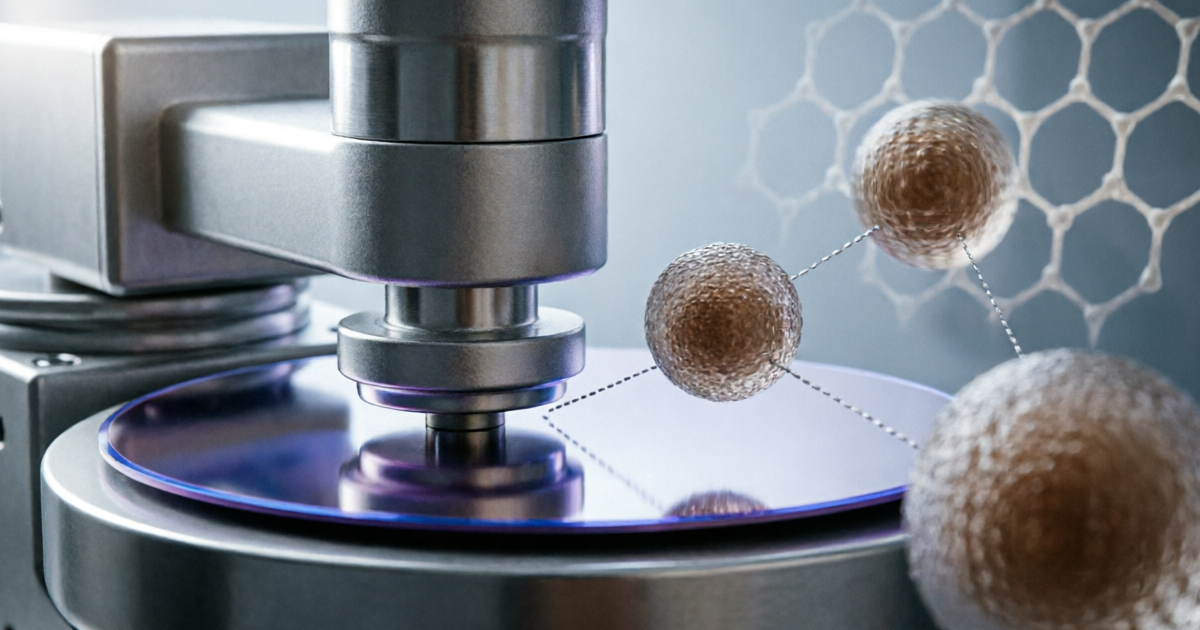
In production, the wafer is held face-down on a carrier and pressed against a polishing pad on a rotating platen. Slurry is dispensed continuously onto the pad, where pad asperities trap abrasive particles and carry them into contact with the wafer. Downforce concentrates pressure on the raised topography, so high points clear first and the surface planarises.
The parameters an engineer actually controls include:
- Downforce — sets the mechanical contribution; higher force raises rate but also defect and dishing risk.
- Platen and head speed — govern relative velocity and slurry transport across the wafer.
- Slurry flow rate — must deliver fresh chemistry and abrasive and remove debris and heat; too little starves the process.
- Temperature — chemical reaction rates are temperature-sensitive, so pad heating during polish must be managed for stability.
- Кондиционер — re-roughens the pad so it keeps transporting slurry; without it, rate decays.
Two supporting elements keep the loop honest: conditioning, above, and the post-CMP clean, which removes residual particles and reaction products before the wafer moves on. A slurry must be compatible with both — a point we return to in the selection workflow.
Knowing When to Stop: Endpoint Detection
Because CMP removes material physically, stopping at the right moment is essential — over-polish causes dishing and erosion, under-polish leaves residue. Endpoint detection systems watch the process in real time, using signals such as motor torque or friction changes as a new material is exposed, or optical reflectance for transparent films. A slurry with good selectivity makes endpoint easier by producing a sharp, detectable change when the stop layer appears.
This is one more reason selectivity and slurry consistency matter: a stable, predictable slurry produces a stable, predictable endpoint signal, which in turn protects yield across thousands of wafers.
What Goes Wrong — and Why
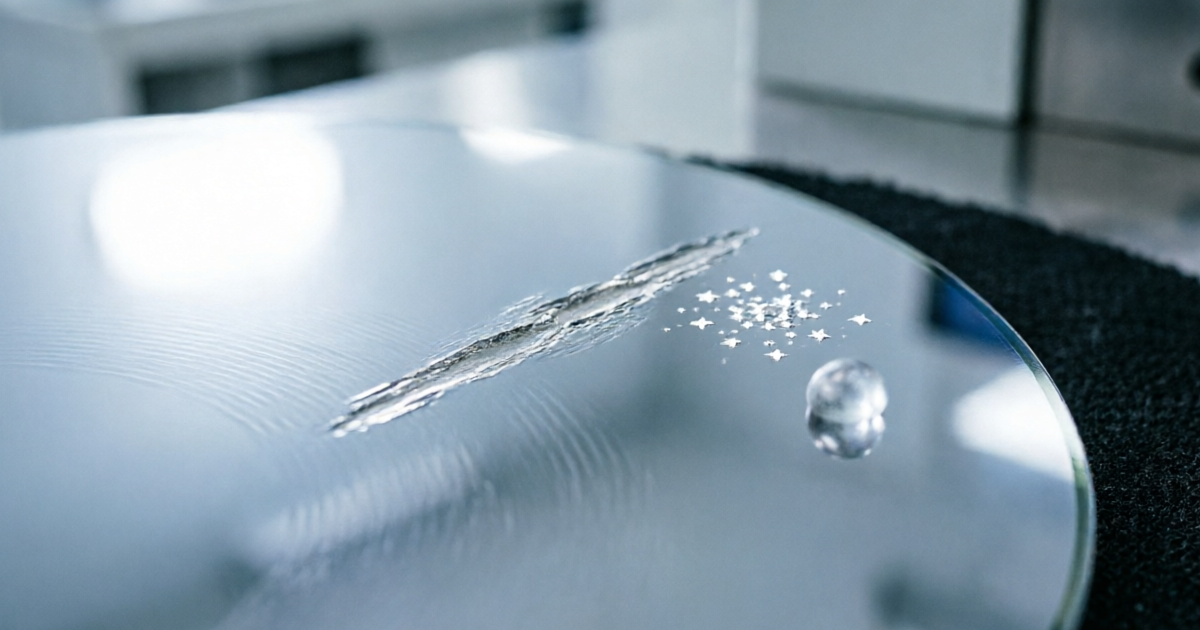
When the chemical–mechanical balance drifts, characteristic defects appear: dishing (over-removal of soft metal in wide features), erosion (thinning of dense arrays), scratches from oversized or agglomerated particles, residue from incomplete clearing, and corrosion when protective chemistry is insufficient. Many of these trace back to slurry instability rather than the recipe itself — see slurry stability and particle agglomeration.
Understanding these failure modes is the foundation for selecting the right slurry for a given step. In practice, an experienced process engineer reads the defect signature backwards: scratches point to the large-particle tail, dishing to chemistry-to-mechanics balance, residue to rate or endpoint, and corrosion to inhibitor strength.
Часто задаваемые вопросы
What does CMP slurry actually remove?
What is Preston's equation in CMP?
What process parameters control CMP?
How does CMP know when to stop?
Why does CMP need both chemistry and mechanics?
What is selectivity and why does it matter?
Talk to the JEEZ slurry engineering team
From first slurry selection to defectivity optimisation and multi-source qualification, JEEZ — Jizhi Electronic Technology Co., Ltd. — helps you match the right polishing slurry to your material and process targets.
Contact JEEZ →Part of the JEEZ Polishing Slurry knowledge series. Reviewed and updated June 2026 by Jizhi Electronic Technology Co., Ltd.