CMP Material Removal Rate and Pad Parameters: A Quantitative Guide
A data-driven analysis of how CMP polishing pad properties — hardness, porosity, groove geometry, and surface texture — determine material removal rate, process window width, and wafer-to-wafer repeatability in semiconductor manufacturing.
Data
- MRR: Definition and Measurement
- The Preston Equation in Depth
- What Determines Kp: Pad Contributions
- Pressure and Velocity: The Primary Knobs
- Pad Hardness vs. MRR: Quantitative Relationship
- Porosity and Slurry Uptake vs. MRR
- Groove Geometry vs. MRR Uniformity
- MRR Stability Over Pad Lifetime
- Process Window Engineering
- FAQ
Material removal rate (MRR) is the central productivity metric of every CMP process. It determines polishing time per wafer, tool throughput, and cost-per-wafer. Yet MRR is not a fixed property of a pad-slurry combination — it is a complex function of pad physical properties, process recipe parameters, wafer film type, and process history (pad age and conditioning state). Understanding what drives MRR quantitatively allows process engineers to predict recipe changes, diagnose yield excursions, and optimize total cost of ownership.
This guide builds from the Preston equation framework to a practical, quantitative understanding of how every major pad parameter contributes to MRR. For the mechanistic context on how pads generate material removal, see first: How CMP Polishing Pads Work.
1. MRR: Definition and How It Is Measured
Material removal rate in CMP is defined as the thickness of film removed from the wafer surface per unit polishing time, expressed in ångströms per minute (Å/min) or nanometers per minute (nm/min). It is measured by comparing pre-polish and post-polish film thickness at multiple points across the wafer using a non-contact optical metrology tool (reflectometer or ellipsometer). The mean removal rate is calculated as: MRR = ΔThickness / PolishTime, where ΔThickness is the mean change in film thickness across the measurement sites and PolishTime is the elapsed polishing time in minutes.
Accurate MRR measurement requires consistent pre-polish film thickness, consistent recipe parameters, and a measurement recipe that samples enough sites to give a representative mean (typically 49- or 121-point wafer maps are used). MRR should be measured and logged for every monitor wafer in the conditioning and production sequence — it is the primary real-time indicator of pad health.
2. The Preston Equation in Depth
The Preston equation was originally derived empirically for glass optical polishing in 1927 and adapted to CMP in the 1990s. It captures the first-order behavior of material removal in CMP with remarkable accuracy across a wide operating range. The key insight is that MRR scales linearly with the product P × V — the specific polishing power delivered to the wafer surface per unit area. The Preston coefficient Kp is the proportionality constant that converts specific power to removal rate.
Calculating Velocity in a CMP Tool
On a rotary CMP tool, the relative velocity V between pad and wafer is not uniform — it varies with radial position on the wafer. The mean relative velocity at a wafer point at radius r from the wafer center, on a tool with platen angular velocity ω₁ and carrier angular velocity ω₂, is approximately:
In practice, the velocity profile non-uniformity across the wafer is one driver of within-wafer MRR variation — the wafer edge (larger r from the platen center) experiences higher relative velocity and therefore higher MRR in a simple Preston model. This is one reason that edge-center uniformity is always a concern in large-wafer CMP and why both platen and carrier RPM must be optimized together.
3. What Determines Kp: Pad Contributions Broken Down
The Preston coefficient Kp is the most information-dense parameter in CMP — it encodes all material system properties into a single number. Understanding what pad properties contribute to Kp allows engineers to predict directional MRR changes when pad specifications change.
| Pad Property | Direction of Kp Change | Mechanism | Typical Magnitude of Effect |
|---|---|---|---|
| Hardness ↑ (Shore D) | Kp ↑ | Stiffer asperities generate higher local contact stress, increasing abrasive engagement force | ~8–15% per 10 Shore D units |
| Asperity height (Ra) ↑ | Kp ↑ | Taller asperities engage more abrasive particles per unit contact area | ~5–12% per µm Ra change |
| Pore density ↑ | Kp ↑ (modest) | More pore-resident slurry delivered to contact interface; higher abrasive particle density at interface | ~3–8% |
| Groove pitch ↓ (finer) | Kp ↑ (uniformity improvement) | More frequent slurry renewal reduces local slurry depletion, maintaining effective abrasive concentration | ~5–10% on mean MRR; ~10–20% on WIWNU |
| Temperature ↑ (pad surface) | Kp ↓ | PU softens above ~40°C; asperity compliance increases, reducing contact stress per asperity | ~2–5% per 10°C above 40°C baseline |
| Pad age ↑ (glazing) | Kp ↓ | Glazed asperity tips reduce real contact area and abrasive engagement; recovered by conditioning | ~30–40% total decline without conditioning |
4. Pressure and Velocity: Manipulating MRR with Recipe Parameters
Because Preston’s equation is linear in both P and V, these are the primary recipe knobs for targeting a specific MRR. However, both parameters have non-linear regimes at their extremes that must be understood to avoid process failures.
🔵 Pressure (P) — Operating Window
- Too low (<1 psi): Hydrodynamic lubrication regime — slurry film separates pad and wafer; MRR → 0; non-contact polishing
- Optimal (1–4 psi for oxide, 0.5–2 psi for Cu/low-k): Mixed lubrication; Preston equation holds; stable, predictable MRR
- Too high (>5–6 psi): Pad deformation reduces effective asperity height; thermal softening reduces Kp; defect density spikes; MRR plateaus or declines
🔶 Velocity (V) — Operating Window
- Too low (<0.1 m/s effective): Insufficient centrifugal slurry delivery; slurry starvation at wafer center; non-uniform removal
- Optimal (0.3–1.0 m/s): Good slurry transport; Preston equation holds; throughput benefit of higher velocity
- Too high (>1.5 m/s): Centrifugal slurry ejection from under wafer; thermal runaway risk; increased pad-conditioner wear at high heat generation rate
5. Pad Hardness vs. MRR: A Quantitative Look
The relationship between pad Shore D hardness and MRR is approximately linear within the production operating range (Shore D 35–65), with a proportionality constant that depends on slurry type, abrasive particle size, and film material. Across our in-house characterization database of oxide CMP recipes, we observe the following approximate relationship:
Shore D 58 pad: MRR = 1,820 ± 65 Å/min (Kp = 1.01 × 10⁻⁸ Pa⁻¹)
Shore D 62 pad: MRR = 2,110 ± 72 Å/min (Kp = 1.17 × 10⁻⁸ Pa⁻¹)
Shore D 66 pad: MRR = 2,380 ± 85 Å/min (Kp = 1.32 × 10⁻⁸ Pa⁻¹)
Implied: ~14% MRR increase per 4 Shore D units at this recipe and slurry combination. Extrapolation to other slurry systems requires independent characterization.
This data has a direct practical implication: if you switch from a Shore D 58 to a Shore D 62 pad (within the same product family), you should expect approximately 14% higher removal rate at identical recipe settings. To maintain the same removal rate target, reduce down-force pressure by approximately 12% or adjust platen speed accordingly.
6. Porosity and Slurry Uptake vs. MRR
Pore structure affects MRR through the slurry micro-transport mechanism. Higher pore density and larger pore diameter increase the reservoir of slurry available at the pad-wafer interface, raising effective abrasive concentration at the contact zone — which increases Kp. However, higher porosity also reduces the solid polymer volume fraction, reducing effective hardness and asperity stiffness — which decreases Kp. These opposing effects create an optimal pore loading that maximizes MRR for a given hardness target.
Our characterization data shows that for hard PU oxide CMP pads at constant Shore D hardness (achieved by adjusting NCO/OH index to compensate for pore volume fraction changes):
- Increasing pore volume fraction from 15% to 25% raises MRR by approximately 8–12% at standard recipe conditions
- Increasing pore volume fraction beyond 30% provides diminishing MRR returns while measurably increasing defect density from pore-debris contamination
- The optimal pore volume fraction for production hard oxide CMP pads is 20–27%, consistent with the IC1000-type industry standard
Poreless pads have effectively zero pore-driven slurry micro-transport. Their MRR is slightly lower than equivalent-hardness porous pads at the same recipe settings (typically 5–12% lower) but delivers significantly better MRR lot-to-lot consistency. For the full poreless vs. porous trade-off, see: Poreless CMP Pads vs. Porous Structure.
7. Groove Geometry vs. MRR Uniformity
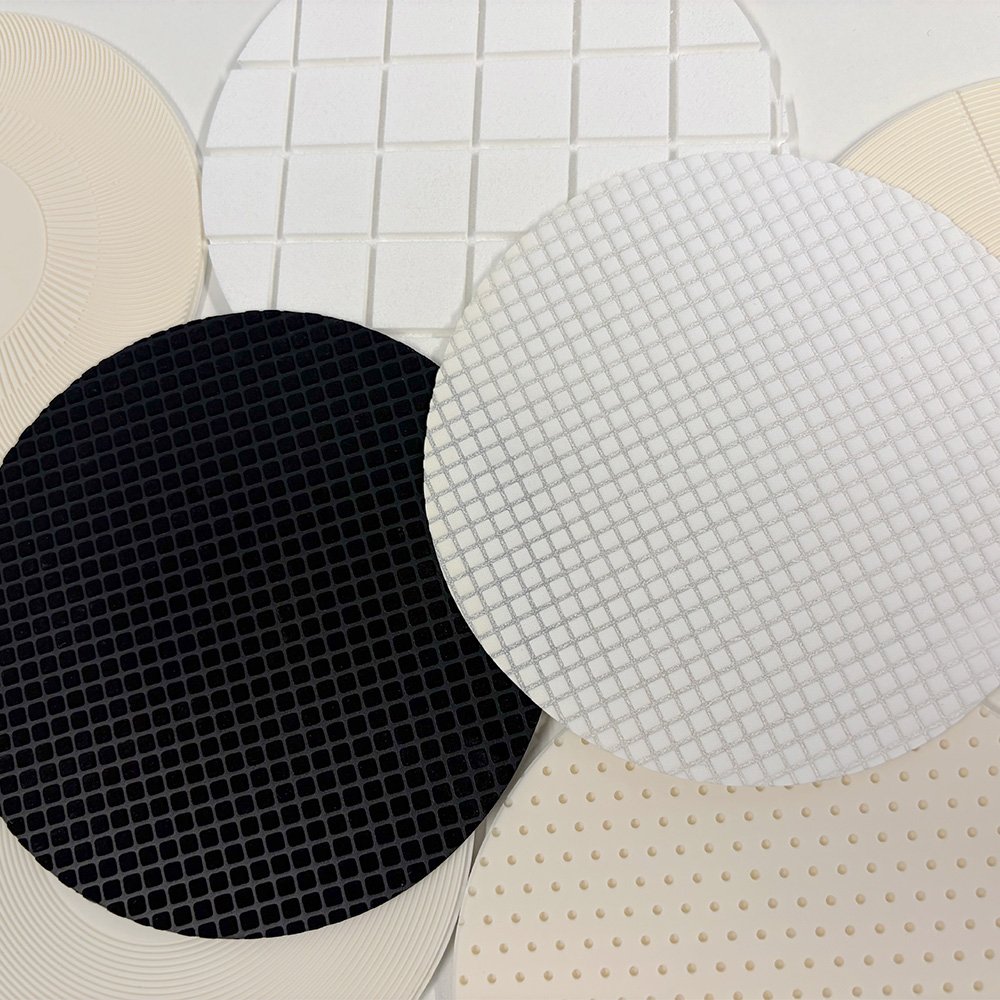
Groove design does not significantly affect mean MRR (the average removal rate across the whole wafer), but it strongly affects MRR uniformity — the radial and azimuthal distribution of removal rate across the 300 mm wafer surface. The key relationship is between groove pitch and the slurry renewal frequency under the wafer.
| Groove Pitch | Slurry Renewals per Revolution (@ wafer center) | Expected WIWNU (1σ) Effect |
|---|---|---|
| 6.0 mm pitch | ~8 renewals/revolution | Higher center-low profile risk — slurry starvation at wafer center |
| 3.0 mm pitch | ~16 renewals/revolution | Standard production — acceptable center-to-edge balance |
| 2.0 mm pitch | ~24 renewals/revolution | Improved center delivery — better uniformity at cost of higher groove fraction |
| 1.5 mm pitch | ~32 renewals/revolution | Best uniformity — diminishing returns; groove fraction may be excessive |
For processes where radial MRR uniformity is the primary concern — such as final Cu BEOL buff steps where WIWNU targets are below 1% (1σ) — fine-pitch groove patterns (1.5–2.0 mm) are preferred despite their lower mean MRR relative to wide-pitch designs. For the full groove design analysis, see: CMP Pad Groove Design and Slurry Distribution.
8. MRR Stability Over Pad Lifetime
Achieving a consistent MRR from wafer to wafer across the full pad lifetime is the operational goal — it is what enables tight thickness control at end-of-polish and minimizes recipe adjustment frequency. Three regimes of MRR behavior occur over pad lifetime:
Break-In Ramp (Wafers 1–50)
MRR rises from a low initial value (~60% of stable-state target) as pad skin is removed and pores are opened. High variability (CV >15%). All wafers in this phase should be non-product monitors. Break-in conditioning accelerates this phase.
Stable Working Phase (Wafers 50–1,800+)
MRR stabilized within ±8% of target. CV <5% with well-optimized conditioning. All production wafers should be polished in this window. Conditioning maintains stable asperity distribution. Small slow drift (<1% per 100 wafers) is normal and expected.
End-of-Life Decline (Final 10–15% of Lifetime)
MRR declines as pad thickness approaches minimum — reduced bulk compressibility changes macro-contact mechanics. Conditioning cannot fully compensate. Sustained MRR decline >15% from stable baseline triggers pad replacement evaluation.
9. Process Window Engineering: Maximizing Throughput Within Yield Constraints
The “process window” for a CMP step is the range of recipe parameters (P, V, slurry flow rate, conditioning intensity) over which all yield metrics — MRR target, WIWNU, defect density — are simultaneously within specification. Wider process windows provide more robustness against process variation and tool-to-tool differences. Narrower windows require tighter process control and are more sensitive to pad lot changes.
Pad parameter choices directly determine process window width:
- Higher pad hardness widens the MRR process window (less sensitive to pressure variation) but narrows the defect window (harder asperities increase scratch sensitivity to over-pressure)
- Tighter pore size distribution (CV <15%) widens the MRR window by reducing pad-to-pad Kp variation — the same recipe delivers the same MRR regardless of which pad in a lot is used
- Optimized groove pitch widens the WIWNU window by reducing the process’s sensitivity to slurry flow rate variations — the groove’s buffering effect smooths out transient flow perturbations
- Poreless pads deliver the widest lot-to-lot Kp consistency (<3% CV) — widening the recipe transfer window when moving between pad lots or tool platforms
For guidance on how to select pads that maximize process window for your specific application, see our comprehensive selection guide: Hard vs. Soft CMP Polishing Pads: Selection Guide.