Custom CMP Polishing Pad Solutions: From Specification to Production
A complete guide to custom CMP polishing pad development at Jizhi Electronic Technology — covering when customization is necessary, what parameters can be specified, the co-development process timeline, qualification requirements, and how to initiate a custom pad project.
R&D
The vast majority of CMP polishing pad requirements in semiconductor manufacturing can be met by catalog products — standard hard polyurethane pads for oxide and tungsten CMP, soft subpads for copper BEOL, and SiC-specific formulations for power device substrates. But a significant and growing segment of CMP applications falls outside what standard catalog products can address: novel substrate materials, non-standard wafer geometries, extremely aggressive slurry chemistries, ultra-precise hardness targets for specialized uniformity requirements, or proprietary groove patterns designed around specific tool configurations.
Jizhi Electronic Technology’s custom CMP pad development program provides the full range of customization services — from minor parameter adjustments (specific hardness within a formulation family, custom groove pitch) to ground-up development of new polymer formulations for materials not previously polished with CMP. This guide explains when custom pads are the right solution, what the development process looks like, and how to initiate a project.
1. When Standard Pads Are Not Enough
Custom pad development is warranted — and the economics justify it — in the following situations:
Novel Substrate Materials
Materials not addressed by standard pad portfolios: gallium oxide (Ga₂O₃), diamond substrates, aluminum nitride (AlN), lithium niobate (LiNbO₃), or other wide-bandgap or piezoelectric substrates where chemical inertness, hardness, or crystal fragility falls outside the design envelope of existing pads.
Non-Standard Wafer Geometries
Square substrates, hexagonal dies, panel formats (for panel-level packaging), or non-standard circular diameters (e.g., 125 mm, 175 mm, or square panels up to 300×300 mm) that standard pad punching and machining cannot accommodate without custom tooling.
Proprietary or Extreme Slurry Chemistry
Slurry systems using oxidizers or pH ranges that degrade standard polyurethane formulations within a single pad lifetime — for example, very high-concentration Fenton reagents for SiC, or strongly alkaline (pH >12) chemistries for specific dielectric films.
Ultra-Precise Hardness Targets
Applications where the optimal hardness window is very narrow — for example, a specific hybrid bonding surface preparation requiring exactly Shore D 32–36 (within a range that standard soft pad families straddle but do not hit precisely) for a particular incoming film stack.
Custom Groove Patterns for Specific Tools
Non-standard CMP tools (legacy equipment, research-grade tools, custom-built systems) with platen geometries, slurry delivery configurations, or carrier arm geometries that standard groove patterns do not optimize for — requiring CFD-modeled custom groove designs.
OEM Private-Label Requirements
Equipment OEMs or system integrators who supply CMP-related tools or sub-systems and require pads supplied under their own brand name with specific formulation ownership or exclusivity arrangements.
2. What Can Be Customized in a Jizhi CMP Pad
| Parameter Category | Customizable Range | Typical Development Time | Minimum Order |
|---|---|---|---|
| Shore D hardness target | Any value Shore D 24–72, in increments as fine as ±2 Shore D | 4–8 weeks (within existing formulation family) | 20 pads |
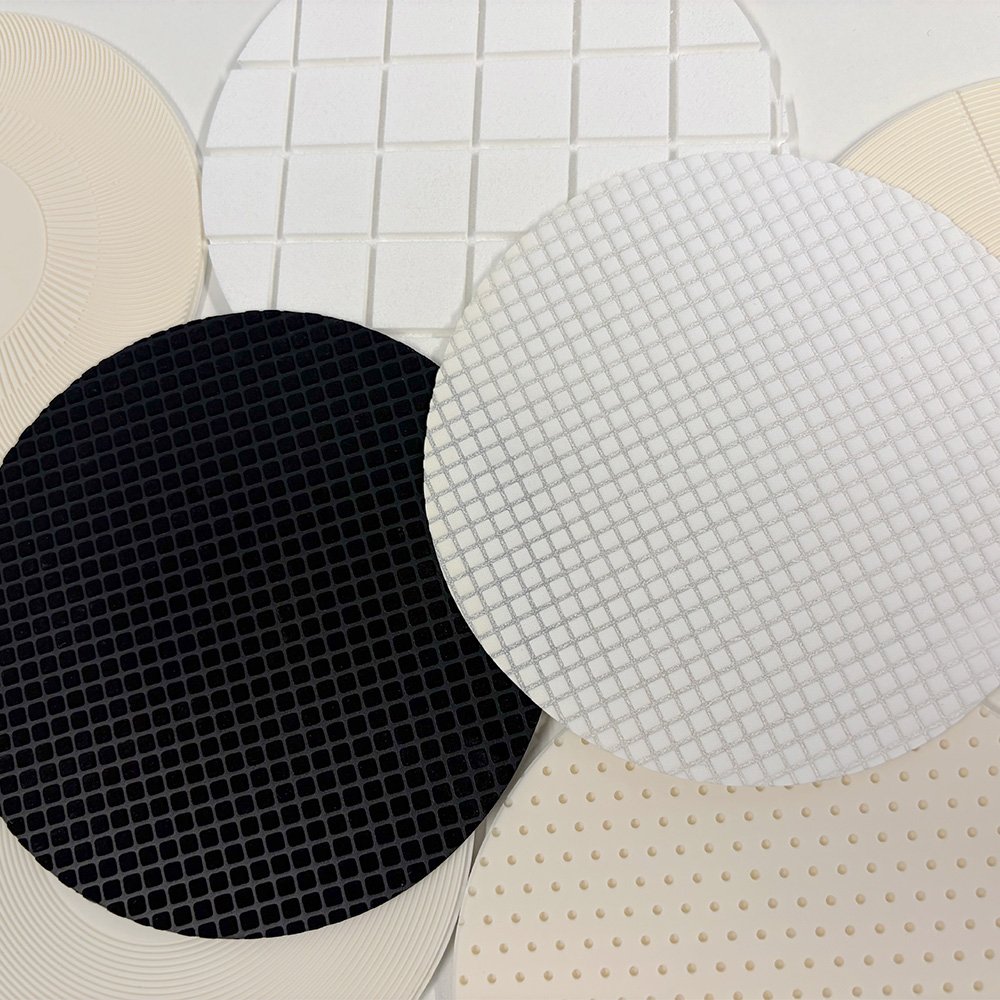
| Groove pattern | Any standard or custom pattern; zone-varying pitch; custom depth and width profiles | 2–4 weeks (machining program only); 6–10 weeks (CFD-optimized) | 20 pads |
| Pad diameter and thickness | Diameter: 100 mm to 800 mm. Thickness: 1.0–4.0 mm. Square pads up to 600×600 mm. | 2–4 weeks (tooling adjustment) | 10 pads |
| Polyol backbone type | Polyether, polyester, polycarbonate, polysiloxane-modified | 8–16 weeks (formulation + curing + characterization) | 50 pads |
| Pore size and density | Mean diameter 15–80 µm; volume fraction 5–35%; or poreless | 8–16 weeks | 50 pads |
| Chemical resistance package | Immersion resistance testing against customer-specified slurry chemistry at process temperature | 4–8 weeks | 20 pads |
| Backing layer specification | PET, polyurethane foam, no backing, or multi-layer laminate | 2–4 weeks | 20 pads |
| Private label / OEM branding | Custom product code, customer logo, customer-specific documentation format | 2–4 weeks (packaging/documentation only) | 100 pads/year |
3. Custom Pad Application Examples
The following examples illustrate the types of custom pad projects Jizhi has undertaken or is currently engaged in as of April 2026:
- Ga₂O₃ substrate final CMP: Gallium oxide (Mohs 7.5) is emerging as a power device substrate for ultra-high-voltage applications. Its chemical inertness to common oxidizers and sensitivity to phosphoric acid-based etching required a custom pad formulation with phosphoric acid resistance, combined with a very soft compliance profile (Shore D 32) to minimize sub-surface damage in the fragile Ga₂O₃ crystal. Development completed in 14 weeks; production samples provided to customer research lab in Q1 2026.
- Panel-level fan-out packaging Cu RDL: A panel format of 300×300 mm (non-standard) with a glass substrate required a custom pad punched to panel dimensions and a very soft (Shore D 28) formulation to accommodate the glass panel’s low stiffness without edge-loading artifacts. Custom backing layer (no subpad, direct PSA to panel tool chuck) was also required. Development completed in 10 weeks.
- High-concentration KMnO₄ SiC CMP: A research customer required a pad compatible with KMnO₄ concentrations up to 5 wt% for experimental high-MRR SiC polishing research. Standard polycarbonate-PU formulations showed hardness degradation after 4 hours at this concentration. A polysiloxane-modified PU formulation was developed that maintained Shore D 65±2 after 24-hour immersion in 5 wt% KMnO₄ at 60°C. Development completed in 18 weeks.
- OEM private-label for CMP tool manufacturer: A CMP equipment OEM required pads supplied under their own brand for their tool’s consumables kit. Jizhi manufactures the JZ-H60-equivalent pad to the OEM’s specification with the OEM’s product code and labeling, delivered in OEM-branded packaging. Exclusivity arrangement covers the OEM’s specific tool model series.
4. The Co-Development Process
Application Assessment Call (Week 1)
A 60-minute technical call between the customer’s process engineering team and Jizhi’s R&D team to characterize the application: substrate material, wafer geometry, slurry chemistry (including oxidizer type and concentration, pH, abrasive type), CMP tool model, target MRR, WIWNU requirement, defect density budget, and any known previous approaches and their failure modes. This call determines whether a catalog product can address the requirement or genuine custom development is needed.
Technical Feasibility Assessment and Proposal (Weeks 2–4)
Jizhi’s materials team assesses the feasibility of the requested customization, including any polymer chemistry challenges, chemical compatibility risks, and geometry/tooling constraints. A written development proposal is issued covering: proposed formulation approach, development timeline, sample milestones, pricing for development samples and production supply, and IP ownership terms. Customer review and approval required before development begins.
Formulation Development and Initial Characterization (Weeks 4–14, application-dependent)
Jizhi’s R&D team formulates and cures prototype pad samples, performing in-house characterization: Shore D mapping, DMA (Tg measurement), chemical resistance immersion testing at customer’s slurry conditions, and pore size distribution analysis. Multiple formulation iterations may be performed to hit the target property window. Customer receives characterization data at each milestone for review and input.
Sample Delivery and Customer Process Evaluation (Weeks 14–22)
Development sample pads (typically 3–5 units) are shipped to the customer for process evaluation on their specific tool and application. Jizhi provides recommended process recipe (pressure, velocity, slurry flow rate, conditioning protocol) and a characterization data sheet for each sample lot. Customer evaluates removal rate, WIWNU, and defect density and provides feedback.
Iteration and Refinement (Weeks 22–30, if needed)
Based on customer process evaluation results, Jizhi adjusts formulation parameters — hardness, pore loading, groove geometry — to optimize performance. A second or third sample iteration may be required for demanding applications. The iteration cycle time is typically 4–6 weeks per iteration, shorter than the initial development cycle because the formulation baseline is established.
Production Formulation Lock and Scale-Up (Weeks 30–38)
Once the customer approves a sample iteration, Jizhi locks the formulation (fixed raw material specifications, processing parameters, and QC acceptance criteria) and scales to production batch sizes. First production lot characterization data is submitted to the customer for final approval before production release.
5. Development Timeline by Customization Complexity
| Customization Type | Typical Timeline to First Sample | Typical Timeline to Production |
|---|---|---|
| Groove pattern only (standard formulation) | 2–4 weeks | 4–6 weeks |
| Hardness adjustment within existing formulation family | 4–8 weeks | 8–12 weeks |
| Pore size or loading modification | 8–12 weeks | 12–18 weeks |
| Polyol backbone substitution (same isocyanate) | 10–16 weeks | 18–24 weeks |
| Ground-up formulation for novel substrate/chemistry | 16–24 weeks | 26–36 weeks |
| OEM private label (existing product, packaging/docs only) | 2–3 weeks | 3–4 weeks |
6. Qualification and Production Transition
Custom pads follow the same qualification protocol as standard pads — the customer performs process qualification on their tool using the approved development sample specification as the baseline, then verifies that the first production lot meets the same acceptance criteria. Jizhi locks the production formulation after the first production lot is approved by the customer and issues a signed formulation lock document that defines the specification baseline for all future production lots.
Change control for custom pad formulations is strictly managed: any change to raw material supplier, polymer formulation, pore-forming agent type, or machining process requires written notification to the customer at least 90 days in advance and customer approval before implementation. This provides the same change control protection that customers receive from qualification of standard products.
7. IP Protection in Co-Development
Custom pad co-development inherently involves sharing technical information between Jizhi and the customer. Our standard co-development agreements include the following IP protections:
- Customer application IP: All information the customer provides about their substrate material, slurry chemistry, process targets, and device application is treated as confidential and protected by a mutual NDA signed before any technical discussion begins.
- Jizhi formulation IP: The specific polyurethane formulation developed for a custom application remains Jizhi’s IP unless explicitly agreed otherwise. Customers receive the right to purchase pads made to that formulation for their specified application.
- Exclusivity options: Customers requiring exclusive access to a specific custom formulation (i.e., Jizhi will not supply the same formulation to competitors) can negotiate exclusivity arrangements. Exclusivity is application-specific, not formulation-specific in general.
- Co-inventions: Where development work generates patentable innovations jointly conceived by both parties, co-ownership arrangements are negotiated in the development agreement before work begins.