Dicing Blade Coolant Why Water Alone Is Not Enough
← Back to: Diamond Dicing Blades: The Complete Guide
Deionised water is cheap, clean, and universally available — so why do semiconductor manufacturers formulate specialised coolant additives for dicing? Because the cutting zone of a dicing blade is not just a wet surface: it is a high-temperature, high-velocity abrasion interface where surface chemistry, heat transfer, particle dynamics, and electrochemical effects all interact simultaneously. This guide explains what DI water cannot do, what a properly formulated coolant additive can, and how to choose the right coolant for your substrate and blade type.
1. The Four Functions of Dicing Coolant
Regardless of whether plain DI water or a formulated coolant is used, any dicing fluid must simultaneously fulfil four distinct functions at the cutting zone. Understanding these functions is the starting point for understanding why DI water alone is inadequate for demanding applications.
DI water performs the thermal management and swarf flushing functions adequately for many standard silicon applications. It is the other two functions — lubrication and static control — where its limitations become apparent, and where coolant additives deliver measurable process improvements.
2. The Limits of Pure DI Water
High Surface Tension
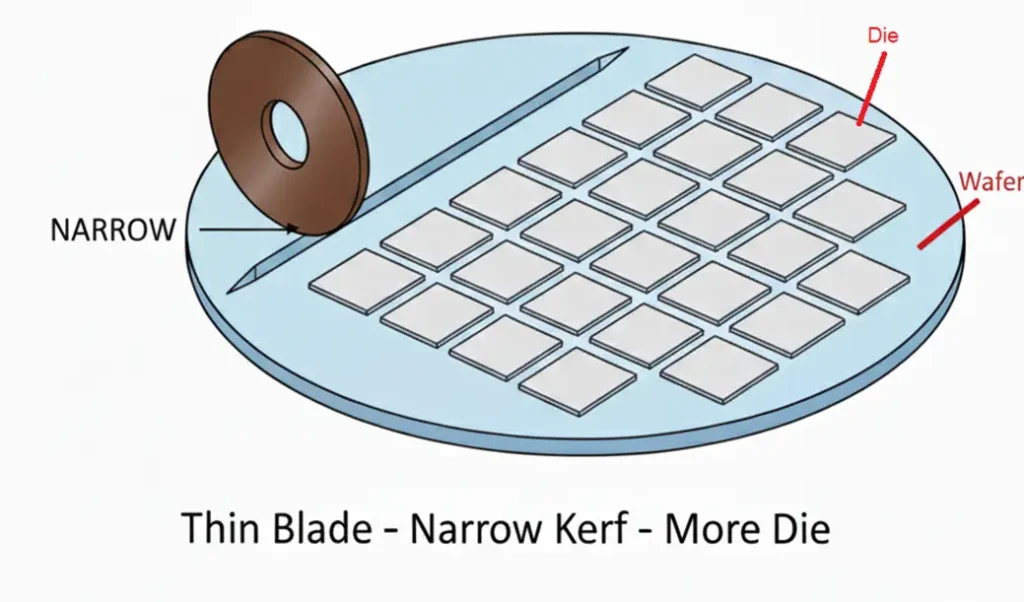
DI water has a surface tension of approximately 72 mN/m — one of the highest of any common liquid. In the narrow kerf created by a dicing blade (often 30–200 µm wide), high surface tension impedes the coolant’s ability to wet the cutting surface fully and flush swarf efficiently. The result is that debris accumulates in the kerf more readily, increasing blade loading and back-side chipping.
No Boundary Lubrication
Pure water provides hydrodynamic lubrication (a thin fluid film) but essentially no boundary lubrication — the chemical adsorption of lubricant molecules onto solid surfaces that reduces metal-to-metal and diamond-to-substrate contact friction. Without boundary lubrication, cutting forces are higher, heat generation per grain impact is greater, and blade bond matrix wear is accelerated.
Electrostatic Charge Accumulation
High-speed abrasion at the cutting zone generates triboelectric charge on both the diced die surfaces and the suspended swarf particles. DI water’s very low ion concentration — which makes it electrically pure — paradoxically makes it a poor medium for charge dissipation. On materials such as LiNbO₃ (pyroelectric) and high-resistivity silicon, charge accumulation attracts contamination particles to die surfaces in ways that are not removed by subsequent rinsing.
No Corrosion Protection
Metal bond blades contain sintered metallic matrices — typically copper, tin, cobalt, or iron alloys. Prolonged exposure to DI water accelerates corrosion of exposed metal surfaces at the blade rim, gradually degrading the bond integrity and shortening blade life. Plain DI water offers no corrosion inhibition.
3. What Coolant Additives Actually Do
A properly formulated dicing coolant additive addresses each of the DI water limitations described above through specific chemical mechanisms:
- Surfactants (surface-active agents): Reduce surface tension from ~72 mN/m to as low as 25–35 mN/m, dramatically improving kerf wetting, swarf flushing, and coolant penetration to the blade–workpiece interface. The practical result is lower back-side chipping and reduced blade loading on fine-kerf cuts.
- Boundary lubricant molecules: Polar molecules that adsorb onto the substrate surface and diamond grains, forming a thin molecular film that reduces friction without impeding coolant flow. This lowers cutting force, reduces heat generation per cut, and improves blade life — particularly on hard materials where cutting forces are already high.
- Anti-static agents: Low-concentration ionic or non-ionic compounds that provide sufficient conductivity to dissipate triboelectric charge without introducing ionic contamination that could affect device electrical performance. Critical for LiNbO₃, high-resistivity Si, and certain MEMS applications.
- Corrosion inhibitors: Film-forming agents that passivate exposed metal surfaces on metal bond blades, preventing oxidation and extending blade life. Important for any application using metal bond blades in continuous or high-volume production.
- Foam suppressants: Prevent excessive foam formation at high flow rates that can obstruct vision system cameras and flow sensors, particularly in enclosed dicing saw designs.
4. Coolant Requirements by Substrate Material
| Материал | Primary Coolant Requirement | Recommended Additive Function |
|---|---|---|
| Кремний (Si) | Swarf flushing; moderate heat removal | Surfactant + mild lubricant |
| Карбид кремния (SiC) | High heat removal; blade protection | High-lubricity additive + corrosion inhibitor; high flow rate essential |
| Арсенид галлия (GaAs) | Arsenic swarf containment; low force | Surfactant for swarf capture; anti-static |
| Сапфир | High heat removal; fine swarf | High-lubricity + surfactant; high flow rate |
| LiNbO₃ / LiTaO₃ | Anti-static; thermal shock prevention | Anti-static agent; consistent flow rate critical |
| Glass / Quartz | Micro-crack prevention; clean surface | Surfactant + lubricant |
| QFN / Laminate Package | Copper swarf management; clean cuts | Surfactant; anti-foam to protect vision system |
For SiC dicing in particular, coolant performance is not optional — the extreme heat generated at Mohs 9.5 hardness makes thermal management at the cutting interface a direct determinant of both die edge quality and blade life. Our detailed SiC dicing guide covers coolant configuration in the context of the full SiC process parameter set.
5. Concentration, Mixing, and Maintenance
Most dicing coolant additives are supplied as a concentrate to be diluted with DI water at the point of use. Typical use concentrations range from 0.1% to 1.0% by volume, depending on the additive formulation and the substrate being cut. Operating at below the recommended concentration reduces the lubrication and anti-static benefits; operating above it may cause foam accumulation, leave residue on die surfaces, or — in the case of ionic anti-static agents — introduce contamination concerns.
Practical Maintenance Guidelines
- Prepare fresh coolant solutions at the start of each production shift — do not reuse coolant that has accumulated significant swarf loading.
- Use the coolant manufacturer’s recommended DI water resistivity (typically >1 MΩ·cm) to avoid introducing ion contamination from the diluent water.
- Inspect coolant delivery nozzles for blockage before each production run. Blocked nozzles are a common cause of sudden chipping escalation mid-lot.
- Clean the saw coolant tank and delivery lines at the frequency specified by the saw manufacturer — coolant residue and biological growth can block filters and nozzles.
6. Coolant and Blade Compatibility
Not all coolant additives are compatible with all blade bond types. Key compatibility considerations include:
- Resin bond blades: Strongly alkaline coolant formulations (pH above ~9) can accelerate degradation of some resin bond matrices over extended exposure. Verify pH compatibility with the blade manufacturer before switching coolant formulations.
- Metal bond blades: Benefit most from corrosion inhibitor additives. Avoid chloride-containing additives that can accelerate corrosion of copper-based bond alloys.
- Electroformed nickel bond blades: Nickel is relatively corrosion-resistant but can be affected by strongly acidic or strongly oxidising coolant additives. Use pH-neutral to mildly alkaline formulations.
At Jizhi Electronic Technology, our coolant formulations are developed and tested in conjunction with our resin bond, metal bond, and nickel bond dicing blade product lines to ensure full compatibility across the consumable system. This integrated approach eliminates the guesswork of matching independently sourced coolant additives to blade specifications.
7. Nozzle Setup and Flow Rate
Even the best coolant formulation delivers no benefit if it is not reaching the cutting zone effectively. Nozzle setup is a frequently overlooked process variable with a direct impact on chipping and blade life.
- Nozzle positioning: Both the front nozzle (upstream of the cut) and rear nozzle (downstream) should be directed at the blade–workpiece contact point, not at the wafer surface away from the cut. Typical nozzle-to-blade clearance is 3–8 mm.
- Flow rate: Standard recommendation is 1.0–1.5 L/min per nozzle for silicon dicing; increase to 1.5–2.5 L/min for hard materials (SiC, sapphire) where heat generation is higher.
- Nozzle inspection: Clean nozzles with DI water flush before each production run and replace any nozzle showing scaling, blockage, or spray pattern distortion.
Coolant and Blade — Engineered Together
Jizhi Electronic Technology offers dicing blade and coolant additive solutions developed and qualified as a system. Contact our team to discuss the right coolant formulation for your substrate, blade type, and production environment.
Request a Coolant Recommendation View Dicing BladesЧасто задаваемые вопросы
↩ Return to the full guide: Diamond Dicing Blades — The Complete Guide