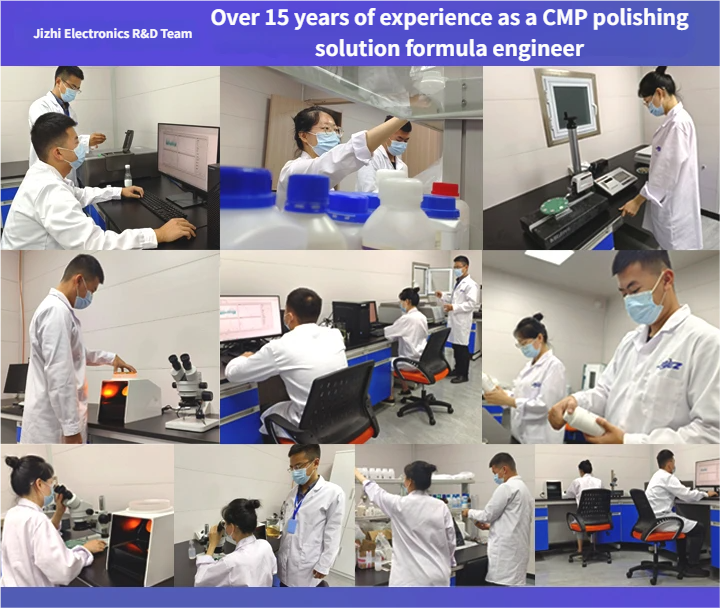
CMP (Chemical Mechanical Polishing) is currently the only technology used in modern industrial manufacturing for surface polishing of workpieces and global planarization of wafer surfaces in integrated circuit manufacturing. The CMP process achieves surface polishing through chemical and mechanical actions. It is widely applied in integrated circuit technology, wafer chip planarization, aerospace materials, the metal industry, and mirror polishing of materials in the optoelectronic industry.
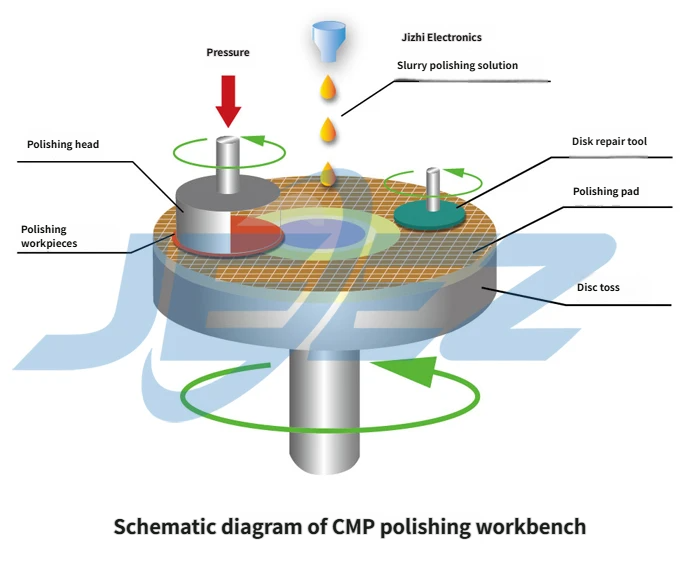
Schematic Diagram of Jizhi Electronics CMP Polishing Process
Based on the type of material being polished, CMP can be divided into three main categories:
(1) Substrates: Primarily silicon materials.
(2) Metals: Including Al/Cu metal interconnect layers, diffusion barrier layers, and adhesion layers such as Ta/Ti/TiN/TiNxCy.
(3) Dielectrics: Including ILD (interlayer dielectrics) such as SiO2/BPSG/PSG, and passivation or barrier layers such as Si3N4/SiOxNy.
During the CMP process, chemical agents in the polishing slurry oxidize the surface of the substrate material, forming a relatively soft oxide layer. This oxide layer is then removed through mechanical friction. The repetitive cycle of oxidation film formation and mechanical removal achieves effective polishing.
Among the CMP material segments, polishing slurry and polishing pads are the most critical materials. Other polishing materials include polishing heads, grinding plates, inspection equipment, and cleaning equipment.
Polishing Slurry
Polishing slurry is a key factor affecting the quality and efficiency of chemical mechanical polishing. Its performance is typically evaluated by measuring the material removal rate (MRR) and surface roughness (Ra). The composition generally includes abrasives, oxidizers, and other additives. The formulation is selected based on the physicochemical properties of the material being polished and the requirements for polishing performance.
-
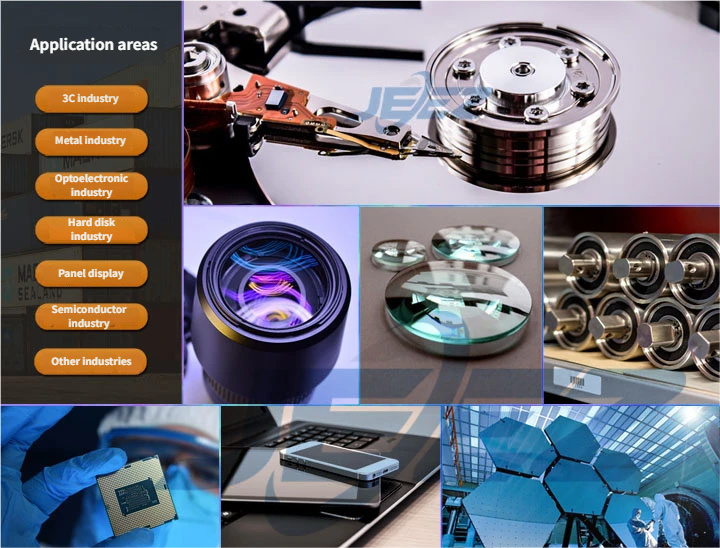
CeO2 (cerium oxide) polishing slurry: Suitable for polishing soft metals, silicon, and other materials. It is the most widely used polishing slurry, commonly applied in the chemical mechanical polishing of products such as mobile phone screens, optical glass, LCD displays, and hard disks.
-
Al2O3 (aluminum oxide) polishing slurry: Offers high hardness and lower cost. It is mostly used for metal materials such as aluminum alloys and stainless steel, as well as sapphire substrates.
-
SiO2 (silicon oxide) polishing slurry: Features small particle size and high-purity nanoscale properties, making it suitable for polishing semiconductor integrated circuits, sapphire, and silicon carbide substrates.
-
Diamond polishing slurry: Characterized by high hardness and angular abrasive particles, it is suitable for hard materials such as optical crystals, magnetic heads, hard disks, superhard alloys, and ceramics.
Depending on the process requirements, polishing slurries are categorized into rough polishing slurry, medium polishing slurry, and fine polishing slurry. The formulation needs to be adjusted and improved based on the properties of the material being polished.
Polishing Pads
In the chemical mechanical polishing process, the polishing pad serves the following functions:
(1) Stores and delivers polishing slurry to the polishing area to ensure continuous and uniform polishing.
(2) Transfers material to remove the required mechanical load.
(3) Removes by-products (such as oxidation products and polishing debris) from the polishing area.
(4) Forms a certain thickness of polishing slurry layer, providing a site for chemical reactions and mechanical removal during polishing.
Polishing pads can be classified into hard and soft types based on material. Hard polishing pads better ensure the flatness of the workpiece surface, while soft polishing pads achieve polished surfaces with thin damage layers and low surface roughness. Commonly used hard polishing pads include coarse cloth pads, fiber fabric pads, and polyethylene pads. Soft polishing pads include polyurethane pads, composite polishing pads, and fleece cloth pads. Fine finishing surfaces often use fine polishing pads such as damping cloth polishing pads.
Currently, with the support of national policies, domestic alternatives to foreign technologies and products have been largely achieved in the mid-to-low-end CMP field in China. However, there remains a significant gap compared to international giants in high-end equipment and cutting-edge technologies. Continuing in-depth research on CMP technology, producing key materials, equipment, or processes with independent intellectual property rights, achieving independent technology and patents for high-end CMP polishing materials, and reducing the cost pressure of purchasing foreign polishing consumables are the directions for efforts and development among all practitioners in the polishing industry.
Jizhi Electronics R&D Team—15 Years of Experienced CMP Polishing Slurry Formulation Engineers, Helping You Overcome Polishing Challenges!