CMP Polishing Pad: Types, Conditioning, and Lifetime Management
A detailed technical guide to CMP polishing pads — covering pad types, material properties, groove architecture, pad conditioning mechanisms, lifetime tracking, and selection criteria for oxide, copper, and advanced-node applications.
The Role of the Polishing Pad in CMP
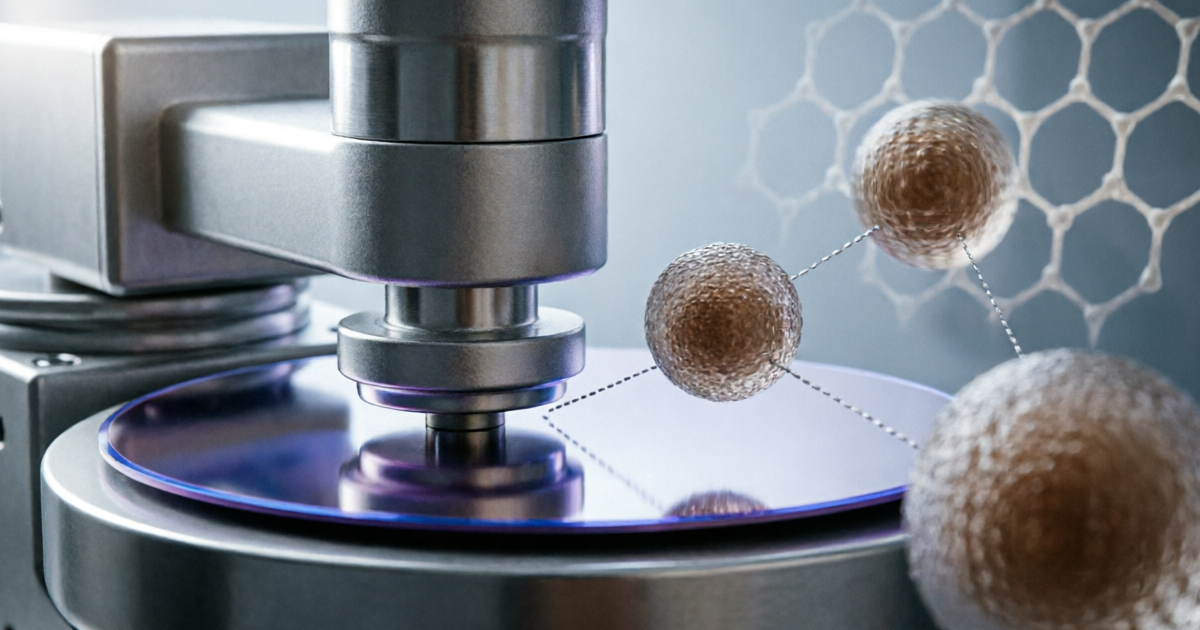
The polishing pad is the primary mechanical interface between the CMP process and the wafer surface. While slurry chemistry gets much of the technical attention in CMP process development, the pad is equally critical: it determines how the slurry is distributed across the wafer, what fraction of the wafer surface is in active contact with abrasive particles at any instant, how the applied pressure is transmitted from the carrier head to the wafer surface, and how uniformly material is removed across the full wafer diameter.
A poorly selected or poorly conditioned pad can cause process instability, within-wafer non-uniformity, and yield-impacting defects that are indistinguishable from slurry problems. Conversely, a well-characterized pad-slurry combination that has been jointly optimized through a systematic DOE delivers more consistent, predictable CMP performance than either component could achieve in isolation. This is why JEEZ recommends evaluating pads and slurries together as a matched consumable set rather than qualifying them independently.
Pad Types: Hard, Soft, and Fixed-Abrasive
Hard Polyurethane Pads (IC1000 Type)
Hard pads — characterized by a Shore D hardness of 55–65 and a Young’s modulus of 300–600 MPa — are the workhorses of production CMP. Their high stiffness means they span across surface topography rather than conforming to it, so polishing pressure is concentrated on the high points of the wafer surface. This is the physical mechanism of planarization: hard pads are self-planarizing. IC1000-type pads are used for oxide ILD CMP, STI CMP (step 1), copper bulk CMP, and tungsten CMP — essentially any application where the primary objective is step height reduction. The limitation of hard pads is their tendency to cause micro-scratches on soft, fragile materials and their higher removal rate on recessed areas compared to soft pads, making them less suitable for the final polishing step where surface finish and dishing control matter most.
Soft Polyurethane Pads (Polytex Type)
Soft pads (Shore D hardness 35–50, Young’s modulus 50–150 MPa) conform to the local surface topography of the wafer. This conformality means polishing pressure is distributed more uniformly across both high and low features — less selective removal of topography peaks. Soft pads are used as the final polishing pad in two-step copper CMP sequences (barrier step), in low-k dielectric CMP where fragile films must be polished at minimal pressure, and for silicon wafer finishing where Ra <0.1 nm is required. Soft pads deliver excellent surface finish but poor planarization efficiency; they should never be used as the sole pad in a process where step height reduction is required.
Stacked Pad Architecture
Production CMP tools universally use a stacked pad configuration: a hard upper polishing pad (the working surface) bonded to a soft compressible subpad. The subpad (typically Suba IV type, Shore A hardness 50–70) compensates for wafer bow and platen surface non-planarity by providing a compliant mechanical interface that maintains uniform contact pressure across the full 300 mm wafer diameter, including the problematic edge region.
Fixed-Abrasive Pads
Fixed-abrasive pads embed the abrasive particles directly in the pad matrix (typically in a periodic array of abrasive composite islands), eliminating the need for abrasive particles in the slurry. They offer the theoretical advantage of a more controlled, uniform particle-surface interaction and enable ultra-high-selectivity polishing for applications like shallow trench isolation where extremely tight Si₃N₄ stop-layer control is needed. However, they are significantly more expensive than conventional slurry-and-pad combinations, have limited material compatibility, and are only in niche production use as of 2026.
Pad Material Science: Polyurethane Structure and Properties
The mechanical properties of a CMP pad are determined by the polyurethane foam microstructure created during pad manufacture. Porous polyurethane pads are produced by a casting process in which a blowing agent generates a network of closed micropores (typically 30–100 µm diameter) throughout the polymer matrix. These pores serve two critical functions: they act as slurry reservoirs, holding a supply of active slurry near the pad-wafer contact zone; and they contribute to the macroscopic compliance of the pad surface, enabling the asperity-scale contact mechanics that govern abrasive particle-wafer interaction.
The key material properties that process engineers should understand and track are:
- Compressive modulus: Determines how the pad deforms under carrier head pressure. Higher modulus → better planarization efficiency; lower modulus → better surface conformality.
- Pore size and density: Controls slurry uptake and retention. Larger, denser pores hold more slurry but may deliver it too aggressively, causing micro-scratching.
- Surface roughness (Ra, Rz): The pad surface asperity height distribution directly determines the effective contact area with the wafer. Fresh pads have Ra of 20–40 µm; properly conditioned pads maintain Ra of 40–80 µm.
- Glass transition temperature (Tg): Sets the upper operating temperature limit. Polishing temperatures should remain at least 20°C below Tg to avoid visco-elastic behavior changes that shift the MRR unexpectedly.
Groove Architecture and Slurry Transport
The surface of a production CMP pad is not smooth — it is machined with a network of grooves that serve as slurry distribution channels. Without grooves, centrifugal force would throw slurry off the pad before it reached the wafer center, creating severe center-fast polishing profiles. Grooves hold and transport slurry across the pad surface, ensuring that a fresh slurry film is continuously presented to every point on the wafer surface during the polishing rotation.
Common Groove Patterns
- Concentric circular grooves (K-grooves): The most common configuration. Uniform slurry distribution across all radii; simple to manufacture. Used in most standard oxide and copper CMP applications.
- Cross-hatch (X-Y grid) grooves: Provides more aggressive slurry exchange and better edge-center uniformity. Used for applications requiring very high slurry consumption or aggressive debris removal from the pad surface.
- Spiral grooves: Combines benefits of circular and cross-hatch patterns. The spiral geometry creates a directed pumping action that moves slurry from the center to the edge of the pad, compensating for centrifugal slurry loss.
- Perforated (hole) patterns: Small holes through the pad allow slurry to be fed from below (through-pad slurry delivery), used in conjunction with special platen designs that pump slurry through the pad from the platen surface.
Groove dimensions (width, depth, pitch) are specified in the pad datasheet and must be considered when changing pad suppliers — different groove architectures can require recipe adjustments even if the pad bulk material is nominally identical.
Pad Conditioning: Mechanism and Methods
Pad conditioning is the process of periodically or continuously abrading the polishing pad surface with a diamond-embedded conditioner disk to maintain the pad’s surface texture and polishing performance throughout its working lifetime. Without conditioning, the pad surface glazes over within 5–20 wafer passes, causing a rapid decline in removal rate and a change in surface finish that introduces defects.
Diamond Conditioner Disk Design
A typical CMP conditioner disk is a stainless steel carrier with industrial diamond grit (particle size 75–200 µm, concentration 30–80 diamonds/cm²) brazed, electroplated, or embedded in a polymer matrix on the working face. The conditioner disk rotates on its own axis while sweeping across the pad surface in a programmed pattern (usually a linear sweep from center to edge) to uniformly condition the entire pad area. The diamond grit cuts micro-channels (2–10 µm deep) back into the pad surface, recreating the open pore structure and surface roughness needed for optimal slurry uptake.
In-Situ vs. Ex-Situ Conditioning
In-situ conditioning runs the conditioner simultaneously with wafer polishing, continuously refreshing the pad surface during the polishing stroke. It provides the most stable, consistent pad performance (minimal run-to-run MRR variation) at the cost of slightly higher pad wear rate and potential contamination of the polishing zone with conditioner-generated pad debris. Ex-situ conditioning runs between wafer polishing steps and does not risk debris contamination of the polish, but allows the pad surface to degrade slightly between conditioner sweeps. Most production fabs use a combination: light in-situ conditioning during polishing plus a more aggressive ex-situ conditioning break at defined intervals.
Pad Glazing: Mechanism and Consequences
Pad glazing is the progressive closure and smoothing of the pad surface microstructure during polishing, driven by three mechanisms: mechanical smearing of pad material under compressive polishing pressure, chemical reaction of slurry components with the pad polymer surface that hardens the surface layer, and filling of pad pores with polishing byproducts (slurry reaction products, pad wear debris, metallic contamination). As the pad glazes, its effective contact area with the wafer increases, reducing the local pressure and therefore the MRR per Preston equation — glazed pads polish slower and less uniformly than freshly conditioned pads.
The practical consequence of pad glazing in production is MRR drift: without adequate conditioning, the polishing rate declines progressively through a pad’s lifetime, requiring increasingly long polish times to achieve the same thickness removal and eventually causing within-lot variation as recipes designed for the mean MRR start underpolishing wafers on glazed pads. In fabs using time-based recipes (without in-situ endpoint detection), pad glazing is a primary source of lot-to-lot and wafer-to-wafer variation.
Pad Lifetime Management
Pad lifetime is typically defined as the number of wafer passes or total polishing time after which the pad’s performance (MRR, uniformity, or defect rate) degrades outside the process specification window. Tracking and managing pad lifetime is a fundamental aspect of CMP process control in any high-volume fab.
| 公制 | 测量方法 | Replacement Trigger |
|---|---|---|
| 焊盘厚度 | Caliper gauge at defined measurement sites | Minimum thickness limit (typically 40–50% of initial thickness) |
| MRR drift | Blanket wafer polishing runs vs. baseline | MRR <80% of initial spec or >5% run-to-run variation |
| WIWNU drift | Post-CMP thickness mapping at 49–121 sites | WIWNU >3% (oxide) or >5% (copper) |
| Defect rate excursion | Post-CMP wafer surface scan (KLA/Candela) | Any upward trend in scratch count per wafer |
| 沟槽深度 | Profilometry | Groove depth <50% of initial spec |
Pad Selection Guide by Application
| 应用 | Recommended Pad Type | Key Properties | Stacked Config? |
|---|---|---|---|
| Oxide ILD CMP | Hard polyurethane (IC1000 type) | High modulus, K-groove, Shore D 60+ | Yes (with soft subpad) |
| STI CMP (Step 1) | 硬质聚氨酯 | High oxide:nitride selectivity compatible; high planarity | Yes |
| Cu Bulk (Step 1) | 硬质聚氨酯 | Durable under H₂O₂ chemistry; spiral or K-groove | Yes |
| Cu Barrier (Step 2) | Soft polyurethane or IC1010 medium | Low defect generation; surface finish Ra <0.3 nm | Yes |
| W CMP | 硬质聚氨酯 | Resistant to alumina slurry abrasion; durable under acidic chemistry | Yes |
| Low-k Dielectric | Soft polyurethane, low modulus | Ultra-low downforce compatible; no delamination risk | 可选 |
| Si Wafer Finishing | Soft non-woven (Polytex type) | Sub-0.1 nm Ra; no polyurethane — special non-woven chemistry | 没有 |
常见问题
Pad replacement frequency depends on the application, polishing aggressiveness, and conditioning protocol. A well-conditioned IC1000-type pad used for oxide ILD CMP typically lasts 500–2000 wafer passes (equivalent to 5–20 km of total polishing distance). Copper CMP pads, which are exposed to oxidizing slurry chemistry, typically have shorter lifetimes (300–1000 wafer passes) due to chemical degradation of the polyurethane surface. The best practice is to track MRR trends and surface roughness measurements as lifetime indicators rather than using a fixed replacement schedule — replace when performance drifts outside the process control window, not on a calendar basis.
They are the same thing. “K-groove” is a trade name for concentric circular groove patterns on IC1000-type pads, derived from the Kelvin groove designation used in the original Rodel/Cabot Microelectronics product naming. The groove pattern consists of concentric rings machined into the pad surface at a defined pitch (typically 3–6 mm) and depth (0.5–1.5 mm). These concentric channels transport slurry radially and help maintain the slurry film between wafer and pad. Other groove patterns — cross-hatch, spiral, XY grid — serve similar slurry transport functions with different slurry residence time distributions and pad-wafer contact area fractions.
Need CMP Pads or Pad Conditioners?
JEEZ supplies hard, soft, and composite CMP polishing pads along with diamond pad conditioners engineered for matched performance with our slurry portfolio.
Request Pad & Conditioner Samples →