Poreless CMP Pads vs. Porous Structure: Technology Comparison
A detailed comparison of poreless and conventional porous CMP polishing pad architectures — examining slurry transport, defect performance, MRR consistency, process control requirements, and total cost of ownership for advanced node and specialty semiconductor applications.
Gen
The shift from conventional porous polyurethane pads to poreless pad architectures is the most significant structural change in CMP pad technology since the introduction of machined groove patterns in the mid-1990s. Poreless pads — with near-zero internal pore volume — eliminate several of the most fundamental performance limitations of conventional pads, particularly lot-to-lot Kp variation and pad-borne polymer debris generation. But they introduce new process control demands that must be understood before a transition is feasible.
This guide provides the rigorous, side-by-side comparison that process engineers need to evaluate whether poreless pads are the right choice for a specific CMP application. For background on pad material types more broadly, see: CMP Pad Materials: Polyurethane vs Other Options.
1. Architectural Differences Explained
In a conventional porous CMP pad, hollow microspheres dispersed throughout the polyurethane matrix create a network of closed-cell micro-pores (20–50 µm diameter, 20–30% volume fraction) that serve as slurry reservoirs. When the pad surface is conditioned, the diamond dresser exposes cross-sections of these pores at the surface, creating an array of micro-cups that absorb and release slurry during polishing. This pore network is the primary slurry transport mechanism within the pad bulk, supplementing the groove-based macro-transport.
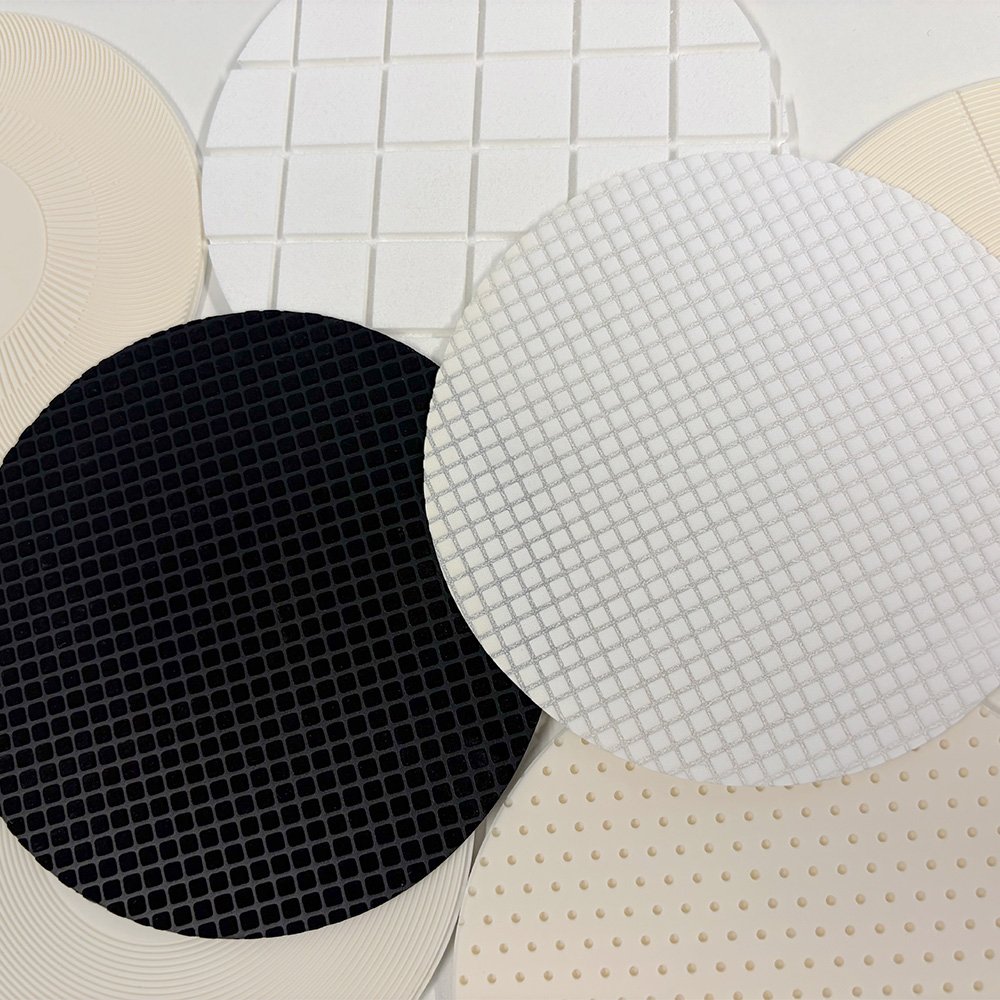
A poreless pad eliminates this internal pore network entirely. The polyurethane is cast from a pore-free formulation (no microspheres), producing a dense, homogeneous polymer matrix with pore volume fraction below 1–2%. The only slurry transport mechanism available is the groove network machined into the pad surface. From a materials science perspective, poreless pads are closer to a solid engineering polymer than to a foam — their mechanical behavior is more predictable, more consistent, and more thermally stable.
2. Slurry Transport: Pore vs. Groove
🔵 Porous Pad — Dual Transport
- Groove channels: macro-transport, slurry delivery from pad edge to contact zone
- Pore reservoir: micro-transport, continuous slurry replenishment between groove passes
- Pore-derived slurry provides a buffer against transient slurry flow interruptions
- Tolerant of slurry flow rate variations of ±20% with minimal MRR impact
- Pore saturation time (1–3 minutes of pre-wet) required before polishing
- Slurry utilization lower — significant volume absorbed into pores and not used at interface
⚡ Poreless Pad — Groove-Only Transport
- Groove channels: sole slurry transport mechanism
- No internal reservoir — slurry at interface is purely groove-delivered, not pad-stored
- Sensitive to slurry flow interruption — MRR drops within seconds of flow stop
- Requires slurry flow rate variation <±10% for stable MRR
- No pre-wet saturation required — ready to polish immediately after installation
- Higher slurry utilization — all delivered slurry reaches the interface directly via grooves
3. Defect Performance Comparison
The most compelling advantage of poreless pads is defect performance, particularly for polymer debris-related particle contamination. The comparison is stark:
| 缺陷类型 | Porous Pad Performance | Poreless Pad Performance | Advantage |
|---|---|---|---|
| Pad polymer debris (particles) | Moderate — pore-wall fragments shed during conditioning and polishing | Very low — no pore walls to fracture; dense matrix sheds minimal debris | Poreless: ~60% fewer pad-borne particles |
| 微小划痕 | Dependent on conditioning — asperity distribution more variable lot-to-lot | Lower variability in asperity distribution — more consistent scratch performance | Poreless: more predictable scratch baseline |
| Slurry particle residues | Moderate — pore-resident slurry can release partially-spent particles | Lower — all slurry is fresh from groove channels; no stale pore-resident particles | Poreless: fewer slurry residue defects |
| MRR-driven non-uniformity | Moderate — pore density variation across pad radius creates MRR radial variation | Very low — groove-only transport has more predictable radial uniformity | Poreless: lower radial MRR variation |
| Pitting from chemical stagnation | Present — pore-resident spent slurry can create chemical hotspots | Eliminated — no stagnant slurry in pores | Poreless: no pore-related pitting |
4. MRR and Lot-to-Lot Consistency
The second major advantage of poreless pads is MRR lot-to-lot consistency — the ability to deliver the same removal rate from one pad lot to the next without recipe adjustment. This is where the pore structure of conventional pads creates a fundamental limitation: pore size distribution (mean diameter and coefficient of variation) varies between production lots despite tight manufacturing controls, causing Kp to shift by 5–15% between lots. This variation requires process engineers to perform removal rate verification on new pad lots and adjust recipe pressure accordingly.
Poreless pads, with no pore structure to vary, deliver Kp values with lot-to-lot CV below 3% — compared to 8–15% CV for conventional porous pads. In practical terms: a process running on a poreless pad in an APC (advanced process control) framework can use a fixed recipe without per-lot verification, reducing engineering overhead and the risk of yield excursion from a new pad lot that was not properly characterized before production release.
5. Process Control Requirements — The Poreless Challenge
The performance benefits of poreless pads come at the cost of significantly tighter process control requirements. These requirements must be evaluated honestly before committing to a poreless pad transition:
- Slurry flow rate stability: ±8% or better — no interruptions; continuous recirculation mandatory
- Groove design: finer pitch mandatory — poreless pads require 1.5–2.5 mm groove pitch vs. 2.5–4.0 mm typical for porous pads, to compensate for the absent pore micro-transport
- Conditioning protocol: gentler — poreless pads respond more acutely to conditioner down-force changes; over-conditioning raises Ra non-uniformly and creates scratch-prone zones
- Pre-polish prep: simplified — no pore saturation pre-wet needed; pad is ready to polish immediately after installation and rinse
6. Conditioning Behavior: Key Differences
Conditioning behavior differs meaningfully between porous and poreless pads in three ways that process engineers must account for when transitioning:
- Break-in time: Poreless pads have no skin layer to remove (the skin is the pad — it is already dense). Break-in is shorter (20–40 dummy wafers vs. 50–100 for porous pads) and MRR reaches stable state faster. However, the first few wafers after installation show slightly elevated debris as machining residue from groove cutting is flushed out.
- Conditioning debris: Conditioning generates less polymer debris from poreless pads because there are no pore walls to fracture. However, the debris that is generated (polymer swarf from surface abrasion) is more consistent in particle size — it does not include the irregular pore-wall fragment shapes that make porous pad debris particularly prone to embedding in soft film surfaces.
- Ra evolution with conditioning: Poreless pads develop lower steady-state Ra than equivalent-hardness porous pads under the same conditioning protocol, because they lack the pore-wall asperity enhancement that porous pads develop. This lower Ra means slightly lower MRR — but also slightly lower scratch generation. Conditioning intensity must be calibrated independently for poreless pads rather than carried over from a porous pad protocol.
7. Total Cost of Ownership Analysis
The unit price premium of poreless pads (2–3× higher) is the most immediate objection to their adoption. A complete TCO analysis often tells a different story:
| Cost Factor | Porous Pad | Poreless Pad | Direction of Advantage |
|---|---|---|---|
| Unit pad price (index) | 1.0× | 2.0–3.0× | Porous |
| Lot qualification cost (engineering labor per lot) | High — MRR verification and recipe adjustment per new lot | Low — fixed recipe; APC compatible | Poreless |
| Yield loss from defect excursions (particle, scratch) | Higher defect rate — more frequent excursions from pore debris | Lower defect rate — especially for advanced node CMP steps | Poreless (if at advanced node) |
| Rework wafer cost | Higher at advanced node — each defective wafer costs $1,000–$10,000+ | Lower — fewer rework events | Poreless (at advanced node) |
| Slurry consumption | Higher — significant slurry volume absorbed into pores | Lower — groove-only transport; higher slurry utilization efficiency | Poreless |
| APC recipe complexity | Higher — lot-specific Kp adjustment required | Lower — fixed recipe possible with tight Kp tolerance | Poreless |
For high-value advanced node processes (7 nm and below) where wafer yield is critically important, poreless pads consistently show positive TCO versus conventional porous pads despite the unit price premium. For mature-node or research applications where defect density is more relaxed and pad cost is a primary concern, conventional porous pads remain the economically rational choice.
8. When to Use Each Architecture
✅ Use Conventional Porous Pads When:
- Process node ≥14 nm where defect density targets are achievable with porous pads
- Slurry delivery system cannot guarantee <±8% flow rate stability
- Research or low-volume production where pad cost per wafer dominates TCO
- Mature-node oxide CMP where defect requirements are relaxed
- SiC substrate intermediate polishing (Stage 2) where MRR is more important than defect density
- Process requires tolerance to occasional slurry flow interruptions
⚡ Use Poreless Pads When:
- Process node ≤7 nm — defect density targets below 10 particles/wafer
- EUV-layer dielectric CMP — any particle that prints in EUV exposure is catastrophic
- APC framework requires per-lot recipe stability without Kp adjustment
- Cu BEOL defect excursions are driven by polymer debris, confirmed by EDX
- 3D NAND step-height CMP requiring ultra-consistent planarization from lot to lot
- Slurry delivery system already optimized for high-flow-rate stability