Contamination Control in Polishing Templates: Clean Room Assembly & Particle Prevention
A single glass fiber fragment from a degraded polishing template carrier plate can scratch dozens of wafers before it is identified. Contamination control starts at template manufacturing — with cleanroom assembly, material selection, and outgassing verification — and continues in-fab through handling, storage, and end-of-life protocols.
The Four Contamination Source Categories
Polishing templates are in intimate contact with both the wafer surface and the polishing slurry throughout each polishing run. Any contamination present on the template — whether introduced during manufacturing, carried over from a previous run, or generated in situ by chemical or mechanical degradation of the template material — has direct access to the wafer surface and the slurry bath. Understanding the four source categories is the prerequisite for implementing controls that address each one effectively.
Glass fiber fragments from FR-4/G-10 delamination, resin debris from epoxy matrix chemical attack, CXT matrix particles from abrasive wear at work-hole edges. Primary source of scratch defects.
Metal ions (Fe, Cu, Ni, Al) adsorbed from slurry onto carrier plate or backing pad surfaces between runs. Desorb during subsequent polishing into the slurry bath and onto wafer surfaces.
Plasticizers, unreacted monomers, and solvent residues migrating from backing pad polymer. Can contaminate slurry bath chemistry and deposit organic films on wafer surfaces that affect subsequent process steps.
Residual slurry from a prior process chemistry carried into a subsequent run. Can introduce incompatible abrasives, pH-modifying chemicals, or metal ions from a different process into the new slurry bath.
The relative importance of each category depends on the process. For silicon SSP in alkaline colloidal silica, organic outgassing from backing pad and ionic contamination are the primary concerns — mechanical particle generation from FR-4 is minimal at alkaline pH with non-oxidizing slurry. For SiC CMP in KMnO₄ or H₂O₂ slurry, mechanical particle generation from chemical attack on FR-4 or G-10 becomes the dominant concern. For compound semiconductor polishing, all four categories are relevant simultaneously. The material grade selection strategy that addresses the mechanical and chemical degradation mechanisms is covered in our FR-4 vs G-10 vs CXT guide; this article focuses on the contamination control measures that operate independently of material grade.
Why Particle Size Matters for Scratch Defects
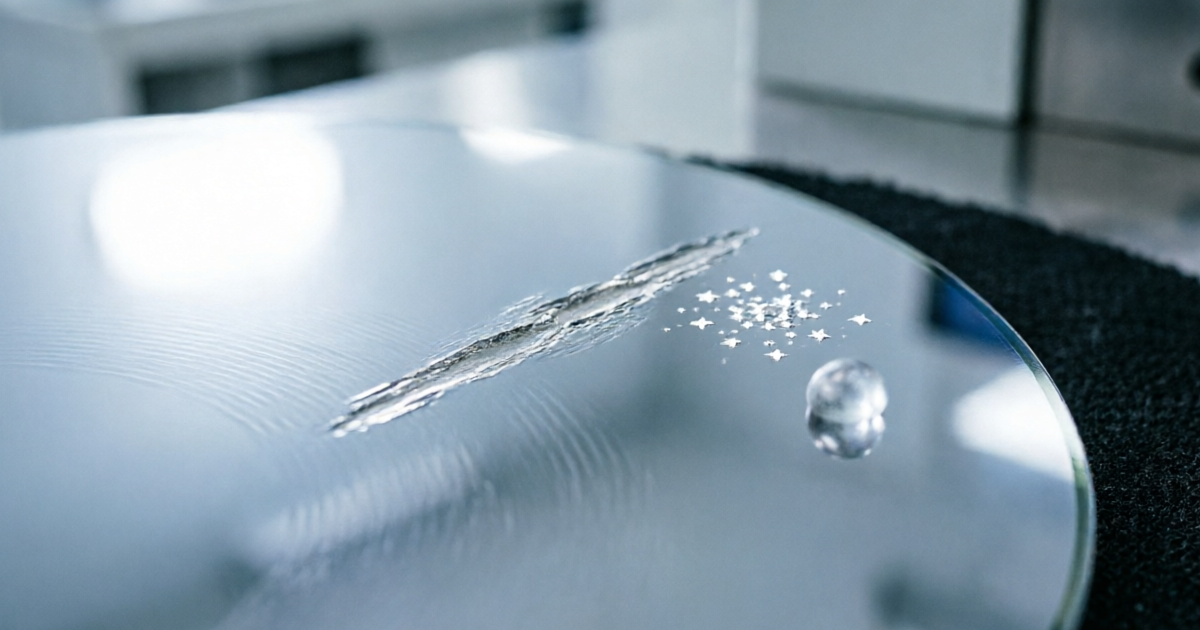
Not all particles from polishing templates create wafer defects. The critical threshold is determined by the relationship between particle size and the polishing gap — the distance between the wafer surface and the polishing pad surface during active material removal. Particles smaller than the polishing gap pass through without contact; particles larger than the gap are trapped between the wafer and pad and translate into compressive force into the wafer surface, creating scratches.
The polishing gap in silicon SSP and CMP is in the 0.1–0.5 µm range — far smaller than glass fiber diameters (5–15 µm) and smaller than most resin debris particles (0.5–5 µm). This means that essentially every glass fiber fragment that enters the polishing bath from a degraded FR-4 or G-10 template is capable of creating a scratch defect. The scratch length produced by a single glass fiber is typically several millimeters — far larger than the fiber diameter — because the fiber is dragged across the wafer surface by the relative motion of the polishing pad, producing a long narrow scratch rather than a point indentation.
Cleanroom Assembly Standards
Polishing templates introduce contamination into the semiconductor process environment from their very first use. Particles deposited on the backing pad surface or trapped in work-hole corners during manufacturing — before the template ever contacts a wafer — become a contamination source in the first polishing run. The cleanroom environment in which the template is assembled directly determines the baseline particle burden the template brings to the process.
The Backing Pad Bonding Operation
Backing pad bonding is the highest contamination risk step in template assembly. The adhesive application process mobilizes any particles present on the carrier plate surface, and the lamination step traps particles at the pad-plate interface where they create localized pad thickness variations that produce TTV non-uniformity. Adhesive squeeze-out at the pad perimeter, if not controlled, creates an irregular adhesive bead at the work-hole edge that is both a particle generation site and a chemical retention reservoir. All backing pad bonding operations should be performed in ISO 5 or better conditions, with the adhesive and pad components handled exclusively with cleanroom-compatible tooling.
IPA wipe followed by DI water rinse and N₂ blow-dry. Inspect under 10× illuminated magnification for residual particles before adhesive application. Any particle on the carrier face at this stage will be laminated under the backing pad.
Risk: embedded pad-interface particles → TTV variationApply PSA or liquid adhesive uniformly across the carrier face. Control coverage to avoid adhesive entering the work-hole opening — adhesive on work-hole walls contacts the wafer edge during polishing and is a metallic/organic contamination source.
Risk: work-hole adhesive contamination → wafer edge ionic contaminationLaminate pad at defined pressure (typically 0.5–1.0 kg/cm²) using a flat press — not hand pressure — to ensure uniform bond thickness across the carrier plate area. Non-uniform lamination pressure creates differential pad thickness that is indistinguishable from carrier plate bow in TTV measurements.
Risk: non-uniform lamination → systematic TTV error from cycle 1Remove any adhesive squeeze-out at the pad perimeter with a cleanroom swab before it cures. For production templates, the pad edge is sealed with a compatible edge sealant to prevent slurry ingress under the pad during polishing — a primary mechanism of pad delamination in service.
Risk: unsealed pad edge → slurry ingress → delamination at cycle 20–40Visual inspection of completed template under illuminated magnification. Particle count verification on backing pad surface (see Section 8). Package immediately in sealed anti-static bag within the ISO 5 zone before removal to storage.
Risk: post-assembly particle deposition during open-air exposure before packagingCarrier Plate Material as a Particle Source
The three carrier plate materials — FR-4, G-10, and CXT — have fundamentally different particle generation characteristics that follow directly from their material structure. Understanding these differences is essential for matching material grade to particle sensitivity requirements, and for predicting the cycle count at which particle generation from chemical degradation will become a yield issue for a given process chemistry.
| Material | Particle Generation Mechanism | Particle Type | Onset Cycle (acidic oxidant slurry) | Mitigation |
|---|---|---|---|---|
| FR-4 | Epoxy matrix chemical attack → fiber-resin interface delamination → glass fiber release | E-glass fibers 5–15 µm dia., resin chunks 1–10 µm | Cycle 20–40 | Switch to G-10 or CXT; limit to alkaline silica only |
| G-10 | Same mechanism as FR-4 but slower (no brominated FR additive accelerating attack); also mechanical abrasion at work-hole wall | E-glass fibers 5–15 µm dia., resin particles 0.5–5 µm | Cycle 40–80 | Switch to CXT for aggressive chemistries; monitor work-hole wall erosion |
| CXT | No fiber-resin interface to delaminate; mechanical abrasion at work-hole edge under severe misuse only | Sub-micron CXT matrix fragments (rare, only under severe abrasion) | Not applicable — pad-limited | Correct work-hole clearance; avoid impact loading during wafer insertion |
The Glass Fiber Liberation Sequence in FR-4/G-10
Glass fiber contamination from FR-4 and G-10 templates is not a sudden event — it follows a predictable four-stage degradation sequence. In Stage 1 (early cycles), the epoxy matrix surface slowly softens and becomes slightly porous. In Stage 2, the fiber-resin interface begins to weaken as slurry chemistry penetrates along the interface. In Stage 3, individual fibers begin to debond from the matrix at the carrier plate surface — this is the stage at which particle generation first becomes detectable in slurry bath sampling. In Stage 4, multiple fiber debonding events accelerate, producing a rapid increase in particle count that coincides with visible surface discoloration and micro-blistering of the carrier plate. The transition from Stage 3 to Stage 4 is rapid — often 5–10 cycles — making Stage 3 detection the critical intervention window. Regular carrier plate surface inspection (visual, 10× magnification) at every measurement interval is the early warning system for Stage 3.
Backing Pad Chemistry & Outgassing
Polishing template backing pads are polymer composites — typically polyurethane-based foams or solid elastomers with Shore A hardness in the 25–80 range depending on the application. These materials contain a range of chemical constituents beyond the base polymer that can migrate into the process environment: plasticizers used to control hardness, residual monomers from incomplete curing, and residual solvent from the manufacturing process. The migration of these constituents into the polishing slurry bath is called outgassing, even though the mechanism is primarily liquid-phase dissolution rather than true vapor-phase release.
Organic Contamination Pathways
Backing pad outgassing introduces organic molecules into the slurry bath that can affect process performance in two ways. First, dissolved organic molecules alter slurry surface chemistry — they can adsorb on silica abrasive particle surfaces, changing colloidal stability and agglomeration behavior, or adsorb on the wafer surface and modify removal rate by blocking active sites. Second, organic molecules that remain on the wafer surface after polishing can interfere with subsequent process steps that are sensitive to surface carbon contamination: gate oxide growth in CMOS processing, metal adhesion in via metallization, and optical thin-film deposition in photonic device fabrication.
The outgassing rate from backing pads is highest during the first 5–10 polishing cycles (the “break-in” period when loosely bound surface constituents are rapidly extracted) and then drops to a low steady-state level for the remainder of the service life. For ultra-high-purity applications — 300 mm silicon CMP for advanced logic nodes, GaAs/InP device polishing — a new template can be pre-conditioned by soaking in DI water at 40–50°C for 30–60 minutes before its first production use, accelerating the extraction of loosely bound organics and shortening the high-outgassing break-in period.
Slurry Cross-Contamination Between Runs
Cross-contamination occurs when residual slurry from one process chemistry is carried into the next polishing run on the same template without adequate intervening cleaning. The risk is highest in fabs that use the same template design for multiple process steps with different slurry chemistries — for example, a silicon template used alternately for SSP (alkaline silica, pH 10) and a pre-metal dielectric CMP step (acidic slurry, pH 4). Even small volumes of residual acidic slurry carried into the alkaline process bath can shift local pH, alter abrasive colloidal stability, and introduce ionic species that produce metallic contamination on the wafer surface.
Cross-Contamination Risk Matrix
| Previous Slurry | Next Slurry | Cross-Contamination Risk | Required Cleaning Between Runs |
|---|---|---|---|
| Alkaline silica (pH 10–12) | Alkaline silica (pH 10–12) | Low | Standard DI rinse |
| Alkaline silica (pH 10–12) | Acidic CeO₂ (pH 4–6) | Moderate | DI rinse + 60 s dilute citric acid (pH 4) pre-soak, then DI rinse |
| KMnO₄ oxidant (pH 9–11) | Any subsequent chemistry | High — MnO₂ deposits | 0.1% citric acid neutralization + DI rinse + visual verification (no brown staining) |
| Bromine-based (GaAs/InP) | Any silicon process | Critical — As/Ga contamination | Dedicated templates per chemistry — do not share templates between GaAs and Si processes |
| H₂O₂ acidic (SiC CMP) | Alkaline silica (Si SSP) | Moderate — Fe ion risk | DI rinse + 60 s dilute HCl (0.1%) strip, then DI rinse; inspect for surface discoloration |
| Diamond abrasive (sapphire) | Diamond abrasive (sapphire) | Low | Standard DI rinse; verify no diamond aggregate clumping in work hole |
The most critical cross-contamination scenario — using a template that has contacted GaAs or InP polishing slurry for any subsequent silicon process — warrants a firm operational policy: templates used for compound semiconductor polishing are never reused for silicon or other semiconductor processes. The arsenic and gallium contamination levels achievable from even trace GaAs slurry residue exceed the tolerable contamination budget for silicon CMOS device junctions by orders of magnitude. Implementing substrate-specific template inventory with clear labeling and segregated storage is the operational control for this risk.
In-Fab Contamination Prevention During Handling
Template contamination does not occur only during polishing — it accumulates at every handling step between storage and the polisher chuck, and between the polisher chuck and return to storage. Each contact event (picking up the template, setting it on a surface, loading wafers into the work hole) is a potential particle transfer event. The following practices eliminate the most common in-fab contamination sources without requiring changes to cleanroom classification or capital equipment.
- Always handle templates with cleanroom gloves. Bare skin contact deposits organic compounds (sebum, amino acids, skin cells) on the backing pad surface. These compounds are difficult to remove with standard DI rinse and accumulate with each handling event, eventually contributing to the organic contamination load in the process bath.
- Never set templates face-down on uncontrolled surfaces. The backing pad surface — which contacts the wafer during polishing — should contact only the interior of its storage bag or a dedicated clean surface. Resting the template face-down on a cleanroom wiper or bench surface deposits particles on the backing pad that transfer to the wafer surface in the next polishing run.
- Inspect the backing pad surface under illuminated magnification before every production lot. A 30-second visual inspection at 5–10× magnification before loading the first wafer of each production lot detects any particles large enough to cause scratch defects that were deposited during storage or handling since the last inspection. This inspection adds 30 seconds to the process setup time and prevents the entire lot from being processed on a contaminated template.
- Use dedicated transfer containers for templates in transit. Moving templates between storage and the polisher in their sealed storage bags — rather than open-air transfer on a flat carrier — eliminates exposure to ambient particulate during transit. In fabs where the polisher is in a different cleanroom zone from the template storage, the template should remain sealed until it is at the polisher station.
- Never blow a template dry with unfiltered compressed air. Facility compressed air in most fabs contains oil mist from compressor lubrication and metallic particles from pipe corrosion, both of which deposit on the template surface. Use filtered nitrogen (H₂O < 10 ppm, oil < 0.01 ppm) from a dedicated clean gas manifold, or allow templates to air-dry in the ISO 5 cleanroom environment.
Particle Verification Protocol
Contamination control measures are only effective if their performance is verified by measurement. The following particle verification protocol establishes the measurement points and acceptance criteria that confirm templates entering production meet the contamination requirements for the application.
| Verification Point | Method | Parameter | Acceptance Criterion | Frequency |
|---|---|---|---|---|
| Incoming template — backing pad surface | Optical particle counter on 50 ml DI water rinse of pad surface | Particles ≥ 0.5 µm per cm² | < 5 particles/cm² ≥ 0.5 µm | 100% on first 3 lots per supplier; 20% thereafter |
| After backing pad bonding (manufacturer) | Visual + illuminated magnification 10× | Visible particles, adhesive squeeze-out, voids | Zero visible particles > 50 µm; zero squeeze-out in work hole | 100% at manufacturer |
| Post-run slurry bath sampling | In-line particle counter on slurry bath sample | Particles ≥ 5 µm (glass fiber detection threshold) | Alert at > 2× baseline; replace template if confirmed uptrend over 3 consecutive runs | Every 10 polishing cycles |
| Carrier plate surface — in-service inspection | Visual under 10× illuminated magnification | Surface discoloration, micro-blistering, fiber exposure | Any Stage 3 degradation signs → immediate replacement evaluation | Every 5 cycles (SiC/compound semi) or every 10 cycles (Si SSP) |
| Wafer surface defect correlation | Post-polish defect inspection (laser scan or optical) | Scratch defect density LPD > 0.5 µm | Alert if scratch density increases > 2× vs. process baseline | First wafer of each template lot + every 20 cycles |
End-of-Life Template Disposal
A polishing template at end of service life has absorbed slurry chemistry into its carrier plate material, accumulated polishing byproducts in the backing pad pores, and — for some processes — adsorbed regulated metal ions or organic compounds from the slurry. Disposal must be consistent with the hazardous material content, which varies significantly by the process chemistry the template was used with.
| Process Chemistry Used | Primary Hazardous Content | Disposal Classification | Key Requirement |
|---|---|---|---|
| Alkaline colloidal silica (Si SSP) | Silica particles, trace K or Na ions | General solid waste (in most jurisdictions) | Verify no regulated metal content in slurry before downgrading to general waste |
| H₂O₂ / acidic (SiC CMP) | Residual H₂O₂ (dissipates quickly), Fe/Cr ions from slurry | Composite material waste | Allow H₂O₂ to fully dissipate before disposal. Check Fe/Cr content vs. local limits. |
| KMnO₄ (SiC/oxide CMP) | MnO₂ deposits, Mn²⁺ ions | Inorganic oxidant waste | Treat with reducing agent (Na₂SO₃ solution) to convert residual oxidant before disposal |
| Bromine-based (GaAs/InP) | Arsenic compounds, gallium, indium, phosphorus | Hazardous waste — regulated | Treat as hazardous waste per facility RCRA/local equivalent procedures. Do not grind. |
| HF / fluoride-containing | Fluoride compounds, SiF₄ precursors | Hazardous waste — regulated | Neutralize fluoride content with Ca(OH)₂ slurry before disposal. Segregate from other waste streams. |
Frequently Asked Questions
Polishing Templates Series — Complete
You’ve reached the final article in the Jizhi polishing templates content series. Explore the full library of 14 engineering guides covering every aspect of polishing template selection, specification, troubleshooting, and operation.