How CMP Equipment Works: A Step-by-Step Process Guide
Table of Contents
The CMP Process, Step by Step
At a high level, chemical mechanical planarization is a repeating cycle of chemical softening and mechanical removal, carried out under tightly controlled pressure, rotation, and slurry flow. While exact sequencing varies between equipment platforms and recipes, the core process follows the same five stages on virtually every CMP tool.
Wafer Loading and Mounting
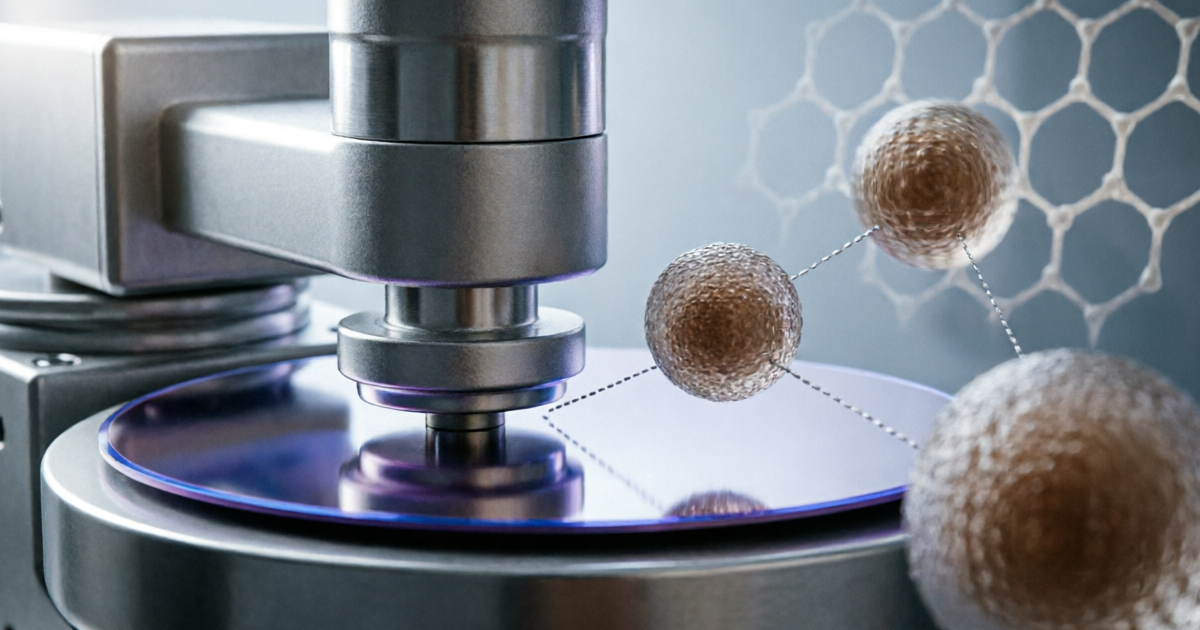
The wafer is transferred into the polishing module and mounted face-down onto the polishing head, where a retaining ring and a flexible membrane hold it securely while allowing pressure to be applied evenly across its surface.
Pad Contact and Pressure Application
The polishing head lowers the wafer onto the rotating polishing pad and applies downward pressure. On modern tools, this pressure is often divided into multiple independently controlled zones across the wafer radius to fine-tune the removal profile.
Slurry Dispense
A slurry arm dispenses a chemically active, abrasive slurry onto the center of the rotating pad. Centrifugal force and pad grooves distribute the slurry across the pad surface and into the wafer-pad interface.
Chemical Reaction and Mechanical Removal
Oxidizers and additives in the slurry react with the exposed film, forming a softened reaction layer. Abrasive particles and the pad’s surface texture then mechanically remove this layer, with high points on the wafer removed faster than low points — producing the planarization effect.
Endpoint Detection and Wafer Unload
An in-situ endpoint detection system continuously monitors the process and signals when the target thickness or planarity has been reached. The polishing head lifts, and the wafer is transferred to the post-CMP cleaning modules.
For a complete look at the equipment subsystems that perform each of these steps, see CMP Equipment Key Components Explained.
The Chemistry Behind Chemical Mechanical Planarization
The “chemical” half of CMP is what distinguishes it from a purely mechanical grinding or lapping process. The slurry dispensed onto the pad is formulated with oxidizers, complexing agents, pH modifiers, and corrosion inhibitors that are selected based on the specific film being polished.
For copper CMP, oxidizers convert the exposed copper surface into a thin oxide or complex layer that is mechanically softer and easier to remove than metallic copper itself. For oxide CMP, the slurry chemistry promotes hydration of the silicon dioxide surface, weakening the silicon-oxygen bonds so that abrasive particles can remove material more efficiently. For tungsten and barrier layers, different oxidizer and chelating agent combinations are used to achieve controlled removal rates without excessive galvanic corrosion between dissimilar metals on the wafer surface.
The pH of the slurry also plays a major role: it affects both the rate of the chemical reaction at the wafer surface and the stability and dispersion of the abrasive particles within the slurry itself. Slurry suppliers carefully balance these factors to deliver a target removal rate, selectivity between different film types, and a low defect profile.
The Mechanics Behind Chemical Mechanical Planarization
The “mechanical” half of CMP comes from the relative motion between the wafer and the polishing pad, combined with the abrasive particles suspended in the slurry and the surface texture of the pad itself.
As the platen and polishing head rotate — often at different speeds and sometimes in different directions — every point on the wafer surface traces a complex path across the pad. The pad’s surface asperities (its microscopic peaks and valleys, refreshed continuously by the conditioner) make contact with the wafer and, together with the abrasive particles trapped at the interface, mechanically remove the chemically softened layer.
Because raised features on the wafer surface make contact with the pad earlier and more frequently than recessed features, they experience a higher effective removal rate. Over many rotations, this differential removal is what flattens the wafer — converting a topographically uneven surface into a globally planar one. The relationship between pressure, relative velocity, and removal rate is the basis for how CMP recipes are tuned, and is closely related to the classical Preston equation used in polishing science.
Key Process Parameters That Control CMP Results
Process engineers tune a relatively small set of parameters to control removal rate, uniformity, and defectivity. The table below summarizes the most important ones and their typical effect.
| Parameter | Effect on Process |
|---|---|
| Downforce / pressure | Higher pressure generally increases removal rate but can increase defects, dishing, and erosion if not controlled per zone |
| Platen and head rotation speed | Affects relative velocity at the pad-wafer interface, influencing removal rate and uniformity |
| Slurry flow rate and concentration | Controls the supply of fresh chemistry and abrasive to the interface; too little can cause non-uniform removal, too much increases consumable cost |
| Pad conditioning frequency | Maintains consistent pad surface texture; under-conditioning leads to declining removal rates over time |
| Platen temperature | Affects the rate of the chemical reaction at the wafer surface, particularly for copper and barrier CMP |
A more detailed look at how the pad and conditioner subsystem influences these parameters over the life of a pad is available in CMP Polishing Pads and Conditioners Explained, and the role of the slurry delivery system in maintaining consistent flow and concentration is covered in CMP Slurry Delivery Systems Explained.
Common CMP Process Challenges
Even with well-tuned parameters, CMP processes are prone to a few recurring challenges that process engineers must manage:
Within-wafer non-uniformity (WIWNU): Variation in removal rate across the radius of the wafer, often caused by uneven pressure distribution, pad wear patterns, or slurry distribution issues.
Dishing and erosion: In damascene structures, softer metal features can be polished faster than surrounding dielectric (dishing), or dense arrays of features can erode faster than isolated ones (erosion) — both of which must be controlled through slurry selectivity and process tuning.
Scratches and particle defects: Large abrasive agglomerates, pad debris, or contamination in the slurry delivery path can cause surface scratches, which is why filtration and slurry line maintenance are critical — covered in more depth in our maintenance guide.
Post-CMP residue: Slurry residue left on the wafer surface after polishing can cause defects in subsequent process steps if not fully removed by the cleaning modules, which we cover in CMP Equipment Cleaning and Contamination Control.
How Equipment Components Fit Into the Process
Every step described above is carried out by a specific subsystem within the CMP tool — the polishing platen and pad provide the mechanical surface, the polishing head controls pressure and wafer positioning, the slurry delivery system supplies the chemistry, the conditioner maintains the pad surface, and the endpoint detection system decides when to stop. Understanding how these components are built and how they interact is the foundation for troubleshooting process drift and planning consumable strategy. For a full breakdown of each subsystem, see CMP Equipment Key Components Explained, and for the bigger picture of how all of this fits into equipment selection, return to our chemical mechanical planarization equipment guide.
Need Help Matching Slurry or Pad Chemistry to Your CMP Process?
JEEZ supplies polishing consumables engineered for stable removal rates and low defectivity. Talk to our team about your specific application.
Contact UsFrequently Asked Questions
What are the main steps in the CMP process?
The core steps are wafer loading onto the polishing head, lowering the wafer onto the rotating pad under controlled pressure, dispensing slurry onto the pad, the combined chemical and mechanical removal of the film, and endpoint detection followed by transfer to cleaning.
Why is CMP called a “chemical mechanical” process?
Because material removal happens through the combined action of a chemically reactive slurry, which softens the wafer surface, and mechanical abrasion from the polishing pad and abrasive particles, which removes the softened layer. Neither action alone produces the same planarization result.
What causes non-uniform removal during CMP?
Non-uniform removal is typically caused by uneven pressure distribution across the wafer, inconsistent pad conditioning, or uneven slurry distribution at the pad-wafer interface. Modern CMP equipment addresses this with multi-zone pressure control on the polishing head.
How does endpoint detection know when to stop polishing?
Endpoint detection systems use in-situ sensing methods — such as optical reflectance, motor current monitoring, or eddy current sensing for metal films — to track changes that correlate with film thickness, allowing the tool to stop the process automatically once the target is reached.