CMP Equipment Key Components Explained
Inhaltsübersicht
Polishing Platen and Table
The polishing platen is the rotating base onto which the polishing pad is mounted. It is one of the most mechanically demanding parts of the entire tool, since it must rotate at a controlled, repeatable speed while maintaining a flat, rigid surface under the pad across thousands of polishing cycles.
Many platens include integrated temperature control — either heating or cooling — because platen temperature directly influences the rate of the chemical reaction between the slurry and the wafer surface, particularly in copper and barrier CMP processes. Some advanced platforms also use vacuum chucking to hold the pad flat and prevent shifting during high-speed rotation.
On multi-platen systems, each platen is typically dedicated to a specific step in a multi-step polish sequence — for example, a bulk-removal step on the first platen followed by a gentler, more selective finishing step on a second platen, with the wafer transferred between platens automatically within the same tool.
Polishing Head and Wafer Carrier
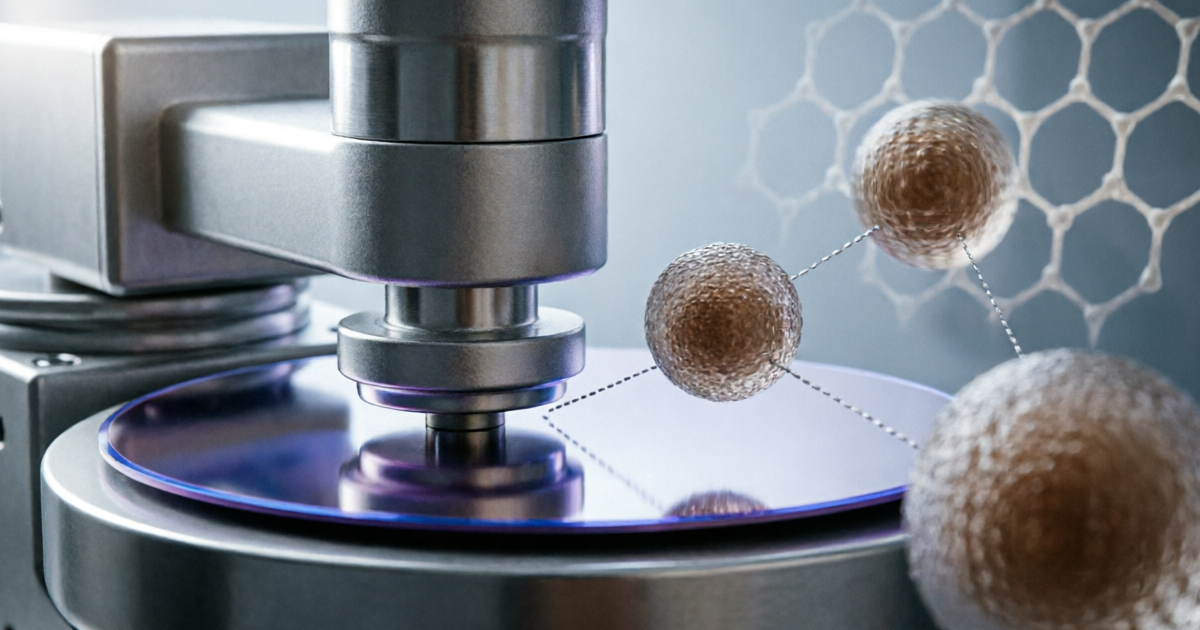
The polishing head, also called the wafer carrier, holds the wafer face-down against the polishing pad and applies the downward pressure that drives the mechanical removal process. It is arguably the single most important component for controlling within-wafer uniformity.
Modern polishing heads use a flexible membrane behind the wafer, divided into multiple independently controllable pressure zones across the wafer’s radius. By adjusting the pressure in each zone, process engineers can compensate for known removal-rate patterns — for example, increasing edge pressure to counteract edge fast-removal effects that are common on many CMP platforms.
A retaining ring around the wafer edge keeps the wafer centered on the pad during polishing and helps manage the pressure profile at the wafer edge, which is often the hardest region of the wafer to planarize uniformly. Retaining ring wear is itself a consumable consideration, since a worn ring can change edge removal behavior over time.
Polishing Pad and Pad Conditioner
The polishing pad is the physical surface the wafer is polished against, and the conditioner is the component responsible for keeping that surface in a consistent, productive state throughout the pad’s life. Pads are typically constructed from polyurethane, often in a layered structure with a harder top layer for mechanical contact and a softer sub-pad layer for compliance and pressure distribution.
As polishing proceeds, the pad surface gradually glazes over — its microscopic texture flattens and becomes less effective at trapping abrasive particles and channeling slurry. The pad conditioner, typically a diamond-embedded disc mounted on a sweeping arm, continuously abrades the pad surface to restore this texture, a process often run both during and between polishing cycles.
Because pad and conditioner condition directly determines removal rate stability and defectivity, this subsystem deserves its own deep dive — see CMP Polishing Pads and Conditioners Explained for pad materials, groove patterns, conditioning profiles, and wear indicators.
Slurry Delivery System
The slurry delivery system supplies the chemically active, abrasive slurry to the pad surface at a controlled flow rate and concentration. It typically includes bulk slurry storage, pumps, in-line filtration, and a dispense arm with one or more nozzles positioned over the pad.
On many modern tools, slurry is delivered as a concentrate and mixed with deionized water at the point of use, allowing the equipment to fine-tune concentration for different process steps without requiring separate bulk supplies for every dilution ratio. Filtration at multiple points in the delivery path is critical for removing oversized abrasive agglomerates that could otherwise cause surface scratches.
The slurry delivery system is covered in full detail — including point-of-use dilution, filtration strategy, and common failure modes — in CMP Slurry Delivery Systems Explained.
Endpoint Detection System
The endpoint detection system monitors the polishing process in real time and signals the tool to stop once the target film thickness or surface condition is reached. Several detection methods are used, often in combination:
| Erkennungsmethode | How It Works |
|---|---|
| Optical reflectance | Measures changes in light reflected from the wafer surface through a window in the polishing pad, useful for transparent or semi-transparent films |
| Motor current / torque monitoring | Detects changes in friction at the pad-wafer interface as the film transitions between materials with different removal characteristics |
| Eddy current sensing | Used primarily for metal films such as copper, detecting changes in conductivity as the metal layer thins |
Accurate endpoint detection is essential for avoiding both under-polishing, which leaves residual film that can cause electrical shorts, and over-polishing, which can erode underlying structures and damage the device.
Cleaning, Drying and Wafer Transfer Modules
After polishing, the wafer carries residual slurry particles and chemical residue on both its front and back surfaces. The cleaning module — typically a combination of brush scrubbers, megasonic cleaning, and chemical rinse stations — removes this residue before the wafer moves to a spin-rinse-dry station.
Wafer transfer robotics move the wafer between the polishing module, cleaning module, and load ports, and are designed to minimize particle generation and avoid scratching the freshly polished surface. The design of this subsystem has a direct impact on defect density and is covered in depth in CMP Equipment Cleaning and Contamination Control.
Frame, Enclosure and Process Control Software
While less visible than the polishing module, the tool’s frame, environmental enclosure, and process control software play an important role in overall performance. The enclosure controls airflow and particle levels around the polishing module, helping to maintain a clean environment for the wafer.
Process control software manages recipe execution — coordinating pressure profiles, platen speeds, slurry flow, conditioning sweeps, and endpoint triggers for each process step — and increasingly incorporates automated data logging and statistical process control (SPC) features that help fabs detect drift before it affects yield.
How These Components Work Together
None of these subsystems operates in isolation. The platen and pad provide the polishing surface, the head controls pressure and positioning, the slurry system supplies the chemistry, the conditioner maintains the pad, the endpoint system decides when to stop, and the cleaning modules prepare the wafer for the next process step — all coordinated by the control software according to a defined recipe. For a walkthrough of how these components interact during an actual polishing cycle, see How CMP Equipment Works, or return to our complete CMP equipment guide for the full picture, including equipment types and applications.
Sourcing Pads, Conditioners or Slurry for Your CMP Tool?
JEEZ supplies polishing consumables designed to work reliably across a range of CMP equipment platforms. Reach out to discuss your specifications.
KontaktHäufig gestellte Fragen
What is the most important component of a CMP tool for uniformity?
The polishing head, or wafer carrier, is generally considered the most important component for within-wafer uniformity, since its multi-zone pressure control directly shapes the removal-rate profile across the wafer’s radius.
Why do CMP tools need a pad conditioner?
Polishing pads gradually glaze over and lose their surface texture during use. The conditioner, typically a diamond-embedded disc, continuously refreshes the pad surface so that removal rates remain consistent throughout the pad’s lifetime.
What types of endpoint detection are used in CMP equipment?
Common methods include optical reflectance for transparent or semi-transparent films, motor current or torque monitoring to detect friction changes between materials, and eddy current sensing for metal films such as copper.
Why is the cleaning module considered part of CMP equipment rather than a separate tool?
Because residual slurry and particles on a freshly polished wafer can cause defects in later process steps, most modern CMP platforms integrate cleaning, drying, and wafer transfer directly into the same tool to minimize handling and reduce contamination risk.