How CMP Polishing Pads Work: Mechanisms, Physics, and Process Science
A rigorous, engineer-level explanation of the mechanical, chemical, and tribological mechanisms that govern material removal in CMP — and how every key pad property maps to a measurable process outcome.
Verified
- The CMP System at a Glance
- Pad-Wafer Contact Mechanics
- The Chemical Removal Mechanism
- The Mechanical Removal Mechanism
- Slurry Transport and the Pad’s Role
- Preston’s Equation and Its Limits
- Tribological Regimes in CMP
- How Pad Properties Drive Outcomes
- Pad Degradation and Performance Drift
- PREGUNTAS FRECUENTES
CMP is often described simply as “chemical and mechanical polishing,” but that shorthand masks a rich interplay of solid mechanics, surface chemistry, hydrodynamics, and tribology. Understanding how a CMP polishing pad actually works — at the level of asperity contact, slurry film dynamics, and chemical reaction kinetics — is what separates engineers who can diagnose and fix CMP yield excursions from those who can only adjust recipe parameters by trial and error.
This article provides a mechanistic, physics-grounded explanation of CMP pad operation. It builds from first principles: what happens at the pad surface when it contacts a wafer, how slurry chemistry and pad mechanics cooperate to remove material, and how that understanding maps to the physical properties specified on a pad data sheet. If you are new to CMP and want to start with the basics first, see: What Is a CMP Polishing Pad? The Ultimate Guide.
1. The CMP System at a Glance
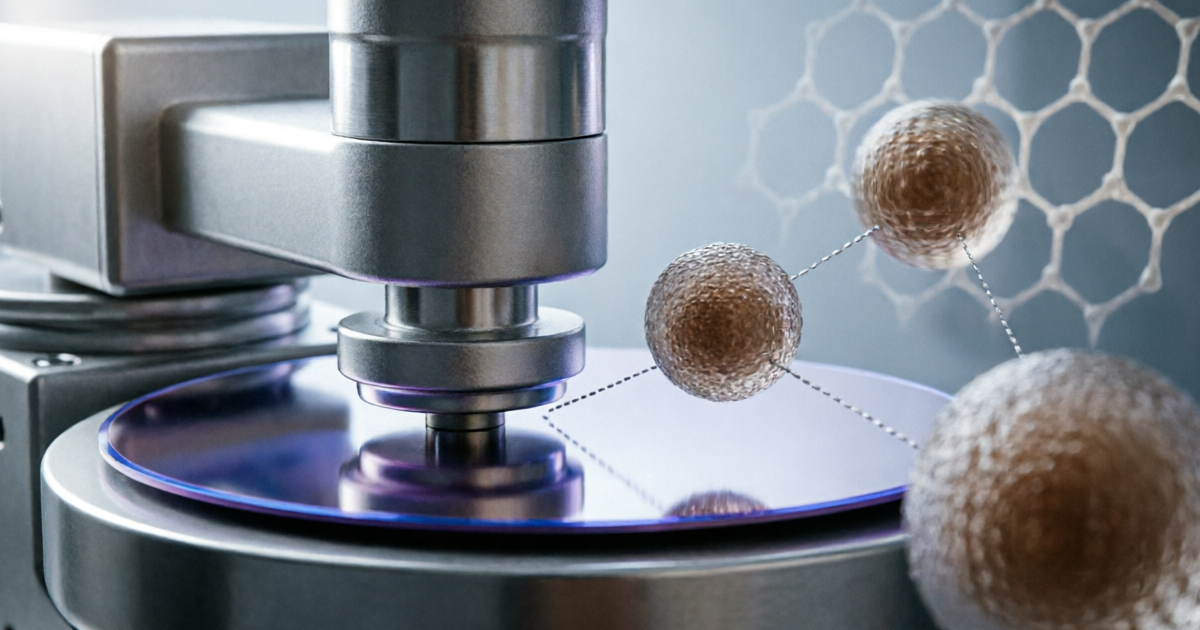
Before diving into the mechanisms, it is useful to establish a clear picture of the physical system. A CMP polishing tool consists of a large rotating platen onto which the pad is mounted, a carrier head that holds the wafer face-down and presses it against the pad under a controlled down-force, and a slurry delivery arm that dispenses abrasive slurry onto the pad surface. Both the platen and the carrier head rotate — typically in the same direction but at slightly different speeds — creating a relative velocity between pad and wafer that drives material removal.
These five steps happen concurrently and cyclically during a polishing run. The pad’s contribution is not limited to a single step — it participates in steps 1 (groove transport), 3 (asperity mechanics), and 4 (groove drainage), while its surface state is governed by step 5. This interdependence is why pad properties affect so many different process outcomes simultaneously.
2. Pad-Wafer Contact Mechanics: What Actually Touches What
The most important and least intuitive aspect of CMP physics is the nature of the contact between pad and wafer. At the macroscale, the pad appears to sit flush against the wafer surface under a uniform pressure. At the microscale, the reality is far more complex — and far more interesting.
The Three-Body Contact Model
Real contact between pad and wafer does not occur over a continuous interface. The pad surface is covered with asperities — micro-scale protrusions of polyurethane polymer — that range from 1 to 20 µm in height and are spaced several tens of micrometers apart. Under the applied down-force, only the tips of the tallest asperities make direct contact with the wafer surface. The actual contact area at any instant is estimated to be 1–5% of the nominal (geometric) pad area.
Between the asperity contact points, a thin film of slurry fills the gap. Abrasive particles (typically 60–200 nm in diameter) are trapped in this gap and can be engaged by both the pad asperity above and the wafer surface below. This three-body configuration — pad asperity / slurry particle / wafer surface — is the primary site of material removal in most CMP applications.
Contact Pressure Distribution
The nominal applied pressure P (carrier head down-force divided by wafer area, typically 1–6 psi on 300 mm tools) is distributed very non-uniformly at the microscale. At asperity tips, local contact stresses can be 10–100× the nominal pressure due to the small real contact area. This high local stress is what enables the abrasive particles trapped at the contact to plastically deform and remove material from the much harder wafer surface films.
Pad hardness directly governs this local stress amplification. A hard pad (Shore D 60) has stiffer asperities that maintain their geometry under load, generating higher local contact stresses and thus higher material removal rates. A soft pad (Shore D 38) has compliant asperities that flatten under load, spreading the contact area and reducing local stress — which lowers the removal rate but improves conformance to wafer topography and reduces defect generation. For a practical guide to choosing between these two extremes, see: Hard vs. Soft CMP Polishing Pads: Selection Guide.
3. The Chemical Removal Mechanism
CMP is not pure mechanical abrasion — the “C” in CMP is doing critical work. The chemical component of material removal operates through a cycle of surface passivation and depassivation that is essential to achieving both the high removal rates and the low defect densities that semiconductor manufacturing requires.
The Passivation-Abrasion Cycle
Chemical Attack: Forming the Passivation Layer
Reactive species in the slurry — oxidizers (H₂O₂, KIO₃, KMnO₄), complexing agents (glycine, benzotriazole), and pH-adjusting buffers — react with the exposed wafer surface to form a thin, chemically modified “passivation layer.” For SiO₂ CMP, this is a silanol-rich gel layer (~2–5 nm thick). For Cu CMP, it is a copper oxide (Cu₂O/CuO) layer. For W CMP, it is a tungsten oxide layer. The passivation layer is softer and more mechanically fragile than the underlying bulk film.
Mechanical Removal: Stripping the Passivation Layer
Abrasive particles, engaged by pad asperities at the three-body contact interface, abrade away the weakened passivation layer. Because the passivation layer is much softer than the bulk film beneath it, the abrasive particles can remove it efficiently without generating deep sub-surface damage in the bulk material. The key insight is that the abrasives are removing the chemically modified surface, not the bulk film directly.
Re-passivation: The Cycle Repeats
Once the passivation layer is removed at a contact point, the fresh bulk film surface is immediately exposed to slurry chemistry and begins forming a new passivation layer. The removal cycle repeats at each asperity contact point with a frequency determined by the relative velocity between pad and wafer and the asperity spacing. At typical process conditions (platen speed 60 rpm, carrier 57 rpm on a 300 mm tool), each point on the wafer surface is contacted by a given pad asperity at a rate of several hundred times per second.
Film-Specific Chemistry Examples
| Película objetivo | Slurry Oxidizer / Agent | Passivation Layer Formed | Key Pad Requirement |
|---|---|---|---|
| SiO₂ (oxide ILD) | High-pH ceria or silica slurry (pH 10–11) | Silanol-gel layer (Si-OH rich, ~3 nm) | Hard pad for planarization efficiency; groove for slurry retention |
| Cu (damascene) | H₂O₂ + BTA (benzotriazole), pH 4–7 | Cu₂O passivation + BTA-Cu complex | Soft pad to protect low-k dielectric; low-scratch surface |
| W (plug fill) | H₂O₂ + Fe²⁺ (Fenton), pH 2–4 | WO₃ tungsten oxide layer | Hard pad; high-selectivity to stop on barrier nitride |
| SiC (power device) | KMnO₄ or H₂O₂ (high conc.), pH 8–10 | SiO₂-like surface oxide (~1–2 nm, forms slowly) | Specialty hard pad with chemical resistance; high-pressure capable |
| Low-k dielectric | Mild pH, low oxidizer concentration | Thin hydroxyl-modified surface | Very soft pad; ultra-low down-force to prevent film delamination |
4. The Mechanical Removal Mechanism: Abrasion, Plowing, and Fracture
The mechanical component of CMP operates through three sub-mechanisms, each dominant in different process conditions:
Micro-abrasion (dominant)
Abrasive particles roll or slide across the passivated surface, removing thin layers of the chemically weakened material through frictional shear. This is the primary mechanism in most semiconductor CMP applications, generating smooth surfaces with Ra < 1 nm.
Micro-plowing
Under high local contact stress — hard pads, large abrasive particles, or high down-force — abrasive particles plastically deform (plow through) the surface rather than rolling across it. Plowing achieves higher removal rates but generates deeper surface damage and scratch defects.
Brittle fracture
Relevant primarily for ultra-hard materials like SiC (Mohs 9.5), where the material does not deform plastically under abrasion. Instead, sub-surface crack propagation and lateral fracture drive material removal. Pad hardness and abrasive type must be carefully matched to avoid deep sub-surface damage that affects device reliability.
The dominant mechanism in any given CMP process is determined by the combination of pad hardness, abrasive particle size and hardness, applied pressure, and target film mechanical properties. For specialty materials such as SiC, where brittle fracture must be carefully managed to avoid sub-surface damage in the final device layer, pad design and slurry selection are significantly more complex. See our detailed treatment in: SiC CMP Polishing Pads for Third-Generation Semiconductors.
5. Slurry Transport and the Pad’s Structural Role
The pad does not just provide a mechanical surface — it is also a fluid transport system. Getting fresh slurry to the pad-wafer contact interface and removing spent slurry and reaction byproducts efficiently is critical to process stability, and the pad’s design directly governs both functions.
Macro-Transport: Groove Networks
The groove network machined into the pad surface provides the primary channels for bulk slurry flow. When slurry is dispensed onto the rotating pad, centrifugal force drives it radially outward through the groove channels. As the wafer sweeps across the pad surface, grooves passing under the wafer edge feed fresh slurry into the contact zone while simultaneously evacuating spent material. Groove pattern geometry — concentric, XY grid, spiral — determines the radial uniformity of slurry delivery and is a major pad design variable. For a full technical analysis of groove design, see: CMP Pad Groove Design and Slurry Distribution.
Micro-Transport: Pad Pores as Slurry Reservoirs
Between grooves, slurry reaches the contact interface through a second, subtler mechanism: capillary uptake into the pad’s open pore network. As the pad rotates past the slurry dispense arm, slurry is drawn into the surface pores by capillary action, creating a distributed reservoir of slurry-soaked pad material beneath the wafer. During polishing, pressure and shear force slurry out of the pores at asperity contact points, replenishing the thin film at the pad-wafer interface continuously.
This is why poreless pads behave differently from conventional porous pads: without an internal reservoir, slurry transport relies entirely on the groove network. Poreless pads demand more precise slurry flow rate control but, in return, offer near-zero pad-borne contamination from pore debris. For a detailed comparison, see: Poreless CMP Pads vs. Porous Structure.
Thermal Transport
Frictional energy at the pad-wafer contact converts to heat, raising the pad and wafer temperature during polishing. Temperature affects both the pad’s mechanical properties (polymers soften with increasing temperature, reducing effective hardness) and the slurry’s chemical reaction rates (oxidation and complexation reactions are temperature-dependent). Groove channels also serve as thermal dissipation pathways, carrying heat away from the contact zone in the slurry flow. Elevated operating temperature — common in SiC and high-pressure oxide CMP — must be accounted for in pad material selection and groove depth specification.
6. Preston’s Equation: The Governing Model and Its Real-World Limits
The empirical relationship between process parameters and material removal rate in CMP is captured by the Preston equation, first proposed by F.W. Preston in 1927 for glass polishing and adapted for semiconductor CMP in the 1990s. It remains the most widely used framework for CMP process modeling despite its simplifications.
The Preston equation states that removal rate scales linearly with both applied pressure and relative velocity. Doubling pressure doubles MRR; doubling velocity doubles MRR. The Preston coefficient Kp encapsulates all the pad and slurry material properties — hardness, porosity, abrasive type, particle size — into a single constant that must be determined empirically for each pad-slurry-film combination.
Where Preston Breaks Down
The linear Preston model works well in the mid-pressure, mid-velocity operating regime of most production CMP processes. Outside this regime, important deviations occur:
⬇️ Low Pressure / Low Velocity Regime
- Hydrodynamic lubrication dominates — the slurry film becomes load-bearing and lifts the pad away from the wafer
- Real contact area approaches zero; MRR drops below Preston prediction
- Occurs at P < ~1 psi or V < 0.1 m/s on 300 mm tools
- Common in soft-pad Cu CMP with ultra-low-k films — engineers must account for non-linear behavior near process limits
⬆️ High Pressure / High Velocity Regime
- Pad deformation under high load reduces effective asperity height and contact area — MRR plateaus or declines
- Frictional heat generation rises rapidly — pad softening reduces effective hardness, further reducing Kp
- Defect density increases sharply above a critical pressure threshold
- Occurs at P > ~5 psi or high-temperature conditions — a common trap in aggressive oxide CMP recipes
Understanding these deviations is essential for process window engineering. The quantitative relationship between pad parameters and Kp is covered in detail in our article on CMP Material Removal Rate and Pad Parameters.
7. Tribological Regimes in CMP: From Boundary to Hydrodynamic
CMP tribology — the study of friction, wear, and lubrication at the pad-wafer interface — is governed by the Stribeck curve framework adapted for the CMP context. Three tribological regimes define the operating space:
Boundary Lubrication Regime (High P, Low V)
Direct asperity-to-asperity contact dominates. The slurry film is too thin to separate the surfaces. Friction is high, removal rate is high, and surface damage risk is elevated. This regime is relevant in the early stages of a polishing run when the pad surface is freshly conditioned and asperities are tall and sharp.
Mixed Lubrication Regime (Optimal Operating Window)
Both direct asperity contact and hydrodynamic slurry film bearing contribute to load support. This is the desired operating regime for most production CMP: removal rate follows Preston’s equation reasonably well, surface quality is acceptable, and the process is stable. Most fab processes operate in this regime by design.
Hydrodynamic (Full-Film) Lubrication Regime (Low P, High V)
The slurry film fully separates pad and wafer — no direct contact. The fluid film is load-bearing, friction drops dramatically, and material removal essentially stops. This regime is intentionally induced in some “soft-landing” CMP endpoint protocols, where a brief low-pressure, high-velocity clearing step removes residual slurry from the wafer surface without further film removal.
8. How Each Pad Property Drives a Specific Process Outcome
With the mechanisms established, we can now map each physical pad property to its process impact with precision. This is the engineering vocabulary that connects a pad data sheet to a process result.
| Pad Property | Mechanism Affected | Primary Process Outcome | Secondary Effect |
|---|---|---|---|
| Hardness (Shore D ↑) | Asperity contact stress ↑ | MRR ↑, planarization efficiency ↑ | Scratch density ↑, WIWNU ↑ on bowed wafers |
| Compressibility (% ↑) | Macro-scale wafer conformance ↑ | WIWNU ↓ (edge-to-center uniformity ↑) | Planarization efficiency ↓ |
| Pore diameter (↑) | Slurry reservoir capacity ↑ | Slurry utilization efficiency ↑ | Contact area ↓, debris risk ↑ |
| Pore density (↑) | Slurry micro-transport to interface ↑ | MRR stability ↑, lower sensitivity to slurry flow variation | Effective hardness ↓ |
| Groove depth (↑) | Macro slurry transport capacity ↑ | More uniform slurry distribution, better byproduct removal | Pad life ↓ (less usable material above groove floor) |
| Groove pitch (↓, closer grooves) | Slurry delivery frequency under wafer ↑ | Radial MRR uniformity ↑ | Contact area ↓; risk of particle trapping in dense grooves |
| Elastic recovery (↑) | Asperity height stability during long runs ↑ | MRR stability over extended polishing campaigns | Higher effective hardness under cyclic loading |
| Surface roughness Ra (↑) | Asperity tip density ↑ | MRR ↑ after conditioning to higher Ra | Micro-scratch risk ↑ |
Understanding these relationships enables systematic pad selection and process optimization. For a focused discussion of how pad material composition determines these properties, see: CMP Pad Materials: Polyurethane vs Other Options.
9. Pad Degradation Mechanisms and Performance Drift Over Time
A freshly installed pad does not deliver its peak, stable performance immediately — nor does a pad in service maintain constant performance without active management. Three simultaneous degradation processes govern how pad performance evolves over its operational lifetime.
Glazing (Thermal Surface Vitrification)
During polishing, frictional heat at asperity contacts partially melts and re-solidifies the polyurethane surface. This “glazing” process smooths asperity tips, reducing surface roughness Ra and effective contact stress — and therefore reducing MRR. An unconditioned pad can lose 30–40% of its initial removal rate within 10–20 wafer passes purely from glazing. In-situ conditioning with a diamond disk dresser continuously abrades away the glazed surface layer, restoring asperity geometry and maintaining stable MRR.
Pore Clogging
Spent abrasive particles, polished film fragments, and reaction byproduct precipitates progressively pack into pad pores and grooves, reducing slurry uptake capacity and disrupting the micro-transport mechanism described in Section 5. Clogged pores create “dead zones” on the pad surface where slurry starvation causes locally low removal rates — a direct contribution to within-wafer non-uniformity. Conditioning abrades the clogged surface layer, re-opening pore access to fresh slurry.
Cumulative Thickness Loss
Both conditioning and polishing remove pad material continuously. The pad thins from its nominal value (typically 2.0–2.5 mm) toward the minimum usable thickness above the backing layer (typically 0.5–0.8 mm). As the pad thins, its bulk compressibility and stiffness change, gradually altering the macroscale contact mechanics and leading to slow drift in WIWNU over the pad lifetime. Tracking pad thickness — via optical measurement or contact gauge at each pad installation and at regular intervals — is a critical process control activity. For a complete protocol on pad conditioning and end-of-life management, see: CMP Pad Conditioning and Lifespan Management.