CMP Defects: Types, Root Causes, and Prevention Strategies
A systematic reference for process and yield engineers covering every major CMP-induced defect mode — mechanism, root cause analysis, inline detection methods, and actionable prevention and corrective action strategies.
Why CMP Defects Matter for Yield
CMP is one of the most defect-sensitive operations in the entire semiconductor fabrication sequence. A single defective CMP run on a fully processed 300 mm wafer — one that has already accumulated 50–100 prior process steps — can destroy the value of weeks of processing on hundreds of die simultaneously. Understanding CMP defect modes in depth is therefore not merely academic: it is a commercial imperative that directly affects yield, cycle time, and manufacturing cost.
CMP defects fall into two broad categories: physical defects (scratches, particles, delamination, cracking) that are immediately detectable by wafer surface inspection tools, and parametric defects (dishing, erosion, non-uniformity, residue) that may not be visible to standard optical inspection but cause electrical failures downstream in probe test or reliability qualification. Both categories require systematic process control strategies to prevent.
Micro-Scratches and Macro-Scratches
Mechanism
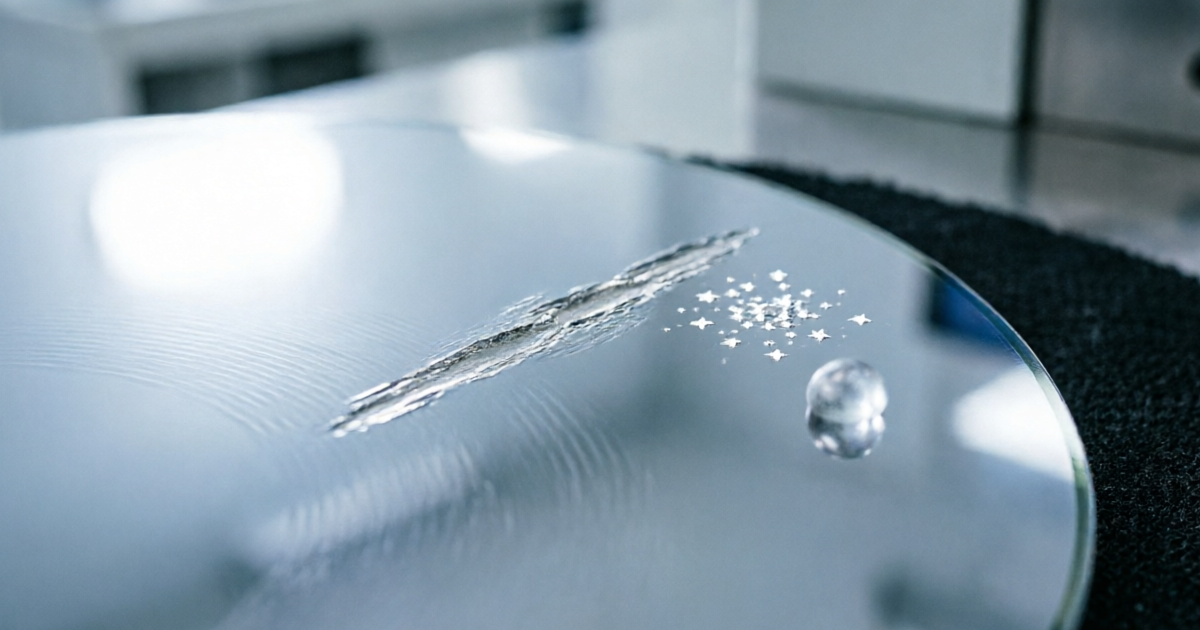
Scratches are formed when a hard, rigid particle (either an agglomerated slurry cluster, a pad debris fragment, or a retaining ring wear particle) is trapped between the polishing pad and the wafer surface and is dragged across the wafer under polishing pressure. The particle acts as a cutting tool, plowing a groove into the wafer surface material. Micro-scratches (width <1 µm, depth <50 nm) are caused by primary abrasive particles that have agglomerated into clusters of 3–5 particles. Macro-scratches (width >1 µm, depth >100 nm) are caused by larger contaminants — pad debris, conditioner diamond fragments, or large agglomerates from slurry delivery system failures.
Yield Impact
A single macro-scratch crossing 200 nm copper interconnects over a distance of 1 mm will sever dozens of lines, killing every die that the scratch crosses. Even micro-scratches that do not fully sever a conductor create thinning defects that accelerate electromigration failure, reducing device reliability below specification. In EUV lithography layers, any scratch or residual particle on the wafer surface creates a local topography variation that disturbs the aerial image focus and causes critical dimension (CD) errors in the patterned layer above.
Root Causes
- Agglomerated slurry particles (oversize agglomerates formed by temperature cycling, pH drift, surfactant depletion, or excessive shear in delivery pumps)
- Contaminated slurry delivery system (particles shed by deteriorated seals, valves, or filter media)
- Diamond conditioner fragments shed into the polish zone (conditioner delamination or overaggressive conditioning)
- Retaining ring wear debris (worn plastic retaining ring generating polymeric particles)
- Pad debris from glazed or damaged pad surface
Prevention Strategies
- Strict point-of-use filtration with scheduled filter replacement
- Inline particle count monitoring at slurry dispense; auto-hold on excursion
- Conditioner disk inspection and replacement schedule based on diamond pullout monitoring
- Retaining ring wear monitoring and proactive replacement
- Slurry shelf-life and storage condition enforcement
Dishing
Mechanism
Dishing is the formation of a concave depression in metal lines or contact areas after CMP, where the metal surface sits below the level of the surrounding dielectric. It results from the mechanical compliance of the polishing pad: as copper in a wide feature polishes slightly faster than the surrounding oxide, a shallow recess forms. The compliant pad then partially conforms to this recess, presenting the pad surface against the copper at greater contact area than against the recessed oxide sidewalls — further accelerating copper removal within the feature and deepening the dishing in a self-amplifying cycle. The severity of dishing scales with feature width, polish time overrun, pad compliance, and slurry MRR ratio (Cu/oxide selectivity).
Prevention
- Use hard pads for bulk removal step (resist pad conformality)
- Optimize endpoint detection to minimize overpolish time
- Increase BTA concentration in Cu slurry to passivate recessed copper areas
- Implement dummy fill at design rule level to equalize pattern density
- Reduce slurry Cu:oxide selectivity for the barrier step
Erosión
Mechanism
Erosion is the thinning of the dielectric layer in regions of high metal pattern density. In a dense array region (e.g., a memory array where metal lines cover 70% of the surface area), the composite removal rate of the metal+dielectric mixture is higher than the removal rate of the field oxide alone, because the metal polishes faster than the oxide and the high density of metal features means the pad is always partially in contact with fast-polishing metal. The result is that the array region is lower than the surrounding field oxide at the end of CMP — a step height that must be accounted for in subsequent lithographic layers.
Prevention
- Metal dummy fill in low-density regions to equalize pattern density across the die (primary mitigation)
- Two-step CMP with separate endpoint triggers for array and field regions
- Slurry selectivity optimization (lower Cu removal rate relative to oxide)
- Die-level CMP simulation to predict erosion topography and guide fill insertion
Delamination and Film Cracking
Mechanism
Delamination is the separation of one or more film layers from the underlying substrate or adjacent layer during CMP. It is the dominant failure mode in low-k dielectric CMP, where the weak cohesive strength and low Young’s modulus of porous ultra-low-k (ULK) films make them extremely susceptible to the mechanical stress generated by polishing forces. Even at polishing pressures below 1 psi, the tensile stress at the film-substrate interface during pad contact can exceed the cohesive strength of a porous ULK film with k <2.2.
Film cracking — typically observed as star-shaped or circumferential crack patterns in dielectric films — is related to delamination but represents intra-film fracture rather than interfacial separation. Cracking is associated with excessive polishing pressure on brittle dielectric films and is irreversible: a cracked dielectric layer must be reworked or the wafer scrapped.
Prevention
- Ultra-low downforce CMP protocols for ULK materials (<1 psi, <0.5 psi for k <2.2)
- Soft pad selection to distribute contact force over a larger effective contact area
- Adhesion-promoting liner layers (SiCN, SiC, CoWP) between ULK and the overlying metal
- Slurry pH optimization — avoid highly acidic slurries that degrade the SiO₂-like backbone of carbon-doped oxide ULK films
- Pre-CMP anneal to maximize film density and cohesive strength before polishing
Corrosion and Pitting
Copper and cobalt interconnect lines are susceptible to galvanic and chemical corrosion during CMP if the slurry chemistry is not properly formulated. Corrosion manifests as pitting (localized dissolution of metal creating microscopic holes in the line), surface roughening (grainy copper surface after CMP indicating non-uniform oxidation-dissolution), or galvanic attack at the Cu-barrier metal interface (where the electrochemical potential difference between Cu and Ta drives preferential dissolution of one metal).
The primary corrosion prevention mechanism in Cu CMP is BTA (benzotriazole), which adsorbs onto copper surfaces to form a passivating monolayer. BTA concentration must be maintained above a threshold (typically >1 mM) throughout the polishing cycle, including during the transition between polishing and post-CMP cleaning. Corrosion risk is highest during static etch (pad lift-off, wafer transfer, rinse transitions) when the mechanical abrasion that removes the corrosion product layer is absent, allowing galvanic corrosion to proceed unchecked.
Within-Wafer Non-Uniformity (WIWNU)
Within-wafer non-uniformity (WIWNU) is the variation in removed film thickness across the diameter of a single polished wafer, expressed as a percentage: WIWNU(%) = (σ / mean) × 100. It is the most comprehensive measure of CMP process performance — a low MRR with excellent uniformity is generally preferable to a high MRR with poor uniformity, because uniformity determines the yield contribution of the CMP step to the process flow.
The primary sources of WIWNU in production CMP are: pad-wafer contact mechanics (bow, edge effects), carrier head pressure zone calibration drift, pad conditioning non-uniformity, slurry flow rate and temperature gradients across the pad, and retaining ring wear. At advanced nodes (28 nm and below), WIWNU specifications of <1.5% (1σ) are required for critical metal layers — achievable only with multi-zone carrier heads, in-situ endpoint control, and statistical process control (SPC) on all critical recipe parameters.
Residue and Staining
Residue defects are materials remaining on the wafer surface after CMP and post-clean that were not successfully removed. The most common forms include: metal residue (incompletely cleared barrier metal in via or trench corners, causing electrical shorts between adjacent metal levels), organic film residue (BTA or slurry surfactant films that resist aqueous cleaning), and cerium-related staining (CeO₂ particles that adhere strongly to SiO₂ surfaces at neutral pH and require acidic cleaning chemistry to remove). Residue defects are detected by wafer surface inspection and verified by energy-dispersive X-ray (EDX) spectroscopy in a scanning electron microscope.
Defect Root Cause Matrix
| Defect | Primary Root Cause | Secondary Root Cause | Método de detección | First Response Action |
|---|---|---|---|---|
| Micro-scratch | Slurry agglomerate (oversize particle) | POU filter bypass or failure | KLA wafer inspection (brightfield) | Replace POU filter; measure slurry PSD |
| Macro-scratch | Conditioner diamond fragment; pad debris | Retaining ring chip | KLA wafer inspection; SEM cross-section | Replace conditioner disk; inspect pad |
| Dishing | Overpolish past endpoint | Soft pad, high Cu:oxide selectivity | AFM step height; XRF Cu thickness | Tighten endpoint detection; reduce overpolish time |
| Erosión | High local pattern density without dummy fill | Slurry over-selectivity in dense array | Post-CMP thickness mapping; profilometry | Add dummy fill (DRC check); optimize selectivity |
| Delaminación | Excessive downforce on ULK film | Poor adhesion of ULK to underlying layer | Optical inspection; acoustic microscopy | Reduce carrier head pressure; check ULK adhesion spec |
| Corrosion/pitting | Insufficient BTA concentration | pH excursion in Cu slurry | SEM; EDX; optical dark-field scan | Check slurry BTA loading; measure slurry pH |
| WIWNU excursion | Carrier head membrane drift / pad glazing | Conditioner sweep non-uniformity | 49/121-site thickness map | Recalibrate carrier head zones; intensify conditioning |
| Metal residue | Underpolish at barrier step endpoint | Poor slurry penetration in feature corners | Sheet resistance; EDX; electrical test | Extend barrier CMP time; optimize slurry flow |
Defect Detection Methods
- Brightfield optical inspection (KLA Surfscan, Candela): High-speed surface scan detecting particles, scratches, and macro defects ≥50 nm. Standard post-CMP inspection tool in all advanced-node fabs.
- Darkfield optical inspection: Particularly sensitive to residue films, staining, and low-contrast topographic defects that brightfield misses.
- Atomic Force Microscopy (AFM): Measures surface roughness (Ra, Rq), dishing depth on designated test structures, and step height erosion profiles. Reference measurement for process qualification.
- Scanning Electron Microscopy (SEM) + EDX: Cross-section SEM for scratch depth analysis, delamination characterization, and residue identification by elemental composition (EDX).
- X-ray fluorescence (XRF): Non-destructive measurement of residual metal film thickness and composition. Used for barrier residue and copper dishing quantification.
- Electrical test (comb/fork structures): Detects metal residue shorts (comb structure leakage) and scratch-induced open circuits (serpentine resistance increase) at the wafer probe stage.
Preguntas frecuentes
In copper CMP, the two most yield-impacting defect types are micro-scratches (caused by slurry agglomerates or delivery system contamination) and dishing (caused by overpolishing of wide copper features). Of these, micro-scratches are typically more immediately detectable by wafer surface inspection and more directly traceable to a root cause (slurry POU filter failure, agglomeration event). Dishing is more insidious — it passes optical inspection but causes RC delay increases and electromigration reliability degradation that appear as yield loss or early-life failures. Both require continuous process monitoring and control.
Some CMP defects can be reworked; others are permanent. For oxide ILD CMP, if the wafer is underpolished (insufficient planarization), it can be repolished — the oxide is reformed, and a second CMP pass can achieve the target planarity. However, overpolished wafers (too much oxide removed) generally cannot be reworked because the oxide cannot be selectively re-deposited. For copper CMP, rework is extremely limited: overpolished copper (excessive dishing) cannot be corrected without stripping and re-depositing the entire metal level. Scratches, delamination, and cracking are always permanent — wafers with these defects are scrapped or downgraded to less critical product.
Facing Unexplained CMP Yield Loss?
JEEZ provides process failure analysis support and can supply sample qualified slurry and pad sets to help you resolve CMP defect excursions quickly.
Request Process Support →