Colloidal Silica vs. Ceria Abrasive in Oxide CMP: A Practical Selection Guide
Choosing between colloidal silica and ceria abrasive is the single most important formulation decision in oxide CMP. The two systems differ in removal mechanism, achievable selectivity, defect profile, cleaning requirements, and supply chain characteristics — and no single abrasive is suitable for all oxide CMP applications. This guide provides a definitive technical and commercial comparison to help engineers select the right abrasive for their specific application. For a full overview of oxide CMP slurry types and applications, see our Oxide CMP Slurry: Complete Technical Guide.
Two Abrasive Systems, Two Applications
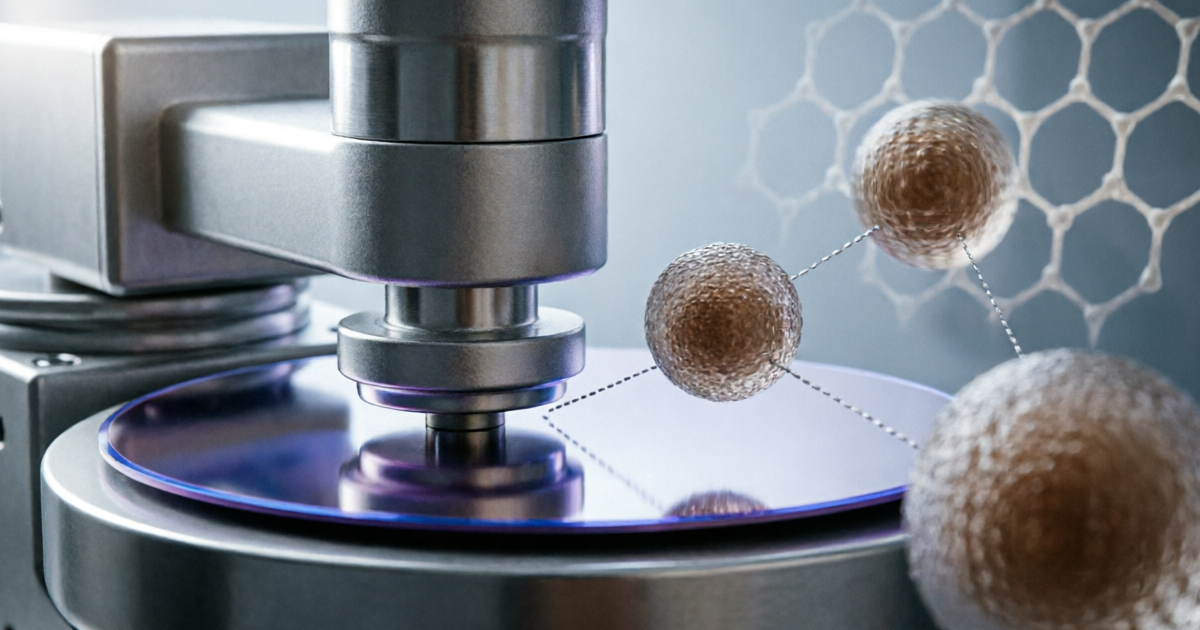
Colloidal silica and ceria represent two fundamentally different approaches to SiO2 removal. Colloidal silica relies on a predominantly mechanical removal mechanism enhanced by alkaline chemical softening — the chemistry is the enabler, but particle-surface contact mechanics drive most of the removal. Ceria relies on a chemical tooth-gear mechanism — Ce–O–Si bond formation at the particle-surface interface — that is so chemically specific to SiO2 that it inherently discriminates against Si3N4 removal.
This fundamental difference in mechanism determines everything downstream: the selectivity each system can achieve, the defect types each generates, the cleaning chemistry each requires, and the supply chain risks each carries. In practice, most semiconductor fabs use both abrasive systems — colloidal silica for BEOL ILD applications where defectivity and surface finish are paramount, and ceria for FEOL STI applications where stop-on-nitride selectivity is non-negotiable. Understanding why each abrasive excels in its application, and where each falls short, is essential for any CMP process engineer.
Colloidal Silica: Properties & Strengths
Colloidal silica for CMP is synthesized from silicon alkoxide precursors (Stöber process) or by ion exchange of sodium silicate solutions, producing amorphous SiO2 particles in the 20–100 nm size range. The synthesis process enables tight control of particle size distribution (PSD), particle morphology (near-spherical), and surface chemistry.
Removal Mechanism
At the alkaline pH (10–11) used in ILD CMP, colloidal silica removal is primarily driven by the mechanical abrasion of SiO2 surfaces that have been chemically softened by Si–O bond hydrolysis. The alkaline solution converts the SiO2 surface to a weak hydrated silica gel layer (~1–5 nm thick) that is easily displaced by abrasive particle contact. The rate of chemical softening increases with pH, which is why ILD slurries use KOH or NH4OH to maintain strongly alkaline conditions.
Key Advantages of Colloidal Silica
- Low defectivity: Softer particle hardness (Mohs ~5.5) and spherical morphology minimize micro-scratch risk. Well-formulated colloidal silica ILD slurry delivers scratch densities below 0.02/cm² at production conditions.
- Excellent surface finish: Post-CMP SiO2 surface roughness (Ra) below 0.15 nm is routinely achievable with colloidal silica, meeting damascene via-bottom roughness requirements at advanced nodes.
- Colloidal stability: Strong negative surface charge (zeta potential –20 to –40 mV at pH 10–11) provides electrostatic stabilization, enabling shelf life of 6–12 months without agglomeration.
- Simple post-CMP cleaning: Standard SC-1 alkaline chemistry (NH4OH:H2O2:H2O) with PVA brush scrubbing is effective for silica particle removal, without the specialized acid clean chemistry required for ceria.
- Diversified supply chain: Colloidal silica is produced by multiple suppliers globally (Evonik, Nalco, Fuso, AGC, and others), providing supply redundancy and competitive pricing.
- CMOS process compatibility: NH4OH-formulated colloidal silica slurry avoids potassium ion contamination risk, making it compatible with CMOS gate dielectric environments.
Limitations of Colloidal Silica
The primary limitation of colloidal silica for oxide CMP is selectivity: SiO2:Si3N4 selectivity of only 5:1 to 15:1 is achievable, which is adequate for ILD applications but wholly insufficient for STI CMP. For ILD applications at advanced nodes involving exposed low-k dielectrics, abrasive contact from colloidal silica can also damage porous ULK films, requiring careful slurry formulation and application of low-pressure recipes.
Ceria: Properties & Strengths
CMP-grade cerium oxide (CeO2) particles are synthesized by high-temperature calcination of cerium carbonate or nitrate precursors followed by precision wet milling. Particle sizes for CMP typically range from 80–200 nm, with D99 specifications below 500 nm being critical for scratch control. The most important quality differentiator in ceria is the surface Ce3+/Ce4+ ratio, which determines the density of active sites for Ce–O–Si bond formation.
Removal Mechanism
Ceria polishes SiO2 primarily through the chemical tooth-gear mechanism: Ce3+ surface sites form Ce–O–Si bridging bonds with SiO2 surface hydroxyls, and the strong Ce–O–Si bond enables mechanical detachment of SiO2 surface units at much lower applied pressures than silica abrasion requires. Si3N4 surfaces do not present accessible Si–OH groups for Ce–O–Si bonding, so they experience only the weak mechanical abrasion component — creating the inherent selectivity advantage of ceria over silica.
Key Advantages of Ceria
- High SiO2:Si3N4 selectivity: Up to 200:1 with optimized PAA additive packages — the only abrasive capable of meeting STI requirements at advanced nodes.
- Higher oxide MRR per unit concentration: Ceria removes SiO2 3–5× more efficiently per unit weight than silica, enabling effective polishing at 0.5–2 wt% vs. 5–15 wt% for silica.
- Superior stop-on-nitride capability: Combined with PAA additives, ceria allows precise termination of polishing at the Si3N4 surface, enabling sub-nanometer nitride loss control.
- Good planarization efficiency: The chemical-mechanical balance of ceria polishing produces good planarization of narrow and medium-width features (reduced dishing vs. mechanical-only abrasion).
Limitations of Ceria
Ceria’s higher hardness (Mohs ~6) and greater tendency to form aggregates create elevated micro-scratch risk compared to colloidal silica. Post-CMP ceria residue — particles that form Ce–O–Si bonds with polished surfaces and resist standard rinse cleaning — is a major process integration challenge requiring specialized acid-based cleaning chemistry. Supply chain concentration in Chinese rare earth production also creates geopolitical risk for global fabs.
Head-to-Head Comparison Table
| Parámetro | Colloidal Silica | Ceria (CeO₂) |
|---|---|---|
| Removal Mechanism | Mechanical abrasion + alkaline chemical softening | Ce–O–Si chemical tooth-gear + mechanical |
| Abrasive Concentration | 5–15 wt% | 0.5–2 wt% |
| Process pH | 10–11 (alkaline) | 5–8 (mildly acidic to neutral) |
| SiO2 MRR | 1,000–3,000 Å/min | 1,500–4,000 Å/min |
| SiO2:Si3N4 Selectividad | 5:1 to 15:1 | 50:1 to 200:1 (with PAA) |
| Particle Hardness (Mohs) | ~5.5 | ~6.0 |
| Scratch Risk | Bajo | Medium–High (aggregation risk) |
| Rugosidad superficial | Ra <0.15 nm (excellent) | Ra 0.15–0.30 nm (good) |
| Post-CMP Cleaning | Standard SC-1, simple | Requires dilute acid clean for ceria residue |
| Colloidal Stability | Excellent (6–12 months shelf life) | Good (3–6 months; settling risk) |
| Supply Chain Risk | Low (diversified global supply) | Medium–High (concentrated rare earth supply) |
| Unit Cost | Lower (per kg abrasive) | Higher (rare earth feedstock premium) |
| Primary Application | ILD oxide CMP (BEOL) | STI CMP (FEOL) |
Application-Specific Selection Guide
Choose Colloidal Silica When:
- Polishing ILD oxide between metal layers (BEOL)
- No hard stop layer is present (timed endpoint)
- Surface finish below Ra 0.15 nm is required
- Low-k or ULK dielectric is exposed during polish
- Post-CMP cleaning resources are limited (standard SC-1 only)
- Metal ion (K+) control is critical
- Supply chain diversification is a priority
Choose Ceria When:
- Polishing STI oxide to a Si3N4 stop layer (FEOL)
- SiO2:Si3N4 selectivity above 30:1 is required
- Sub-nanometer nitride loss control is mandatory
- FinFET fin height uniformity is being controlled
- 3D NAND oxide/nitride stack CMP is the application
- Specialized post-CMP cleaning infrastructure is available
Cost & Supply Chain Considerations
At the unit price level, CMP-grade colloidal silica costs significantly less per kilogram than CMP-grade ceria. However, the total cost of ownership comparison is more nuanced: ceria’s higher per-particle removal efficiency means that a 1 wt% ceria slurry can outperform a 12 wt% silica slurry on oxide MRR, so the slurry cost per wafer polished is more competitive than unit price comparisons suggest. Additionally, the specialized post-CMP cleaning required for ceria residue adds cleaning chemical and tool time costs that should be included in any total cost comparison.
On supply chain, colloidal silica is produced by multiple suppliers across multiple geographies — Japan, Germany, the United States, and China — providing genuine supply redundancy. Ceria feedstock (cerium carbonate) is dominated by Chinese rare earth production, with Chinese producers controlling approximately 70–80% of global cerium supply. This concentration creates supply continuity risk that some fabs manage through strategic inventory buildup, dual-sourcing from cerium processors in different supply chains, or qualification of alternative high-selectivity slurry formulations using synthetic mixed-oxide abrasives under development by several specialty chemical companies as of 2026.
For a detailed evaluation of each abrasive in its respective application, see our dedicated articles: ILD Oxide CMP Slurry: TEOS Planarization Process Guide y STI CMP Slurry: Ceria Chemistry & Selectivity Guide.
Preguntas frecuentes
Can colloidal silica ever be used for STI CMP?
Colloidal silica can be used for STI CMP at mature nodes (180 nm to 130 nm) where the nitride budget is large enough (10–20 nm loss acceptable) and the selectivity requirement is below ~15:1. However, for all advanced nodes below 90 nm, the tight nitride budget demands selectivity above 30:1 — achievable only with ceria. Using colloidal silica for STI at sub-45 nm nodes would result in unacceptable nitride loss and systematic transistor performance degradation.
Why does ceria require specialized post-CMP cleaning?
Ceria particles form Ce–O–Si bonds with SiO2 surfaces during polishing. These bonds survive standard SC-1 alkaline cleaning because alkaline conditions actually favor Ce–O–Si bond stability. Effective ceria removal requires dilute acidic chemistry (citric acid or oxalic acid at pH 2–4), which competitively complexes Ce ions and breaks the Ce–O–Si surface bond, allowing particle detachment. Silica particles do not form chemical bonds with the polished surface and are removed by standard SC-1 plus brush scrubbing.
Is there a single abrasive that can replace both colloidal silica and ceria?
No commercially available single abrasive in 2026 can replace both. The application requirements are fundamentally different: ILD needs low defectivity and simple cleaning (favoring silica), while STI needs high selectivity and stop-on-nitride capability (requiring ceria). Several specialty chemical companies are developing alternative high-selectivity abrasive systems (including ceria-doped silica and synthetic composite abrasives), but none have achieved the production qualification breadth needed to replace ceria in STI at advanced nodes as of July 2026.
Which abrasive is better for 3D NAND oxide CMP?
3D NAND oxide/nitride stack CMP (ONO stack planarization) uses ceria abrasive because each CMP step in the ONO stack must stop on or near the nitride surface. The selectivity requirement, while not as stringent as STI (nitride budget is larger), is still above 30:1 — achievable with ceria but not with standard colloidal silica ILD formulations. Some 3D NAND producers use modified ceria formulations with tuned selectivity specifically optimized for the stress state and composition of their specific ONO stack chemistry.