Post-CMP Cleaning Modules: Brush Scrubbers, Megasonic Systems & Integration on Modern CMP Tools
Every leading-edge CMP machine is built around a dry-in/dry-out architecture, in which wafer cleaning is integrated directly into the tool rather than handled as a separate downstream process step. The cleaning modules within this architecture — brush scrubbers, megasonic systems, chemical rinse stations, and drying modules — are responsible for removing the slurry residue, polishing byproducts, and metallic contamination introduced during polishing, and represent an essential, frequently underappreciated determinant of final device yield. This guide covers the engineering design and operating principles of each major post-CMP cleaning technology as of July 2026.
This article is part of the JEEZ CMP knowledge base. For the complete equipment overview, see: CMP Machines: The Complete Guide to Chemical Mechanical Planarization Equipment.
The Dry-In/Dry-Out Architecture
Modern production CMP machines are engineered around a dry-in/dry-out architecture, in which the wafer enters the tool dry from a FOUP, proceeds through polishing and cleaning entirely within a single sealed process environment, and exits the tool dry — without ever being exposed to the open fab ambient air between the polishing and cleaning steps. This integrated architecture, pioneered industry-wide following early development by Ebara Corporation, is essential to achieving the sub-ppb level of surface cleanliness required for advanced-node device yield.
The critical engineering requirement underlying this architecture is continuous wafer wetness maintenance between the conclusion of polishing and the start of active cleaning. If a freshly polished wafer surface is permitted to dry — even briefly — residual slurry particles and polishing byproducts dry-bond to the surface through capillary and electrostatic forces, becoming dramatically more difficult to remove during subsequent cleaning steps and significantly elevating post-CMP particle count and scratch defect risk.
Three Categories of Post-CMP Contamination
Effective post-CMP cleaning module design must address three fundamentally distinct categories of surface contamination, each requiring a different removal mechanism:
Silica, ceria, or alumina nanoparticles from the polishing slurry that electrostatically adhere to the wafer surface, particularly at regions of opposite surface charge polarity.
Oxidized wafer material, metal-organic complexes formed through slurry additive reactions, and dissolved polishing debris that can re-deposit onto the wafer surface as it dries if not actively removed.
Trace metal ions from slurry additives or tool wetted surfaces that must be removed to prevent transistor gate dielectric degradation and reliability impact.
PVA Brush Scrubbers
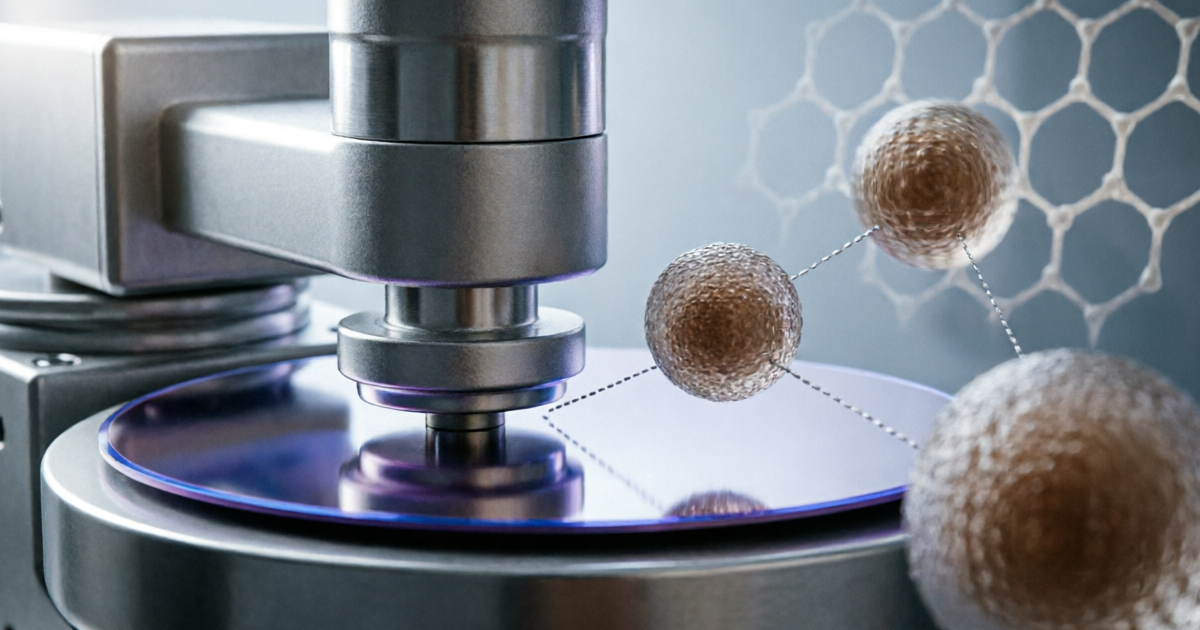
Polyvinyl alcohol (PVA) brush scrubbing is the primary mechanical cleaning mechanism on virtually all production CMP tools, serving as the first active cleaning stage immediately following the polishing platens.
Brush Design and Operation
Cylindrical PVA brushes, featuring a soft, sponge-like microcellular structure, rotate in gentle contact with both the front (device) and back surfaces of the wafer simultaneously, typically using deionized (DI) water combined with dilute alkaline chemistry (ammonium hydroxide, NH4OH), organic acid solutions (citric acid), or proprietary cleaning chemistries selected to match the specific contamination profile of the preceding polishing step. The combination of gentle mechanical agitation from the brush microstructure and the chemical cleaning solution lifts particle and organic residue from the wafer surface, carrying it away in the rinse stream.
Effective Particle Size Range
PVA brush scrubbing is most effective at removing larger-diameter particles, generally above 50nm, where the mechanical contact force of the brush microstructure can reliably overcome the adhesion forces holding the particle to the wafer surface. Sub-50nm particles, which adhere more strongly through van der Waals and electrostatic forces relative to their size, are less reliably removed by brush scrubbing alone and typically require supplementary megasonic cleaning for full removal.
Brush Wear and Contamination Management
PVA brushes themselves require periodic replacement and careful contamination management, since a worn or contaminated brush can become a particle source rather than a cleaning mechanism. Production tools typically incorporate brush conditioning or rinse cycles between wafers to maintain brush cleanliness, and brush replacement intervals are tracked as part of routine preventive maintenance scheduling.
Megasonic Cleaning
Megasonic cleaning supplements brush scrubbing by using high-frequency acoustic energy — typically in the 800kHz to 1MHz range — transmitted through a liquid medium to dislodge nano-scale particles that mechanical brush contact alone cannot reliably remove.
Cleaning Mechanism
The acoustic energy generates localized pressure fluctuations and micro-streaming flow patterns within the cleaning liquid at the wafer surface, creating shear forces sufficient to overcome the adhesion forces holding sub-50nm particles to the surface without the direct mechanical contact that brush scrubbing requires. This non-contact mechanism makes megasonic cleaning particularly valuable for advanced-node applications with fragile, high-aspect-ratio surface features that could be damaged by more aggressive mechanical contact cleaning methods.
Frequency and Power Optimization
Megasonic system frequency and power settings must be carefully optimized for each application — excessive power can risk pattern damage on sensitive structures, particularly for advanced-node devices with delicate low-k dielectric materials or fine copper interconnect features, while insufficient power fails to achieve adequate sub-50nm particle removal efficiency. This optimization is an important element of post-CMP cleaning recipe development, particularly when qualifying new device generations with increasingly fragile surface structures.
Chemical Rinse Stations
Targeted chemical rinse steps provide selective removal capability for specific contamination types that mechanical and acoustic cleaning methods cannot fully address.
Common Chemical Rinse Formulations
- Dilute hydrofluoric acid (HF): Removes native oxide regrowth and certain metallic contamination species, commonly used following metal CMP steps.
- SC-1 (Standard Clean 1): An ammonium hydroxide/hydrogen peroxide/water mixture (NH4OH/H2O2/H2O) effective for organic contamination and particle removal through surface charge modification.
- SC-2 (Standard Clean 2): A hydrochloric acid/hydrogen peroxide/water mixture (HCl/H2O2/H2O) targeted at metallic ion contamination removal.
- Citric acid solutions: Used in some copper CMP cleaning sequences for selective metal ion chelation without the aggressive oxidizing character of SC-2 chemistry.
Chemical rinse formulation selection depends heavily on the specific CMP application and its associated contamination profile — copper CMP cleaning sequences, for example, must carefully balance effective metal ion and particle removal against the risk of introducing new copper surface corrosion through overly aggressive chemical exposure.
Marangoni Drying
The final stage of the post-CMP cleaning sequence is wafer drying, where Marangoni drying technology has become the industry-standard approach for advanced-node applications.
How Marangoni Drying Works
Marangoni drying uses isopropyl alcohol (IPA) vapor introduced at the boundary between the wet wafer surface and the surrounding gas environment, creating a surface tension gradient that pulls the residual DI water rinse film away from the wafer surface in a controlled, contact-free manner as the wafer is slowly withdrawn from the rinse liquid or as the drying boundary sweeps across the wafer surface. This surface-tension-driven mechanism avoids the watermark formation and particle redeposition risk associated with simple evaporative or spin-drying approaches.
Why Contact-Free Drying Matters
Marangoni drying’s contact-free nature makes it the preferred drying method for patterned wafers with fragile surface features or exposed copper interconnect structures, since it avoids the mechanical stress that contact-based drying methods could introduce to delicate advanced-node device structures, while simultaneously achieving the watermark-free surface finish required for downstream metrology and processing steps.
Slurry Design for Cleanability
The effectiveness of post-CMP cleaning is substantially influenced by characteristics of the polishing slurry itself, not solely by the cleaning module hardware and chemistry. Slurry abrasive particle zeta potential — the electrostatic surface charge characteristic of the particles — directly affects how readily those particles adhere to the wafer surface and, correspondingly, how readily they can be removed during cleaning. Slurry formulations engineered with cleanability as an explicit design parameter, alongside particle size distribution control to minimize the population of particles in the most difficult-to-remove size range, can meaningfully reduce the cleaning module burden and improve overall post-CMP particle count performance.
JEEZ slurry formulations are engineered with post-CMP cleanability as an explicit design parameter, targeting particle charge profiles and low-particle-count specifications that support efficient downstream cleaning module performance across a range of brush, megasonic, and chemical rinse configurations.
JEEZ slurries are formulated for cleanability alongside removal rate and selectivity performance. Our technical team can help evaluate whether slurry characteristics are contributing to your cleaning challenges.
Preguntas frecuentes
Dry-in/dry-out architecture describes a CMP tool design in which the wafer enters dry from a FOUP, proceeds through polishing and cleaning entirely within a sealed process environment, and exits dry, without exposure to open fab air between polishing and cleaning. This architecture, pioneered industry-wide following early Ebara Corporation development, is essential for achieving the surface cleanliness levels required at advanced process nodes.
PVA brush scrubbing uses direct mechanical contact from soft, sponge-like brushes combined with chemical cleaning solution to remove larger particles, generally above 50nm. Megasonic cleaning uses high-frequency acoustic energy (800kHz-1MHz) to generate non-contact shear forces that dislodge sub-50nm particles that brush contact alone cannot reliably remove. Most production CMP tools use both methods in sequence for comprehensive particle removal.
Marangoni drying uses isopropyl alcohol vapor to create a surface tension gradient that pulls residual rinse water away from the wafer in a contact-free manner, avoiding watermark formation and particle redeposition risk. This contact-free mechanism is particularly important for advanced-node wafers with fragile surface features or exposed copper interconnects that could be damaged by mechanical contact-based drying methods.
Post-CMP cleaning addresses three categories of contamination: residual abrasive particles from the polishing slurry (silica, ceria, or alumina nanoparticles), polishing byproducts (oxidized wafer material and metal-organic complexes from slurry additive reactions), and metallic ion contamination from slurry additives or tool wetted surfaces that can degrade transistor gate dielectric reliability if not fully removed.
Yes. Slurry abrasive particle zeta potential (electrostatic surface charge) directly affects how readily particles adhere to and can be removed from the wafer surface. Slurry formulations engineered with cleanability as an explicit design parameter, alongside tight particle size distribution control, can meaningfully improve post-CMP particle count performance and reduce the burden on downstream cleaning modules.