Explication de la composition des boues de CMP
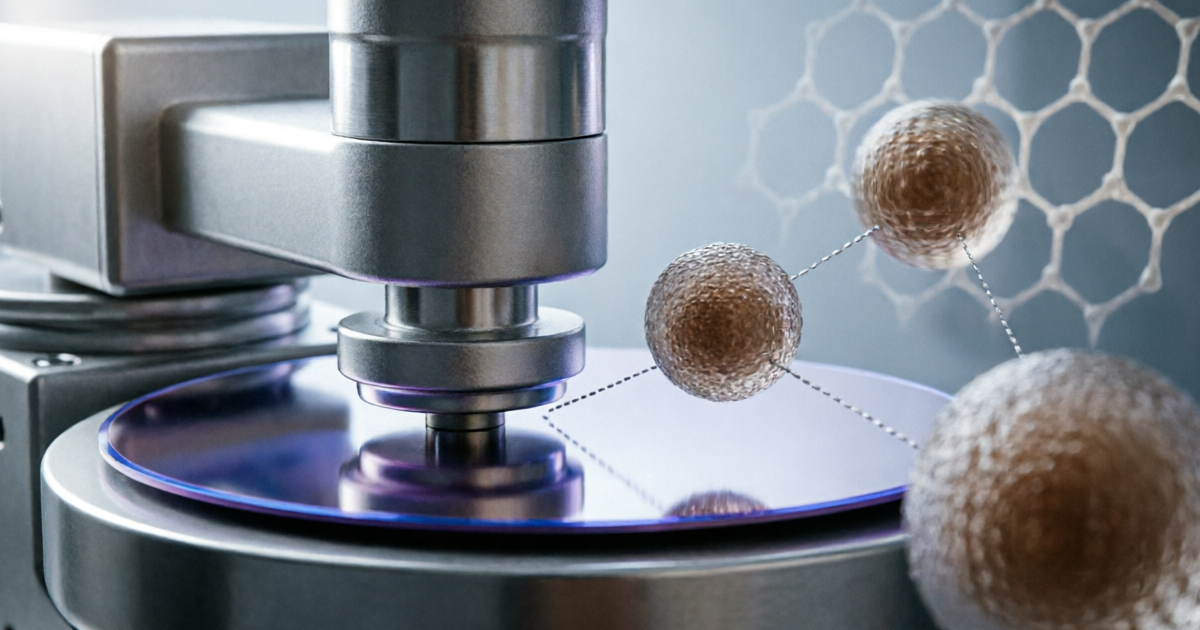
A finished CMP slurry looks like a simple milky liquid, but it is a tightly controlled multi-component system. This guide explains what CMP slurry is made of, what each ingredient does to removal rate, selectivity and defectivity, and how the pieces interact.
The Building Blocks at a Glance
Every CMP slurry is engineered around a single idea: make the chemistry and the abrasive work together to remove a softened surface layer cleanly. Each ingredient exists to push one of the three performance levers — rate, selectivity or defectivity — without disturbing the others. If you are new to the process, our guide on how CMP slurry works provides the context; the broader landscape is in the polishing slurry pillar guide.
By volume a slurry is mostly water, but its behaviour is dictated by the few percent of solids and the fraction of a percent of carefully chosen additives. Tiny changes in those minor components can swing removal rate by tens of percent or turn a low-defect slurry into a scratching one — which is why composition is controlled so tightly.
Particules abrasives
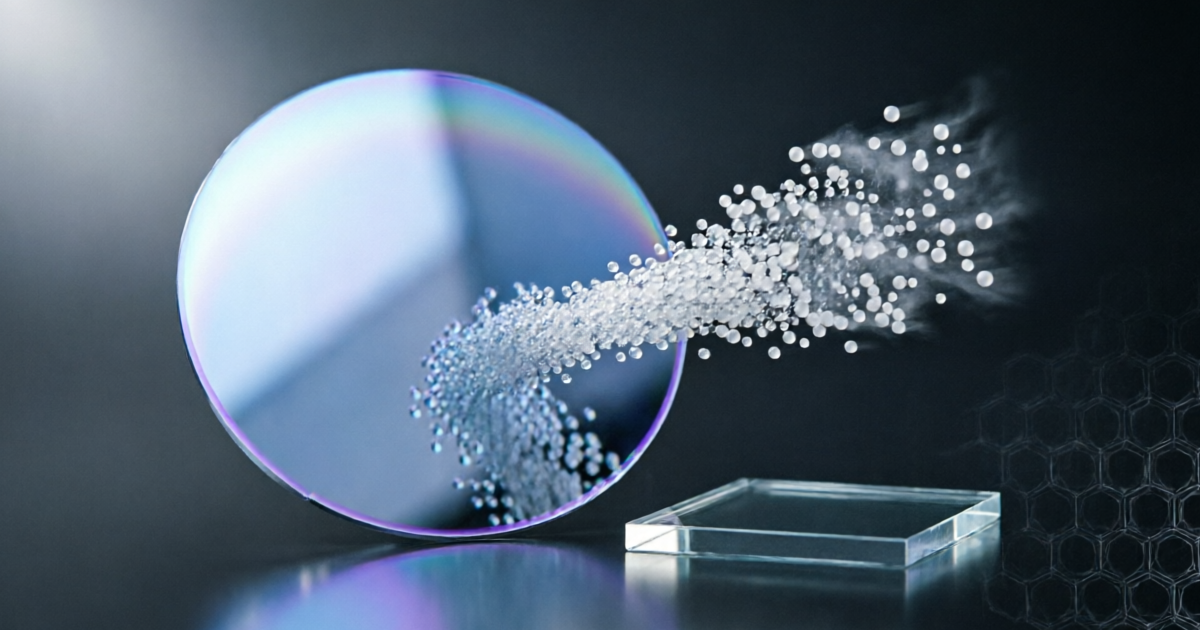
The abrasive is the mechanical workhorse — typically colloidal or fumed silica, cerium oxide, alumina or, for the hardest substrates, diamond. Three properties dominate: mean particle size, size distribution (especially the large-particle tail that causes scratches) and purity. Higher solids loading generally raises removal rate but increases defect risk, so formulators optimise rather than maximise.
Particle morphology matters too. Colloidal silica is grown as discrete spherical particles and tends to give the lowest defectivity; fumed silica is built from fused aggregates that can be more aggressive but harder to keep stable. The trade-offs between abrasive families are compared in silica vs ceria vs alumina vs diamond slurry.
Solids Loading and Particle Size
Two of the most powerful formulation knobs are how much abrasive is in the slurry (solids loading or weight percent) and how big the particles are. Up to a point, raising solids loading increases the number of active contact points and lifts removal rate; beyond that point the rate saturates while defect risk keeps climbing. Mean particle size shifts the balance between aggressive removal and fine finishing.
| Lever | Increase it and… | Risque |
|---|---|---|
| Solids loading | Removal rate rises, then saturates | More defects, higher cost, lower stability |
| Mean particle size | More aggressive removal | Higher roughness and scratch risk |
| Large-particle tail | (never desirable) | Direct cause of scratches |
The Chemical System
The chemistry is what separates CMP from simple grinding. The main classes are:
- Oxidisers — such as hydrogen peroxide, used in metal CMP to convert the metal surface into a softer oxide. Oxidiser type and concentration are primary removal-rate knobs.
- Complexing / chelating agents — bind dissolved metal ions and set the balance between static chemical etch and mechanical removal, which governs dishing and corrosion.
- Corrosion inhibitors — form a protective film over recessed metal, critical for copper interconnect integrity.
- Dispersants and surfactants — keep abrasive particles separated, wet the surface and help carry away debris.
- pH adjusters and buffers — hold the slurry in its designed window, because surface charge, particle stability and reaction rates are all pH-dependent.
- Biocides and stabilisers — protect shelf life against microbial growth and chemical drift.
Each additive is present at a level chosen to do its job without provoking side effects. An inhibitor that is too strong starves removal; too weak and recessed metal corrodes. This narrow-window behaviour is typical of nearly every component.
pH, Surface Charge and Zeta Potential
pH is arguably the master variable of a slurry. It controls reaction rates, the solubility of reaction products, and — critically — the electrical charge on the abrasive particles. That charge, characterised by the zeta potential, is what keeps particles repelling one another and staying dispersed. Near the particle’s isoelectric point the charge collapses, repulsion disappears and the slurry becomes prone to agglomeration, the failure mode detailed in slurry stability and particle agglomeration.
This is why a slurry is formulated to operate at a pH comfortably away from its isoelectric point, and why even small pH excursions during handling or dilution can have outsized effects on both performance and stability.
Ultrapure Water and Purity
Water is the carrier and the largest component by volume. Because trace metal and ionic contamination translate directly into defects and device-reliability problems, CMP slurries are built on ultrapure water and high-purity raw materials. Metallic contamination is especially damaging in front-end steps, where mobile ions can degrade transistor performance. Purity is not a detail here — it is a first-order driver of yield.
Why You Cannot Tune One Ingredient Alone
The ingredients are coupled. Raising an oxidiser to boost rate can shift pH, change particle surface charge and accelerate static etch all at once. That coupling is the reason reformulating a slurry is never a one-variable exercise, and why consistent supplier-side process control is so important. It is also why point-of-use blending — mixing concentrate, oxidiser and water just before the tool — is common: it keeps reactive components apart until the last moment.
The composition you ultimately choose flows from how you select a slurry by material and process.
A robust slurry has a wide, forgiving process window: small drifts in temperature, dilution or pH should not push performance off target. That robustness is designed into the composition through buffering and balanced additives, not added later.
Questions fréquemment posées
What is CMP slurry made of?
What does the oxidiser do in a metal CMP slurry?
What is zeta potential and why does it matter?
How does solids loading affect performance?
Why are corrosion inhibitors needed?
Does water purity really matter that much?
Talk to the JEEZ slurry engineering team
From first slurry selection to defectivity optimisation and multi-source qualification, JEEZ — Jizhi Electronic Technology Co., Ltd. — helps you match the right polishing slurry to your material and process targets.
Contact JEEZ →Part of the JEEZ Polishing Slurry knowledge series. Reviewed and updated June 2026 by Jizhi Electronic Technology Co., Ltd.