CMP Slurry for Silicon Wafer: Types, Selection & Best Practices
A complete engineer’s guide to colloidal silica, fumed silica, and abrasive-free slurries for silicon wafer CMP — covering formulation chemistry, key parameters, stage-matching, handling protocols, and troubleshooting.
Why Slurry Is the Most Critical CMP Consumable
Of all the materials that enter a chemical mechanical polishing tool, the polishing slurry exerts the most immediate and direct influence on every output that matters: removal rate, surface roughness, defect density, and wafer yield. Swap the slurry and virtually every quality metric changes. This is why engineers at leading wafer manufacturers treat CMP slurry selection as a process engineering decision rather than a procurement one — and why deep knowledge of slurry types and selection criteria is indispensable for anyone responsible for silicon wafer polishing performance.
This guide from Jizhi Electronic Technology Co., Ltd. (JEEZ) covers the four principal slurry types used in silicon CMP, the key formulation parameters you must evaluate before qualification, a practical framework for matching slurry to polishing stage, and the handling practices that protect slurry performance from warehouse to dispense nozzle. For a broader overview of where slurry fits in the complete silicon wafer polishing process, see our Complete Guide to Silicon Wafer Polishing.
The Four Types of CMP Slurry for Silicon Wafer Polishing
Silicon CMP slurries are not monolithic: four distinct formulation families serve different polishing stages and performance requirements. Understanding each type’s mechanism, strengths, and limitations is the foundation for intelligent slurry selection.
1. Colloidal Silica Slurry (Rough Polish)
Colloidal silica is the most widely used abrasive for silicon CMP at every polishing stage. For rough polishing — the double-side CMP (DSP) stock-removal step — larger colloidal silica particles (D50: 80–150 nm) are used in an alkaline medium (KOH or TMAH base, pH 10.5–11.5) at abrasive concentrations of 5–15 wt%. The relatively large particle size and higher alkalinity together produce removal rates in the range of 300–800 nm/min, sufficient to remove the 10–20 μm of silicon required per side in DSP.
The chemical synergy between silica abrasive and silicon substrate is what distinguishes colloidal silica from harder alternatives. Both materials are silicon-oxygen compounds; the alkaline medium promotes the formation of a hydrated SiO₂·nH₂O surface layer on the silicon that is chemically softened and mechanically more susceptible to abrasion by the pad and particles. This synergy makes colloidal silica far gentler and less likely to produce deep sub-surface damage than alumina or diamond abrasives at comparable removal rates.
2. Fine Colloidal Silica Slurry (Finish Polish)
Final-polish (SSP finish) slurries use much smaller colloidal silica particles (D50: 20–50 nm) at low abrasive concentrations (0.1–2.0 wt%). The goal shifts from material removal to surface perfection: eliminating haze, minimizing LPD count, and achieving Ra below 0.1 nm. Chemical action — alkaline dissolution of the silicon surface — dominates over mechanical abrasion. Pressure on the polishing head is reduced to below 1 psi (6.9 kPa) to prevent mechanical scratching. The slurry must be extremely well-controlled for particle size distribution: even a small population of particles above 500 nm can dominate the scratch defect count on an otherwise clean wafer.
3. Fumed Silica Slurry
Fumed silica is produced by flame hydrolysis of silicon tetrachloride, yielding highly porous aggregates with a high specific surface area (100–380 m²/g). Compared to colloidal silica, fumed silica particles are more irregular in shape and more reactive, offering slightly higher removal rates at equivalent concentration. However, fumed silica slurries are less colloidally stable than colloidal silica — their particles tend to re-aggregate more readily — making them more challenging to handle in recirculation systems and more prone to generating large agglomerates. Their use in silicon wafer CMP has declined relative to colloidal silica as LPD and haze specifications have tightened.
4. Abrasive-Free Alkaline Solutions
For the most demanding final-polish applications — particularly on 300mm prime-grade wafers destined for advanced node device processing — some process engineers use abrasive-free polishing solutions: purely alkaline media (typically TMAH or dilute KOH at pH 10–11) with no solid particles at all. Material removal occurs entirely through chemical dissolution of the silicon surface, at removal rates of just 5–20 nm/min. The absence of abrasive particles eliminates the mechanical component entirely, delivering the absolute lowest Ra achievable (<0.06 nm in optimized processes) and near-zero LPD counts from particle sources. The trade-off is very slow removal rate and a higher sensitivity to pad surface condition.
Key Slurry Parameters and How to Evaluate Them
When qualifying or comparing CMP slurries, a systematic evaluation of these formulation parameters will differentiate high-performance products from mediocre ones:
| Paramètres | Pourquoi c'est important | Measurement Method | Typical Spec (Finish Polish) |
|---|---|---|---|
| pH | Controls removal rate, oxide selectivity, and colloidal stability | pH electrode, temperature-compensated | 10.0–11.0 ± 0.1 |
| D50 particle size | Median particle size — determines normal abrasion | Dynamic light scattering (DLS) | 20–50 nm |
| D99 / Dmax | Tail of size distribution — controls scratch risk | DLS + single-particle optical sensing | <300 nm (D99) |
| Zeta potential | Colloidal stability indicator; more negative = more stable | Electrophoretic light scattering | <−30 mV at process pH |
| Abrasive concentration | Directly affects removal rate and mechanical abrasion intensity | Gravimetry or ICP-OES | 0.5–2.0 wt% |
| Metal impurities | Fe, Cu, Na, K can contaminate wafer surface and damage gate oxides | ICP-MS | Fe, Cu <1 ppb; Na, K <10 ppb |
| Settling rate | Faster settling = more agglomeration risk in stagnant delivery lines | Visual settle test (1 hr standing) | No visible settling |
Matching Slurry to Polishing Stage
One of the most common mistakes in silicon CMP process design is using a single slurry for both the rough and finish polish stages, or using a rough-polish slurry concentration in a finish-polish application. Each stage has fundamentally different requirements:
| Paramètres | Double-Side CMP (DSP) — Rough | Single-Side CMP (SSP) — Finish |
|---|---|---|
| Primary goal | Stock removal & global flatness (TTV) | Surface quality (Ra, LPD, haze) |
| Abrasive type | Colloidal SiO₂, 80–150 nm D50 | Fine colloidal SiO₂ 20–50 nm, or abrasive-free |
| SiO₂ concentration | 5–15 wt% | 0.1–2.0 wt% |
| pH | 10.5–11.5 | 9.5–11.0 |
| Removal rate target | 300–800 nm/min | 20–100 nm/min |
| Pad type | Hard polyurethane (IC1000-type) | Soft porous polyurethane (Suba-type) |
| Applied pressure | 1.5–4 psi (10–28 kPa) | 0.5–1.0 psi (3.5–7 kPa) |
| LPD priority | Secondary | Critical (<30 @ 35 nm, 300mm) |
Never allow rough-polish slurry carry-over into the finish-polish step. Residual large particles from the DSP slurry will dominate the scratch count on the finish-polished surface. A DI water or dilute acid quench rinse between the DSP and SSP steps is standard practice in production facilities.
Slurry Handling and Best Practices
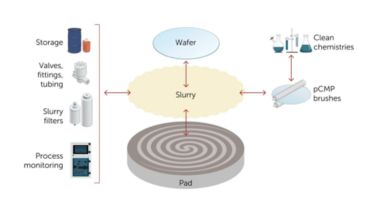
The best-formulated slurry on the market will underperform if it is handled, stored, or dispensed incorrectly. The following practices protect slurry integrity from delivery to the wafer surface:
- Storage temperature: Store colloidal silica slurry at 10–30°C. Freezing irreversibly agglomerates silica particles; temperatures above 40°C accelerate pH drift and Ostwald ripening (particle coarsening). Do not store near heat sources or in unventilated outdoor facilities.
- Continuous agitation: Keep slurry in constant gentle agitation (paddle mixer or recirculation loop) in storage tanks to prevent sedimentation. Stagnant slurry in delivery lines will develop settled particle zones that flush as damaging boluses when flow resumes.
- Point-of-use filtration: Install a 0.2–0.5 μm point-of-use filter immediately upstream of the dispense nozzle. This final filtration step removes any agglomerates that formed in transit and is the last line of defense against killer particles.
- Shelf life: Colloidal silica slurries typically carry a 6–12 month shelf life from the date of manufacture. Check the certificate of analysis (CoA) with each delivery and apply FIFO (first in, first out) inventory management. Expired slurry should be disposed of, not used on production wafers.
- Dilution protocol: If using concentrated slurry that requires dilution with DI water before use, always add slurry to water (not water to slurry) while stirring, to maintain colloidal stability during mixing. Use DI water with >18 MΩ·cm resistivity.
- Flow rate: Optimized flow rates vary by tool and pad configuration, but typical final-polish slurry flow rates are 100–250 ml/min. Excessive flow does not improve performance and is wasteful; insufficient flow causes slurry starvation in the wafer–pad contact zone.
Common Slurry-Related Process Problems and Solutions
| Symptôme | Likely Slurry Root Cause | Corrective Action |
|---|---|---|
| Scratch count increase | Agglomerate formation (D99 growing), killer particles from settled slurry | Check POU filter; inspect delivery line for stagnant zones; verify slurry age; check storage temperature |
| Removal rate drop | pH drift (too low), abrasive concentration decrease (dilution error), pad glazing (not strictly slurry) | Measure pH at tool inlet; check slurry concentration; verify dilution ratio; condition pad |
| Haze increase | Slurry pH too high (isotropic etch of silicon), incompatible slurry carry-over from previous step | Measure and adjust pH; verify quench rinse between polish steps; check slurry lot purity |
| LPD count elevation | Residual particles from insufficient filtration; elevated particle count in slurry lot | Replace POU filter; review lot CoA particle data; check post-CMP cleaning effectiveness |
| High metallic contamination | Elevated Na/K in slurry base; Fe/Cu from polishing hardware leaching into slurry | Request low-metal slurry grade; inspect polishing hardware for corrosion; verify DI water purity |
Questions fréquemment posées
Need a CMP Slurry That Delivers?
JEEZ formulates and supplies colloidal silica CMP slurries engineered for every silicon wafer polishing stage. Our technical team provides full particle size distribution data, recirculation compatibility guidelines, and on-site process support.
Contact JEEZ Technical Team