Post-CMP Cleaning: Methods, Challenges, and Best Practices
A comprehensive guide to post-CMP wafer cleaning — covering contamination types, cleaning chemistry, brush scrubbing, megasonic techniques, drying methods, and process integration at advanced nodes including ≤7 nm.
Why Post-CMP Cleaning Is Critical
A CMP step that achieves perfect planarization and zero dishing is worthless if the wafer exits the polisher covered in slurry residue. Post-CMP cleaning is not a secondary or finishing step — it is an integral process gate that directly determines whether a wafer can proceed through the rest of the fab sequence. Inadequate post-CMP cleaning is one of the leading contributors to yield loss at all technology nodes, and its importance increases dramatically as device dimensions shrink below 10 nm.
Consider the scale of the challenge: after a copper CMP step, a 300 mm wafer surface may carry 10⁹–10¹¹ residual slurry particles per cm², dissolved copper ions at concentrations sufficient to cause gate oxide degradation, and a monolayer of organic residue from slurry additives. Every one of these contaminant categories causes a specific, well-characterized failure mechanism if left on the wafer surface — and all three must be removed simultaneously by the post-CMP cleaning process.
Contaminant Types & Their Yield Impact
| Contaminant Type | Source | Failure Mechanism | Typical Spec |
|---|---|---|---|
| Slurry abrasive particles (SiO₂, CeO₂, Al₂O₃) | CMP slurry residue | Lithography scatter defects; patterning failures; via blockage | <0.5 particles/cm² ≥32 nm |
| Metallic ions (Cu²⁺, Fe³⁺, Na⁺) | Slurry additives, tool hardware corrosion | Gate oxide contamination; minority carrier lifetime reduction; NBTI/PBTI in PMOS | <10¹⁰ atoms/cm² |
| Organic residues | Slurry surfactants, BTA, glycine decomposition products | Incomplete oxide removal in subsequent etch; adhesion failure in PVD; contact resistance increase | No measurable organic layer by XPS |
| Pad and retaining ring debris | Mechanical wear during polishing | Physical scratch extension; deep via blockage | <0.1 particles/cm² ≥200 nm |
| Watermarks (silica spots) | Improper drying; DI water evaporation | Residual silica deposits that resist reclean; lithography defects | Zero watermarks by inspection |
PVA Brush Scrubbing
Polyvinyl alcohol (PVA) brush scrubbing is the most widely deployed post-CMP cleaning method in production fabs worldwide. A cylindrical PVA brush — porous, flexible, and highly hydrophilic — rotates in contact with the spinning wafer surface, physically dislodging and sweeping away adsorbed particles and residues while a cleaning chemical flows continuously through the brush and onto the wafer surface.
Mechanism of Particle Removal
Particle removal by PVA brushes combines three forces: hydrodynamic drag from the fluid film between brush and wafer, direct mechanical contact force from the brush nodules, and chemical surface energy modification by the cleaning chemistry that reduces particle-to-wafer adhesion force (making particles easier to dislodge). The PVA brush itself never contacts the wafer surface directly — a thin film of cleaning liquid separates brush from wafer at all times, which is why brush pressure optimization is critical: too light means insufficient hydrodynamic drag; too heavy creates a meniscus that can trap particles and scratch the surface.
Double-Sided Scrubbing
Post-CMP cleaning modules are typically designed for simultaneous front-side and back-side brush scrubbing. The wafer back-side also accumulates contamination during polishing (slurry wicking around the carrier membrane) and must be cleaned to prevent chucking contamination on electrostatic chucks in downstream CVD, implant, and lithography tools. Back-side metallic contamination in particular is difficult to measure and is a leading cause of cross-contamination in hot-wall furnace processes.
Megasonic Cleaning
Megasonic cleaning uses high-frequency acoustic energy — typically in the 700 kHz to 2 MHz range — transmitted through the cleaning liquid to create acoustic streaming forces that lift particles from the wafer surface without direct mechanical contact. It is particularly valuable for removing sub-100 nm particles that are too small to be effectively dislodged by brush scrubbing (smaller particles have higher surface adhesion-to-mass ratios, making them harder to remove mechanically) and for cleaning fragile low-k dielectric surfaces where brush contact pressure must be minimized to prevent delamination.
Mechanism: Acoustic Streaming vs. Cavitation
At megasonic frequencies, cavitation (bubble formation and collapse) is largely suppressed, and the primary cleaning mechanism is acoustic streaming — a steady, directed fluid flow generated by the acoustic wave gradient that creates a boundary layer velocity gradient near the wafer surface. Particles within the acoustic streaming boundary layer experience drag forces that exceed the van der Waals adhesion force holding them to the surface. The acoustic streaming force scales with frequency and acoustic power but is inversely proportional to particle diameter — smaller particles are harder to remove, requiring higher power levels that in turn risk acoustic damage to fragile film stacks.
Copper Compatibility Considerations
Megasonic cleaning chemistry for copper CMP post-clean must be carefully formulated. Certain cleaning chemistries — particularly those with low pH and high oxidizer content — cause galvanic corrosion on copper interconnects in the absence of BTA corrosion inhibitor during megasonic agitation. The acoustic pressure fluctuations can accelerate chemical transport to and from the copper surface, increasing local etch rates. Proprietary low-pH chelating formulations with BTA loading are preferred for copper post-megasonic clean.
Cleaning Chemistry Selection
Post-CMP cleaning chemistry must be matched to three factors: the material being cleaned (the polished film surface chemistry), the type and charge characteristics of the slurry abrasive (silica, ceria, or alumina), and the downstream process requirements (acceptable metal contamination levels, surface roughness, and hydrophilicity). No single universal cleaning chemistry exists for all post-CMP applications.
| CMP Application | Recommended Chemistry | pH | Targets Removed | Key Consideration |
|---|---|---|---|---|
| Oxide / STI CMP | Dilute SC1 (NH₄OH:H₂O₂:H₂O) or DIW + PVA | 9-11 | SiO₂ particles, organic residue | SC1 may slightly etch Si₃N₄ at high concentrations; dilute appropriately |
| Cuivre CMP | Citric acid + BTA, or proprietary Cu post-clean | 3–5 | Cu ions, SiO₂ particles, organic | BTA required to prevent corrosion; rinse thoroughly to remove BTA before barrier removal |
| Tungsten CMP | Dilute HF + H₂O₂, or proprietary W clean | 2-4 | Al₂O₃ particles, W oxide, metal ions | HF attacks SiO₂ — concentration must be controlled to avoid over-etching |
| Low-k Dielectric CMP | Aqueous amine-based formulation, low pressure | 8–10 | SiO₂ particles, organics | Avoid acids; low-k is hydrophobic and resists aqueous cleaning — adjuvants needed |
| STI Ceria | Dilute citric acid or EDTA post-clean | 3–5 | CeO₂ particles (positively charged at low pH) | CeO₂ is positively charged and adheres strongly to negatively charged SiO₂ surfaces at neutral pH — acidic chemistry inverts zeta potential for better lift-off |
Drying Methods: Marangoni vs. Spin-Dry
The final step of post-CMP cleaning — drying the wafer surface without leaving watermarks — is deceptively challenging. DI water has a surface tension of ~72 mN/m, and as it evaporates from a flat surface, any dissolved silica or other mineral content precipitates out, forming watermark defects that are extremely difficult to remove in a subsequent clean step. Two primary drying methods are used in post-CMP applications.
Marangoni Drying (IPA-Assisted)
Marangoni drying uses a surface tension gradient to pull the DI water film off the wafer surface without leaving residue. A nitrogen carrier gas saturated with isopropanol (IPA) vapor is directed at the water-to-air interface as the wafer is slowly withdrawn from the rinse bath (or as the water level is lowered). The IPA vapor reduces the surface tension of the water at the contact line, creating a Marangoni flow that sweeps the water film off the wafer in a single continuous motion. The result is a perfectly dry, residue-free surface with no watermarks. Marangoni drying is the gold standard for post-CMP drying and is required for advanced-node applications where watermark defect specifications are tightest.
Spin-Dry
Conventional spin-dry uses centrifugal force (1000–3000 RPM) to fling DI water off the wafer surface, followed by a nitrogen hot gas purge. Spin-dry is faster than Marangoni drying but more susceptible to watermark formation because some water film remains at the wafer center and edge regions during the drying spin. It is acceptable for less critical cleaning steps and for older technology nodes where watermark specifications are less stringent.
Full Cleaning Sequence Design
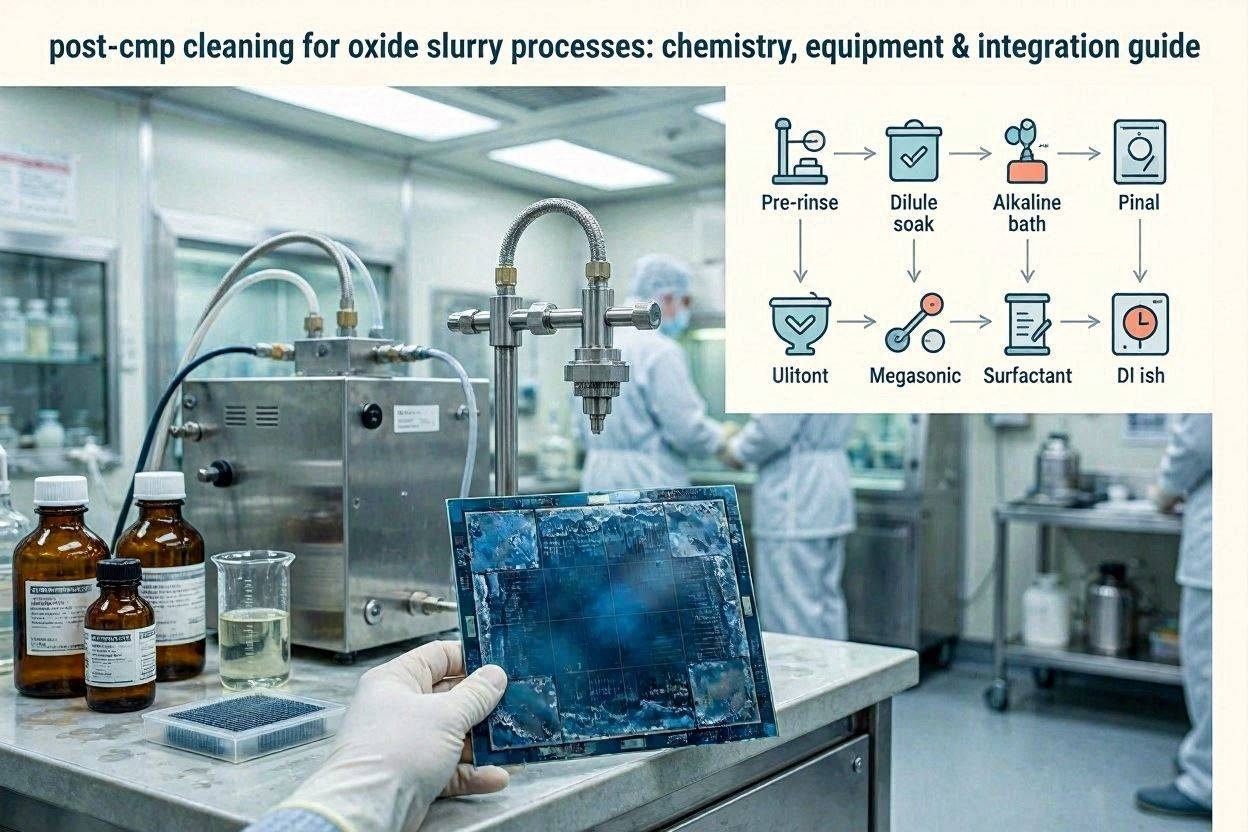
A production post-CMP cleaning sequence integrates multiple cleaning steps in series, each targeting a specific contaminant class. The following sequence represents best practice for copper CMP post-clean at advanced nodes:
Immediate Water Rinse (in-situ)
As soon as the carrier head lifts off the pad, DI water floods the wafer surface to prevent slurry drying. This step must be executed within seconds of polishing endpoint — dried slurry is an order of magnitude harder to remove than wet slurry.
Front-Side PVA Brush Scrub (Cu Post-Clean Chemistry)
PVA brush scrubbing with dilute citric acid + BTA at pH 3–5 removes the bulk of residual slurry particles and dissolves copper oxide surface layer while BTA prevents fresh corrosion. Brush rotation speed: 200–400 RPM; wafer rotation: 50–150 RPM.
Back-Side PVA Brush Scrub
Simultaneous or sequential back-side brush scrub with dilute DIW or weak acid chemistry. Focus on metallic contamination removal from the carrier membrane contact area.
Megasonic Rinse (Optional, Advanced Node)
For sub-10 nm applications, a megasonic step with DI water or dilute NH₄OH removes sub-50 nm particles that brush scrubbing misses. Power: 5–15 W/cm²; duration: 30–90 seconds.
DI Water Flood Rinse
High-flow DI water rinse (2–5 L/min) removes cleaning chemical residues and final particle flushes. Resistivity of rinse drain is monitored; step ends when effluent resistivity approaches DI water baseline (18 MΩ·cm).
Marangoni IPA Dry
IPA-assisted Marangoni drying produces a particle- and watermark-free surface. Withdrawal speed is precisely controlled (1–5 mm/s) to maintain a uniform water contact angle across the wafer radius.
Advanced Node Challenges (≤10 nm)
As device dimensions scale below 10 nm, post-CMP cleaning faces a set of challenges that have no simple precedent from earlier generations. Three are particularly significant in 2026:
Sub-Nanometer Feature Sensitivity
At 3 nm and 2 nm nodes, copper line widths approach 8–12 nm and barrier metal thickness is below 2 nm. Any cleaning chemistry that is even slightly more aggressive than its specification — a pH shift of 0.5 units, a temperature excursion of 5°C — can cause measurable thinning of these structures. Cleaning chemistries at advanced nodes must be formulated and delivered with pharmaceutical-grade concentration and temperature precision.
EUV-Compatible Surface Cleanliness
EUV lithography — now in high-volume manufacturing at 3 nm and below — is exquisitely sensitive to post-CMP wafer surface cleanliness. A single 20 nm particle on the EUV reticle or wafer can create a killer defect. Post-CMP cleaning specifications for EUV-exposed layers call for particle counts below 0.05 particles/cm² at 20 nm and above — specifications that require optimized megasonic + Marangoni drying sequences and inline particle monitoring after every clean cycle.
Low-k Compatibility
The ultra-low-k (ULK) dielectric films used at advanced nodes are hydrophobic and mechanically fragile. Aqueous cleaning chemistries have poor wetting of hydrophobic ULK surfaces, requiring the addition of surfactants that in turn must be rinsed away completely. Brush scrubbing pressure must be reduced to avoid inducing subsurface cracking in porous ULK films — the low Young’s modulus of these materials means that even gentle brush contact can generate subsurface delamination cracks that are invisible to optical inspection but cause reliability failures in the field.
Common Post-CMP Cleaning Defect Modes
| Defect | Root Cause | Prevention |
|---|---|---|
| Residual slurry particles | Insufficient brush scrub pressure/time; depleted cleaning chemistry; brush wear | Brush condition monitoring; chemistry concentration SPC; scheduled brush replacement |
| Watermarks | Incomplete drying; slow IPA withdrawal; high DI water mineral content | Marangoni drying; DI water TOC and silica monitoring; withdrawal speed optimization |
| Copper corrosion pits | Insufficient BTA in Cu post-clean; pH too low; long dwell time in acid without inhibitor | Formulated Cu post-clean with BTA; minimize rinse-to-dry time; pH monitoring |
| PVA brush-induced scratches | New brush not broken in; brush contamination; excessive brush pressure | Break-in protocol; brush particle release monitoring; pressure optimization DOE |
| Metal back-contamination | Cross-contamination from cleaning module hardware; inadequate back-side clean | Hardware passivation; back-side clean chemistry optimization; regular hardware clean |
Questions fréquemment posées
Struggling with Post-CMP Cleaning Defects?
JEEZ offers compatible post-CMP cleaning chemistry formulations, PVA brush solutions, and process engineering support to help you achieve yield-grade wafer cleanliness.
Talk to a Cleaning Process Expert →