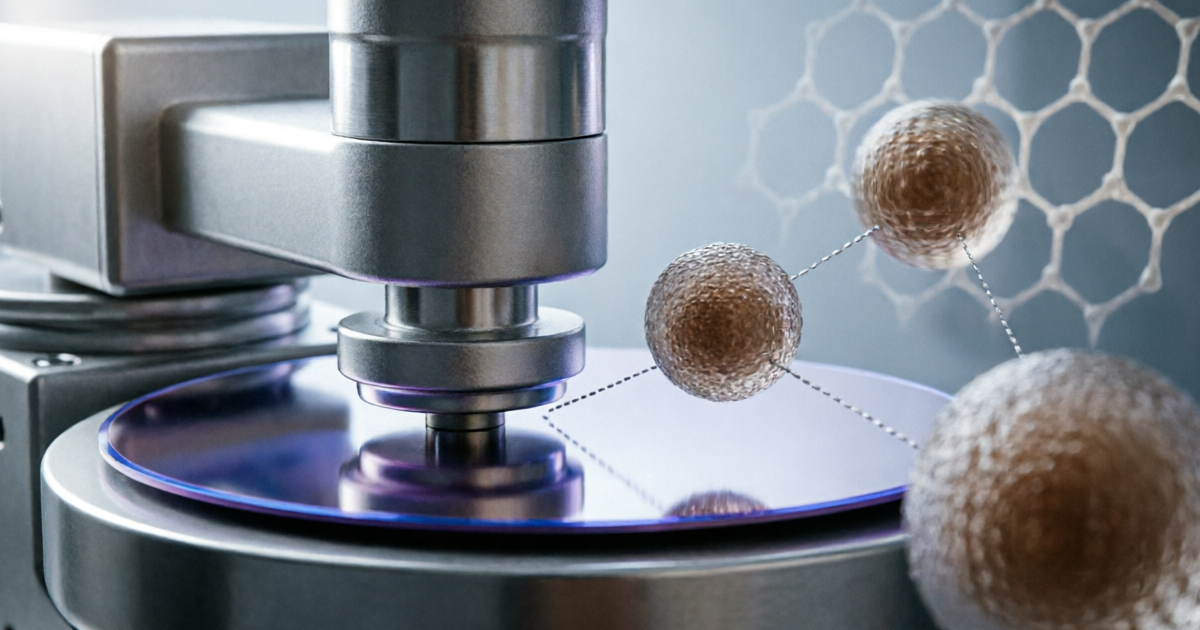
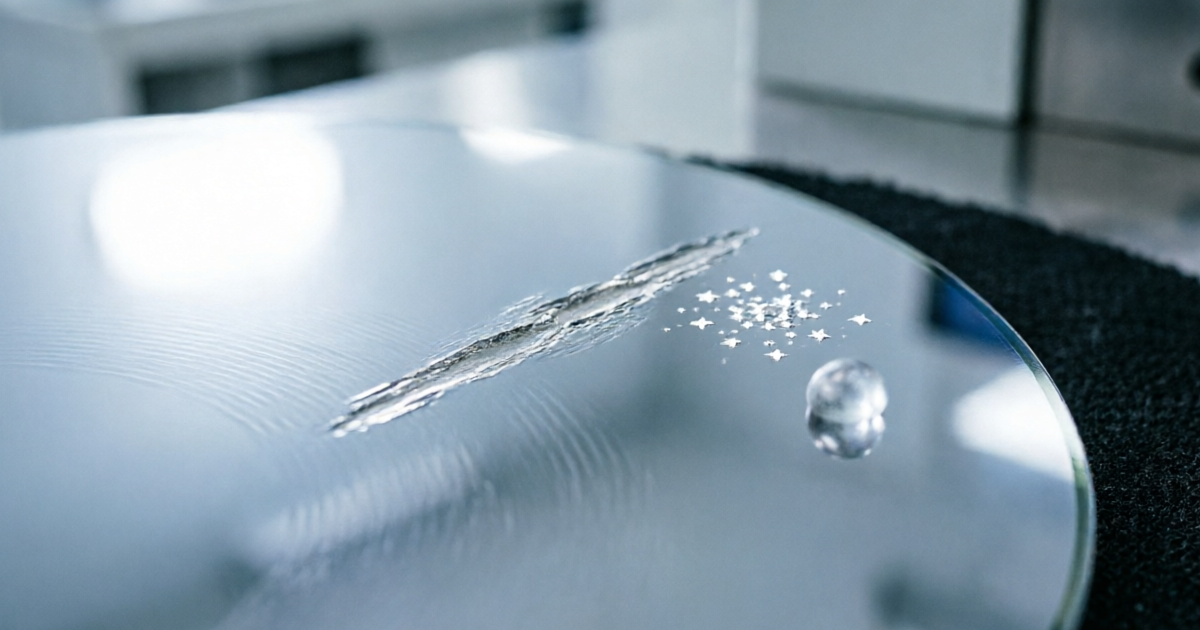
Post-CMP Cleaning & Planarization Metrology: Ensuring Surface Quality
The CMP process itself is only half of the planarization module. What follows — post-CMP cleaning and metrology — determines whether the wafer achieves the surface cleanliness, roughness, and thickness uniformity required for the next process step. This guide provides a comprehensive technical reference for post-CMP cleaning chemistry and techniques, all key planarization metrology parameters, endpoint detection methods, and the run-to-run control systems that tie them together.
01Why Post-CMP Cleaning Is Non-Negotiable
CMP inherently contaminates the wafer surface it is polishing. The polishing process introduces: nano-scale abrasive particles from the slurry that adhere electrostatically and physically to the wafer surface; metallic ions dissolved from the polished film and from slurry chemical components that deposit as trace metal contamination; and organic residues from surfactants, chelating agents, corrosion inhibitors (BTA), and pad decomposition products. If these contaminants are not removed before the next process step, they cause yield loss through several mechanisms.
Slurry particles remaining on the wafer surface after CMP can: block via etch into the dielectric (causing open circuits); cause bridging shorts between adjacent metal lines; nucleate void formation during subsequent CVD; or act as particle seeds that damage photolithography optics during the next exposure step. Even a single particle >100 nm at a critical location can cause a chip failure.
Post-CMP cleaning is therefore not a cosmetic step — it is a yield-critical process step with its own specifications, process controls, and metrology requirements. In a leading-edge fab, the post-CMP cleaning module is validated with the same rigor as the polishing step itself. The cleaner must remove particles, metal contamination, and organic residues to well-defined specifications before the wafer is allowed to proceed to the next deposition, etch, or lithography step.
02Contamination Types After CMP
Slurry Particle Residues
Nano-scale abrasive particles (SiO₂, CeO₂, Al₂O₃, 20–200 nm) that adhere to the wafer surface by van der Waals and electrostatic forces. CeO₂ and Al₂O₃ particles are harder to remove than SiO₂ due to higher surface charge and stronger adhesion. Particles in recessed features (narrow trenches, via openings) are inaccessible to brush contact and require megasonic energy for dislodgement.
Metallic Ion Contamination
Transition metal ions (Cu²⁺, Fe³⁺, Ce³⁺/Ce⁴⁺, Al³⁺, K⁺) dissolved from polished films and slurry chemical components adsorb onto the wafer surface and dielectric films. Copper is particularly problematic — it is a fast diffuser in SiO₂ and Si, and even at concentrations below 10¹⁰ atoms/cm² can cause gate oxide integrity degradation and minority carrier lifetime reduction. Iron from Fenton-chemistry SiC CMP is monitored at similar stringency.
Organic Residues
Surfactants, benzotriazole (BTA) corrosion inhibitor, glycine and citrate chelating agents, and pad decomposition fragments remain on the wafer surface after polishing. BTA, in particular, forms a stable Cu–BTA complex on copper surfaces that is water-insoluble and resists simple DIW rinsing. Organic residues at the dielectric–metal interface degrade adhesion and can outgas during subsequent CVD at elevated temperatures, causing void formation in deposited films.
Mechanical Damage Residues
Polishing-induced surface micro-scratches leave material displaced from the scratch path accumulated at the scratch terminus (“pileup”). Scratch pileup material is poorly adherent and must be removed by cleaning to prevent it from becoming a mobile particle during subsequent processing. In ULK dielectric CMP, mechanically damaged porous material at the polished surface may also require chemical cleaning to remove before the surface can be reliably sealed by subsequent barrier metal deposition.
03PVA Brush Scrubbing
Polyvinyl alcohol (PVA) brush scrubbing is the primary mechanical particle removal step in post-CMP cleaning. PVA brushes are cylindrical sponge rollers (diameter 30–60 mm, length matching the wafer diameter) manufactured from cross-linked PVA polymer with a controlled open-cell foam structure. The PVA material is hydrophilic, soft (Shore A ~5–15), chemically resistant to CMP cleaning chemistries, and can be precision-machined to have a defined surface texture (nodular or smooth) that controls the contact mechanics at the brush–wafer interface.
Scrubbing Mechanism
During PVA brush scrubbing, the rotating brush roller contacts the wafer surface (front side) with the brush center axis parallel to the wafer plane and perpendicular to the wafer translation direction. The brush compression (contact force) is precisely controlled — typically 0.05–0.5 N/cm² — to ensure sufficient mechanical contact for particle dislodgement without abrading or scratching the wafer surface. A chemical solution (DIW, dilute NH₄OH, citric acid, or HF depending on the application) is delivered through the brush interior and flows to the brush surface, providing both the liquid medium for particle dislodgement (hydrodynamic lift) and the chemical component for surface passivation or metal dissolution.
Dual-Brush Modules
Production post-CMP cleaners use dual-brush modules that clean both the front (device) side and back side of the wafer simultaneously — two counter-rotating brush rollers above and below the wafer while the wafer translates between them. Back-side cleaning is critical to remove particles that were deposited on the wafer back-side during CMP (from the carrier head membrane or the pad) and that would otherwise contaminate the chuck in subsequent process tools, creating back-side particle problems that are difficult to diagnose and control.
PVA Brush Chemistry: Application-Specific
| CMP Module | Brush Cleaning Chemistry | Concentration | Target Contamination |
|---|---|---|---|
| Oxide / STI CMP | DIW or dilute NH₄OH | 0.01–0.1% NH₄OH | SiO₂ / CeO₂ particles |
| Tungsten CMP | Dilute NH₄OH + citric acid | 0.1% NH₄OH, 0.1–1% citric acid | Al₂O₃ particles, Fe, Al ions |
| Cuivre CMP | Dilute citric acid or ammonium citrate | 0.1–1% citric acid, pH 4–5 | SiO₂ particles, Cu²⁺ ions, BTA |
| SiC CMP | Dilute HCl or HNO₃ + DIW | 0.1–1% HCl | Fe ions (Fenton), Ce/Mn particles |
04Megasonic Cleaning
Megasonic cleaning applies high-frequency acoustic waves (850 kHz to 2 MHz) to a liquid bath or to a flowing liquid film over the wafer surface. At these frequencies, the acoustic field generates intense pressure fluctuations that create microstreaming currents near the wafer surface and, at sufficient power levels, transient acoustic cavitation — the rapid formation and collapse of microscopic bubbles in the liquid that produces highly localized mechanical impulses. The microstreaming and cavitation energy dislodges particles from the wafer surface without requiring direct mechanical contact, making megasonic cleaning particularly valuable for removing particles from recessed features (narrow trenches, via openings) that PVA brushes cannot reach.
Megasonic Frequency Selection
Frequency selection is a critical process parameter. Lower frequencies (850 kHz) generate stronger cavitation events (larger bubble collapse impulses) that more effectively remove strongly adherent particles but risk mechanical damage to fragile surface structures — particularly problematic for ULK porous dielectric films, which can be damaged by strong cavitation events. Higher frequencies (1.5–2 MHz) produce gentler microstreaming with minimal cavitation, providing safer cleaning for fragile film stacks at the cost of reduced cleaning efficiency for strongly adherent large particles. Most leading-edge fabs use 1–2 MHz megasonic cleaning for post-CMP applications, accepting some reduction in large particle removal efficiency in exchange for damage-free processing of fragile dielectric films.
Megasonic Cleaning Chemistry
Megasonic cleaning is performed in a chemical bath or under a flowing chemical film. The most common chemistries are:
- SC1 (Standard Clean 1): NH₄OH : H₂O₂ : H₂O = 1:1:5, at 45–65°C. The combined alkaline chemistry and mild oxidizing action removes organic contamination and many particle types while slightly etching the SiO₂ surface (removing a thin contaminated surface layer). Standard for oxide and STI post-CMP cleaning.
- Dilute HF: 0.05–0.5% HF in DIW. Removes native oxide from silicon surfaces and disrupts the electrostatic adhesion of particles on SiO₂ surfaces by making the silicon surface hydrophobic. Used selectively where Si surface preparation is needed before gate oxide growth.
- DIW (Ultra-pure deionized water): 18.2 MΩ·cm resistivity DIW used as a final rinse medium. The megasonic energy applied to DIW provides particle removal through microstreaming alone, without chemical contribution — useful as a damage-safe final cleaning step after chemical baths.
05Wet Chemical Cleaning
Sequential wet chemical cleaning baths address different contamination types that mechanical brush scrubbing and megasonic energy cannot fully remove:
SC1 — Particle and Organic Removal
NH₄OH : H₂O₂ : H₂O (1:1:5 to 1:2:10) at 65–75°C for 5–10 minutes. The alkaline-oxidizing mixture lifts particles by oxidizing the wafer surface and creating electrostatic repulsion between the oxidized surface and abrasive particles (both negatively charged at pH >9). Simultaneously removes organic surface films by oxidative degradation. Followed by a hot DIW overflow rinse (75°C, 10 min) to remove SC1 residues and displaced particles before they re-adhere.
SC2 — Metallic Contamination Removal
HCl : H₂O₂ : H₂O (1:1:6) at 65–75°C for 5–10 minutes. The acidic-oxidizing mixture dissolves metallic surface contamination by converting metal ions to soluble chloride complexes and removing them into solution. Effective for: alkali metals (Na⁺, K⁺), alkaline earth metals (Ca²⁺, Mg²⁺), and transition metals (Fe³⁺, Al³⁺, Cr³⁺). Not used for copper-containing surfaces (Cu²⁺ dissolved by SC2 but HCl can attack Cu metal). Followed by a DIW cascade rinse.
Dilute Citric Acid — Copper CMP Specific
0.1–1% citric acid (pH 4–5) replaces SC2 for copper CMP post-clean applications where HCl would attack exposed copper surfaces. Citric acid forms stable Cu–citrate complexes that keep dissolved copper in solution without re-deposition, while the mild acid pH also assists BTA complex dissolution from the copper surface. Does not attack copper metal at low concentrations, making it compatible with exposed copper damascene surfaces after CMP.
Final DIW Rinse and Spin-Dry
Ultra-pure DIW (18.2 MΩ·cm) cascade or overflow rinse to dilute and remove all chemical residues from the wafer surface. Followed by N₂-assisted centrifugal spin-dry (2,000–4,000 rpm) that removes water from the wafer surface without leaving watermarks. IPA (isopropyl alcohol) vapor drying (Marangoni drying) is used for hydrophobic surfaces where water beading creates drying marks that look like particle contamination on surface inspection.
06Cleaning Chemistry by CMP Application
| CMP Module | Step 1 Chemistry | Step 2 Chemistry | Final | Key Concern |
|---|---|---|---|---|
| Oxide/STI CMP | PVA brush + dilute NH₄OH | Megasonic SC1 | DIW rinse + spin-dry | CeO₂/SiO₂ particle removal |
| Tungsten CMP | PVA brush + citric acid | SC1 megasonic | SC2 + DIW + dry | Al₂O₃ particles, Fe³⁺, K⁺ ions |
| Cu CMP (Step 1+2) | PVA brush + citric acid / ammonium citrate | Megasonic DIW or SC1 | DIW + Marangoni dry | SiO₂ particles, Cu²⁺ ions, BTA residue |
| ULK ILD CMP | PVA brush + low-force, dilute NH₄OH | Low-power megasonic (1.5–2 MHz) | DIW + gentle spin-dry | Dielectric damage; delamination risk |
| SiC CMP | PVA brush + dilute HCl | SC2 (metal removal) | DIW + dry; TXRF check for Fe | Fe contamination from Fenton chemistry |
07Surface Roughness Metrics: Ra, Rq, and Rz
Post-CMP surface roughness is the most fundamental quality metric for the polished surface. Three complementary parameters are used to fully characterize the surface texture, each sensitive to different aspects of the height distribution:
Arithmetic Average Roughness (Ra)
Definition: The arithmetic mean of the absolute height deviations from the mean surface plane, measured over a defined scan length L: Ra = (1/L) ∫|z(x)| dx. Ra is the most commonly specified CMP roughness metric — it provides a single-number summary of average surface texture. Typical CMP specifications: Ra <0.5 nm for advanced logic ILD CMP; Ra <0.3 nm for copper CMP final buff; Ra <0.2 nm for SiC epi-ready substrates; Ra <0.3 nm for hybrid bonding surface preparation. Limitation: Ra is insensitive to rare high-amplitude events (occasional deep scratches or high spikes), which may be more damaging to device yield than the average surface texture implies.
Root Mean Square Roughness (Rq or RMS)
Definition: The root mean square of the height deviation from the mean surface: Rq = √[(1/L) ∫z(x)² dx]. Rq is always ≥ Ra (for a Gaussian height distribution, Rq ≈ 1.25 × Ra). Because squaring the height values amplifies high-amplitude excursions, Rq is more sensitive than Ra to the presence of occasional deep scratches or high spikes in the surface profile. Use in CMP: Rq is specified alongside Ra for applications where rare high events are particularly damaging — for example, gate oxide growth on a polished silicon surface, where a single surface spike can create a localized field enhancement leading to early oxide breakdown.
Maximum Height (Rz — Peak-to-Valley)
Definition: The vertical distance between the highest peak and the deepest valley in the measurement area (ISO 4287 definition: average of maximum peak-to-valley height over five consecutive sampling lengths). Rz directly captures the worst-case surface feature height in the measurement area. Use in CMP: Rz is particularly relevant for applications where worst-case topography is more critical than average texture — for example, the maximum step height at a copper-to-dielectric boundary, or the maximum scratch depth on a freshly polished wafer. Rz values are typically 6–10× Ra for a CMP-polished surface with a near-Gaussian height distribution.
08Uniformity Metrics: WIWNU and TTV
Non-uniformité à l'intérieur de la plaquette (WIWNU)
WIWNU is the primary process control metric for CMP film thickness uniformity across the 300 mm wafer. It is defined as the standard deviation (1σ) of the film thickness measurements across a defined grid of measurement sites (typically 49, 81, or 121 sites on a 300 mm wafer, excluding a 3–5 mm edge exclusion zone), expressed as a percentage of the mean film thickness:
WIWNU (%) = (σ / μ) × 100
where σ is the standard deviation of the thickness measurements and μ is the mean thickness across all measurement sites. A WIWNU of 1% on a 300 nm remaining film means the standard deviation of thickness is 3 nm — individual sites may vary by ±6–9 nm (±2–3σ) from the mean. WIWNU is the primary feedback metric for run-to-run (R2R) control systems that adjust the CMP polishing recipe for the next lot based on the current lot’s measured WIWNU map.
Total Thickness Variation (TTV)
TTV is the total range of film thickness across the wafer — the difference between the maximum and minimum thickness measurement at any site on the wafer (within the edge exclusion zone). TTV = Tmax − Tmin. While WIWNU characterizes the statistical spread of thickness values, TTV captures the worst-case variation — useful for identifying systematic edge effects, center-heavy or edge-heavy removal profiles that may be within WIWNU specification on average but create a worst-case thickness outlier that exceeds the per-site specification.
Die-Level Planarity
Beyond wafer-level WIWNU and TTV, some advanced applications require characterization of planarity at the die level — within-die uniformity (WIDNU) that captures thickness variation across a single chip area (typically 10–30 mm²). Within-die variation is driven by pattern density effects during CMP (the “loading effect” — isolated features vs. dense arrays are planarized at different rates) and is the metric most directly linked to transistor performance uniformity within a single chip.
09Metrology Tools and Techniques
| Technique | Measured Parameter | Spatial Resolution | Débit | CMP Application |
|---|---|---|---|---|
| Spectroscopic Reflectometry | Film thickness, WIWNU, TTV | ~50 µm spot size | High (<30 s/wafer) | Oxide, STI, ILD CMP — primary in-line thickness metrology |
| Spectroscopic Ellipsometry | Film thickness + optical constants | ~30–100 µm | Medium (1–5 min/wafer for multi-point) | ULK dielectric, gate oxide post-CMP characterization |
| Four-Point Probe (4PP) | Sheet resistance (metal film thickness proxy) | ~1 mm | Haut | Copper CMP, tungsten CMP — in-line sheet Rs uniformity |
| Atomic Force Microscopy (AFM) | Ra, Rq, Rz, surface topography | <1 nm lateral | Low (5–30 min/site) | All CMP modules — standard for Ra/Rq specification verification |
| Optical Surface Inspection | Particle and scratch defect density and location | 0.1–0.5 µm (dark-field) | High (<3 min/wafer) | All CMP modules — mandatory post-clean particle inspection |
| TXRF (Total Reflection XRF) | Surface metal contamination (>10⁸ atoms/cm²) | ~1 cm² spot | Low (5–30 min/site) | Copper CMP (Cu contamination), SiC CMP (Fe from Fenton) |
| Cross-Section TEM/SEM | Subsurface damage, dishing depth, scratch depth | <1 nm | Very low (destructive) | Qualification and failure analysis; not in-line |
10Endpoint Detection In Depth
Endpoint detection (EPD) is the in-situ capability that allows the CMP tool to stop polishing automatically when the target film thickness or stop layer condition is reached — without relying on a fixed polishing time. EPD is essential for achieving consistent post-CMP film thickness across wafers and lots despite normal process variation in incoming film thickness, slurry MRR fluctuation, and pad wear.
Optical Interferometric EPD
A laser or broadband light source passes through a transparent platen window and through the rotating pad onto the wafer surface. The reflected signal undergoes optical interference between reflections from the polished film top surface and the underlying interface. As the film thins during polishing, the interference fringe pattern oscillates with a period equal to one half-wavelength of optical path length change. The EPD algorithm counts fringes (each fringe corresponds to a known thickness change) and triggers polish stop when the target count is reached, or detects a signal transition (discontinuity in the oscillation pattern) that corresponds to arrival at the stop layer interface.
Optical EPD works optimally when: the polished film is optically transparent (or semi-transparent) at the laser wavelength; the film-to-substrate optical contrast is sufficient for detectable interference; and the polishing MRR is stable enough that the fringe-to-thickness calibration remains accurate throughout the run. For metal film CMP (copper, tungsten), where optical penetration is limited to 10–20 nm, broadband spectroscopic analysis of the reflectance spectrum replaces single-wavelength interferometry.
Motor Current / Friction EPD
The friction coefficient between the polishing pad and the wafer surface changes when the polishing transitions from one film to another — each material has a different tribological interaction with the pad and slurry combination. This friction change manifests as a change in the motor torque required to maintain the target rotational speed, detectable as a change in the motor current draw of the platen drive or carrier head drive. Motor current EPD is particularly effective for:
- STI CMP: The friction increase when polishing stops on Si₃N₄ vs. SiO₂ produces a clear motor current step that reliably signals the endpoint.
- Tungsten CMP: The transition from W (low friction with alumina slurry) to TiN/TiW barrier (higher friction) to SiO₂ PMD produces sequential friction steps detectable in the motor current signal.
Motor current EPD is less accurate than optical EPD for precise thickness targets because the friction transition may be gradual rather than abrupt, and it varies with pattern density across the wafer — dense metal pattern areas reach the stop layer before sparse areas, creating a first-endpoint / last-endpoint distribution across the wafer diameter rather than a single clean endpoint signal.
Eddy Current EPD for Metal Films
An electromagnetic coil embedded in the platen induces eddy currents in electrically conductive films on the wafer surface. The amplitude of the eddy current response is proportional to the metal film’s conductance (thickness × conductivity). As copper or tungsten is removed during CMP, the eddy current signal decreases in a manner that is directly, quantitatively related to the remaining film thickness — with sub-nm precision achievable in well-calibrated systems. Eddy current EPD provides a continuous, absolute thickness measurement during metal CMP without requiring optical access and without sensitivity to slurry opacity or pad material optical properties. It is the standard EPD method for copper CMP Step 1 (bulk copper removal) at leading-edge logic fabs.
11Run-to-Run Process Control (R2R)
Run-to-Run (R2R) process control is the feed-forward/feedback control architecture that adjusts the CMP polishing recipe for each successive wafer or lot based on measured process outcomes (post-CMP film thickness maps) and incoming wafer state (pre-CMP film thickness maps). Without R2R control, CMP performance would drift over time as consumables age — the pad glazes progressively, the slurry concentration fluctuates, and the tool components wear — causing systematic offsets in post-CMP film thickness that accumulate into out-of-specification results.
R2R Control Loop Architecture
Pre-CMP Measurement (Feed-Forward)
The incoming film thickness distribution is measured by reflectometry at 49–121 sites. The R2R controller calculates the required removal depth at each radial zone of the multi-zone carrier head to achieve the target post-CMP thickness profile, accounting for the known incoming thickness non-uniformity.
Recipe Adjustment
The R2R controller updates the polishing recipe parameters — primary polish time, per-zone carrier head pressure profile, over-polish time — to achieve the target post-CMP profile given the current incoming film map and the current model of CMP tool behavior (removal rate vs. pressure curves, uniformity response functions).
Post-CMP Measurement (Feedback)
Post-CMP film thickness is measured at the same site grid. The actual post-CMP thickness map is compared to the target. Any systematic offset or pattern in the residual error — center-high, edge-high, quadrant asymmetry — is used to update the R2R model’s prediction of the tool’s removal rate response function for the next lot.
Model Update and Convergence
The R2R controller uses an exponentially weighted moving average (EWMA) filter — or a more sophisticated model-based control algorithm — to update the CMP model parameters continuously. The EWMA weight (λ, typically 0.2–0.5) determines how quickly the model tracks real changes in tool behavior vs. how aggressively it filters random noise in individual lot measurements.
12Quality Specifications by CMP Application
| CMP Application | WIWNU Target | Surface Roughness (Ra) | Particle Spec (≥0.1 µm) | Metal Contamination |
|---|---|---|---|---|
| Oxide ILD CMP | <2% | <0.5 nm | <0.05 /cm² | <5×10¹⁰ atoms/cm² (Cu) |
| STI CMP | <1.5% | <0.5 nm | <0.05 /cm² | <5×10¹⁰ atoms/cm² (metals) |
| Tungsten CMP | <2% | <1 nm | <0.1 /cm² | <1×10¹⁰ atoms/cm² (metals) |
| Cu CMP (Step 1+2) | <1.5% | <0.5 nm | <0.05 /cm² | <1×10¹⁰ atoms/cm² (Cu) |
| Cu CMP Buff / Hybrid Bonding | <1% | <0.3 nm | <0.01 /cm² | <5×10⁹ atoms/cm² (Cu) |
| SiC Epi-Ready Polish | <1% (TTV <5 µm) | <0.2 nm | <0.1 /cm² (≥0.5 µm) | <1×10¹⁰ atoms/cm² (Fe, Ni) |
Complete CMP Consumables from JEEZ
JEEZ manufactures CMP polishing slurries, polishing pads, and absorption films that are engineered for the cleanliness, uniformity, and surface finish specifications your process demands. Contact our technical team to discuss your post-CMP quality requirements and consumable selection.
Contact JEEZ Technical Team →