Silica vs. Alumina Abrasives in Copper CMP Slurry: Hardness, Defectivity & Selectivity
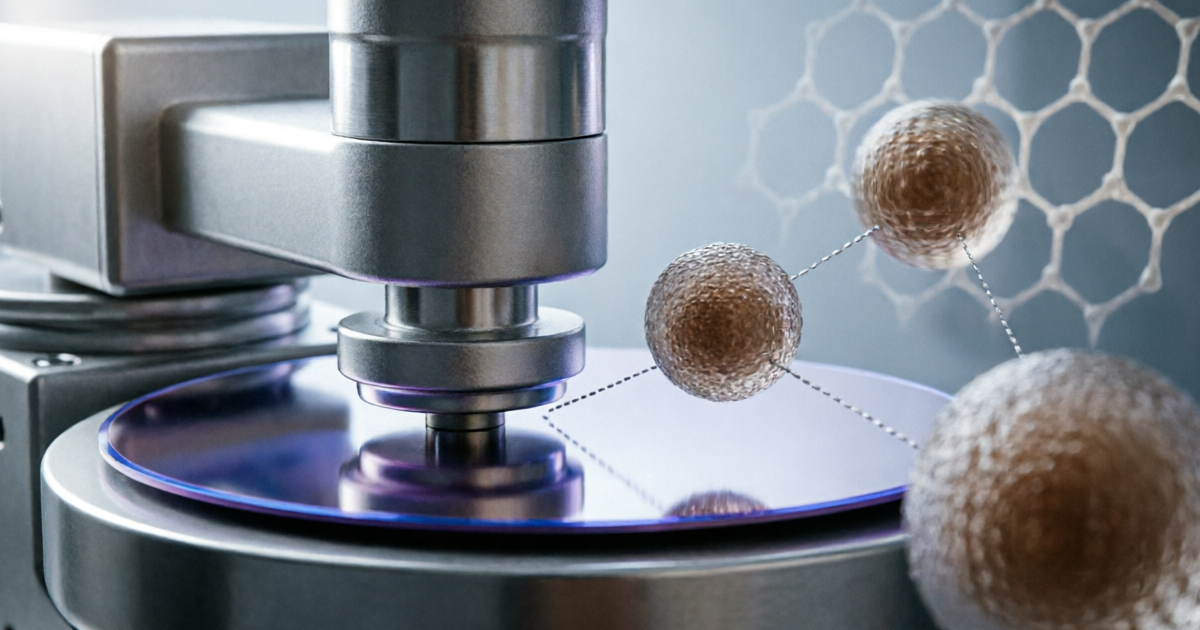
The choice of abrasive particle in copper CMP slurry is one of the most consequential formulation decisions a process engineer faces. Silice colloïdale et alumina represent fundamentally different mechanical approaches to the same polishing task — and they produce measurably different outcomes in removal rate, surface defect density, and material selectivity. This article compares both abrasive types across the properties that matter most in production copper CMP: hardness and material removal kinetics, particle size and defectivity, surface chemistry and selectivity, and the process application scenarios where each excels.
Table des matières
- 01.The Role of Abrasives in Copper CMP
- 02.Colloidal Silica: Properties & Applications
- 03.Alumina Abrasives: Fumed vs. Colloidal
- 04.Hardness, Scratch Mechanisms & Defectivity
- 05.Particle Size, Distribution & Colloidal Stability
- 06.Selectivity Implications of Abrasive Choice
- 07.Abrasive Selection Decision Framework
- 08.Questions fréquemment posées
1. The Role of Abrasives in Copper CMP
Abrasive particles provide the mechanical component of the CMP process. Without them, the chemical system — oxidizer, complexing agent, corrosion inhibitor — would produce isotropic dissolution that removes copper uniformly from all surfaces, including the recessed features that must be preserved. Abrasives are what make material removal selective to pad-contact zones: they concentrate the mechanical energy of the pad-wafer interface into discrete contact events at particle-scale dimensions, enabling removal of the chemically softened copper oxide layer preferentially at elevated surface points.
The performance requirements placed on CMP abrasives span several dimensions simultaneously:
- Hardness: Must be hard enough to mechanically disrupt the BTA-Cu passivation film and abrade the copper oxide layer at the polishing pressure used.
- Size and distribution: D50 must be large enough to make effective contact with the softened copper surface; D99 must be controlled to prevent oversized particles from causing scratch defects.
- Surface chemistry: Surface charge (zeta potential) determines colloidal stability, particle-surface interactions, and the effective selectivity between different materials being polished.
- Chemical inertness: The abrasive must not react chemically with the copper, ILD, or barrier metal in ways that alter the fundamental polishing mechanism or contaminate the wafer surface.
2. Colloidal Silica: Properties & Applications
Physical Properties
Mohs hardness ≈ 7 (bulk fused SiO₂). Spherical morphology. D50 range 30–200 nm in production formulations. Point of zero charge (PZC) ≈ pH 2–3. Stable as negative colloid above pH 3.
Production Synthesis
Stöber process (base-catalyzed TEOS hydrolysis) or ion-exchange process from sodium silicate. Both yield narrow PSD. Surface functionalization possible via silane coupling agents.
Colloidal silica is the dominant abrasive in Step 2 barrier CMP slurries and in all advanced-node (7 nm and below) copper CMP applications — for Step 1 as well as Step 2. Its lower hardness relative to alumina is actually an asset in these contexts: it removes the softened copper oxide layer efficiently without generating sub-surface damage, and it is gentle enough to coexist with fragile ELK dielectric materials (which have mechanical hardness lower than SiO₂ itself at k < 2.5).
Surface Chemistry and Selectivity
The surface of colloidal silica particles at neutral pH is covered with silanol groups (Si–OH) that are fully deprotonated to Si–O⁻ at pH > 5, giving the particles a large negative zeta potential (typically −30 to −50 mV at pH 7). This strong negative charge provides excellent electrostatic stabilization of the colloidal dispersion and creates an electrostatic barrier between particles and the similarly negative ILD surface (TEOS oxide, ELK OSG) — reducing abrasive-ILD contact and contributing to the high Cu:ILD selectivity observed with colloidal silica formulations.
Surface functionalization of colloidal silica — attaching organic groups via silane chemistry — allows further tuning of selectivity. Amino-functionalized silica particles (positive surface charge at neutral pH) show increased Cu:barrier selectivity at specific pH ranges because of their affinity for the oxidized copper surface (negative). Carboxyl-functionalized particles can be tuned for specific surface selectivity in advanced BEOL processes. This chemistry flexibility is one of colloidal silica’s key advantages over alumina as abrasive platforms evolve for advanced node requirements.
3. Alumina Abrasives: Fumed vs. Colloidal
Alumina (Al₂O₃) exists in several crystallographic phases relevant to CMP: gamma-alumina (γ-Al₂O₃, Mohs ≈ 7.5–8.5, the most common CMP phase) and alpha-alumina (α-Al₂O₃, Mohs ≈ 9, harder and more abrasive). In copper CMP, gamma-alumina is predominantly used in both fumed and colloidal forms.
Fumed Alumina
Fumed alumina is produced by high-temperature vapor-phase hydrolysis of aluminum chloride, producing fractal, chain-like agglomerate structures of primary particles (10–50 nm) that form loose secondary agglomerates (100–500 nm). This fractal morphology provides a very high specific surface area (BET ≈ 80–150 m²/g) and excellent mechanical cutting efficiency — the sharp edges and angles of the primary particle chain contacts with the copper surface create higher local stress concentrations than the smooth spherical silica particles, delivering higher removal rates at the same nominal particle size.
The tradeoff of fumed alumina’s fractal morphology is more difficult colloidal stability: the complex agglomerate structures are prone to further agglomeration under shear stress in the CMP process, and controlling D99 to prevent large agglomerates from causing scratch defects is more challenging than with colloidal silica. Fumed alumina slurries require more aggressive filtration (0.2 µm absolute POU filter) and tighter pH control to maintain stable colloidal dispersion.
Colloidal Alumina
Colloidal alumina is produced by precipitation from aluminum salt solutions under controlled pH and temperature, yielding more uniform, pseudo-spherical particles with narrower size distribution than fumed alumina. Colloidal alumina has better colloidal stability than fumed alumina but somewhat lower removal rate per unit mass due to the lower surface energy of its rounder particle morphology. It occupies a performance middle ground between fumed alumina (high rate, high defect) and colloidal silica (lower rate, low defect).
4. Hardness, Scratch Mechanisms & Defectivity
The scratch risk of an abrasive is determined not simply by its bulk hardness but by the interaction between particle hardness, morphology, size distribution, and the mechanical properties of the surface being polished. In copper CMP, three materials with very different hardness profiles are polished simultaneously: copper (Vickers ≈ 369 MPa), barrier metal (Ta: ≈ 873 MPa, Co: ≈ 1043 MPa), and ILD (TEOS SiO₂: ≈ 8,800 MPa).
| Abrasif | Dureté Mohs | Vickers Hardness (MPa) | Scratch Risk on Cu | Scratch Risk on ELK ILD |
|---|---|---|---|---|
| Colloidal SiO₂ | ≈7.0 | ≈5,500–7,000 | Faible | Low–Medium |
| γ-Al₂O₃ (colloidal) | ≈7.5–8.5 | ≈15,000–20,000 | Moyen | Moyen |
| Fumed Al₂O₃ | ≈7.5–8.5 | ≈15,000–20,000 | Moyenne-élevée | Haut |
| α-Al₂O₃ | ≈9.0 | ≈22,000–25,000 | Haut | Très élevé |
Scratch formation in copper CMP follows a plastic deformation model: a particle indent into the surface creates a groove when the local contact pressure exceeds the surface’s yield strength. For a given polishing pressure, smaller particles create smaller contact areas and therefore higher local stress concentrations — counter-intuitively, smaller particles can produce deeper scratches than larger ones if they are harder. However, this effect is secondary to the dominant scratch mechanism in production: oversized particles (agglomerates, hard inclusions, pad debris) with D > 500 nm are responsible for the vast majority of critical scratches in production copper CMP. This is why D99 control and POU filtration are more important defect-reduction levers than the choice of nominal abrasive type.
5. Particle Size, Distribution & Colloidal Stability
The ideal abrasive particle size for copper CMP involves competing tradeoffs. Larger particles (D50 > 150 nm) create larger contact areas per particle, reducing local stress concentration and scratch depth — but also reducing the number of contact events per unit area at fixed particle mass concentration, potentially reducing removal rate uniformity. Smaller particles (D50 < 60 nm) provide more contact points and better surface conformality but generate lower removal rate per contact event due to lower mechanical energy per impact.
Production copper CMP slurries use D50 values in the range of 60–150 nm for both silica and alumina abrasives — a range that balances removal rate efficiency with defect risk. The D99 control is more critical than D50: the presence of even a small number of large particles (D > 500 nm) in the abrasive distribution dramatically increases scratch density. Colloidal silica typically achieves D99/D50 ratios of 2.5–3.5 in production formulations; fumed alumina typically shows D99/D50 ratios of 5–15, reflecting its less uniform agglomerate structure.
Colloidal stability — the resistance of the particle dispersion to agglomeration under slurry delivery conditions (pump recirculation, temperature variation, pH change) — is better for colloidal silica than alumina at most conditions. The highly negative zeta potential of silica at neutral pH (−30 to −50 mV) provides strong electrostatic repulsion between particles, while alumina has a PZC near pH 8–9, meaning it is near-zero or positively charged in the typical copper CMP pH range of 4–7, with weaker electrostatic stabilization.
6. Selectivity Implications of Abrasive Choice
The choice of abrasive significantly affects the material removal selectivity between copper, barrier metal, and ILD — independently of the chemical component of the slurry. This mechanical selectivity contribution arises from the different hardness ratios between the abrasive and each material being polished.
For colloidal silica: SiO₂ (hardness ≈ 7,000 MPa) is harder than copper oxide (≈ 150–400 MPa as the polished species, after H₂O₂ oxidation) and softer than ILD SiO₂ (≈ 8,800 MPa) and barrier Ta (≈ 8,000 MPa). This means silica abrasives preferentially scratch the softer copper oxide while making minimal contact with the harder ILD — contributing a mechanical component to high Cu:ILD selectivity.
For alumina: Al₂O₃ (hardness ≈ 15,000–20,000 MPa) is harder than all three materials being polished — copper, ILD, and barrier metals. This means alumina removes all three at rates proportional to their hardness, with no mechanical selectivity contribution. The Cu:ILD selectivity of alumina-based slurries is driven entirely by the chemical components (BTA passivation of ILD vs. copper oxidation), making it harder to achieve high Cu:ILD selectivity with alumina than with silica.
7. Abrasive Selection Decision Framework
The practical guide for abrasive selection in copper CMP reduces to a small number of process-condition-driven rules:
- Step 1 at conventional nodes (≥28 nm, ≥1.5 psi): Fumed or colloidal alumina for maximum removal rate. The higher defect risk is tolerable because Step 1 defects are partially removed in Step 2. Use POU 0.2 µm filtration to control D99.
- Step 1 at advanced nodes (<7 nm, <1 psi, ELK ILD present): Engineered colloidal silica with chemically enhanced formulations (higher H₂O₂, optimized glycine). Alumina’s defect risk is unacceptable on ELK dielectrics and narrow copper features at sub-nm dishing tolerance.
- Step 2 (all nodes): Colloidal silica, always. The need for high Cu:ILD selectivity and low defectivity at Step 2 makes alumina unsuitable in essentially all production applications.
- Step 3 buff (advanced nodes): Sub-40 nm colloidal silica or abrasive-free formulations for minimum surface roughness and maximum planarity restoration.
2026 trend: The industry-wide push to lower polishing pressures for ELK compatibility is steadily shifting abrasive choices in Step 1 from alumina toward advanced colloidal silica — even at conventional nodes where ELK is not used — because the defect reduction benefits of silica outweigh the removal rate advantage of alumina once a slurry’s chemical activity is sufficiently enhanced to compensate mechanically. JEEZ’s CuB-S (silica-based Step 1) series reflects this trend.
8. Questions fréquemment posées
Can colloidal silica achieve the same removal rate as alumina in Step 1 copper CMP?
At equivalent polishing pressure, colloidal silica typically delivers 30–50% lower removal rate than alumina for bulk copper Step 1. However, this gap can be substantially narrowed by increasing oxidizer concentration (more H₂O₂), reducing BTA loading, and increasing particle loading. At advanced-node low-pressure conditions (<1 psi), the practical removal rate gap between optimized silica and alumina formulations narrows to <20%, making silica the preferred choice given its much better defect profile on ELK dielectric stacks.
Why does particle zeta potential matter for abrasive selectivity?
Zeta potential determines the electrostatic interaction between abrasive particles and the surfaces being polished. A negatively charged colloidal silica particle (zeta ≈ −40 mV at pH 7) experiences electrostatic repulsion from the negatively charged ILD surface (SiO₂ and OSG are also negative at neutral pH) — reducing effective contact with the ILD and contributing to high Cu:ILD selectivity. Alumina near its PZC (pH 8–9) has near-zero zeta potential at copper CMP pH ranges, providing no electrostatic selectivity contribution — removal rates are determined almost entirely by the mechanical hardness ratio.
How does abrasive type affect post-CMP cleaning requirements?
Alumina abrasives tend to adhere more tenaciously to the polished surface than colloidal silica — alumina’s positive surface charge (at pH < PZC) causes electrostatic adhesion to the negatively charged wafer surface and to the BTA-Cu complex film. This means alumina-containing slurries typically require more aggressive post-CMP cleaning (higher citric acid concentration, longer brush scrub time) than silica-based slurries. The cleaning chemistry must also be verified to be free of alumina re-deposition risk after the brush step.
Is ceria (CeO₂) relevant for copper CMP?
Ceria is primarily used in shallow trench isolation (STI) and oxide CMP applications where its ability to chemically attack Si–O bonds provides extremely high SiO₂ removal rate and selectivity. In copper CMP, ceria’s strong oxide removal mechanism is generally undesirable — it would cause excessive ILD erosion in Step 2. However, as of 2026, some research groups and advanced packaging applications are exploring ceria-hybrid formulations for planarization of copper/oxide stacks in redistribution layer (RDL) CMP, where the primary polishing surface is oxide rather than copper. This remains a non-mainstream application and is not used in front-end-of-line copper interconnect CMP.
Need Help Choosing the Right Abrasive for Your Copper CMP Process?
Jizhi Electronic Technology Co., Ltd. (JEEZ) offers alumina-based CuB and colloidal silica-based CuB-S Step 1 slurries, as well as the full CuS Step 2 series — all with application engineering support for abrasive selection and process optimization at any node and barrier stack.
Contact JEEZ Application Engineering →