CMP Slurry for Advanced Nodes: 5nm, 3nm, 2nm & Beyond — Technical Challenges & Innovations
As semiconductor technology crosses into the angstrom era, CMP slurry formulation science faces its most demanding challenges yet. Mechanically fragile ultra-low-k dielectrics, new metal conductors with no CMP precedent, three-dimensional transistor architectures, and defect budgets measured in single digits per wafer — this guide examines each challenge in technical depth and maps the formulation innovations driving solutions.
📋 Table of Contents
- Why Advanced Nodes Make CMP Progressively More Demanding
- Challenge 1: Ultra-Low-k (ULK) Dielectric CMP
- Challenge 2: Gate-All-Around (GAA) Transistor CMP
- Challenge 3: Cobalt CMP — The MOL Contact Revolution
- Challenge 4: Ruthenium CMP — The Next Frontier
- Challenge 5: 3D NAND High-Aspect-Ratio CMP
- Challenge 6: Advanced Packaging CMP
- Challenge 7: Abrasive-Free Slurry (AFS) for Defect-Zero Applications
- Node-by-Node CMP Requirements Summary
- Frequently Asked Questions
1. Why Advanced Nodes Make CMP Progressively More Demanding
The relationship between semiconductor node scaling and CMP complexity is not linear — it is compounding. Each generation tightens requirements across every dimension simultaneously: stricter planarity budgets, narrower defectivity windows, higher selectivity demands, tighter WIWNU targets, and new target materials requiring fresh formulation approaches with no prior qualification history.
Three structural trends drive this compounding difficulty. Feature size reduction: a 10 nm height variation tolerable at 28nm can cause catastrophic EUV exposure failures at 3nm, where depth-of-focus may be only 30–50 nm — planarity budgets shrink faster than the node number itself. Increasing CMP step count: from ~12 steps at 28nm to over 28 at TSMC N2, total complexity grows linearly while each step's tolerance budget shrinks. New material introductions: cobalt contacts, ruthenium liners, ELK SiCOH — each may require a purpose-designed slurry with no existing commercial baseline.
📌 The Tolerance Budget Problem
At 28nm, a CMP step might allow ±15 nm remaining-film variation. At 3nm, the equivalent step may allow ±2 nm — an 87% reduction in tolerance for a process running 10× more wafers per day. Achieving ±2 nm requires better slurry formulation, tighter WIWNU control, more precise endpoint detection, and tighter control of every variable from slurry temperature to pad conditioning frequency.
2. Challenge 1: Ultra-Low-k (ULK) Dielectric CMP
Ultra-Low-k (ULK) Dielectric CMP
The mechanical fragility problem that redefined BEOL CMP formulation
The transition from dense SiO₂ ILD (k ≈ 4.0) to porous ultra-low-k dielectrics (k < 2.5) was one of the most disruptive material changes in BEOL interconnect history. Introducing porosity — air-gaps distributed through a SiCOH matrix — reduces mechanical stiffness and fracture toughness by 60–80% relative to dense SiO₂.
Standard abrasive contact generates local stress concentrations exceeding the fracture strength of porous ULK films, producing sub-surface cracking, delamination at the ULK/etch-stop interface, and macro-scale spallation in severe cases. Increasing abrasive concentration or downforce to improve MRR is strictly counter-productive — it linearly increases mechanical film damage probability.
Advanced Slurry Solutions for ULK CMP
ULK-compatible formulations shift the removal mechanism decisively toward the chemical side: reduced abrasive concentration (2–5 wt% vs. 8–12 wt% standard); smaller, spherical particles with D50 30–60 nm and D99 <120 nm (any particle above 200 nm is catastrophic); pH-optimized alkaline conditions (pH 9.5–10.5) maximizing Si–O–Si hydrolytic dissolution; and non-ionic surfactant stress-shielding to distribute abrasive contact stress across fragile pore walls.
⚠️ ELK — The Next Frontier
At 2nm and beyond, extreme low-k (ELK) dielectrics with k approaching 2.0 require porosity of 30–40%, approaching the mechanical limits of abrasive-based CMP processability. ELK CMP will likely require abrasive-free slurry or a fundamentally new planarization approach for the most fragile BEOL layers.
3. Challenge 2: Gate-All-Around (GAA) Transistor CMP
Gate-All-Around (GAA) / Nanosheet CMP
New transistor geometry creates FEOL CMP steps with no historical precedent
Gate-all-around transistors — commercialized by Samsung at SF3 in 2022 and TSMC at N2 in 2025 — replace the FinFET fin with horizontal silicon nanosheets surrounded on all four sides by gate metal. This architecture introduces multiple new FEOL CMP requirements with no pre-existing qualification baseline.
New GAA-Specific CMP Steps
- SiGe/Si nanosheet stack planarization: Requires controlled Si:SiGe selectivity near 1:1 and sub-2 nm WIWNU — a new formulation target with no FinFET precedent.
- Inner spacer recess CMP: Spacer fill must be precisely recessed within the vertical space between nanosheets — process window measured in single nanometers.
- Gate metal CMP for nanosheet fill: Three-material co-polish (gate metal, gate fill, ILD) with near-zero dishing tolerance in dimensions 10× smaller than equivalent FinFET gate.
GAA CMP slurry development is among the most active formulation research areas at all leading suppliers as of 2025. Any CMP excursion at this step destroys the transistor channel irreversibly — making it the highest-stakes process qualification activity in the 2nm era.
4. Challenge 3: Cobalt CMP — The MOL Contact Revolution
Cobalt (Co) CMP
Replacing tungsten in MOL contacts at ≤10nm — with far more complex electrochemistry
Cobalt replaced tungsten in MOL contacts at 10nm and below, driven by lower contact resistance at sub-20 nm diameters and superior ALD gap-fill. Its electrochemical behavior is dramatically more complex than tungsten's — creating a CMP formulation challenge that took the industry several years to solve at production defectivity levels.
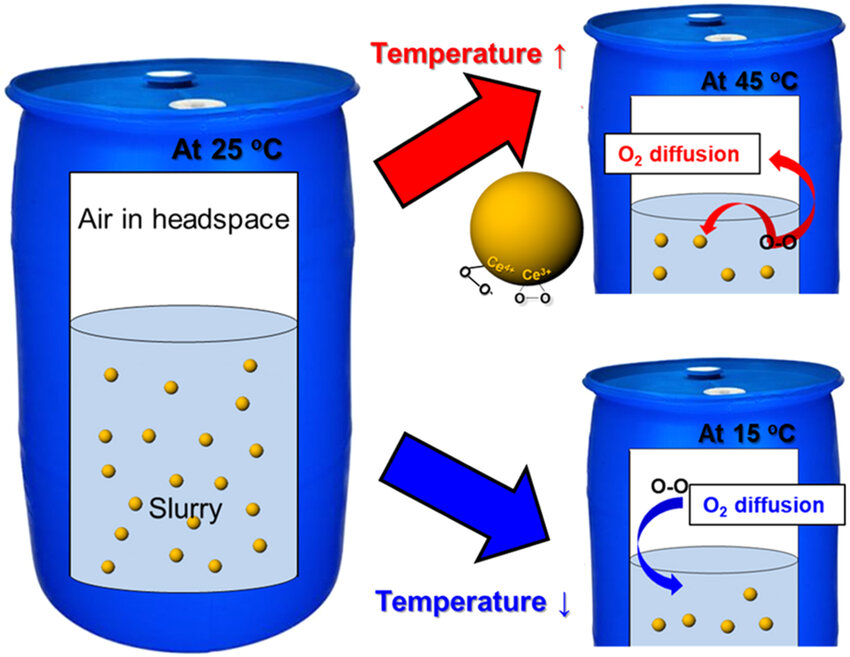
Cobalt is electrochemically active across a wide pH range. In contact with adjacent TiN liner or SiO₂ ILD, it forms galvanic cells driving localized dissolution and microscopic pitting even without mechanical abrasion. Successful Co CMP slurry requires simultaneous optimization of: H₂O₂ oxidizer (0.5–2 wt%, temperature-sensitive); corrosion inhibitors selective for Co/TiN galvanic suppression; chelating agents for Co²⁺/Co³⁺ management; and near-neutral to mildly acidic pH (4–7). See our Copper CMP Slurry guide for broader BEOL metal CMP context.
5. Challenge 4: Ruthenium CMP — The Next Frontier
Ruthenium (Ru) CMP
The most chemically inert metal in the advanced node materials toolkit
Ruthenium is the leading candidate for barrier, liner, and local interconnect at 2nm and beyond: low bulk resistivity, excellent electromigration resistance, and ALD deposition at sub-1 nm thickness. It presents the most formidable CMP challenge of any advanced node metal — its native oxide RuO₂ is dense, adherent, and electrically conductive. The standard CMP strategy of forming a soft removable surface oxide simply does not work for Ru: RuO₂ is harder than most abrasive particles.
Effective Ru removal requires either strong oxidizers forming soluble RuO₄²⁻ species (raising volatility and safety concerns) or strongly acidic conditions dissolving Ru²⁺/Ru³⁺ directly. Active research directions include periodate (IO₄⁻) oxidizers, ceric ammonium nitrate (CAN), and plasma-assisted pre-activation. As of 2025, no commercially qualified production Ru CMP slurry exists broadly — first qualifications at leading 2nm fabs are expected by 2026–2027, making this the most actively watched frontier in CMP formulation science.
Advanced Node CMP Application? Talk to Our Engineers.
Jizhi Electronic Technology supports CMP slurry qualification for oxide, STI, and metal applications from our Wuxi, Jiangsu facility.
Request a Technical Discussion →6. Challenge 5: 3D NAND High-Aspect-Ratio CMP
3D NAND HARC CMP
The highest-topography, highest-MRR CMP challenge in production today
3D NAND presents a CMP challenge orthogonal to advanced logic: rather than lateral miniaturization, it demands CMP over extreme vertical topography. As manufacturers stack 200, 300, and eventually 400 layer pairs, the tungsten word line fill creates step heights of 3–8 μm that must be globally planarized within lithography WIWNU budgets.
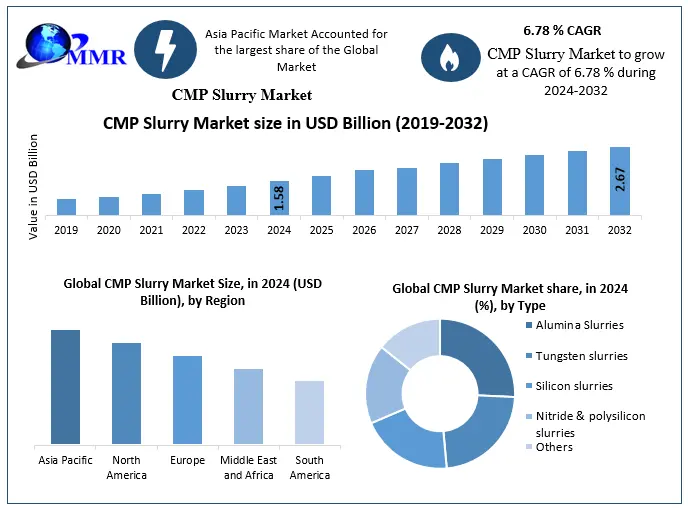
CMP on extreme topography produces a center-fast or edge-fast polish profile driven by differential contact pressure at topographic peaks — worsening systematically as layer count increases. Advanced 3D NAND W slurry addresses this through: viscosity-modified carriers using shear-thinning polymer additives; sustained high-MRR formulation maintaining 4,000–6,000 Å/min W removal across the full 300mm wafer for extended cycle times; and pad–slurry co-optimization requiring jointly engineered pad groove geometry and slurry flow distribution. The 3D NAND CMP segment is one of the fastest-growing tungsten slurry applications — see our CMP Slurry Market analysis for growth projections.
7. Challenge 6: Advanced Packaging CMP
Advanced Packaging CMP
TSV reveal, RDL copper, hybrid bonding — fastest-growing new CMP segment (~18% CAGR)
Advanced packaging — CoWoS, SoIC, HBM stacking, fan-out wafer-level packaging — is the fastest-growing CMP application segment, driven by AI infrastructure demand for die-to-die bandwidth achievable only through tight 3D integration. Its CMP challenges are fundamentally different from conventional FEOL or BEOL processing.
TSV Cu CMP: 5–20 μm Cu overburden requires sustained high-MRR polishing over 20–40 minute cycles, exposing H₂O₂ decomposition and pH drift limitations negligible in standard 2–5 minute Cu CMP. RDL Cu CMP: Fan-out packaging RDL copper forms in polymer dielectrics (polyimide, PBO) requiring near-neutral pH, low-abrasive-concentration formulations incompatible with standard alkaline oxide slurry. Hybrid bonding surface preparation: TSMC SoIC and Sony stacked sensor hybrid bonding requires Ra <0.5 nm and atomic-level planarity across 300mm — arguably the most demanding CMP specification in semiconductor manufacturing, requiring near-abrasive-free or AFS chemistry.
8. Challenge 7: Abrasive-Free Slurry (AFS) for Defect-Zero Applications
Abrasive-Free Slurry (AFS)
When even a single abrasive-induced scratch is unacceptable
For EUV photomask blank final polish, SOI wafer preparation, and 2nm node ULK ILD finishing, even a single micro-scratch from an abrasive particle represents an unacceptable yield risk. Abrasive-free slurry achieves removal through purely chemical mechanisms — oxidizer-driven surface activation combined with complexing-agent-assisted molecular dissolution — with no particulate contact. AFS sacrifices removal rate (<200 Å/min) for essentially perfect surface quality, making it exclusively a final finishing step after bulk removal by conventional abrasive CMP.
🔮 EUV Mask Blank CMP
A single scratch on an EUV mask blank can print as a defect on every wafer exposed through it for 50,000–100,000 wafer lifetimes. The cost of a single mask print defect, amortized across all affected wafers, can exceed $1M — fully justifying AFS-based finishing despite its low throughput. For AFS chemistry context, see our guide on CMP Slurry Composition.
9. Node-by-Node CMP Requirements Summary
The table below consolidates CMP requirements across node generations. For the full application-type breakdown, see our CMP Slurry Types guide.
| Node | ~CMP Steps | Key New CMP Challenge | Critical Slurry Requirement | New Materials |
|---|---|---|---|---|
| 28nm | ~12 | Low-k ILD (k ≈ 3.0) | Reduced abrasive pressure; surfactant stabilization | SiCOH; TaN/Ta barrier |
| 14/16nm | ~15 | FinFET STI; ULK (k ≈ 2.7) | High-selectivity ceria STI; gentle ULK oxide | High-k/metal gate; FinFET fins |
| 10/7nm | ~18 | Co contact; ULK (k ≈ 2.5) | Co-compatible pH; inhibitor co-optimization | Cobalt contacts; porous ULK |
| 5nm | ~22 | EUV integration; tighter WIWNU | WIWNU <1.5%; LPC <50/mL; pH ±0.1 | EUV resist; Mo hard mask |
| 3nm | ~25 | Late FinFET; early GAA; ULK (k <2.4) | Sub-2 nm dishing; AFS for ELK finish | ELK dielectric; Ru liner (early) |
| 2nm | >28 | GAA production; Ru barrier | GAA-specific selectivity; Ru oxidizer R&D | GAA nanosheets; Ru barrier; Mo gate |
| A14/1.4nm | 30+ | CFET; ELK (k <2.0); air gap ILD | AFS for most dielectric layers; new metal | CFET; 2D materials; air gap ILD |
Conventional vs. Advanced-Node CMP Slurry: Key Specification Shifts
- WIWNU: <3% (1σ) acceptable
- Defectivity: <100 scratches/wafer
- D99: <300 nm (silica)
- LPC (>0.5 μm): <500/mL
- Dishing: <50 nm
- Trace metals: <20 ppb/element
- pH control: ±0.3 acceptable
- Oxidizer assay: ±10% relative
- WIWNU: <1.5% (1σ) required
- Defectivity: <20 scratches; critical <3
- D99: <150 nm (silica); <250 nm (ceria)
- LPC (>0.5 μm): <50/mL
- Dishing: <20 nm (BEOL)
- Trace metals: <5 ppb/element (ICP-MS)
- pH control: ±0.1 required
- Oxidizer assay: ±3% relative
10. Frequently Asked Questions
Why can't existing CMP slurries be used at advanced nodes without reformulation?
How does EUV lithography affect CMP slurry requirements?
Is cobalt CMP qualified in high-volume production?
What does GAA mean for CMP step count per wafer?
When will ruthenium CMP slurry be in production?
Conclusion
The progression from 28nm to 2nm represents more than a decade of continuous CMP formulation innovation — ULK mechanical fragility, GAA transistor geometry, cobalt and ruthenium electrochemistry, 3D NAND topography, advanced packaging surface requirements, and the approaching limits of abrasive-based CMP collectively define the most technically demanding era in CMP slurry history. For process engineers, treating slurry as a precisely co-engineered process variable — not a commodity consumable — becomes ever more consequential as the node shrinks.
For foundational CMP slurry knowledge, return to the Complete CMP Slurry Guide. For formulation chemistry details, see CMP Slurry Composition. For market growth context, see the CMP Slurry Market Forecast 2025–2032.