Copper CMP Slurry: Dual Damascene Process, Formulation & Defect Control — Complete Engineering Guide
Copper CMP is the most chemically complex and process-sensitive step in BEOL semiconductor manufacturing. A three-stage polishing sequence — each requiring a fundamentally different slurry chemistry — must deliver bulk copper removal, barrier/liner planarization, and final buff polish while holding dishing below 20 nm and erosion below 15 nm at advanced nodes. This guide covers every dimension of copper CMP slurry: chemistry, process integration, defect failure modes, and the formulation evolution required at 5nm and below.
📋 Table of Contents
- Why Copper CMP Is Uniquely Challenging
- The Dual Damascene Process: Why Three CMP Steps?
- Step 1: Bulk Copper Removal Slurry
- Step 2: Barrier / Liner CMP Slurry
- Step 3: Dielectric Buff Polish
- BTA Chemistry: The Copper CMP Corrosion Inhibitor
- Dishing & Erosion: The Critical Cu CMP Defects
- Key Process Parameters & Their Effect on Cu CMP
- Copper CMP at Advanced Nodes: 5nm, 3nm & Beyond
- Full Cu CMP Slurry Comparison Table
- Frequently Asked Questions
1. Why Copper CMP Is Uniquely Challenging
Copper was introduced as the primary BEOL interconnect metal by IBM and Motorola in 1997, replacing aluminum in a transition that required simultaneously solving three previously unsolved manufacturing problems: copper deposition into sub-micron trenches and vias (solved by electrochemical deposition, ECD), copper barrier/liner technology (TaN/Ta, later Co/Ru), and copper planarization — because copper cannot be dry-etched with practical selectivity, making CMP the only viable planarization technology for dual damascene copper.
This mandatory dependency on CMP for copper patterning makes copper CMP slurry a non-substitutable, process-critical consumable in every BEOL interconnect layer of every advanced logic, DRAM, and mature-node device manufactured today. The fundamental challenges that make copper CMP harder than oxide CMP are:
- Electrochemical complexity: Copper is a noble metal with complex oxidation/reduction behavior. Its CMP must balance active oxidation (for removal) with passivation (to prevent corrosion of already-polished features) — simultaneously, in the same slurry.
- Multi-material co-planarization: The barrier step must simultaneously remove TaN/Ta, copper, and SiO₂ (or low-k dielectric) at carefully controlled relative rates — too much Cu removal causes dishing; too much dielectric removal causes erosion.
- Interconnect resistance sensitivity: Dishing and erosion in copper CMP directly translate to increased line resistance and RC delay — a yield and performance impact that worsens with every node as metal line cross-sections shrink.
- Contamination sensitivity: Cu²⁺ ions in slurry effluent are highly mobile contaminants that can diffuse into gate oxide if not properly managed in slurry chemistry and post-CMP clean.
📌 Copper vs. Tungsten CMP — Key Differences
Tungsten CMP operates in a simple, well-defined regime: high-MRR removal of W in an oxidizing acidic environment with a well-passivated Ti/TiN stop layer providing natural endpoint. Copper CMP operates in a fundamentally more difficult regime: the “stop layer” (TaN/Ta barrier) is only 3–5 nm thick and must itself be removed in the subsequent step, the slurry must simultaneously remove and passivate copper, and the process window for acceptable dishing and erosion is measured in single-digit nanometers at advanced nodes. These differences explain why Cu CMP slurry development has historically been the most complex and longest-cycle formulation effort in CMP consumables.
2. The Dual Damascene Process: Why Three CMP Steps?
The dual damascene copper interconnect process — the manufacturing flow used for every copper metal layer in advanced semiconductor devices — creates the multi-step CMP requirement through its fill-then-planarize architecture. In dual damascene, the dielectric layer is first patterned with both the via and trench geometry, then lined with barrier/liner films (TaN/Ta or Co/Ru), and finally filled with electroplated copper. The copper overburden — the excess copper above the trench level — can be 1–3 μm thick on the wafer surface and must be entirely removed while leaving copper only within the trench and via features.
This creates an inherently multi-step CMP challenge because no single slurry formulation can optimally serve all three removal objectives:
- Bulk Cu removal requires a highly Cu-selective slurry (Cu:barrier >100:1) to rapidly clear the copper overburden without significantly attacking the thin TaN/Ta barrier — premature barrier exposure causes barrier-level non-uniformity and yield loss.
- Barrier/liner removal requires a near-unity selectivity formulation (Cu:Ta:SiO₂ ≈ 1:1:1) that removes the exposed TaN/Ta barrier while simultaneously controlling the rate of copper and dielectric removal to minimize dishing and erosion — diametrically opposed to the Step 1 selectivity requirement.
- Dielectric buff (optional) uses a gentle low-MRR oxide polish to remove residual barrier or slurry contamination from the dielectric surface and restore the dielectric surface planarity after Step 2.
The incompatible selectivity requirements of Steps 1 and 2 are the fundamental reason that copper CMP requires at least two distinct slurry formulations. No chemistry discovered to date can simultaneously achieve Cu:barrier >100:1 (Step 1) and Cu:barrier ≈ 1:1 (Step 2) — these are thermodynamically and kinetically mutually exclusive targets. For a detailed discussion of how this fits into the broader CMP slurry types taxonomy, see our dedicated article.
3. Step 1: Bulk Copper Removal Slurry
Bulk Copper Removal
High-selectivity, high-MRR oxidizing slurry — the workhorse step
Removal Mechanism
The bulk copper removal mechanism in Step 1 is a three-stage electrochemical-mechanical cycle operating continuously across the polishing pad:
H₂O₂ oxidizes the copper surface to Cu(OH)₂ or CuO — mechanically softer than base copper and chemically accessible to chelating agents. Chelators (typically glycine, citric acid, or amino acid derivatives at pH 3–5) form stable soluble Cu²⁺ complexes that transport dissolved copper away from the polishing interface in the slurry liquid film. Abrasive particles then remove the hydroxide reaction layer from the topographic peaks, re-exposing fresh metallic copper to oxidative attack. This cycle repeats thousands of times per second across the pad-wafer interface.
High Selectivity Against the Barrier
The Step 1 slurry achieves Cu:barrier selectivity >100:1 through a combination of chemistry and pH design: at pH 3–5, H₂O₂ is an effective copper oxidizer but a poor oxidizer for TaN and Ta, which form stable passivating oxide layers (Ta₂O₅, TaN) that resist the Step 1 chemical environment. The chelating agents are also designed to specifically complex Cu²⁺ ions rather than Ta or Ti species, maintaining the selectivity advantage. When the copper overburden is cleared and the TaN/Ta barrier is exposed across the full wafer surface, the change in surface reflectance (copper → TaN) triggers the optical endpoint detection system, signaling transition to Step 2.
⚠️ Step 1 Over-Polish Risk
After the copper endpoint signal is detected, fabs typically apply 10–30% over-polish to ensure complete copper clearing across WIWNU variation. Each second of over-polish in Step 1 both consumes additional TaN/Ta barrier and introduces incremental dishing in wide copper features. Minimizing the required over-polish percentage through improved WIWNU control (better slurry uniformity and pad conditioning) directly reduces the dishing budget consumed before Step 2 begins.
4. Step 2: Barrier / Liner CMP Slurry
Barrier / Liner Removal
The hardest step: near-unity selectivity across three mutually competing materials
The Near-Unity Selectivity Challenge
The barrier step is widely regarded as the most formulation-difficult CMP process in production. The challenge is unique: the slurry must remove three fundamentally different materials — metallic copper (noble, electrochemically active), tantalum nitride (ceramic, chemically inert), and silicon dioxide (amorphous oxide, chemically etchable) — at nearly equal rates, while simultaneously preventing the over-removal of copper in the wide-line areas (dishing) and the over-removal of dielectric in densely patterned array areas (erosion).
These objectives are in tension. The slurry's oxidizer and chelator chemistry that enables copper removal will, if uncontrolled, also cause excessive copper dissolution from already-polished recessed areas (dishing). The abrasive loading and pH that enables dielectric removal will, if unoptimized, cause preferential oxide erosion in dense metal arrays (erosion). The barrier slurry formulation must solve all four objectives simultaneously:
- Remove TaN/Ta at ≥200 Å/min to achieve practical cycle times for the 3–5 nm barrier film
- Maintain Cu removal at a controlled, low rate to planarize residual step height without causing dishing
- Remove SiO₂/low-k dielectric at a rate matched to copper removal to prevent erosion in array areas
- Suppress copper surface corrosion with inhibitors (BTA derivatives) in recessed features to limit dishing
Barrier Slurry Formulation Approach
Modern barrier CMP slurry formulations achieve near-unity selectivity through a carefully balanced multi-component system: colloidal silica abrasive (30–60 nm, 3–6 wt%) provides mechanical removal of all three materials without the extreme hardness bias of alumina; pH 6–9 is selected to ensure that H₂O₂ is an effective but moderate oxidizer for copper while anionic surfactant complexes with Ta²O₅ surfaces reduce its effective hardness against abrasive contact; and low-concentration BTA (50–200 ppm) provides selective copper corrosion inhibition in recessed features where abrasive contact frequency is low, specifically suppressing the dishing component of copper over-removal. For a deeper discussion of how these additive classes function, see our guide on CMP Slurry Composition.
5. Step 3: Dielectric Buff Polish
Dielectric Buff Polish (Optional)
Surface restoration and residual contamination removal after barrier step
The optional buff step is deployed in process flows where the barrier step leaves residual TaN particles, barrier film micro-scratches, or slurry chemical contamination on the dielectric surface. A short alkaline oxide slurry buff (15–30 seconds) polishes the dielectric surface at low MRR, removing the top 50–100 nm of contaminated dielectric while using very low Cu MRR to avoid adding additional dishing to the already-polished copper features. The buff step significantly reduces the post-CMP clean burden and improves the defect map presented to post-CMP inspection — at the cost of additional cycle time and slurry consumption. At advanced nodes where every process step matters for cycle time, the buff step is carefully evaluated for cost-vs-benefit in each integration scheme.
Looking for a Copper CMP Slurry Partner?
Jizhi Electronic Technology provides CMP polishing slurry with application engineering support from Wuxi, Jiangsu — serving the Yangtze River Delta semiconductor cluster.
Request a Technical Consultation →6. BTA Chemistry: The Copper CMP Corrosion Inhibitor
Benzotriazole (BTA, C₆H₅N₃) is the canonical corrosion inhibitor for copper CMP slurry and one of the most studied organic additives in the entire CMP formulation literature. Understanding BTA's mechanism, concentration sensitivity, and limitations is essential for any process engineer working with copper CMP.
How BTA Works
BTA molecules adsorb onto copper surfaces through their triazole nitrogen atoms, forming a dense, hydrophobic Cu–BTA complex monolayer. This monolayer acts as a kinetic barrier against further oxidative attack by H₂O₂ or dissolved oxygen, dramatically reducing the copper corrosion current in the recessed feature areas where abrasive mechanical contact is minimal. The net effect is that BTA suppresses copper removal selectively in the recessed (already-polished) areas of the pattern while having minimal effect in the topographic peak areas where abrasive contact mechanically disrupts the BTA layer and maintains active copper removal — exactly the selectivity behavior needed to achieve low dishing.
BTA Concentration Sensitivity
🔴 BTA: A Double-Edged Additive
BTA concentration must be precisely controlled within a narrow optimal window — typically 50–300 ppm in Step 2 barrier slurry. Too little BTA: inadequate corrosion inhibition in recessed Cu features → excessive dishing; copper surface roughness increases from uncontrolled H₂O₂ attack. Too much BTA: the Cu–BTA complex forms on topographic copper peaks as well, suppressing the targeted copper removal rate and reducing clearing efficiency; BTA also contributes to post-CMP clean difficulty as a surface residue requiring specific alkaline clean chemistry for removal.
BTA Environmental and Regulatory Considerations
BTA is classified as a potential environmental hazard in aqueous effluent due to its resistance to conventional biological wastewater treatment — it is not readily biodegradable under typical treatment plant conditions. Regulatory pressure in Japan, Europe, and increasingly in China has driven research into BTA-free or reduced-BTA copper CMP slurry formulations using alternative nitrogen-containing heterocyclic inhibitors (benzimidazole derivatives, triazole variants with modified biodegradability profiles). While full BTA elimination in production Cu CMP slurry remains challenging as of 2025, reduced-BTA formulations with improved environmental profiles are commercially available from several leading suppliers.
7. Dishing & Erosion: The Critical Copper CMP Defects
Dishing and erosion are the two characteristic yield-limiting defects of copper CMP, both arising from the difficulty of controlling simultaneous removal of materials with different mechanical and chemical properties. Understanding their root causes is essential for process engineers optimizing slurry selection and process parameters. For a complete treatment of all CMP defect types, see our article on CMP Slurry Defects Analysis & Quality Control.
| Defect | Definition | Root Cause | Primary Mitigation | Spec Target (<5nm node) |
|---|---|---|---|---|
| La pêche | Cu surface below surrounding dielectric in wide isolated lines (≥5 μm width) | Pad bending over wide features; over-oxidation of Cu in recessed areas; inadequate BTA; Step 1 over-polish | Increase BTA concentration; reduce H₂O₂; optimize Step 1 endpoint; harder pad | <20 nm at 10 μm line width |
| Erosion | Dielectric field recessed below target level in dense Cu array areas | High effective pad pressure on dense Cu arrays; high dielectric MRR in Step 2 slurry; inadequate Cu:dielectric selectivity control | Reduce Step 2 dielectric MRR; adjust pH; optimize abrasive concentration; use softer pad | <15 nm over 50% density arrays |
| Cu Corrosion / Pitting | Localized Cu surface pits from galvanic or chemical dissolution | Insufficient BTA; excessive H₂O₂ at low abrasion contact; galvanic coupling at Cu/TaN interface | Increase inhibitor concentration; reduce H₂O₂; check pad conditioner uniformity | Zero visible pits (>30 nm diameter) |
| TaN Residue | Incompletely removed barrier film on dielectric surface | Insufficient Step 2 TaN MRR; low over-polish; WIWNU of Step 2 exceeds tolerance | Increase Step 2 over-polish; improve WIWNU; add buff step | Zero TaN residue by EDX inspection |
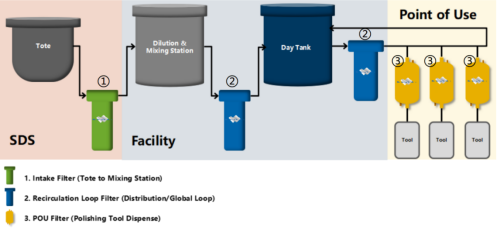
| Micro-scratches | Surface scratches in Cu or dielectric from abrasive particle contacts | LPC spikes in slurry; agglomerated particles; pad contamination; slurry instability | Tighten incoming LPC spec; improve POU filtration; check slurry temperature/age | <5 critical scratches/wafer (post-clean) |
8. Key Process Parameters & Their Effect on Copper CMP
| Paramètres | Gamme typique | Effect on Cu MRR | Effect on Dishing | Effect on Defectivity |
|---|---|---|---|---|
| Downforce (pressure) | 0.5–3.0 psi | ↑ Increases (Preston's law) | ↑ Increases (pad deflection over Cu) | ↑ Increases (abrasive contact energy) |
| Platen / wafer velocity | 50–120 rpm | ↑ Increases (Preston's law) | → Moderate effect | ↓ Decreases (better slurry refresh) |
| H₂O₂ concentration | 0.5–5 wt% (step-dependent) | ↑ Increases (to plateau) | ↑ Increases (more Cu corrosion) | ↑ Pitting risk at high concentration |
| BTA concentration | 50–300 ppm | ↓ Decreases | ↓↓ Significantly reduces | → Neutral to slightly positive |
| pH | 3–5 (Step 1); 6–9 (Step 2) | Context-dependent | ↓ Higher pH reduces Cu corrosion | → Higher pH improves silica stability |
| Slurry flow rate | 150–300 mL/min | → Weak effect | → Minimal | ↓ Higher flow reduces particle stagnation |
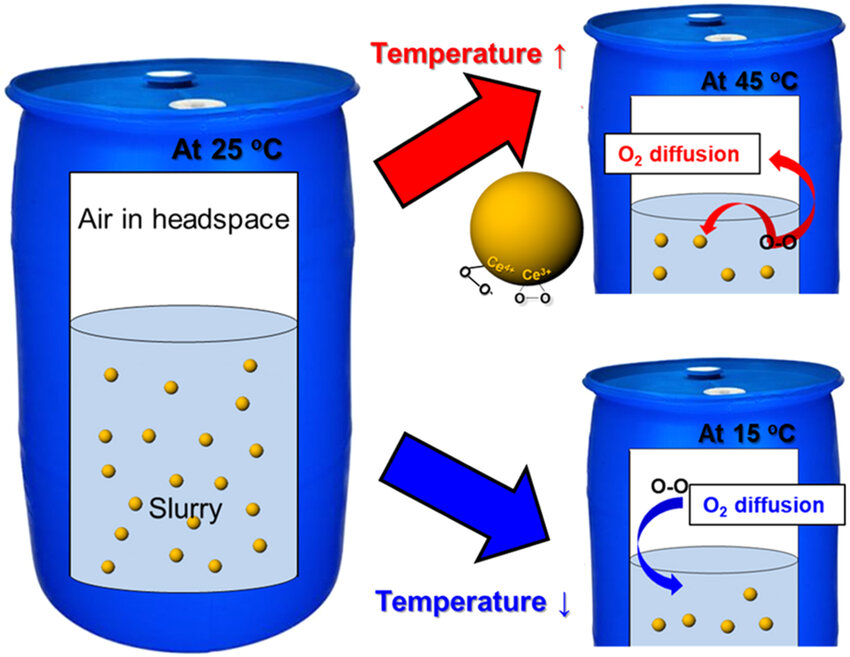
| Slurry temperature | 20–25°C (controlled) | ↑ Increases with T (H₂O₂ rate ↑) | ↑ Higher T increases corrosion rate | ↑ H₂O₂ decomposition rate ↑ with T |
| Pad conditioning | In-situ continuous | → Maintains baseline | → Maintains uniformity | ↓ Glazed pad → slurry starvation → ↑ scratch |
9. Copper CMP at Advanced Nodes: 5nm, 3nm & Beyond
As copper interconnect dimensions shrink below 10 nm half-pitch at 5nm and 3nm nodes, the copper CMP process faces a set of challenges that push the boundaries of conventional slurry formulation and process control. Three specific issues dominate the advanced-node copper CMP landscape:
9.1 The Resistance → Dishing Coupling Problem
At 28nm, a 10 nm dishing depth in a 100 nm wide copper line reduces the effective line cross-section by 10% — a meaningful but manageable RC impact. At 5nm, the same 10 nm dishing in a 20 nm wide line reduces the cross-section by 50% — a catastrophic resistance increase that violates timing margins. This geometric sensitivity means that dishing specifications at advanced nodes have tightened from <50 nm (28nm generation) to <20 nm (10nm generation) to <10 nm (5nm node target) — each generation requiring fundamentally more precise BTA concentration control, H₂O₂ concentration stability, and Step 1 endpoint accuracy.
9.2 Low-k Dielectric Integration
As covered in our article on CMP Slurry for Advanced Nodes, the ultra-low-k (ULK) dielectric used in advanced BEOL layers (k < 2.5) is mechanically fragile. Copper CMP Step 2 slurry in contact with ULK dielectric must apply significantly lower abrasive mechanical stress than would be acceptable on dense SiO₂, requiring re-optimized abrasive concentration, particle size, and downforce settings that may compromise TaN removal rate and require extended Step 2 polish times — which in turn increases the over-polish-driven dishing and erosion.
9.3 Cobalt and Ruthenium Liner Integration
At 10nm and below, the TaN/Ta barrier/liner system is being replaced or supplemented with cobalt (Co) and ruthenium (Ru) liners to reduce barrier thickness and improve copper fill in narrow vias. Copper CMP Step 2 slurry must now achieve near-unity selectivity across four materials (Cu, TaN, Co/Ru, and low-k dielectric) rather than three — a dramatically more complex formulation target. Co and Ru have different electrochemical potentials than Ta, changing the galvanic coupling dynamics at the Cu/liner interface and requiring reoptimization of the inhibitor and oxidizer systems. As of 2025, Co-liner-compatible barrier CMP slurry is in production at leading fabs, while Ru-liner-compatible formulations remain in active development.
✅ Advanced Node Cu CMP: Key Slurry Requirements
For sub-10nm node copper CMP slurry qualification, the minimum specification set should include: dishing <15 nm at 10 μm test line; erosion <12 nm at 50% density array; Cu MRR uniformity WIWNU <2% (1σ); micro-scratch count <5 post-clean; H₂O₂ lot-to-lot assay ±3%; BTA concentration ±5%; trace Cu, Na, K, Fe, Ta <5 ppb each (ICP-MS); and colloidal silica D99 <150 nm with LPC (>0.5 μm) <50/mL.
10. Full Copper CMP Slurry Comparison: Step 1 vs. Step 2 vs. Step 3
| Paramètres | Step 1: Bulk Cu | Step 2: Barrier/Liner | Step 3: Dielectric Buff |
|---|---|---|---|
| Primary Target | Cu overburden (1–3 μm) | TaN/Ta barrier (3–5 nm) | Dielectric surface restoration |
| pH Range | 3–5 (acidic) | 6–9 (near-neutral to alkaline) | 9–11 (alkaline) |
| Oxidizer | H₂O₂ 1–5 wt% | H₂O₂ 0.1–1 wt% (low) | None or trace |
| Abrasive | Colloidal silica, 30–80 nm, 3–8 wt% | Colloidal silica, 20–60 nm, 2–5 wt% | Colloidal silica, 20–50 nm, 1–3 wt% |
| Chelating Agent | Glycine, citric acid, amino acid (high conc.) | Low-concentration chelator | None or very low |
| BTA / Inhibitor | Low or none (high MRR needed) | 50–300 ppm BTA (critical) | Low or none |
| Cu MRR | 3,000–8,000 Å/min | 300–800 Å/min | <50 Å/min |
| TaN/Ta MRR | <50 Å/min (suppressed) | 200–600 Å/min | <10 Å/min |
| SiO₂ MRR | <30 Å/min (suppressed) | 200–400 Å/min | 200–600 Å/min |
| Cu:Barrier Selectivity | >100:1 | ≈ 1:1–2:1 | N/A |
| Dishing Risk | Low (fast removal, no wide-line contact) | High (critical step for dishing control) | Very low |
| Endpoint Method | Optical (reflectance at barrier exposure) | Motor current + optional optical | Timed |
| Typical Duration | 60–180 seconds | 30–90 seconds | 15–30 seconds |
| Most Critical Spec | Cu MRR uniformity (WIWNU); Step 1 endpoint accuracy | Dishing (<20 nm); TaN clearing; Cu:SiO₂ balance | Residual defect count; surface roughness |
11. Frequently Asked Questions
Why does copper CMP require two different slurries instead of one?
What causes copper CMP dishing and how is it controlled?
What is the role of hydrogen peroxide (H₂O₂) in copper CMP slurry?
How does copper CMP change at 5nm and below?
How should copper CMP slurry be stored to prevent H₂O₂ degradation?
Conclusion
Copper CMP slurry is the most chemically complex and process-integration-sensitive consumable in BEOL semiconductor manufacturing. The three-step dual damascene polishing sequence — bulk Cu removal, barrier/liner planarization, and optional dielectric buff — requires three mutually incompatible slurry formulations, each engineered to optimize a different set of competing performance objectives. The BTA-H₂O₂-chelator chemistry triangle at the heart of copper CMP formulation has been refined over 25+ years of production learning, but continues to evolve as advanced nodes push dishing tolerances to single-digit nanometers and introduce new barrier materials that redefine the selectivity target space.
For process engineers, the most important insight from this guide is that copper CMP performance is driven as much by the precision of process parameter control — H₂O₂ assay, BTA concentration, slurry temperature, Step 1 over-polish percentage — as by the intrinsic formulation of the slurry itself. A well-formulated slurry run at poorly controlled process conditions will underperform a moderately formulated slurry run with disciplined process control. For foundational slurry chemistry knowledge, return to our guide on CMP Slurry Composition. For the full CMP slurry landscape, revisit the Complete CMP Slurry Guide.