Single-Side vs. Double-Side Polishing: Which Is Right for Your Wafer?
A complete technical comparison of SSP and DSP polishing architectures — covering equipment mechanics, surface quality outputs, global flatness control, application selection criteria, and the hybrid DSP+SSP approach used in 300mm prime-grade production.
The Architecture Decision That Defines Wafer Geometry
Single-side polishing (SSP) and double-side polishing (DSP) are not merely two different ways to achieve the same result — they are fundamentally different process architectures with complementary strengths. Choosing between them, or combining them, shapes every geometry and surface quality metric on the finished wafer: TTV, bow, SFQR, Ra, and LPD count. For engineers specifying a new polishing process or evaluating an existing one, understanding the physics behind each approach is essential.
This guide from Jizhi Electronic Technology Co., Ltd. (JEEZ) explains how each method works, compares their outputs across all critical metrics, and provides a practical framework for selecting the right method — or combination — for your application. For context on where SSP and DSP fit in the complete polishing process, see our Complete Guide to Silicon Wafer Polishing.
How Single-Side Polishing (SSP) Works
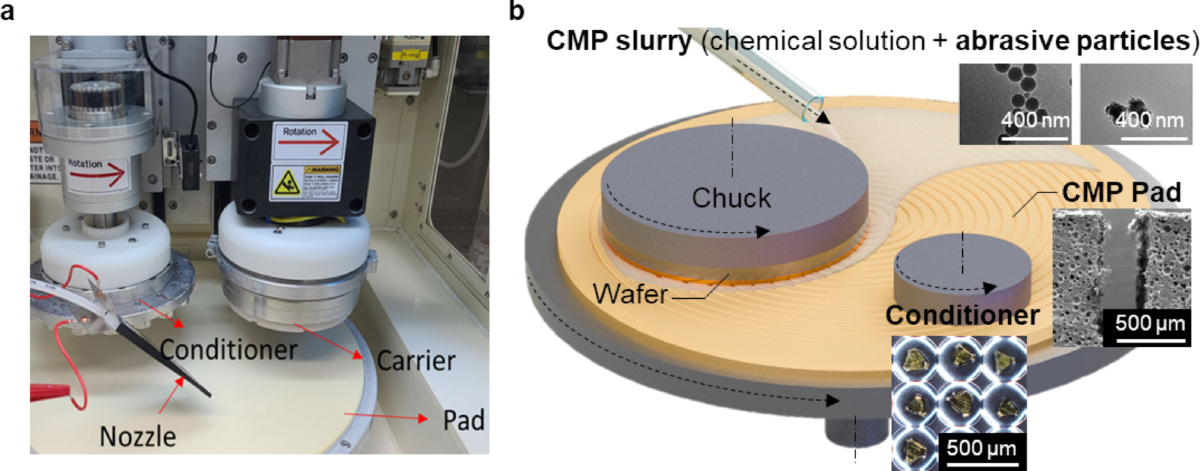
In a single-side polishing tool, the wafer is held face-down on a rotating carrier head. Older SSP tools use a wax-bonding technique: the wafer back surface is bonded to a flat ceramic or glass carrier plate using thermoplastic mounting wax. The bonded assembly is pressed against the rotating polishing pad, and polishing proceeds on the front surface only. Wax mounting provides very rigid, flat wafer support, which is beneficial for achieving excellent local planarity (SFQR) in the contact zone.
Modern single-side polishers — particularly for 200mm and 300mm wafers — use vacuum chuck or pneumatic membrane carrier heads rather than wax bonding. A flexible membrane applies a controlled, multi-zone pressure profile to the back of the wafer, pressing it against the pad. The retaining ring surrounding the wafer prevents lateral movement and also applies a separate load to the pad surface just outside the wafer edge, which is critical for edge uniformity control.
SSP Strengths
- Precise front-surface quality control (Ra, haze, LPD) because the process is optimized entirely for the device face
- Multi-zone carrier head enables active compensation for removal rate non-uniformity — excellent SFQR control
- Lower equipment cost than DSP for small-batch or R&D applications
- Flexible: can process one wafer at a time or in cassette batches
- Suitable as a finish step after DSP in a hybrid process flow
SSP Limitations
- Does not polish the back surface — back surface quality must be acceptable from DSP or etching
- Global flatness (TTV, bow, warp) is primarily inherited from earlier steps, not improved by SSP
- Wax mounting (older process): wafer can deform slightly under polishing pressure relative to wax shape — can introduce local flatness errors
- Retaining ring effect creates a challenging edge zone (last 2–5 mm of radius) where SFQR is harder to control
How Double-Side Polishing (DSP) Works
In a double-side polishing machine, wafers are loaded into thin carrier plates — typically made from precision-ground stainless steel or engineering ceramic, with wafer-sized holes machined with very tight tolerances on hole diameter and parallelism. A DSP tool has upper and lower platens, each carrying a polishing pad. The carrier plate sits between the platens, and wafers ride freely in the carrier holes, polishing on both surfaces simultaneously.
The critical geometric advantage of DSP is the floating wafer constraint. Because the wafer is not rigidly held — it floats in the carrier plate hole under approximately equal pressure from both pads — DSP naturally drives toward a wafer geometry that equalizes the removal rate on both surfaces. Thick regions of the wafer receive slightly more pressure from both sides simultaneously, creating a self-planarizing differential removal that converges the wafer toward a flat, uniform geometry. This mechanism cannot be replicated by SSP polishing each side separately, because SSP introduces a reference-surface dependency that DSP does not have.
DSP Strengths
- Excellent global flatness control: TTV <0.5 μm achievable on 300mm prime wafers
- Simultaneous front and back polishing → natural flatness correction through self-planarizing mechanism
- High throughput: multiple wafers per carrier plate, multiple carriers per machine cycle
- Both surfaces polished to mirror quality in one step
- Produces very low bow and warp, important for vacuum chuck adhesion in fab tools
DSP Limitations
- Higher equipment cost and mechanical complexity than SSP
- Carrier plates require precise machining and periodic flatness recertification
- Cannot independently control front vs. back surface quality
- Not suitable as a final finish step for ultra-low LPD or sub-0.1 nm Ra applications — must be followed by SSP finish polish
SSP vs. DSP: Side-by-Side Comparison
| Criterion | Single-Side Polishing (SSP) | Double-Side Polishing (DSP) |
|---|---|---|
| Surfaces polished | Front only | Front and back simultaneously |
| Global flatness (TTV) | Inherited from prior steps; limited correction capability | Excellent correction (<0.5 μm achievable on 300mm) |
| Local flatness (SFQR) | Excellent; multi-zone pressure actively controls SFQR | Good; dependent on carrier plate and pad uniformity |
| Surface roughness (Ra) | Excellent (<0.08 nm) with soft pad + fine slurry | Good (<0.5 nm); not optimized for ultra-low Ra |
| LPD count | Very low (<30 @ 35nm) with optimized finish recipe | Moderate; typically requires SSP finish step to hit spec |
| Bow / warp control | Limited | Excellent, due to symmetric material removal |
| Пропускная способность | Lower (one or few wafers per batch) | High (multiple wafers per carrier, per cycle) |
| Equipment complexity | Нижний | Higher |
| Carrier plate requirement | Not required | Required (precision-machined, periodic recertification) |
| Typical application | Finish polish; R&D; test/monitor wafers | Stock removal; prime-grade geometry control |
When to Choose SSP, DSP, or the Hybrid Approach
Choose SSP When:
- Producing test, monitor, or specialty wafers where back-surface quality is less critical
- The global flatness (TTV, bow) is already adequate from a prior DSP or etch step
- Ultra-low LPD count (<30) or sub-0.1 nm Ra is required as the final process output
- Processing in R&D, pilot, or small-batch production environments where DSP capital cost is not justified
- Performing the finish stage in a DSP+SSP hybrid sequence (see below)
Choose DSP When:
- Manufacturing prime-grade 200mm or 300mm production wafers to tight TTV (<1 μm) and bow (<40 μm) specifications
- Both front and back surfaces must meet surface quality specifications (double-side polished wafers for specific device applications)
- High throughput is required — DSP processes multiple wafers per cycle
- Global flatness correction is needed because lapping and etching have not achieved adequate TTV
The Hybrid DSP + SSP Approach: Industry Standard for 300mm Prime
In virtually all 300mm prime-grade silicon wafer production as of June 2026, the standard process flow combines both polishing methods in sequence: a DSP step for global flatness and stock removal, followed by an SSP finish step on the front surface only. This hybrid architecture leverages the complementary strength of each method:
- DSP handles geometry: The self-planarizing mechanism of DSP controls TTV, bow, and warp to production specification. The DSP step removes most of the silicon that needs to be removed (10–20 μm per side), making the SSP step’s job purely a surface-quality operation.
- SSP handles surface quality: The finish SSP step polishes only 0.5–1.5 μm from the front surface, but eliminates all haze, reduces LPD count to <30, and delivers Ra below 0.1 nm — performance that a DSP step alone cannot achieve because DSP pad and slurry chemistry are optimized for removal rate and flatness, not for ultra-smooth surface quality.
Equipment and Cost Considerations
DSP machines are mechanically more complex — and correspondingly more expensive — than SSP tools. The precision-machined carrier plates represent a significant ongoing consumable and maintenance cost: plates must be periodically measured for flatness, repaired, or replaced. Carrier plate qualification (using monitor wafers to verify that plate geometry meets specifications after recertification) consumes production capacity.
SSP machines are simpler and lower in capital cost, but for a given throughput target a production facility may need more SSP tools than DSP tools because SSP processes only the front surface and typically polishes fewer wafers per cycle. For a typical 300mm fab producing prime-grade wafers, the DSP + SSP hybrid requires investment in both machine types, but the combination delivers a total cost of ownership that is lower than attempting to achieve all quality targets with SSP alone — because DSP can achieve the global flatness specification with a single aggressive slurry and pad combination far more efficiently than SSP ever could.
For a detailed analysis of how process choices affect CMP total cost of ownership, see: CMP Cost Optimization: How to Reduce Slurry Consumption and Improve Yield.
Часто задаваемые вопросы
Selecting the Right CMP Slurry for Your Polishing Architecture
JEEZ formulates dedicated slurries for both DSP stock-removal and SSP finish-polish stages. Whether you run a DSP-only, SSP-only, or hybrid process, our technical team can recommend the right product and parameters for your equipment and specification.
Contact JEEZ Technical Team