CMP Slurry: Types, Applications & Selection Guide
A complete engineering reference for selecting, qualifying, and optimizing chemical mechanical planarization slurries — from oxide STI to advanced copper, tungsten, cobalt, and next-generation metal chemistries.
1. What Is CMP Slurry and Why Does It Matter?
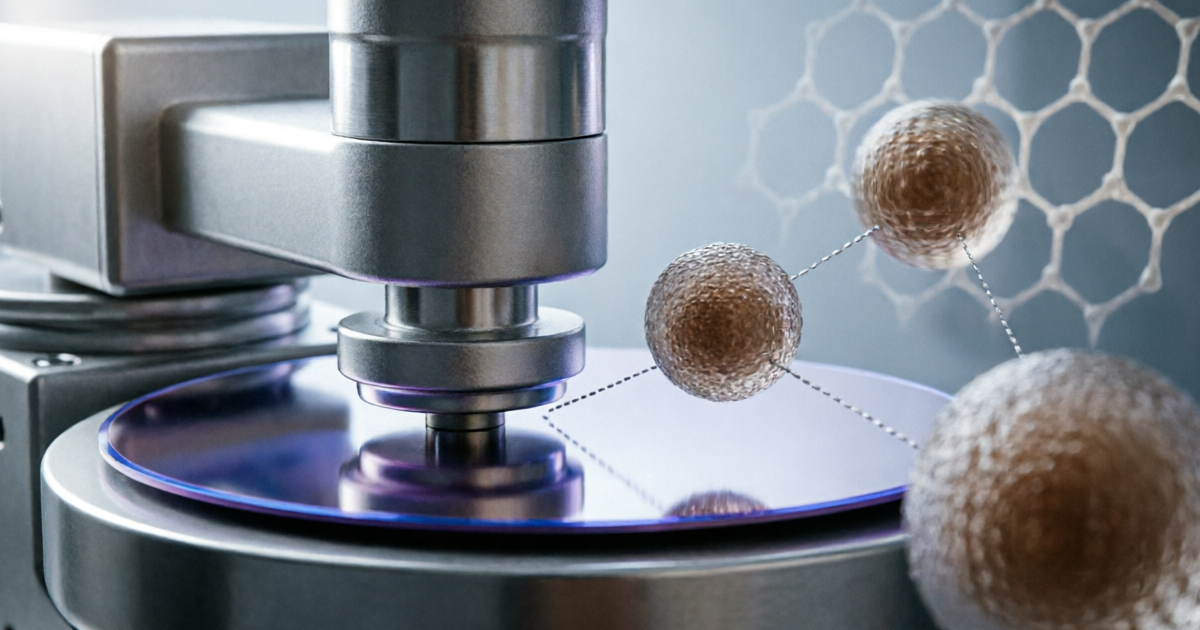
CMP slurry is the liquid chemical–mechanical medium that makes semiconductor wafer planarization possible. It is a carefully engineered aqueous colloidal suspension introduced between the rotating polishing pad and the wafer surface during the chemical mechanical planarization (CMP) process. Unlike a simple abrasive polish, CMP slurry combines two simultaneous mechanisms: chemical softening of the wafer surface through reactive chemistry, and mechanical material removal through abrasive particle contact and hydrodynamic shear forces.
This dual-action mechanism is what gives CMP its unique ability to achieve both global planarity and high selectivity — removing material from elevated regions while leaving recessed areas largely untouched. No other wafer-level process offers this combination of capabilities, making CMP slurry one of the most technically complex consumables in semiconductor manufacturing.
The performance of a CMP slurry is defined by a multi-dimensional set of specifications that must all be satisfied simultaneously. A slurry that achieves a high material removal rate (MRR) but produces unacceptable scratch counts is not commercially viable. Equally, a slurry with excellent defect performance but inadequate selectivity will cause erosion of surrounding films. Navigating these tradeoffs is the central challenge of slurry selection and process optimization.
2. Anatomy of a CMP Slurry: Key Components Explained
Every CMP slurry formulation, regardless of its target application, is built from the same fundamental ingredient classes. Understanding what each component does — and how it interacts with the others — is essential for troubleshooting performance issues and for making informed decisions when evaluating competing products.
磨料颗粒
- The mechanical cutting agent; responsible for physical material removal
- Most common types: ceria (CeO₂), colloidal silica (SiO₂), alumina (Al₂O₃)
- Particle size typically 20–150 nm; distribution width (PDI) is tightly controlled
- Concentration usually 0.5–10 wt%; higher concentration ≠ always higher MRR
- Surface charge (zeta potential) governs colloidal stability and pad interaction
Oxidizing Agents
- React with the metal or dielectric film surface to form a softer oxidized layer
- H₂O₂ (hydrogen peroxide): standard for Cu CMP; thermally unstable above 40 °C
- KIO₃, Fe(NO₃)₃: used in some tungsten slurry formulations
- Concentration must be tightly controlled — too high causes excessive corrosion
- Added at point of use (POU) in some slurry systems to maximize stability
Complexing / Chelating Agents
- Form soluble metal complexes to prevent re-deposition of removed material
- Citric acid, glycine, amino acids commonly used for copper CMP
- EDTA and similar for heavy metal ion sequestration
- Concentration and pH determine complexation efficiency
- Must be compatible with post-CMP clean chemistry to ensure complete removal
Corrosion Inhibitors
- Form a thin protective film on metal surfaces to control over-etch and galvanic attack
- BTA (benzotriazole): industry standard for copper CMP passivation
- TTZ (tolyltriazole), imidazole derivatives used for cobalt and barrier metals
- Concentration must balance protection vs. MRR suppression
- Film formation kinetics must match pad–wafer contact time
pH Buffer System
- Maintains stable pH throughout the slurry bath lifetime and on-tool residence
- pH range: 2–4 (acidic, W/Co), 7–9 (neutral/alkaline, oxide/Cu), 10–12 (alkaline, STI)
- pH drifts of ±0.5 can cause significant MRR shifts and selectivity changes
- Ammonia, KOH, HNO₃, citric acid commonly used as adjusters
Surfactants & Dispersants
- Maintain colloidal stability by preventing particle agglomeration
- Anionic, cationic, and non-ionic types selected based on slurry pH
- Amphiphilic surfactants also help wet the pad surface for uniform slurry distribution
- Excess surfactant can reduce MRR by interfering with abrasive–surface contact
- Must be removable in post-CMP clean without leaving organic residue
3. CMP Slurry Types by Application
CMP slurries are not interchangeable. Each application — defined by the target film, underlying stop layer, device architecture, and performance requirements — demands a dedicated slurry chemistry. The following table provides a comprehensive reference map of slurry types used across modern semiconductor manufacturing.
| 泥浆类别 | 目标电影 | 停止层 | 磨料 | pH 值范围 | Key Selectivity Requirement |
|---|---|---|---|---|---|
| STI Oxide | SiO₂ (HDP, TEOS) | Si₃N₄ | Ceria | 5–9 | SiO₂:SiN > 100:1 |
| ILD Planarization | SiO₂, FSG, USG | None (timed) | Ceria or Silica | 7-10 | Uniform removal rate |
| Pre-metal dielectric | BPSG, PSG | Si, poly-Si | Silica | 8–11 | SiO₂:Si > 50:1 |
| Copper bulk (Step 1) | 铜 | Barrier metal | Colloidal silica | 4-8 | Cu:barrier > 50:1 |
| Barrier clearing (Step 2) | Ta/TaN, TiN, Co, Ru | SiO₂ | Colloidal silica | 5–9 | Barrier:oxide ≈ 1:1–5:1 |
| Tungsten via | W | TiN, SiO₂ | Alumina or silica | 2-5 | W:TiN > 20:1 |
| Cobalt contact | Co | TiN, dielectric | Colloidal silica | 4-7 | Co:dielectric 5:1–20:1 |
| 多晶硅 | 多晶硅 | SiO₂, SiN | Colloidal silica | 9-12 | Poly-Si:SiO₂ tunable |
| Shallow poly / gate | Poly-Si (thin) | High-k dielectric | Dilute colloidal silica | 9-11 | Ultra-low damage requirement |
| 钌 | Ru | Dielectric | Colloidal silica + oxidizer | 3-6 | Emerging; chemistry maturing |
| Hybrid bonding | SiO₂, SiCN | None (final surface) | Ultra-pure silica | 7–9 | Sub-0.3 nm Ra required |
4. Oxide & STI Slurry Deep Dive
Oxide CMP — and in particular Shallow Trench Isolation (STI) planarization — represents the largest single application segment for CMP slurry by volume. STI is the process that defines the isolation regions between neighboring transistors and is performed at the very beginning of the FEOL sequence. The performance requirements are severe: SiO₂ must be removed rapidly and uniformly across a 300 mm wafer while stopping with high precision and selectivity on the underlying Si₃N₄ hard mask.
Why Ceria Dominates STI CMP
Cerium oxide (CeO₂) abrasive is the material of choice for STI slurries because of a phenomenon known as the chemical tooth effect. Unlike silica or alumina, ceria particles form direct Ce–O–Si surface bonds with silicon dioxide at the contact interface. This chemical bonding mechanism dramatically increases the removal rate of SiO₂ relative to Si₃N₄, which does not participate in this reaction to the same degree. The result is a natural SiO₂:Si₃N₄ selectivity that can exceed 100:1 under optimized conditions — far beyond what silica-based slurries can achieve.
Ceria STI Slurry Advantages
- High intrinsic SiO₂:SiN selectivity without additives
- Excellent step-height reduction efficiency
- Lower abrasive concentration needed (0.5–2 wt%) vs. silica
- Good post-CMP surface roughness (<0.15 nm Ra achievable)
- Widely qualified on Applied Materials Mirra and Ebara platforms
Ceria STI Slurry Challenges
- Ceria particles are harder and can cause micro-scratch defects if agglomerated
- Sensitive to ionic contamination — bath purity critical
- Ceria supply chain depends heavily on Chinese rare earth output
- Requires careful pH control (typically 5–8) for optimal Ce–O–Si reaction
- Higher raw material cost compared to fumed or colloidal silica
Pattern Density Effects and WIWNU
One of the most persistent challenges in STI CMP is managing within-wafer non-uniformity (WIWNU) caused by pattern density variation across the die and across the wafer. Areas with high oxide pattern density experience slower planarization because the load is distributed across a larger contact area (lower local pressure). This density-dependent removal rate leads to residual topography after CMP — the so-called “oxide loading effect.”
Modern STI slurry formulations address this through selectivity additives — typically anionic polymers or amino acids — that preferentially adsorb on Si₃N₄ surfaces, amplifying the natural selectivity of ceria and improving the response of the slurry to pattern density variation. Combining these additive-tuned slurries with pad systems engineered for planarization efficiency is the standard approach for achieving <10 nm residual topography across the full 300 mm wafer.
5. Copper CMP Slurry Deep Dive
Copper damascene CMP is a two-step process that is the workhorse of BEOL (back-end-of-line) interconnect fabrication at all logic nodes from 180 nm down to the leading edge. It is also one of the most chemically complex CMP applications, involving simultaneous polishing of multiple materials — copper, barrier metals, and dielectric — each with very different mechanical and chemical properties.
The Copper Damascene CMP Sequence
Bulk copper removal (Step 1 slurry): High MRR copper slurry removes the thick copper overburden deposited by electroplating. The step runs until the barrier metal is just exposed across the full wafer. Target MRR: 300–600 nm/min for copper, near-zero for barrier.
Barrier clearing (Step 2 slurry): The barrier metal (Ta/TaN, TiN, or Co liner) is removed along with any residual copper. The slurry must remove barrier material while minimizing copper dishing and oxide erosion. Selectivity between barrier, copper, and SiO₂ is carefully balanced.
Optional buff (soft pad + dilute slurry): A third low-pressure step with a soft pad removes residual barrier particles and reduces surface roughness to meet defect specifications. Not all process flows include this step, but it is increasingly common at sub-14 nm nodes.
Chemistry of Copper CMP: The BTA Balance
Copper CMP slurry chemistry must simultaneously achieve high copper MRR while protecting recessed copper surfaces from over-etch. This is accomplished through the interplay of three chemical components:
- H₂O₂ (oxidizer): Converts copper metal to a softer Cu₂O or CuO surface layer that is more easily removed by abrasive contact. The oxidizer concentration directly controls copper MRR — but if too high, it causes roughening and pitting on the polished copper surface.
- BTA / azole inhibitors: Form a thin, protective Cu–BTA passivation film on copper surfaces. This film is mechanically removed by the abrasive only where the pad exerts local contact pressure (i.e., at the high points). On recessed copper features, the BTA film remains intact, suppressing further chemical attack and thus controlling dishing.
- Glycine or citric acid (complexant): Dissolves the chemically oxidized copper layer and forms soluble Cu-complexes that are carried away by slurry flow, preventing re-deposition.
6. Tungsten CMP Slurry Deep Dive
Tungsten CMP is used to planarize tungsten plug fills in contact and via structures. It is one of the oldest and most mature CMP applications, having been introduced at the 0.35 µm node in the early 1990s. Despite its maturity, tungsten CMP remains technically demanding: the slurry must achieve high W MRR while stopping on the underlying TiN barrier and SiO₂ dielectric without causing over-polish or recess of the tungsten plugs.
Oxidizer Chemistry Options for W CMP
H₂O₂-Based Tungsten Slurries
- Most widely used in current production
- Clean by-products (H₂O only); easier to handle than iron-based systems
- W MRR: 100–300 nm/min at typical conditions
- Moderate selectivity to TiN and SiO₂
- Susceptible to H₂O₂ decomposition by metal ion contamination
Fe(NO₃)₃-Based Tungsten Slurries
- Iron(III) nitrate as oxidizer; historically the first W CMP chemistry
- Higher MRR than H₂O₂ systems; good selectivity control
- Iron contamination risk — strict post-CMP clean required
- Less favored in advanced logic due to Fe contamination sensitivity
- Still used in some mature node / DRAM applications
Alumina abrasive is the traditional choice for W CMP, valued for its hardness and effectiveness at removing the tenacious WO₃ surface layer formed by the oxidizer. However, alumina’s high hardness also brings higher scratch risk, and many leading-edge applications are transitioning to optimized colloidal silica formulations that can achieve comparable MRR with significantly better defect performance — particularly important as tungsten via dimensions shrink below 20 nm.
7. Barrier & Advanced Metal Slurries
As semiconductor technology has advanced to sub-10 nm nodes, CMP must now handle an expanding portfolio of metals beyond the traditional Cu/W/Ti/Ta system. Barrier and new-metal slurries represent the most rapidly evolving frontier of CMP chemistry.
Cobalt (Co) CMP
Cobalt has replaced tungsten as the preferred contact and local interconnect metal at 7 nm and below in several TSMC and Samsung process flows, due to its lower resistivity at small feature dimensions. Cobalt CMP presents unique challenges: Co is significantly softer than W and is susceptible to galvanic corrosion at interfaces with TiN and dielectric films. Slurries must be formulated with mild oxidizers, Co-specific complexants, and corrosion inhibitors that do not suppress MRR to unacceptable levels.
Ruthenium (Ru) CMP
Ruthenium is an emerging metal for contacts, local interconnects, and gate fill at sub-5 nm nodes, with a bulk resistivity advantage over both W and Co at nanometer dimensions. Ru CMP chemistry is currently maturing in R&D environments: Ru is chemically resistant to common oxidizers and requires highly oxidizing acidic environments (typically containing KIO₄ or Ce-based oxidizers at pH 2–4) to achieve useful MRR. Managing Ru selectivity against underlying dielectrics remains an active area of development.
Molybdenum (Mo) CMP
Molybdenum is attracting significant interest as a replacement for tungsten in wordline fill applications in 3D NAND and as a gate metal for GAA transistors, where its good thermal stability and workfunction make it attractive. Mo CMP uses strongly oxidizing acidic slurries. MoO₃ dissolution kinetics are pH-sensitive, creating a lever for selectivity control between Mo and surrounding SiO₂ or SiN films.
For a detailed comparison of abrasive performance across all these metal systems, refer to our companion article on CMP Abrasives: Ceria vs. Silica vs. Alumina.
8. Slurry Selection Framework
Selecting a CMP slurry for a new process application requires a structured evaluation methodology. The following framework is used by process engineers at leading fabs and is the basis for JEEZ’s application engineering engagement process.
Define the process specification envelope: Document the target film, stop layer, overburden thickness, target MRR, required selectivity, WIWNU budget (<2% 1σ typical), dishing and erosion limits, and maximum allowable scratch/defect density. These become your pass/fail criteria for slurry qualification.
Screen candidate chemistries: Based on the target film and stop layer, identify the appropriate abrasive type and oxidizer chemistry. Request product data sheets and qualification datasets from multiple suppliers. Prioritize suppliers who can provide application-matched data from comparable tool platforms.
Conduct blanket wafer DOE: Evaluate MRR, WIWNU, and surface morphology (AFM roughness) on blanket films as a function of the key process variables: down force, platen speed, slurry flow rate, pad type, and slurry concentration. Identify the sweet spot within the Preston space for your target MRR and uniformity.
Patterned wafer evaluation: Run the candidate slurry on patterned qualification wafers (SEMATECH 854/956 masks or equivalent) to measure dishing, erosion, and residuals across a range of pattern densities and feature sizes. Compare results against your specification limits.
Defect and contamination characterization: Run full-wafer defect inspections (KLA 2930 or equivalent) and VPD-ICPMS for trace metal analysis. Compare metal impurity levels against ITRS/IRDS requirements for the relevant process level (FEOL gate CMP has the most stringent limits).
Stability and shelf-life testing: Evaluate particle size distribution, pH, and MRR as a function of storage time and temperature. Confirm compliance with your fab’s minimum shelf-life requirements (typically 6–12 months from date of manufacture).
Lot-to-lot consistency audit: Request three or more consecutive production lots and verify key parameters (MRR on reference wafers, particle size D50 and D90, pH) fall within the supplier’s Certificate of Analysis (COA) limits. Consistency is often as important as absolute performance.
9. Slurry Qualification Process in Production
Introducing a new slurry into a production environment requires formal qualification through the fab’s change control process. Even a slurry that is technically superior to the incumbent must pass a qualification gate designed to protect yield and process stability. The key qualification milestones are:
- Engineering split: The new slurry runs on a subset of wafers alongside the baseline, enabling direct performance comparison under identical process conditions.
- Extended lot qualification: After the initial split shows acceptable results, the new slurry is run on a larger lot (typically 25+ wafers) to generate statistically meaningful defect and uniformity data.
- Downstream yield correlation: Wafers polished with the new slurry are tracked through subsequent process steps and electrical test to confirm that any changes in CMP performance do not affect final device yield.
- Reliability screen: For gate-level applications, accelerated reliability tests (TDDB, EM) may be required to confirm that trace metal contamination from the new slurry does not degrade long-term device reliability.
- Supply chain audit: The slurry supplier’s manufacturing site, raw material sourcing, QC procedures, and supply continuity plans are reviewed as part of the full qualification package.
JEEZ provides comprehensive qualification support packages for all our slurry products, including certified reference wafer MRR data, lot-to-lot consistency reports, full COA documentation, and dedicated application engineering support throughout the qualification process. Contact our technical team to initiate a qualification engagement.
10. Common Slurry-Related Problems & Solutions
| Symptom | Most Likely Root Cause | Diagnostic Step | 纠正行动 |
|---|---|---|---|
| MRR dropping over time within a run | Pad glazing; slurry H₂O₂ decomposition | Check conditioning endpoint; test fresh slurry lot | Increase conditioning frequency; verify slurry temperature at POU |
| High scratch count on blanket wafers | Particle agglomeration; oversized particles | Measure PSD (DLS); inspect slurry filter | Replace 0.1 µm POU filter; check slurry bath agitation and recirculation |
| Excessive copper dishing | Over-polishing; insufficient BTA concentration | Reduce polish time; check inhibitor concentration in bath | Tighten endpoint detection; verify BTA concentration via titration |
| Poor STI uniformity (oxide loading effect) | Insufficient selectivity additive; pad too soft | Map WIWNU across wafer; check additive lot | Increase selectivity additive concentration; switch to harder pad |
| Metal contamination on post-CMP wafers | Slurry metal impurities; inadequate post-CMP clean | VPD-ICPMS of wafer surface; review slurry COA | Switch to higher-purity slurry grade; intensify post-CMP DHF clean step |
| MRR lot-to-lot variation >5% | Supplier abrasive particle size drift; pH variation | Measure reference wafer MRR on incoming lots; check PSD and pH | Tighten incoming inspection spec; request tighter COA limits from supplier |
For a comprehensive treatment of CMP process defects and their root causes, see our dedicated guide on CMP 工艺缺陷:原因、类型和解决方案.
11.常见问题
What is the difference between CMP slurry Step 1 and Step 2?
In copper damascene CMP, Step 1 slurry is a high-MRR formulation designed to rapidly remove the bulk copper overburden, stopping on the barrier metal layer. Step 2 slurry removes the exposed barrier metal (Ta/TaN, TiN, or Co liner) while minimizing copper dishing and dielectric erosion. Step 2 slurries typically have more balanced selectivity between Cu, barrier, and SiO₂ compared to the strongly Cu-selective Step 1 slurry.
How does slurry pH affect CMP performance?
pH affects virtually every aspect of slurry behavior: abrasive particle surface charge (and therefore colloidal stability and aggregation tendency), the rate and mechanism of chemical attack on the wafer surface, inhibitor film formation kinetics, and the solubility of removal by-products. For ceria STI slurries, pH controls the Ce–O–Si bond formation rate. For copper slurries, pH affects BTA inhibitor film integrity. Even a ±0.3 pH unit drift from the target can cause measurable MRR and selectivity changes in sensitive formulations.
Can I reuse or recirculate CMP slurry?
Slurry recirculation is practiced at some fabs to reduce chemical cost, but it is not universally recommended. Recirculated slurry contains accumulated metal ions, abraded pad debris, and oxidizer breakdown products that can increase defectivity and contamination risk. If recirculation is used, thorough filtration, pH monitoring, and oxidizer concentration refresh are required. Most high-volume advanced-logic fabs use once-through slurry delivery to ensure consistent quality at every wafer pass.
What is the shelf life of CMP slurry?
Shelf life varies by slurry type. Most oxide and polysilicon slurries remain stable for 12–18 months from the date of manufacture when stored at 15–25 °C with occasional gentle agitation. Copper slurries containing pre-mixed H₂O₂ have significantly shorter shelf lives (often 3–6 months) due to oxidizer degradation. Some fabs address this by receiving slurry without H₂O₂ and adding it at point-of-use. Always refer to the supplier’s SDS and product-specific storage guidelines.
Request a CMP Slurry Sample from JEEZ
Our application engineers will match the right slurry formulation to your process node, target film, and tool platform — and ship a qualified sample with full COA documentation and technical support.
Request a Slurry Sample ← CMP Materials Complete Guide