Boues de CMP : Types, applications et guide de sélection
Une référence technique complète pour la sélection, la qualification et l'optimisation des boues de planarisation chimique et mécanique - de la STI oxyde aux chimies avancées du cuivre, du tungstène, du cobalt et des métaux de la prochaine génération.
1. Qu'est-ce que le lisier de CMP et quelle est son importance ?
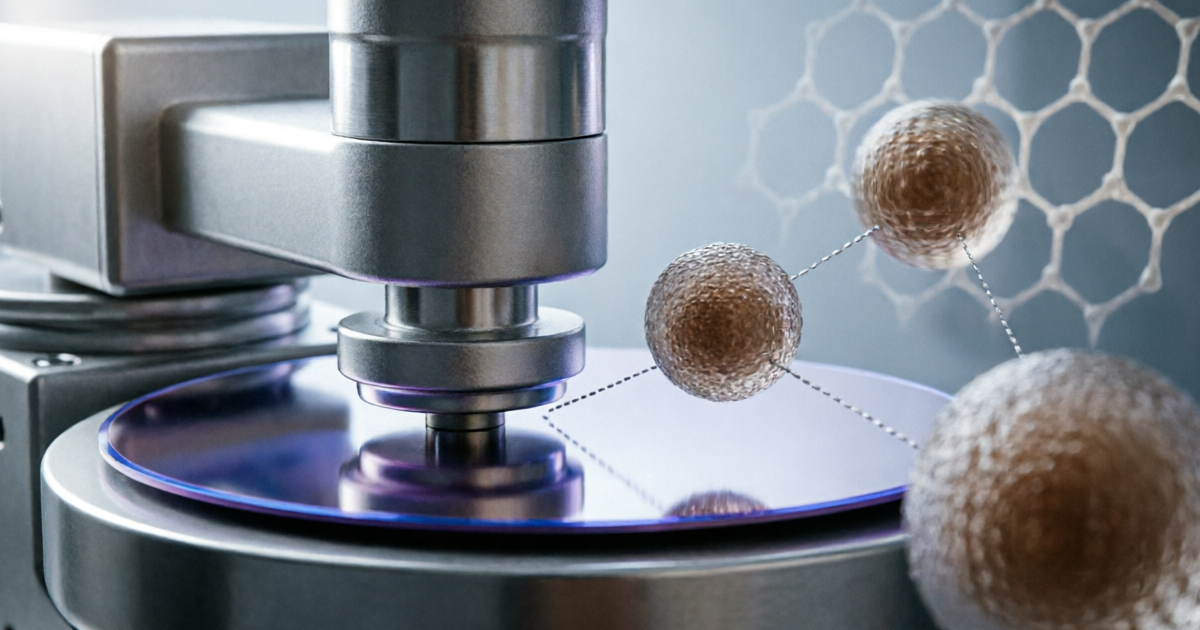
La suspension CMP est le milieu liquide chimico-mécanique qui rend possible la planarisation des plaquettes de semi-conducteurs. Il s'agit d'une suspension colloïdale aqueuse soigneusement conçue, introduite entre le tampon de polissage rotatif et la surface de la plaquette pendant le processus de planarisation chimico-mécanique (CMP). Contrairement à un simple polissage abrasif, la suspension CMP combine deux mécanismes simultanés : adoucissement chimique de la surface de la plaquette par chimie réactive, et enlèvement mécanique des matériaux par le contact des particules abrasives et les forces de cisaillement hydrodynamiques.
C'est ce mécanisme à double action qui confère à la CMP sa capacité unique à obtenir à la fois une planéité globale et une grande sélectivité, en éliminant le matériau des zones élevées tout en laissant les zones en retrait pratiquement intactes. Aucun autre procédé au niveau des plaquettes n'offre cette combinaison de capacités, ce qui fait de la boue CMP l'un des consommables les plus complexes sur le plan technique dans la fabrication des semi-conducteurs.
Les performances d'une suspension CMP sont définies par un ensemble de spécifications multidimensionnelles qui doivent toutes être satisfaites simultanément. Une suspension qui atteint un taux élevé d'enlèvement de matière (MRR) mais qui produit un nombre inacceptable de rayures n'est pas commercialement viable. De même, une suspension qui présente une excellente performance en matière de défauts mais une sélectivité inadéquate provoquera l'érosion des films environnants. Le défi principal de la sélection de la suspension et de l'optimisation du processus consiste à trouver le juste milieu.
2. Anatomie d'une boue de CMP : Explication des composants clés
Chaque formulation de suspension de CMP, quelle que soit son application cible, est construite à partir des mêmes classes d'ingrédients fondamentaux. Il est essentiel de comprendre ce que fait chaque composant - et comment il interagit avec les autres - pour résoudre les problèmes de performance et prendre des décisions éclairées lors de l'évaluation de produits concurrents.
Particules abrasives
- L'agent de coupe mécanique ; responsable de l'enlèvement physique de la matière.
- Types les plus courants : céria (CeO₂), silice colloïdale (SiO₂), alumine (Al₂O₃).
- La taille des particules est généralement comprise entre 20 et 150 nm ; la largeur de la distribution (PDI) est étroitement contrôlée.
- Concentration généralement comprise entre 0,5 et 10 wt% ; concentration plus élevée ≠ MRR toujours plus élevé
- La charge de surface (potentiel zêta) régit la stabilité des colloïdes et l'interaction avec les tampons.
Agents oxydants
- Réagir avec la surface du métal ou du film diélectrique pour former une couche oxydée plus douce.
- H₂O₂ (peroxyde d'hydrogène) : standard pour la CMP du Cu ; thermiquement instable au-dessus de 40 °C
- KIO₃, Fe(NO₃)₃ : utilisé dans certaines formulations de boues de tungstène.
- La concentration doit être étroitement contrôlée - une concentration trop élevée entraîne une corrosion excessive.
- Ajouté au point d'utilisation (POU) dans certains systèmes de boues pour maximiser la stabilité.
Agents complexants / chélateurs
- Former des complexes métalliques solubles pour empêcher la redéposition des matériaux enlevés
- Acide citrique, glycine, acides aminés couramment utilisés pour le CMP du cuivre
- EDTA et similaires pour la séquestration des ions de métaux lourds
- La concentration et le pH déterminent l'efficacité de la complexation
- Doit être compatible avec la chimie de nettoyage post-CMP pour garantir une élimination complète.
Inhibiteurs de corrosion
- Former une fine pellicule protectrice sur les surfaces métalliques pour contrôler le surmordançage et l'attaque galvanique.
- BTA (benzotriazole) : norme industrielle pour la passivation du cuivre CMP
- TTZ (tolyltriazole), dérivés d'imidazoles utilisés pour le cobalt et les métaux de barrage
- La concentration doit trouver un équilibre entre la protection et la suppression du MRR
- La cinétique de formation du film doit correspondre au temps de contact entre le tampon et la plaquette.
Système tampon pH
- Maintien d'un pH stable pendant toute la durée de vie du bain de boue et sur l'outil.
- Gamme de pH : 2-4 (acide, W/Co), 7-9 (neutre/alcalin, oxyde/Cu), 10-12 (alcalin, STI)
- Des dérives de pH de ±0,5 peuvent entraîner des changements significatifs de MRR et de sélectivité.
- Ammoniaque, KOH, HNO₃, acide citrique couramment utilisés comme correcteurs.
Tensioactifs et dispersants
- Maintien de la stabilité colloïdale en empêchant l'agglomération des particules
- Types anioniques, cationiques et non ioniques sélectionnés en fonction du pH de la boue
- Les tensioactifs amphiphiles permettent également de mouiller la surface du tampon pour une distribution uniforme de la boue.
- L'excès de tensioactif peut réduire le taux de mortalité en interférant avec le contact entre l'abrasif et la surface.
- Doit pouvoir être enlevé lors du nettoyage post-CMP sans laisser de résidus organiques.
3. Types de boues CMP par application
Les barbotines CMP ne sont pas interchangeables. Chaque application - définie par le film cible, la couche d'arrêt sous-jacente, l'architecture de l'appareil et les exigences de performance - exige une composition chimique de suspension spécifique. Le tableau suivant fournit une carte de référence complète des types de suspension utilisés dans la fabrication moderne de semi-conducteurs.
| Catégorie de boues | Film cible | Couche d'arrêt | Abrasif | Gamme de pH | Exigence de sélectivité clé |
|---|---|---|---|---|---|
| Oxyde de STI | SiO₂ (HDP, TEOS) | Si₃N₄ | Ceria | 5-9 | SiO₂:SiN > 100:1 |
| Planarisation de l'ILD | SiO₂, FSG, USG | Aucun (chronométré) | Ceria ou Silica | 7-10 | Taux d'enlèvement uniforme |
| Diélectrique pré-métallique | BPSG, PSG | Si, poly-Si | Silice | 8-11 | SiO₂:Si > 50:1 |
| Cuivre en vrac (étape 1) | Cu | Barrière métallique | Silice colloïdale | 4-8 | Cu:barrière > 50:1 |
| Élimination des barrières (étape 2) | Ta/TaN, TiN, Co, Ru | SiO₂ | Silice colloïdale | 5-9 | Barrière:oxyde ≈ 1:1-5:1 |
| Tungstène via | W | TiN, SiO₂ | Alumine ou silice | 2-5 | W:TiN > 20:1 |
| Contact cobalt | Co | TiN, diélectrique | Silice colloïdale | 4-7 | Co:diélectrique 5:1-20:1 |
| Polysilicium | Poly-Si | SiO₂, SiN | Silice colloïdale | 9-12 | Poly-Si:SiO₂ accordable |
| Polyéthylène peu profond / portail | Poly-Si (fin) | Diélectrique high-k | Silice colloïdale diluée | 9-11 | Exigences très faibles en matière de dommages |
| Ruthénium | Ru | Diélectrique | Silice colloïdale + oxydant | 3-6 | Émergence ; maturation de la chimie |
| Collage hybride | SiO₂, SiCN | Aucun (surface finale) | Silice ultra-pure | 7-9 | Ra inférieur à 0,3 nm requis |
4. Plongée profonde dans les boues d'oxyde et de STI
Le CMP des oxydes - et en particulier la planarisation de l'isolation des tranchées peu profondes (STI) - représente le segment d'application le plus important en volume pour la pâte CMP. La STI est le processus qui définit les régions d'isolation entre transistors voisins et qui est exécuté au tout début de la séquence FEOL. Les exigences de performance sont sévères : SiO₂ doit être enlevé rapidement et uniformément sur une tranche de 300 mm tout en s'arrêtant avec une précision et une sélectivité élevées sur le masque dur Si₃N₄ sous-jacent.
Pourquoi le cérium domine la STI CMP
L'oxyde de cérium (CeO₂) est le matériau de choix pour les boues STI en raison d'un phénomène connu sous le nom d'abrasivité. effet dentaire chimique. Contrairement à la silice ou à l'alumine, les particules de céria forment des liaisons de surface directes Ce-O-Si avec le dioxyde de silicium à l'interface de contact. Ce mécanisme de liaison chimique augmente considérablement le taux d'élimination de SiO₂ par rapport à Si₃N₄, qui ne participe pas à cette réaction dans la même mesure. Il en résulte une sélectivité naturelle SiO₂:Si₃N₄ qui peut dépasser 100:1 dans des conditions optimisées - bien au-delà de ce que les boues à base de silice peuvent atteindre.
Avantages de la boue Ceria STI
- Sélectivité intrinsèque élevée SiO₂:SiN sans additifs
- Excellente efficacité dans la réduction de la hauteur des marches
- Plus faible concentration d'abrasif nécessaire (0,5-2 wt%) par rapport à la silice
- Bonne rugosité de surface post-CMP (<0,15 nm Ra réalisable)
- Largement qualifié sur les plateformes Mirra et Ebara d'Applied Materials
Défis liés à la boue Ceria STI
- Les particules de céria sont plus dures et peuvent provoquer des micro-rayures si elles sont agglomérées.
- Sensible à la contamination ionique - la pureté du bain est critique
- Ceria supply chain depends heavily on Chinese rare earth output
- Requires careful pH control (typically 5–8) for optimal Ce–O–Si reaction
- Higher raw material cost compared to fumed or colloidal silica
Pattern Density Effects and WIWNU
One of the most persistent challenges in STI CMP is managing within-wafer non-uniformity (WIWNU) caused by pattern density variation across the die and across the wafer. Areas with high oxide pattern density experience slower planarization because the load is distributed across a larger contact area (lower local pressure). This density-dependent removal rate leads to residual topography after CMP — the so-called “oxide loading effect.”
Modern STI slurry formulations address this through selectivity additives — typically anionic polymers or amino acids — that preferentially adsorb on Si₃N₄ surfaces, amplifying the natural selectivity of ceria and improving the response of the slurry to pattern density variation. Combining these additive-tuned slurries with pad systems engineered for planarization efficiency is the standard approach for achieving <10 nm residual topography across the full 300 mm wafer.
5. Copper CMP Slurry Deep Dive
Copper damascene CMP is a two-step process that is the workhorse of BEOL (back-end-of-line) interconnect fabrication at all logic nodes from 180 nm down to the leading edge. It is also one of the most chemically complex CMP applications, involving simultaneous polishing of multiple materials — copper, barrier metals, and dielectric — each with very different mechanical and chemical properties.
The Copper Damascene CMP Sequence
Bulk copper removal (Step 1 slurry): High MRR copper slurry removes the thick copper overburden deposited by electroplating. The step runs until the barrier metal is just exposed across the full wafer. Target MRR: 300–600 nm/min for copper, near-zero for barrier.
Barrier clearing (Step 2 slurry): The barrier metal (Ta/TaN, TiN, or Co liner) is removed along with any residual copper. The slurry must remove barrier material while minimizing copper dishing and oxide erosion. Selectivity between barrier, copper, and SiO₂ is carefully balanced.
Optional buff (soft pad + dilute slurry): A third low-pressure step with a soft pad removes residual barrier particles and reduces surface roughness to meet defect specifications. Not all process flows include this step, but it is increasingly common at sub-14 nm nodes.
Chemistry of Copper CMP: The BTA Balance
Copper CMP slurry chemistry must simultaneously achieve high copper MRR while protecting recessed copper surfaces from over-etch. This is accomplished through the interplay of three chemical components:
- H₂O₂ (oxidizer): Converts copper metal to a softer Cu₂O or CuO surface layer that is more easily removed by abrasive contact. The oxidizer concentration directly controls copper MRR — but if too high, it causes roughening and pitting on the polished copper surface.
- BTA / azole inhibitors: Form a thin, protective Cu–BTA passivation film on copper surfaces. This film is mechanically removed by the abrasive only where the pad exerts local contact pressure (i.e., at the high points). On recessed copper features, the BTA film remains intact, suppressing further chemical attack and thus controlling dishing.
- Glycine or citric acid (complexant): Dissolves the chemically oxidized copper layer and forms soluble Cu-complexes that are carried away by slurry flow, preventing re-deposition.
6. Tungsten CMP Slurry Deep Dive
Tungsten CMP is used to planarize tungsten plug fills in contact and via structures. It is one of the oldest and most mature CMP applications, having been introduced at the 0.35 µm node in the early 1990s. Despite its maturity, tungsten CMP remains technically demanding: the slurry must achieve high W MRR while stopping on the underlying TiN barrier and SiO₂ dielectric without causing over-polish or recess of the tungsten plugs.
Oxidizer Chemistry Options for W CMP
H₂O₂-Based Tungsten Slurries
- Most widely used in current production
- Clean by-products (H₂O only); easier to handle than iron-based systems
- W MRR: 100–300 nm/min at typical conditions
- Moderate selectivity to TiN and SiO₂
- Susceptible to H₂O₂ decomposition by metal ion contamination
Fe(NO₃)₃-Based Tungsten Slurries
- Iron(III) nitrate as oxidizer; historically the first W CMP chemistry
- Higher MRR than H₂O₂ systems; good selectivity control
- Iron contamination risk — strict post-CMP clean required
- Less favored in advanced logic due to Fe contamination sensitivity
- Still used in some mature node / DRAM applications
Alumina abrasive is the traditional choice for W CMP, valued for its hardness and effectiveness at removing the tenacious WO₃ surface layer formed by the oxidizer. However, alumina’s high hardness also brings higher scratch risk, and many leading-edge applications are transitioning to optimized colloidal silica formulations that can achieve comparable MRR with significantly better defect performance — particularly important as tungsten via dimensions shrink below 20 nm.
7. Barrier & Advanced Metal Slurries
As semiconductor technology has advanced to sub-10 nm nodes, CMP must now handle an expanding portfolio of metals beyond the traditional Cu/W/Ti/Ta system. Barrier and new-metal slurries represent the most rapidly evolving frontier of CMP chemistry.
Cobalt (Co) CMP
Cobalt has replaced tungsten as the preferred contact and local interconnect metal at 7 nm and below in several TSMC and Samsung process flows, due to its lower resistivity at small feature dimensions. Cobalt CMP presents unique challenges: Co is significantly softer than W and is susceptible to galvanic corrosion at interfaces with TiN and dielectric films. Slurries must be formulated with mild oxidizers, Co-specific complexants, and corrosion inhibitors that do not suppress MRR to unacceptable levels.
Ruthenium (Ru) CMP
Ruthenium is an emerging metal for contacts, local interconnects, and gate fill at sub-5 nm nodes, with a bulk resistivity advantage over both W and Co at nanometer dimensions. Ru CMP chemistry is currently maturing in R&D environments: Ru is chemically resistant to common oxidizers and requires highly oxidizing acidic environments (typically containing KIO₄ or Ce-based oxidizers at pH 2–4) to achieve useful MRR. Managing Ru selectivity against underlying dielectrics remains an active area of development.
Molybdenum (Mo) CMP
Molybdenum is attracting significant interest as a replacement for tungsten in wordline fill applications in 3D NAND and as a gate metal for GAA transistors, where its good thermal stability and workfunction make it attractive. Mo CMP uses strongly oxidizing acidic slurries. MoO₃ dissolution kinetics are pH-sensitive, creating a lever for selectivity control between Mo and surrounding SiO₂ or SiN films.
For a detailed comparison of abrasive performance across all these metal systems, refer to our companion article on CMP Abrasives: Ceria vs. Silica vs. Alumina.
8. Slurry Selection Framework
Selecting a CMP slurry for a new process application requires a structured evaluation methodology. The following framework is used by process engineers at leading fabs and is the basis for JEEZ’s application engineering engagement process.
Define the process specification envelope: Document the target film, stop layer, overburden thickness, target MRR, required selectivity, WIWNU budget (<2% 1σ typical), dishing and erosion limits, and maximum allowable scratch/defect density. These become your pass/fail criteria for slurry qualification.
Screen candidate chemistries: Based on the target film and stop layer, identify the appropriate abrasive type and oxidizer chemistry. Request product data sheets and qualification datasets from multiple suppliers. Prioritize suppliers who can provide application-matched data from comparable tool platforms.
Conduct blanket wafer DOE: Evaluate MRR, WIWNU, and surface morphology (AFM roughness) on blanket films as a function of the key process variables: down force, platen speed, slurry flow rate, pad type, and slurry concentration. Identify the sweet spot within the Preston space for your target MRR and uniformity.
Patterned wafer evaluation: Run the candidate slurry on patterned qualification wafers (SEMATECH 854/956 masks or equivalent) to measure dishing, erosion, and residuals across a range of pattern densities and feature sizes. Compare results against your specification limits.
Defect and contamination characterization: Run full-wafer defect inspections (KLA 2930 or equivalent) and VPD-ICPMS for trace metal analysis. Compare metal impurity levels against ITRS/IRDS requirements for the relevant process level (FEOL gate CMP has the most stringent limits).
Stability and shelf-life testing: Evaluate particle size distribution, pH, and MRR as a function of storage time and temperature. Confirm compliance with your fab’s minimum shelf-life requirements (typically 6–12 months from date of manufacture).
Lot-to-lot consistency audit: Request three or more consecutive production lots and verify key parameters (MRR on reference wafers, particle size D50 and D90, pH) fall within the supplier’s Certificate of Analysis (COA) limits. Consistency is often as important as absolute performance.
9. Slurry Qualification Process in Production
Introducing a new slurry into a production environment requires formal qualification through the fab’s change control process. Even a slurry that is technically superior to the incumbent must pass a qualification gate designed to protect yield and process stability. The key qualification milestones are:
- Engineering split: The new slurry runs on a subset of wafers alongside the baseline, enabling direct performance comparison under identical process conditions.
- Extended lot qualification: After the initial split shows acceptable results, the new slurry is run on a larger lot (typically 25+ wafers) to generate statistically meaningful defect and uniformity data.
- Downstream yield correlation: Wafers polished with the new slurry are tracked through subsequent process steps and electrical test to confirm that any changes in CMP performance do not affect final device yield.
- Reliability screen: For gate-level applications, accelerated reliability tests (TDDB, EM) may be required to confirm that trace metal contamination from the new slurry does not degrade long-term device reliability.
- Supply chain audit: The slurry supplier’s manufacturing site, raw material sourcing, QC procedures, and supply continuity plans are reviewed as part of the full qualification package.
JEEZ provides comprehensive qualification support packages for all our slurry products, including certified reference wafer MRR data, lot-to-lot consistency reports, full COA documentation, and dedicated application engineering support throughout the qualification process. Contact our technical team to initiate a qualification engagement.
10. Common Slurry-Related Problems & Solutions
| Symptôme | Most Likely Root Cause | Diagnostic Step | Corrective Action |
|---|---|---|---|
| MRR dropping over time within a run | Pad glazing; slurry H₂O₂ decomposition | Check conditioning endpoint; test fresh slurry lot | Increase conditioning frequency; verify slurry temperature at POU |
| High scratch count on blanket wafers | Particle agglomeration; oversized particles | Measure PSD (DLS); inspect slurry filter | Replace 0.1 µm POU filter; check slurry bath agitation and recirculation |
| Excessive copper dishing | Over-polishing; insufficient BTA concentration | Reduce polish time; check inhibitor concentration in bath | Tighten endpoint detection; verify BTA concentration via titration |
| Poor STI uniformity (oxide loading effect) | Insufficient selectivity additive; pad too soft | Map WIWNU across wafer; check additive lot | Increase selectivity additive concentration; switch to harder pad |
| Metal contamination on post-CMP wafers | Slurry metal impurities; inadequate post-CMP clean | VPD-ICPMS of wafer surface; review slurry COA | Switch to higher-purity slurry grade; intensify post-CMP DHF clean step |
| MRR lot-to-lot variation >5% | Supplier abrasive particle size drift; pH variation | Measure reference wafer MRR on incoming lots; check PSD and pH | Tighten incoming inspection spec; request tighter COA limits from supplier |
For a comprehensive treatment of CMP process defects and their root causes, see our dedicated guide on Défauts du processus CMP : Causes, types et solutions.
11. Frequently Asked Questions
What is the difference between CMP slurry Step 1 and Step 2?
In copper damascene CMP, Step 1 slurry is a high-MRR formulation designed to rapidly remove the bulk copper overburden, stopping on the barrier metal layer. Step 2 slurry removes the exposed barrier metal (Ta/TaN, TiN, or Co liner) while minimizing copper dishing and dielectric erosion. Step 2 slurries typically have more balanced selectivity between Cu, barrier, and SiO₂ compared to the strongly Cu-selective Step 1 slurry.
How does slurry pH affect CMP performance?
pH affects virtually every aspect of slurry behavior: abrasive particle surface charge (and therefore colloidal stability and aggregation tendency), the rate and mechanism of chemical attack on the wafer surface, inhibitor film formation kinetics, and the solubility of removal by-products. For ceria STI slurries, pH controls the Ce–O–Si bond formation rate. For copper slurries, pH affects BTA inhibitor film integrity. Even a ±0.3 pH unit drift from the target can cause measurable MRR and selectivity changes in sensitive formulations.
Can I reuse or recirculate CMP slurry?
Slurry recirculation is practiced at some fabs to reduce chemical cost, but it is not universally recommended. Recirculated slurry contains accumulated metal ions, abraded pad debris, and oxidizer breakdown products that can increase defectivity and contamination risk. If recirculation is used, thorough filtration, pH monitoring, and oxidizer concentration refresh are required. Most high-volume advanced-logic fabs use once-through slurry delivery to ensure consistent quality at every wafer pass.
What is the shelf life of CMP slurry?
Shelf life varies by slurry type. Most oxide and polysilicon slurries remain stable for 12–18 months from the date of manufacture when stored at 15–25 °C with occasional gentle agitation. Copper slurries containing pre-mixed H₂O₂ have significantly shorter shelf lives (often 3–6 months) due to oxidizer degradation. Some fabs address this by receiving slurry without H₂O₂ and adding it at point-of-use. Always refer to the supplier’s SDS and product-specific storage guidelines.
Request a CMP Slurry Sample from JEEZ
Our application engineers will match the right slurry formulation to your process node, target film, and tool platform — and ship a qualified sample with full COA documentation and technical support.
Request a Slurry Sample ← CMP Materials Complete Guide