CMP Polishing Pads and Conditioners Explained
Índice
- What Is a CMP Polishing Pad?
- Pad Structure: Top Layer vs Sub-Pad
- Pad Materials and Groove Patterns
- Pad Selection Criteria by Application
- What Is a Pad Conditioner?
- The Conditioning Process and Sweep Profiles
- Pad Life and Wear Indicators
- Conditioner Disc Types and Wear
- Common Pad-Related Issues
- Preguntas frecuentes
What Is a CMP Polishing Pad?
A CMP polishing pad is the consumable surface mounted on the polishing platen that the wafer is pressed against during chemical mechanical planarization. It performs two roles at once: it provides the mechanical texture needed to remove the chemically softened layer from the wafer surface, and it acts as a distribution medium that carries slurry across the wafer-pad interface.
Pads are most commonly made from polyurethane, chosen for its balance of stiffness, compressibility, and chemical resistance to the oxidizers and additives found in CMP slurries. The specific formulation, density, and surface texture of the pad have a direct and measurable effect on removal rate, planarization efficiency, and defect levels.
Pad Structure: Top Layer vs Sub-Pad
Most CMP pads used in production are not a single uniform material, but a laminated stack of two layers with different mechanical properties:
Top layer (polishing layer): A harder, more rigid polyurethane layer that makes direct contact with the wafer. Its surface is engineered with a specific texture — often created through a foaming or casting process — that traps slurry and abrasive particles at the interface.
Sub-pad: A softer, more compressible layer beneath the top layer that helps distribute pressure evenly and compensates for small variations in platen flatness or wafer bow. The sub-pad’s compressibility has a significant influence on planarization efficiency — how effectively the pad polishes high points faster than low points.
The combination of a stiff top layer (for local planarization) and a compliant sub-pad (for global uniformity) is one of the key design trade-offs in pad engineering, and different pad constructions are optimized for different process steps within the same multi-platen tool.
Pad Materials and Groove Patterns
Beyond the basic layered structure, pads are differentiated by their surface texture and groove pattern, both of which affect how slurry is distributed and how quickly the pad wears.
| Feature | Typical Purpose |
|---|---|
| Concentric circular grooves | Help distribute slurry evenly across the pad radius and provide channels for removing spent slurry and debris |
| XY or grid grooves | Provide more uniform slurry transport in multiple directions, often used on larger pads for 300 mm wafers |
| Surface porosity / texture | Determines how much slurry and abrasive is retained at the pad surface between conditioning cycles |
| Pad hardness (durometer) | Harder pads tend to improve local planarization but can increase defectivity on soft or fragile films; softer pads are gentler but may planarize less aggressively |
Pad Selection Criteria by Application
Different CMP process steps call for different pad characteristics. Bulk oxide removal steps often use harder, more aggressive pads to maximize throughput, since the goal is primarily material removal rather than fine planarization. Copper and barrier polishing steps, by contrast, often use softer pads or multi-layer constructions specifically designed to minimize dishing and erosion in damascene structures, where over-removal of soft copper relative to surrounding dielectric is a constant concern.
Final, low-defect “buff” or polish steps frequently use very soft pads with minimal abrasive content in the slurry, prioritizing surface finish and defect reduction over removal rate. Because pad selection and slurry chemistry are so closely linked, pad qualification is typically performed together with the slurry it will be paired with — a topic we touch on in How CMP Equipment Works.
What Is a Pad Conditioner?
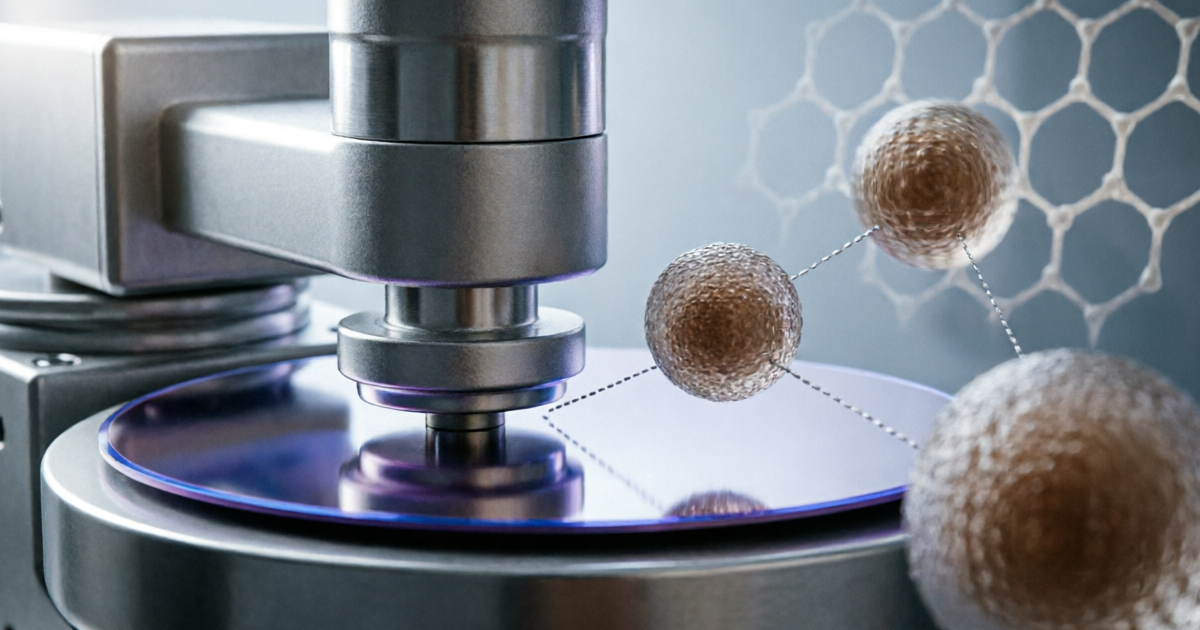
A pad conditioner is a component — typically a disc embedded with diamond particles — mounted on a sweeping arm that moves across the pad surface to maintain its texture. As polishing proceeds, the pad’s surface gradually compresses and glazes, reducing its ability to hold slurry and abrasive at the interface and causing removal rates to drift downward over time.
The conditioner counteracts this by continuously (or periodically) abrading the pad surface, opening up its texture and removing glazed material. Conditioning can be performed in-situ, meaning during the polishing cycle itself, or ex-situ, meaning between wafers — and many production tools use a combination of both depending on the process step.
The Conditioning Process and Sweep Profiles
The conditioner arm sweeps the diamond disc across the pad in a defined pattern, typically covering the full radius of the pad multiple times per conditioning cycle. The sweep speed, the pressure applied by the conditioner disc, and the number of sweeps per wafer are all recipe parameters that affect both pad life and removal rate stability.
Too little conditioning leads to a gradual decline in removal rate as the pad glazes over, requiring process compensation or causing drift in film thickness targets. Too much conditioning, on the other hand, accelerates pad wear and shortens pad life, increasing consumable costs. Finding the right balance is an ongoing optimization that depends on the specific pad, slurry, and process step combination.
Pad Life and Wear Indicators
Pad life is generally tracked in terms of polishing cycles or accumulated polishing time rather than calendar time, since pad wear is driven by actual usage. Fabs typically establish a pad replacement schedule based on a combination of cycle counts, measured pad thickness, and process performance indicators such as removal rate drift or increasing within-wafer non-uniformity.
Visual and measurable indicators of an aging pad include reduced groove depth, surface glazing that is difficult for the conditioner to fully remove, and an increasing rate of pad-related defects such as scratches. Tracking these indicators closely is part of the broader maintenance program we describe in CMP Equipment Maintenance and Consumables Guide.
Conditioner Disc Types and Wear
Conditioner discs are typically classified by their diamond grit size and the pattern in which diamonds are arranged on the disc surface — ranging from randomly distributed diamond coatings to precisely engineered, patterned diamond arrays designed for more consistent and predictable pad texturing.
Like pads, conditioner discs wear over time as the diamonds dull or become dislodged, reducing their ability to refresh the pad surface effectively. Worn conditioner discs are a common — and sometimes overlooked — root cause of gradual removal rate drift, since the pad may appear visually similar even as its texture changes subtly.
Common Pad-Related Issues
A few pad-related issues account for a large share of CMP process troubleshooting:
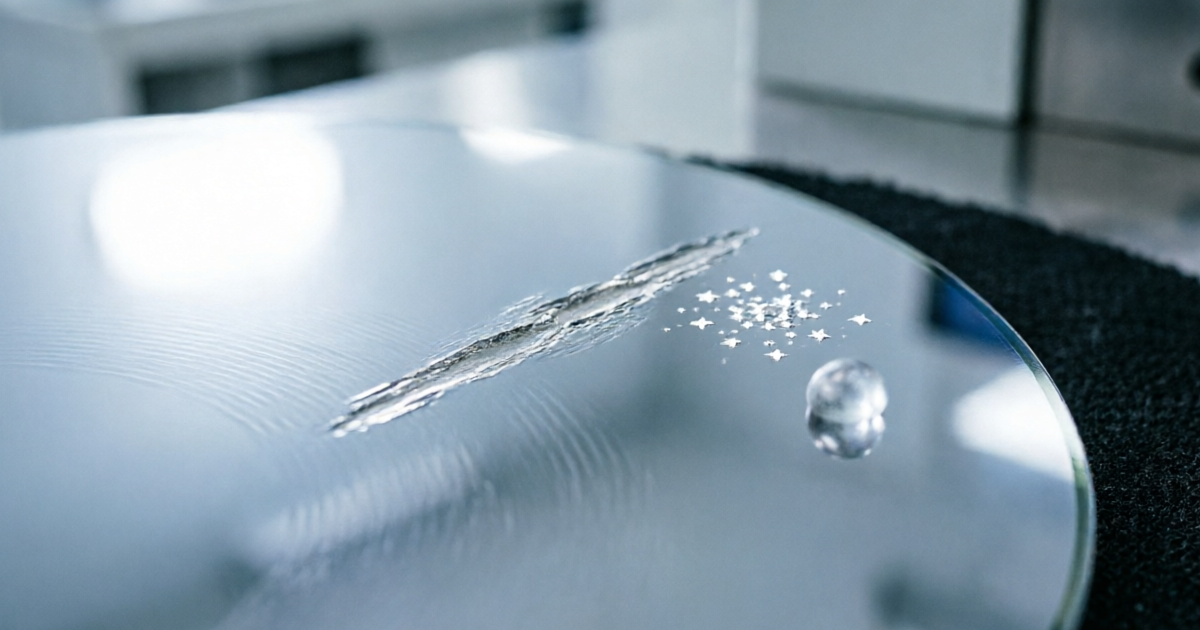
Glazing: A smoothing-over of the pad surface texture that reduces slurry retention and lowers removal rate, usually addressed through more aggressive or more frequent conditioning.
Hydroplaning: Excess slurry buildup that creates a fluid layer between the pad and wafer, reducing direct mechanical contact and lowering removal rate — often related to groove design, slurry flow rate, or platen speed.
Pad-induced scratches: Debris embedded in the pad surface, or damage from a worn conditioner, can create localized defects on the wafer surface that show up as scratches during inspection.
For a broader look at how these issues connect to the slurry side of the process, see CMP Slurry Delivery Systems Explained, and for the full equipment picture, return to our chemical mechanical planarization equipment guide.
Looking for CMP Polishing Pads or Conditioner Discs?
JEEZ supplies polishing pads and conditioning solutions engineered for stable removal rates across a range of CMP applications. Get in touch with our team.
Contacte con nosotrosPreguntas frecuentes
What material are CMP polishing pads made from?
Most CMP polishing pads are made from polyurethane, often in a layered construction with a harder top polishing layer and a softer, more compressible sub-pad layer beneath it.
How often should a CMP polishing pad be replaced?
Pad replacement is typically scheduled based on polishing cycle counts and measured performance indicators such as removal rate and uniformity, rather than on a fixed calendar schedule, since wear is driven by actual usage.
What does a pad conditioner do?
A pad conditioner, usually a diamond-embedded disc, sweeps across the polishing pad to maintain its surface texture, counteracting the glazing that naturally occurs as the pad is used and helping keep removal rates consistent over the pad’s life.
Why do different CMP process steps use different pads?
Different steps have different goals — bulk removal steps prioritize throughput and often use harder, more aggressive pads, while finishing steps prioritize defect reduction and planarity, often using softer pads paired with low-abrasive slurries.