Lechada CMP: Tipos, composición, granulometría y guía de selección
Todo lo que los ingenieros de procesos y especialistas en adquisiciones necesitan saber sobre los lodos CMP: química de los abrasivos, distribución del tamaño de las partículas, tipos de lodos por aplicación, métricas de calidad y cómo seleccionar la formulación adecuada para su nodo de proceso.
¿Qué es el lodo CMP?
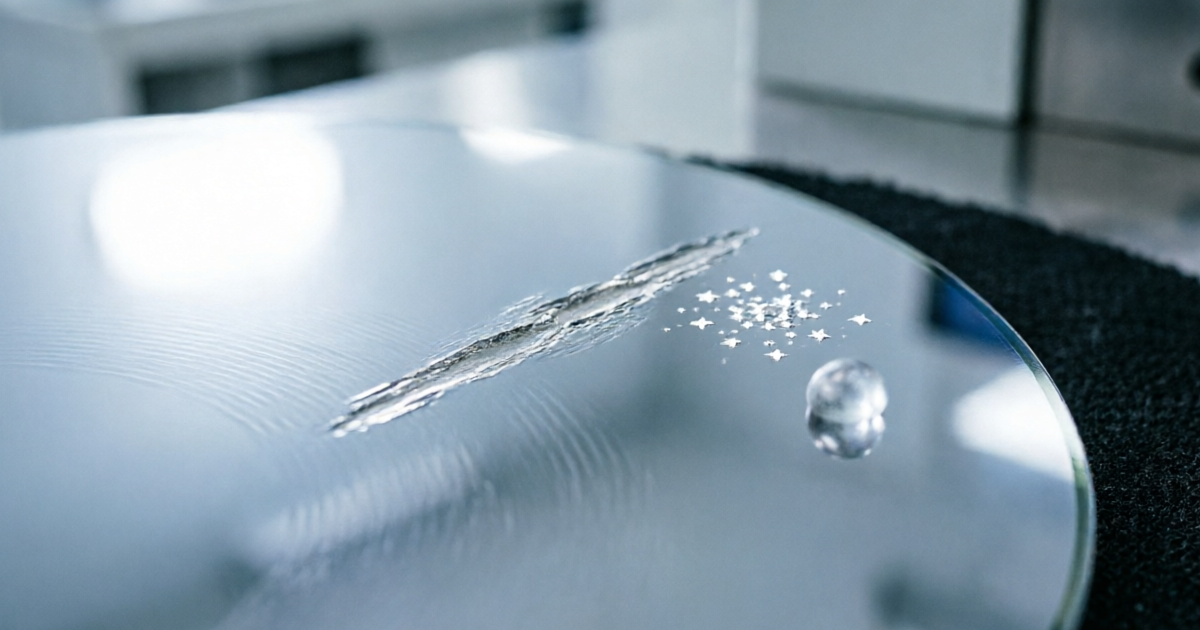
La lechada CMP es el medio líquido química y mecánicamente activo que hace posible la planarización químico-mecánica. Se trata de una suspensión coloidal de nanopartículas abrasivas dispersas en una formulación química acuosa, diseñada para grabar químicamente el material objetivo (ablandando su superficie) y erosionarlo mecánicamente (eliminando la capa ablandada). El resultado es la eliminación de material a velocidades de 50-1000+ nm/min con valores de rugosidad superficial inferiores a 0,3 nm Ra, un rendimiento que ningún proceso mecánico o químico podría alcanzar por sí solo.
El lodo es el consumible químicamente más sofisticado de cualquier proceso CMP y, en las fábricas de nodos avanzados, es también uno de los más caros. Un solo paso de CMP de obleas de 300 mm puede consumir entre 100 y 300 ml de pasta, cuyo valor a granel es de varios dólares por litro, lo que convierte el coste de la pasta en una partida importante del presupuesto de consumibles de una fábrica. Seleccionar la pasta adecuada y gestionarla correctamente en el sistema de suministro es un imperativo técnico y comercial.
Desglose de la composición química
Un lodo CMP es mucho más que partículas en agua. Cada componente desempeña un papel específico en el control de la velocidad de reacción química, la eficacia de la abrasión mecánica, la calidad de la superficie de la película pulida y la estabilidad de la propia lechada en los sistemas de almacenamiento y suministro.
🔵 Partículas abrasivas
El caballo de batalla mecánico. Nanopartículas de sílice coloidal (SiO₂), dióxido de cerio (CeO₂), alúmina (Al₂O₃) o dióxido de manganeso (MnO₂). El tamaño, la forma y la química de la superficie de las partículas afectan al rendimiento del pulido. Distribución de tamaño de partícula más estrecha → MRR más consistente y menos defectos.
🟡 Agentes oxidantes
Activa químicamente la superficie del material objetivo para facilitar su eliminación. El H₂O₂ predomina en la CMP de cobre (convierte el Cu⁰ en CuO/Cu(OH)₂). KIO₃ y NH₄HF₂ se utilizan en formulaciones especializadas de tungsteno. La concentración debe controlarse con precisión: demasiado alta → corrosión; demasiado baja → caída de la velocidad.
🟢 Agentes quelantes / complejantes
Fijar los iones metálicos disueltos (Cu²⁺, Fe³⁺) para evitar la redeposición en la superficie de la oblea y controlar la selectividad del grabado. La glicina, el ácido cítrico y el EDTA son opciones comunes. También sirven como agentes de pasivación superficial sobre el cobre en zonas de baja densidad de patrones para controlar el dishing.
🔴 Inhibidores de la corrosión
El benzotriazol (BTA) es el inhibidor de corrosión estándar para CMP de cobre. Se adsorbe fuertemente en las superficies de Cu para formar una monocapa protectora, evitando la corrosión galvánica durante las fases estáticas del pulido (elevación de la almohadilla, transferencia de la oblea) cuando la tasa de grabado químico podría de otro modo picar las líneas de cobre.
⚗️ Tampón de pH
El pH afecta en gran medida al potencial zeta de las partículas abrasivas (que determina la estabilidad coloidal), a la velocidad de reacción química y a la eficacia de los inhibidores de la corrosión. La variación del pH, causada por la absorción de CO₂ o el envejecimiento del lodo, es una de las causas principales de la variación de la MRR de un lote a otro.
💧 Surfactantes y dispersantes
Evitar la aglomeración de partículas abrasivas durante el almacenamiento y la entrega. Un lodo bien disperso mantiene una distribución monomodal del tamaño de las partículas. El agotamiento del tensioactivo a lo largo del tiempo, especialmente en sistemas de bombeo de alto cizallamiento, es una de las principales causas de la generación de partículas de gran tamaño y defectos por rayado.
Tipos y propiedades de las partículas abrasivas
La elección del material abrasivo es una de las decisiones fundamentales en la formulación de los lodos CMP. Los distintos tipos de abrasivos tienen características de reactividad química, dureza y carga superficial radicalmente diferentes que los hacen adecuados para aplicaciones específicas e inadecuados para otras.
Sílice coloidal (SiO₂)
El abrasivo más versátil y utilizado en CMP. Las partículas de sílice coloidal se producen mediante el proceso Stöber o por hidrólisis controlada de ortosilicato de tetraetilo (TEOS), produciendo partículas casi esféricas con un excelente control de la distribución de tamaños. A pH alcalino (9-12), las partículas de SiO₂ tienen carga negativa, lo que impide su aglomeración por repulsión electrostática. La sílice coloidal es el abrasivo estándar para CMP de óxido ILD, CMP de STI (como abrasivo secundario junto con la ceria), CMP de cobre y CMP dieléctrico de baja k. Su dureza relativamente baja (Mohs 7) hace que sea menos propensa a inducir microarañazos que los abrasivos más duros.
Dióxido de cerio (CeO₂ / Ceria)
El cerio es el abrasivo preferido para aplicaciones que requieren muy alta selectividad entre el dióxido de silicio y el nitruro de silicio - en particular STI CMP, donde el objetivo es detenerse con precisión en la capa de tope de pulido de Si₃N₄ mientras se elimina el óxido TEOS de las zanjas. La química única de la ceria implica la formación directa de enlaces Ce-O-Si con la superficie de SiO₂ (el mecanismo del “diente”), lo que permite velocidades de eliminación entre 5 y 10 veces superiores a las de la sílice coloidal con concentraciones de abrasivo idénticas. Esta reactividad química también explica su alta selectividad: reacciona mucho menos fácilmente con el Si₃N₄. Los lodos de cerio requieren un control cuidadoso del pH (normalmente 5-8) y una especificación precisa de la superficie BET de las partículas de cerio, ya que la morfología de las partículas afecta en gran medida al rendimiento del pulido.
Alúmina (Al₂O₃)
La alúmina es el abrasivo CMP común más duro (Mohs 9) y se utiliza principalmente para CMP de tungsteno (W) y metales de barrera, donde su acción de corte agresiva es necesaria para eliminar materiales duros y refractarios. Generalmente no es adecuado para CMP de dieléctricos o cobre porque su dureza genera densidades de rayado inaceptables en materiales más blandos. Se utilizan tanto la alfa-alúmina (corindón) como la gamma-alúmina (menor dureza), prefiriéndose la gamma-alúmina por su mejor dispersabilidad y menor índice de rayado.
Distribución granulométrica: La métrica crítica de la calidad
De todos los parámetros de calidad especificados en el certificado de análisis de un lodo CMP, la distribución del tamaño de las partículas (PSD) es el que más influye en el rendimiento de los defectos. La relación es directa e implacable: una sola partícula sobredimensionada (diámetro >1 µm) en contacto con la superficie de la oblea bajo presión de pulido puede crear un arañazo de decenas de micras de longitud que mata a todos los troqueles con los que se cruza.
El problema de la distribución bimodal
Los lodos CMP que han empezado a aglomerarse desarrollan una PSD bimodal: una población primaria de nanopartículas de tamaño correcto (50-250 nm) y una población secundaria de grupos aglomerados (1-10 µm). La población de aglomerados, incluso en concentraciones tan bajas como 100-500 partículas por mL, es suficiente para causar pérdidas de rendimiento significativas en nodos avanzados, donde un solo arañazo en una interconexión de cobre de 8 nm constituye un fallo de circuito abierto.
Técnicas de medición de la PSD
- Dispersión dinámica de la luz (DLS): Rápido, no destructivo y sensible a la población primaria de partículas. Menos preciso para la cola de la distribución a >500 nm. La técnica estándar de control de calidad para la aceptación de lotes de lodo entrante.
- Dimensionamiento óptico de partículas individuales (SPOS): Técnica especializada que detecta y cuenta partículas individuales en el rango de 0,5-100 µm. Es el método más sensible para detectar aglomerados a bajas concentraciones (rango de ppm). Recomendado para aplicaciones de nodos avanzados en las que la pérdida de rendimiento por rayado es crítica.
- Espectroscopia de correlación de fluorescencia (FCS): Técnica emergente capaz de caracterizar tanto las partículas primarias como los aglomerados en una sola medición con gran precisión. Útil para la caracterización de lodos en I+D.
Tipos de purines por aplicación
| Aplicación | Abrasivo | pH | Aditivo clave | Objetivo MRR | Especificaciones de rendimiento |
|---|---|---|---|---|---|
| Óxido de ILD (TEOS/PETEOS) | SiO₂ coloidal | 10-11 | Tampón KOH, amina | 150-400 nm/min | Uniformidad dentro de la oblea <3% |
| STI Ceria | CeO₂ + SiO₂ | 5-8 | Aditivo de aminoácidos | 100-300 nm/min | Selectividad SiO₂:Si₃N₄ >100:1 |
| Cu a granel (Damasceno) | SiO₂ coloidal | 3-5 | H₂O₂, BTA, glicina | 500-1500 nm/min | Pulido <15 nm en líneas de 5 µm |
| Barrera de Cu (Paso 2) | SiO₂ coloidal | 6-9 | H₂O₂, BTA, ácido graso | 50-150 nm/min | Cu:Ta:Selectividad de óxido controlada |
| Tungsteno (W) | Al₂O₃ o SiO₂ | 2-4 | H₂O₂, catalizador de Fe | 200-600 nm/min | Baja erosión en el campo TEOS |
| Dieléctrico de baja k | SiO₂ coloidal (blando) | 10-12 | Tensioactivo, amina | 50-150 nm/min | Sin delaminación a <2,5k |
| Cobalto (Co) | SiO₂ coloidal | 7-9 | H₂O₂, Inhibidor coespecífico | 100-300 nm/min | Baja picadura, corrosión controlada |
| Puerta Poly-Si | SiO₂ coloidal | 11-12 | Amina, tensioactivo | 50-200 nm/min | Alta selectividad poli:óxido |
Tasa de eliminación, selectividad y eficacia de planarización
Tasa de eliminación (RR) - el espesor de material eliminado por unidad de tiempo (nm/min) - es la principal métrica de rendimiento, pero rara vez la más importante para la calidad del proceso. Selectividad - la relación de las velocidades de eliminación entre dos materiales diferentes pulidos en las mismas condiciones- suele ser más crítica, ya que el CMP debe detenerse de forma fiable en la interfaz de la capa prevista.
Para STI CMP, se necesita una selectividad SiO₂:Si₃N₄ de >100:1 para garantizar que no se consuma el tope de pulido de nitruro mientras se elimina el óxido de una región de patrón denso. Para el CMP de barrera de cobre, la selectividad Cu:barrera:óxido debe ajustarse cuidadosamente: una selectividad de barrera demasiado alta deja metal residual; una demasiado baja erosiona el óxido. Estas compensaciones se gestionan ajustando la química del lodo: añadiendo aditivos que mejoren la selectividad (como aminoácidos para el lodo de ceria) o modificando la concentración de oxidante y el pH.
Eficacia de la planarización cuantifica la eficacia con la que la combinación de pasta y almohadilla convierte la topografía de la superficie en una superficie plana. Se mide controlando la reducción de la altura de los escalones en función del tiempo de pulido. Un proceso de alta eficacia de planarización reduce la altura de los escalones rápidamente al inicio del pulido (cuando los puntos altos tienen una presión mucho mayor) y se aproxima a la planitud global antes de alcanzar el punto final.
Mejores prácticas de suministro y almacenamiento de purines
Incluso un lodo perfectamente formulado generará defectos e inestabilidad en el proceso si se almacena o suministra de forma incorrecta. El sistema de suministro de lechada (SDS) es el guardián invisible de la calidad entre el contenedor a granel del proveedor y la almohadilla de pulido, y debe diseñarse y mantenerse con el mismo rigor que la propia herramienta CMP.
Normas de almacenamiento
- Almacenar los bidones de purín a temperaturas controladas (15-25°C). La congelación provoca la aglomeración irreversible de las partículas; las altas temperaturas aceleran la descomposición del oxidante (H₂O₂) y modifican el pH.
- Mantenga los contenedores sellados hasta su uso y mantenga una manta de nitrógeno en los tanques a granel para evitar la disolución de CO₂, que acidifica los lodos alcalinos con el tiempo.
- Respete estrictamente las especificaciones de caducidad. La mayoría de las lechadas CMP tienen una vida útil de 6 a 12 meses a partir de la fecha de fabricación. El uso de lechadas caducadas es una de las principales causas de variaciones inexplicables del rendimiento por rayado.
- Nunca mezcle lotes de purines de diferentes partidas en el mismo sistema de suministro sin una secuencia completa de lavado y limpieza entre ellos.
Diseño del sistema de suministro
- Utilice bucles de recirculación continua para evitar la sedimentación de partículas en las líneas de distribución. La velocidad de flujo debe mantenerse por encima del umbral de sedimentación de Stokes para el mayor tamaño de partícula previsto.
- Especifique materiales húmedos de polipropileno (PP) o HDPE en todos los componentes en contacto con el lodo. Los componentes metálicos provocan contaminación y descomposición catalítica del oxidante.
- Instale filtros POU en cada punto de suministro. Sustitúyalos según lo programado, no por indicación de restricción de flujo: los filtros degradados liberan aglomerados capturados como un evento de defecto de bolo.
- Controle el recuento de partículas y el pH en línea a la salida del sistema de suministro mediante un conjunto de sensores automatizados. Cualquier desviación fuera de las especificaciones debe provocar una parada inmediata del proceso.
Si desea un análisis en profundidad de la manipulación de lodos, incluidas las matrices de compatibilidad química y las especificaciones de los componentes SDS, consulte nuestro artículo dedicado: Almacenamiento, manipulación y seguridad de los purines CMP.
Guía de selección de lodos para ingenieros de procesos
La selección de la lechada CMP adecuada para una nueva aplicación implica un proceso de evaluación estructurado. El siguiente marco guía a los ingenieros de procesos a través de los puntos clave de decisión:
1. Definir la pila de material de destino
Identificar el material a eliminar (Cu, W, SiO₂, Si₃N₄, low-k) y la capa de tope subyacente. Esto determina la selectividad necesaria y limita el tipo de abrasivo y el intervalo de pH.
2. Establecer objetivos de MRR y uniformidad
Determine el espesor a eliminar, el tiempo de pulido objetivo (para el rendimiento) y la uniformidad aceptable dentro de la oblea (WIWNU %). Estos son los parámetros de presión y velocidad que debe soportar la pasta.
3. Especificar el presupuesto por defecto
Defina el número máximo aceptable de arañazos, la densidad de partículas en la superficie de la oblea post-CMP y los límites de contaminación metálica (átomos/cm²). Los presupuestos más ajustados requieren abrasivos más blandos, una menor concentración de abrasivo y una filtración POU de mayor calidad.
4. Evaluar la compatibilidad de la capa de lechada
Las diferentes químicas de los lodos interactúan de forma diferente con la química de la superficie de los pads. Los lodos de óxido con alto pH pueden degradar ciertas formulaciones de poliuretano de los pads con el tiempo; los lodos de Cu ácidos requieren materiales de pad con pH estable. Confirme la compatibilidad de las pastillas con el proveedor de la lechada antes de comprometerse con un juego de consumibles.
5. Calificar con DOE de oblea ciega
Ejecutar un DOE completo en obleas de mantilla (sin patrón) para mapear la MRR en función de la presión, la MRR en función de la velocidad de la platina y la respuesta de uniformidad. Establezca la ventana de proceso antes de pasar a la cualificación de obleas con patrón.
6. Calificación de obleas con patrón
Mida la desviación en líneas metálicas anchas (1-100 µm), la erosión en regiones de patrón de alta densidad y los residuos en el límite del campo de la matriz. Compárelos con los límites de sus normas de diseño antes de autorizar el uso de la lechada para la producción.
Preguntas frecuentes
¿Busca el lodo CMP adecuado para su proceso?
JEEZ ofrece lodos CMP de óxido, cobre, tungsteno y especiales diseñados para un rendimiento avanzado del nodo. Solicite hoy mismo una consulta técnica y un kit de cualificación de muestras.
Solicitud de muestras de purines →