CMP Slurry: Types, Composition, Particle Size, and Selection Guide
Everything process engineers and procurement specialists need to know about CMP slurry — abrasive chemistry, particle size distribution, slurry types by application, quality metrics, and how to select the right formulation for your process node.
Что такое шламовый материал CMP?
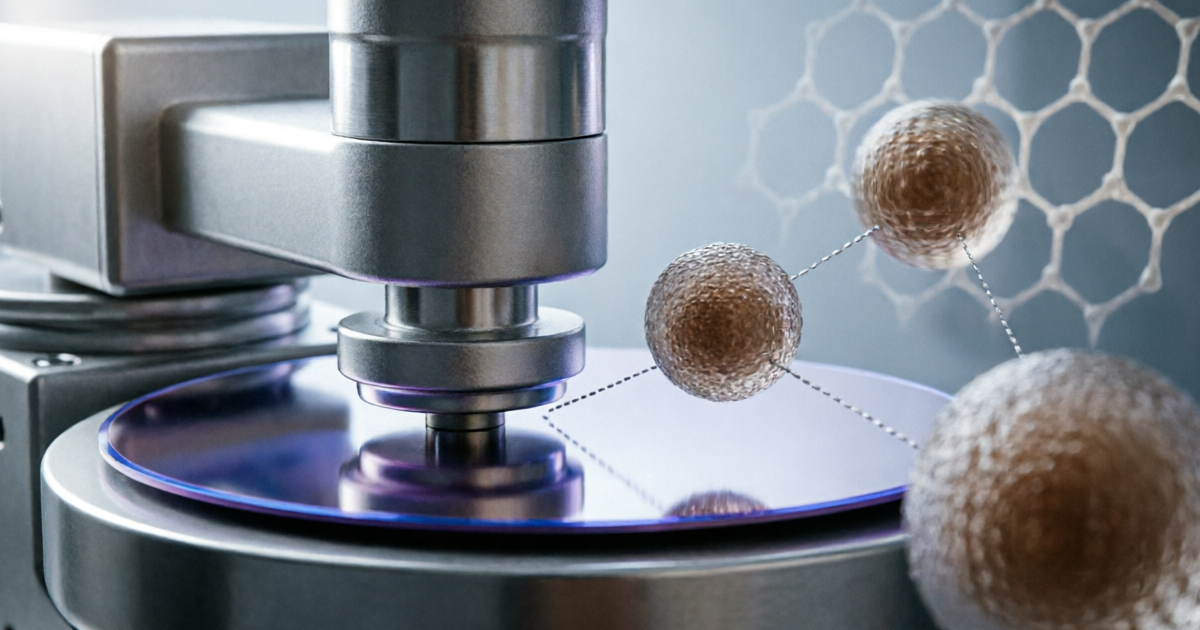
CMP slurry is the chemically and mechanically active liquid medium that makes Chemical Mechanical Planarization possible. It is a colloidal suspension of abrasive nanoparticles dispersed in an aqueous chemical formulation, engineered to simultaneously etch the target material chemically (softening its surface) and abrade it mechanically (removing the softened layer). The result is material removal at rates of 50–1000+ nm/min with surface roughness values below 0.3 nm Ra — performance no mechanical or chemical process alone could achieve.
Slurry is the most chemically sophisticated consumable in any CMP process, and in advanced-node fabs, it is also one of the most expensive. A single 300 mm wafer CMP step may consume 100–300 mL of slurry worth several dollars per liter in bulk, making slurry cost a significant line item in a fab’s consumables budget. Selecting the right slurry — and managing it correctly in the delivery system — is both a technical and commercial imperative.
Chemical Composition Breakdown
A CMP slurry is far more than particles in water. Each component plays a specific role in controlling the chemical reaction rate, the mechanical abrasion efficiency, the surface quality of the polished film, and the stability of the slurry itself in storage and delivery systems.
🔵 Abrasive Particles
The mechanical workhorse. Nanoparticles of colloidal silica (SiO₂), cerium dioxide (CeO₂), alumina (Al₂O₃), or manganese dioxide (MnO₂). Particle size, shape, and surface chemistry all affect polishing performance. Narrower particle size distribution → more consistent MRR and fewer defects.
🟡 Oxidizing Agents
Chemically activate the target material surface for easier removal. H₂O₂ is dominant for copper CMP (converts Cu⁰ to CuO/Cu(OH)₂). KIO₃ and NH₄HF₂ are used in specialized tungsten formulations. Concentration must be precisely controlled — too high → corrosion; too low → rate drop.
🟢 Chelating / Complexing Agents
Bind dissolved metal ions (Cu²⁺, Fe³⁺) to prevent re-deposition onto the wafer surface and control etch selectivity. Glycine, citric acid, and EDTA are common choices. Also serve as surface passivation agents on copper at low pattern density areas to control dishing.
🔴 Corrosion Inhibitors
Benzotriazole (BTA) is the standard corrosion inhibitor for copper CMP. It adsorbs strongly onto Cu surfaces to form a protective monolayer, preventing galvanic corrosion during the static phases of polishing (pad lift, wafer transfer) when the chemical etch rate could otherwise pit the copper lines.
⚗️ pH Buffers
Maintain slurry pH within a narrow target range. pH strongly affects the zeta potential of abrasive particles (determining colloidal stability), the chemical reaction rate, and the corrosion inhibitor effectiveness. Drift in pH — caused by CO₂ absorption or slurry aging — is a root cause of lot-to-lot MRR variation.
💧 Surfactants & Dispersants
Prevent abrasive particle agglomeration during storage and delivery. A well-dispersed slurry maintains a monomodal particle size distribution. Surfactant depletion over time — especially under high shear in delivery pump systems — is a leading cause of oversize particle generation and scratch defects.
Abrasive Particle Types & Properties
The choice of abrasive material is one of the most fundamental decisions in CMP slurry formulation. Different abrasive types have dramatically different chemical reactivity, hardness, and surface charge characteristics that make them suitable for specific applications and unsuitable for others.
Colloidal Silica (SiO₂)
The most versatile and widely deployed abrasive in CMP. Colloidal silica particles are produced by the Stöber process or by controlled hydrolysis of tetraethyl orthosilicate (TEOS), yielding near-spherical particles with excellent size distribution control. At alkaline pH (9–12), SiO₂ particles are negatively charged, which prevents agglomeration through electrostatic repulsion. Colloidal silica is the standard abrasive for oxide ILD CMP, STI CMP (as a secondary abrasive alongside ceria), copper CMP, and low-k dielectric CMP. Its relatively low hardness (Mohs 7) makes it less prone to induce micro-scratches than harder abrasives.
Cerium Dioxide (CeO₂ / Ceria)
Ceria is the abrasive of choice for applications requiring very high selectivity between silicon dioxide and silicon nitride — particularly STI CMP, where the objective is to stop precisely on the Si₃N₄ polish stop layer while removing TEOS oxide from the trenches. Ceria’s unique chemistry involves direct Ce–O–Si bond formation with the SiO₂ surface (the “tooth” mechanism), enabling removal rates 5–10× higher than colloidal silica at identical abrasive concentrations. This chemical reactivity also explains its high selectivity: it reacts much less readily with Si₃N₄. Ceria slurries require careful pH control (typically 5–8) and precise BET surface area specification of the ceria particles, as particle morphology strongly affects polishing performance.
Глинозем (Al₂O₃)
Alumina is the hardest common CMP abrasive (Mohs 9) and is used primarily for tungsten (W) and barrier metal CMP, where its aggressive cutting action is needed to remove hard, refractory materials. It is generally unsuitable for dielectric or copper CMP because its hardness generates unacceptable scratch densities on softer materials. Alpha-alumina (corundum) and gamma-alumina (lower hardness) are both used, with gamma-alumina preferred for its better dispersibility and lower scratch rates.
Particle Size Distribution: The Critical Quality Metric
Of all the quality parameters specified on a CMP slurry certificate of analysis, particle size distribution (PSD) is the single most consequential for defect performance. The relationship is direct and unforgiving: a single oversize particle (diameter >1 µm) in contact with the wafer surface under polishing pressure can create a scratch tens of microns long that kills every die it intersects.
The Bimodal Distribution Problem
CMP slurries that have begun to agglomerate develop a bimodal PSD: a primary population of correctly sized nanoparticles (50–250 nm) and a secondary population of agglomerate clusters (1–10 µm). The agglomerate population, even at concentrations as low as 100–500 particles per mL, is sufficient to cause significant yield loss at advanced nodes where a single scratch across an 8 nm copper interconnect constitutes an open circuit failure.
PSD Measurement Techniques
- Dynamic Light Scattering (DLS): Fast, non-destructive, and sensitive to the primary particle population. Less accurate for the tail of the distribution at >500 nm. The standard QC technique for incoming slurry lot acceptance.
- Single Particle Optical Sizing (SPOS): Specialized technique that detects and counts individual particles in the 0.5–100 µm range. The most sensitive method for detecting agglomerates at low concentrations (ppm range). Recommended for advanced-node applications where scratch yield loss is critical.
- Fluorescence Correlation Spectroscopy (FCS): Emerging technique capable of characterizing both primary particles and agglomerates in a single measurement with high precision. Useful for R&D slurry characterization.
Slurry Types by Application
| Приложение | Абразив | pH | Key Additive | Target MRR | Key Performance Spec |
|---|---|---|---|---|---|
| ILD Oxide (TEOS/PETEOS) | Коллоидный SiO₂ | 10-11 | KOH buffer, amine | 150–400 nm/min | Within-wafer uniformity <3% |
| STI Ceria | CeO₂ + SiO₂ | 5-8 | Amino acid additive | 100–300 nm/min | SiO₂:Si₃N₄ selectivity >100:1 |
| Cu Bulk (Damascene) | Коллоидный SiO₂ | 3-5 | H₂O₂, BTA, glycine | 500–1500 nm/min | Dishing <15 nm on 5 µm lines |
| Cu Barrier (Step 2) | Коллоидный SiO₂ | 6–9 | H₂O₂, BTA, fatty acid | 50–150 nm/min | Cu:Ta:Oxide selectivity controlled |
| Вольфрам (W) | Al₂O₃ или SiO₂ | 2-4 | H₂O₂, Fe catalyst | 200–600 nm/min | Low erosion on TEOS field |
| Low-k Dielectric | Colloidal SiO₂ (soft) | 10-12 | Surfactant, amine | 50–150 nm/min | No delamination at <2.5k |
| Кобальт (Co) | Коллоидный SiO₂ | 7–9 | H₂O₂, Co-specific inhibitor | 100–300 nm/min | Low pitting, controlled corrosion |
| Poly-Si Gate | Коллоидный SiO₂ | 11–12 | Amine, surfactant | 50–200 nm/min | High poly:oxide selectivity |
Removal Rate, Selectivity & Planarization Efficiency
Removal rate (RR) — the thickness of material removed per unit time (nm/min) — is the primary throughput metric but rarely the most important for process quality. Селективность — the ratio of removal rates between two different materials polished under the same conditions — is often more critical, because CMP must stop reliably at the intended layer interface.
For STI CMP, an SiO₂:Si₃N₄ selectivity of >100:1 is needed to ensure the nitride polish stop is not consumed while oxide is being cleared from a dense pattern region. For copper barrier CMP, the Cu:barrier:oxide selectivity must be carefully tuned — too high a barrier selectivity leaves residual metal; too low erodes the oxide. These trade-offs are managed by adjusting slurry chemistry: adding selectivity-enhancing additives (such as amino acids for ceria slurry) or modifying oxidizer concentration and pH.
Planarization efficiency quantifies how effectively the slurry and pad combination converts surface topography into a flat surface. It is measured by monitoring step height reduction as a function of polish time. A high-planarization-efficiency process reduces step height rapidly at the start of polishing (when high points have much greater pressure) and approaches global flatness before the endpoint is reached.
Slurry Delivery & Storage Best Practices
Even a perfectly formulated slurry will generate defects and process instability if it is stored or delivered incorrectly. The slurry delivery system (SDS) is the unseen quality guardian between the supplier’s bulk container and the polishing pad, and it must be designed and maintained with the same rigor as the CMP tool itself.
Storage Guidelines
- Store slurry drums at controlled temperatures (15–25°C). Freezing causes irreversible particle agglomeration; high temperatures accelerate oxidizer decomposition (H₂O₂) and change pH.
- Keep containers sealed until use and maintain a nitrogen blanket on bulk tanks to prevent CO₂ dissolution, which acidifies alkaline slurries over time.
- Observe shelf-life specifications strictly. Most CMP slurries carry a 6–12 month shelf life from manufacture date. Using expired slurry is a leading cause of unexplained scratch yield excursions.
- Never mix slurry lots from different batches in the same delivery system without a full flush and cleaning sequence in between.
Delivery System Design
- Use continuous recirculation loops to prevent particle settling in distribution lines. Flow velocity must be maintained above the Stokes settling threshold for the largest expected particle size.
- Specify polypropylene (PP) or HDPE wetted materials in all slurry-contact components. Metal components cause contamination and catalytic oxidizer decomposition.
- Install POU filters at every dispense point. Replace on schedule, not on flow-restriction indication — degraded filters release captured agglomerates as a bolus defect event.
- Monitor particle count and pH inline at the delivery system outlet using an automated sensor suite. Any drift outside specification should trigger an immediate process hold.
For an in-depth discussion of slurry handling, including chemical compatibility matrices and SDS component specifications, see our dedicated article: Хранение, обработка и безопасность шлама CMP.
Slurry Selection Guide for Process Engineers
Selecting the right CMP slurry for a new application involves a structured evaluation process. The following framework guides process engineers through the key decision points:
1. Define the Target Material Stack
Identify the material to be removed (Cu, W, SiO₂, Si₃N₄, low-k) and the underlying stop layer. This determines the required selectivity and constrains the abrasive type and pH range.
2. Set MRR and Uniformity Targets
Determine the thickness to be removed, the target polishing time (for throughput), and the acceptable within-wafer uniformity (WIWNU %). These drive pressure and velocity recipe parameters that the slurry must support.
3. Specify Defect Budget
Define the maximum acceptable scratch count, particle density on the post-CMP wafer surface, and metal contamination limits (atoms/cm²). Tighter budgets require softer abrasives, lower abrasive concentration, and higher-grade POU filtration.
4. Evaluate Slurry-Pad Compatibility
Different slurry chemistries interact differently with pad surface chemistry. High-pH oxide slurries can degrade certain pad polyurethane formulations over time; acidic Cu slurries require pH-stable pad materials. Confirm pad compatibility with the slurry supplier before committing to a consumable set.
5. Qualify with Blanket Wafer DOE
Run a full DOE on blanket (unpatterned) wafers to map MRR vs. pressure, MRR vs. platen speed, and uniformity response. Establish the process window before moving to patterned wafer qualification.
6. Run Patterned Wafer Qualification
Measure dishing on wide metal lines (1–100 µm), erosion at high-density pattern regions, and residuals at the array-field boundary. Compare against your design rule limits before releasing the slurry for production use.
Часто задаваемые вопросы
Ищете подходящий шлам CMP для вашего процесса?
JEEZ offers oxide, copper, tungsten, and specialty CMP slurries engineered for advanced node performance. Request a technical consultation and sample qualification kit today.
Request Slurry Samples →