Semiconductor Polishing Slurry Sapphire Polishing Slurry / Grinding Slurry
Sapphire Polishing Slurry / Sapphire A-Plane Polishing Slurry / Sapphire C-Plane Polishing Slurry
SiO2/Al2O3/CeO2/ZrO2

Caractéristiques principales
- High-purity raw materials with no contamination
- Fast polishing rate with high planarization
- High removal rate, good stability, low damage layer, and excellent surface quality
Nom du produit
Sapphire Polishing Slurry / Sapphire A-Plane Polishing Slurry / Sapphire C-Plane Polishing Slurry
Product Description
The Sapphire Grinding Slurry / Sapphire LED Substrate Polishing Slurry / Sapphire Slurry formulation developed for the semiconductor and optical industries is suitable for the planarization of sapphire substrates, epitaxial wafers, and LEDs. Designed to meet the requirements of every substrate manufacturing stage from grinding to CMP, it provides a high-performance, cost-effective solution for sapphire substrate polishing applications.
Caractéristiques du produit
High-purity raw materials with no contamination
Fast polishing rate with high planarization
High removal rate, good stability, low damage layer, and excellent surface quality
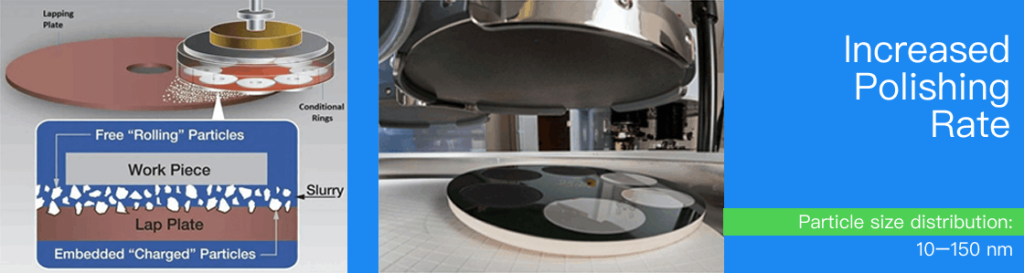
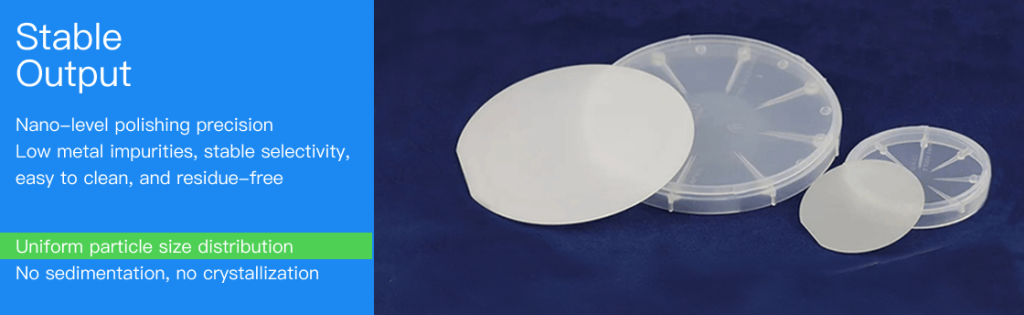
Features of JIZHI Electronics CMP Sapphire Grinding Slurry / Polishing Slurry
1.High-performance slurry for the mass production of sapphire wafers.
2.The formulation is designed to meet the requirements of every process stage in substrate manufacturing, from grinding to CMP, and is suitable for oriented sapphire wafers, including C-plane, A-plane, and R-plane polishing.
3.It achieves a high removal rate with no subsurface damage, while providing excellent stability and reusability.
4.The JIZHI Electronics sapphire slurry product portfolio provides a high-performance and cost-effective solution.
5.Customized one-to-one solutions can be provided according to specific grinding and polishing requirements.
C-Plane Sapphire Substrate Polishing Process and Supporting Materials
| Process | Category | Particle Size (μm) | pH | Model | Matching Plate / Pad | Rate (μm/min) |
|---|---|---|---|---|---|---|
| Grinding | Polycrystalline Diamond-Like Slurry | 5-6 | 4-6 | JZ-CD06 | Copper Plate | 3.3 |
| Polycrystalline Diamond-Like Slurry | 3-4 | 4-6 | JZ-CD04 | Copper Plate | 2.6 | |
| Polycrystalline Diamond-Like Slurry | 1-2 | 4-6 | JZ-CD02 | Copper Plate | 2 | |
| Polissage | Alumina Polishing Slurry | 0.5-1.5 | 12-14 | JZ-A02 | Nonwoven Fiber Pad | 0.13 |
| Alumina Polishing Slurry | 0.5-1.5 | 3-5 | JZ-A03 | Nonwoven Fiber Pad | 0.08 |
Technical Specifications of Diamond Grinding Slurry
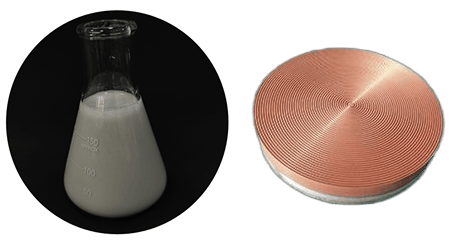
| Specification | Coarse Grinding Diamond Slurry | ||
|---|---|---|---|
| Product Type | Polycrystalline Diamond-Like Slurry | ||
| Model | JZ-CD06 | JZ-CD04 | JZ-CD02 |
| Matching Plate / Pad | Copper Plate | Copper Plate | Copper Plate |
| pH Value | 4-6 | 4-6 | 4-6 |
| Particle Size (D50) | 5–6 μm | 3–4 μm | 1–2 μm |
| Removal Rate | 3.3 μm/min | 2.6 μm/min | 2.0 μm/min |
| Surface Quality | Fine grinding texture | ||
Caractéristiques du produit
Fast removal rate / Easy to clean after polishing / Stable particle size with fine texture
Technical Specifications and Product Introduction of Alumina Polishing Slurry
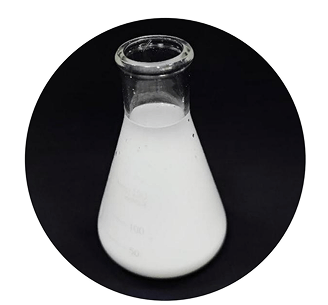
| Specification | Alumina Polishing Slurry | |
|---|---|---|
| Applicable Wafer | C-plane Sapphire Substrate | |
| Product Model | JZ-A02 | JZ-A03 |
| Matching Polishing Pad | Non-woven Pad Z-800T | |
| Solid Content | 20 | 20 |
| pH Value | 12-14 | 3-5 |
| Particle Size (D50) | 0.5-1.5 μm | 0.5-1.5 μm |
| Removal Rate | 0.13μm | 0.08μm |
| Dilution Ratio | 5–10× | 5–10× |
Caractéristiques du produit
High dilution ratio, reducing costs
Alkaline formulation with fast removal rate, good suspension performance, and easy redispersion
Long service life, stable particle size, and no scratching
Technical Specifications and Product Introduction of Polishing Pad
Suitable for rough polishing of sapphire and silicon carbide substrates
Resistant to strong acids, alkalis, and corrosion, with a long service life Moderate hardness, maintaining good removal rate while reducing the risk of scratching Made from a special polymer polyurethane and non-woven composite structure, compatible with alumina-based rough polishing slurries for over 48 hours
| Model | Épaisseur (mm) | Shore A Hardness | Density (g/cm³) | Compression Ratio (%) |
|---|---|---|---|---|
| JZ-800T | 1.5MM | 90 | 0.44 | 2.1 |
Backing adhesive and grooving services can be provided according to different requirements.
Standard grid groove sizes: 5×5 mm, 10×10 mm, 15×15 mm, 20×20 mm, 25×25 mm, 30×30 mm, etc.
Standard diameters: 380 mm, Φ610 mm, Φ640 mm, Φ855 mm, Φ910 mm, Φ930 mm, Φ1120 mm, Φ1180 mm, Φ1300 mm, etc.; custom sizes available.
AFM Surface Roughness Measurement
Sapphire Polishing Slurry JZ-A02
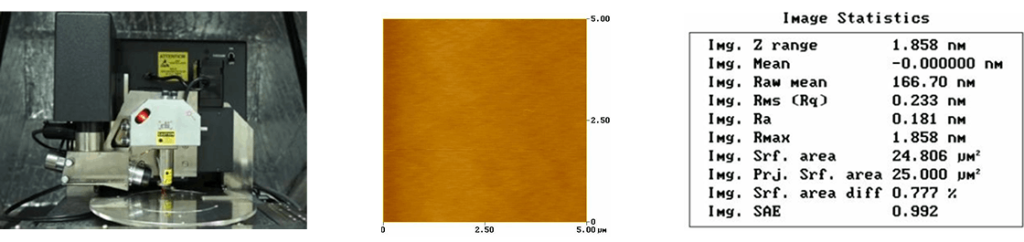
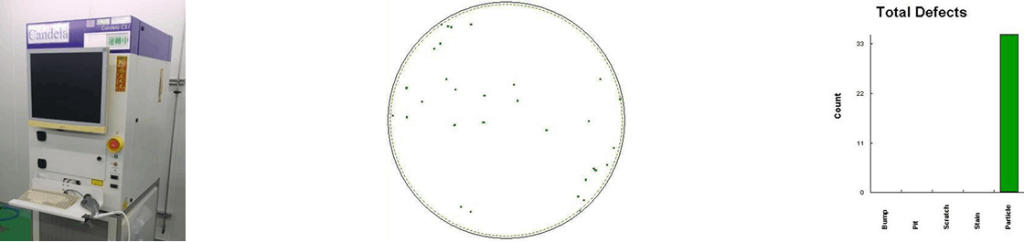
Data Performance After Candela Inspection
Data Performance After Candela Inspection
Storage Method for JIZHI Electronics SiC Silicon Carbide Polishing Slurry
Stocker dans un entrepôt bien ventilé, frais et sec. Le produit doit être stocké à une température comprise entre 5 et 35 °C, à l'abri de la lumière directe du soleil et du gel. S'il est stocké à une température inférieure à 0 °C, une agglomération irréversible peut se produire, rendant le produit inutilisable.
Prix des liquides de polissage CMP / Slurry de JIZHI Electronics
Les boues de polissage des métaux CMP de JIZHI Electronics sont fabriquées à l'aide de technologies et d'équipements de production avancés à l'étranger et sont formulées avec des compositions chimiques spécialisées. La qualité des boues de polissage de JIZHI Electronics est comparable à celle de produits importés similaires.
Grâce à une production locale, les boues CMP de JIZHI Electronics offrent des délais de livraison courts, une haute qualité stable et des prix compétitifs et rentables.
Pourquoi choisir Jizhi Electronics ?
10 ans d'expérience dans le domaine de la fabrication de matériaux optiques
10 ans d'expérience dans le domaine de la fabrication de matériaux optiques
Les solutions et formules de polissage sont personnalisées avec souplesse
Formule non toxique et biodégradable conforme aux normes internationales.
Débogage gratuit des processus
40% temps de traitement plus rapide par rapport à la conventiona
Introduire des technologies et des équipements de production étrangers
L'optimisation du taux de consommation permet de réduire les coûts d'exploitation globaux.